Within Slovenia
How Protesters Turned Stigma Into Satire
The Zombie Church transformed a hostile political label into parody, ritual and public criticism during Slovenia's anti-corruption protests.
On this page
- The anti corruption protests of 2012 13
- Invented religion as political performance
- What parody reveals about collective belief
Page outline Jump by section
Introduction
The Zombie Church was one of the most unusual products of Slovenia’s anti-corruption protests of 2012–13. It was not a movement based on supernatural belief, nor an example of mass hysteria. Instead, it was a deliberately invented religion that transformed a political insult into satire. After government supporters dismissed demonstrators as “zombies”—implying they were mindless followers or resurrected communists—protesters embraced the label, appearing in zombie make-up, carrying giant puppets and eventually founding the Trans-Universal Zombie Church of the Blissful Ringing. Through parody, ritual and legal activism, they challenged both political rhetoric and the privileged position of established religion in Slovenian public life.[Cambridge University Press & Assessment]cambridge.orgCambridge University Press & AssessmentInvented Religion, the Awakened Polis, and Sacred Disestablishment: The Case of Slovenia's “Zombie…
Within the broader history of collective belief in Slovenia, the Zombie Church is significant because it reversed the usual pattern of political labelling. Rather than allowing opponents to define them as dangerous outsiders, protesters deliberately exaggerated the accusation until it became absurd. The result was a form of political theatre that revealed how fear, stigma and symbolic language can shape public opinion.
The anti-corruption protests of 2012–13
The Zombie Church emerged during the wave of demonstrations known as the All-Slovenian Uprising. The protests began in Maribor in late 2012 over allegations of corruption surrounding Mayor Franc Kangler and rapidly expanded into nationwide demonstrations against political corruption, austerity measures and public distrust of the political elite. Tens of thousands participated across Slovenia, making the movement the country’s largest protest wave since independence.[Counterfire]counterfire.orgSlovenia’s ‘Zombie uprising’ | CounterfireSlovenia’s ‘Zombie uprising’ | Counterfire…
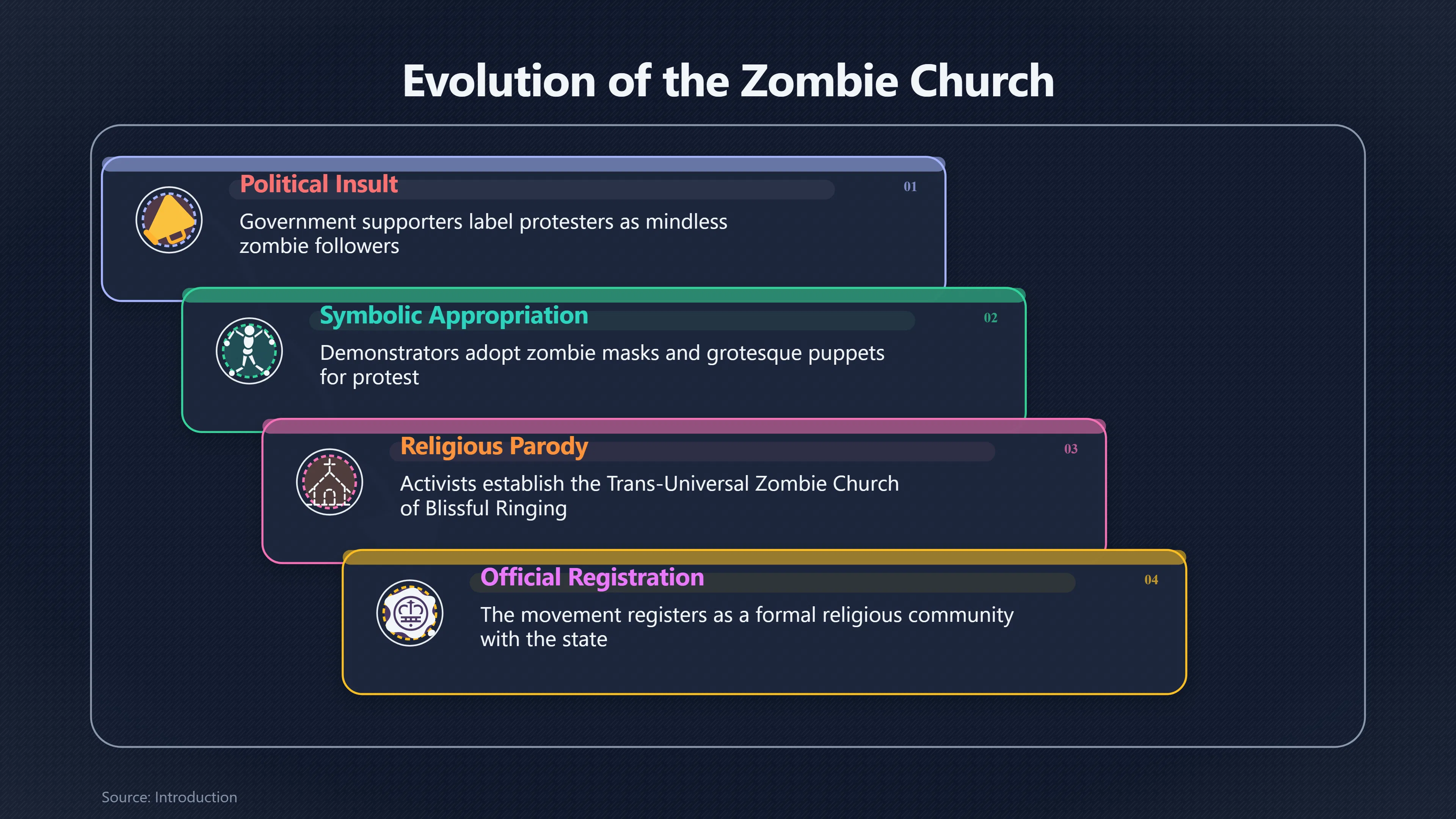
As the protests grew, supporters of Prime Minister Janez Janša sought to undermine them rhetorically. One widely discussed message from the governing Slovenian Democratic Party described the demonstrations as a “zombie uprising” rather than a genuine national uprising. According to later interviews with participants, many protesters understood the label as suggesting that they were politically “dead” remnants of the former Yugoslav socialist system rather than independent citizens acting on current grievances.[ResearchGate]researchgate.netOpen source on researchgate.net.
Instead of rejecting the insult, demonstrators appropriated it. Zombie masks, theatrical costumes and grotesque puppets soon became central visual symbols of the protests. What had been intended as a dismissive label became an instantly recognisable emblem of resistance.
Invented religion as political performance
The symbolism did not end with costumes. Activists gradually developed the idea into a parody religion called the Trans-Universal Zombie Church of the Blissful Ringing. Religious language, ceremonies and organisational structures were adopted not because participants claimed supernatural beliefs, but because they offered an effective way to criticise political power and the relationship between church and state.[Cambridge University Press & Assessment]cambridge.orgCambridge University Press & AssessmentInvented Religion, the Awakened Polis, and Sacred Disestablishment: The Case of Slovenia's “Zombie…
The church’s rituals blended humour with legal argument. Members staged mock religious services in public, complete with bells, pots and pans. The reference to “blissful ringing” was itself satirical. Earlier political decisions had classified the ringing of church bells as protected religious expression rather than ordinary environmental noise. Zombie Church activists argued that if bell-ringing deserved legal protection because it formed part of religious practice, then their own ritualised protest noise should receive equal treatment.[ResearchGate]researchgate.netOpen source on researchgate.net.
This transformed an abstract constitutional debate into an easily understood public performance. Rather than arguing only in legal language, protesters demonstrated perceived inequalities through theatrical action.
Turning stigma into political criticism
The Zombie Church illustrates a broader phenomenon found in many protest movements: the reappropriation of hostile labels.
Instead of allowing “zombie” to imply irrationality or manipulation, protesters redefined it as a symbol of ordinary citizens confronting a political system they regarded as unresponsive. The parody worked on several levels:
- It exposed how political opponents attempt to delegitimise dissent through ridicule.
- It mocked the tendency to portray critics as hidden ideological enemies rather than people with genuine grievances.
- It encouraged participants from different political backgrounds to unite around a shared satirical identity.
- It attracted domestic and international media attention without relying on violence or intimidation.[Cambridge University Press & Assessment]cambridge.orgCambridge University Press & AssessmentInvented Religion, the Awakened Polis, and Sacred Disestablishment: The Case of Slovenia's “Zombie…
Researchers of political religion argue that this was more than street theatre. By adopting the structure of a church, activists highlighted questions about who receives public recognition as a religion, how states distinguish sincere belief from parody, and whether legal privileges should apply equally across different communities.[Cambridge University Press & Assessment]cambridge.orgCambridge University Press & AssessmentInvented Religion, the Awakened Polis, and Sacred Disestablishment: The Case of Slovenia's “Zombie…

Registration and legal significance
The movement did not disappear after the protests subsided. It proceeded to register officially as a religious community with the Slovenian state, an outcome that surprised many observers because the organisation openly acknowledged its satirical origins. The registration allowed activists to continue challenging legal and administrative practices concerning religious equality and state neutrality.[ResearchGate]researchgate.netOpen source on researchgate.net.
This development shifted the discussion beyond protest politics. Critics questioned whether a parody religion should qualify for official recognition, while supporters argued that equal treatment under the law should not depend on whether outsiders considered a religion conventional, humorous or unusual. The debate therefore became part of a wider conversation about religious freedom and the state’s role in recognising belief communities.[old.delo.si]old.delo.siUpasana in Zombi cerkev sta užalili del katoličanovUpasana in Zombi cerkev sta užalili del katoličanov
What the Zombie Church reveals about collective belief
Although the Zombie Church belongs within a history of collective belief and social scares, it represents almost the opposite of a moral panic.
There was no widespread belief that zombies existed, nor did participants seek to persuade the public of supernatural claims. Instead, they consciously used religious symbolism to expose how language can manufacture suspicion and social division.
The case demonstrates several important points:
- Political labels can shape public perceptions even when they have little factual basis.
- Satire can weaken attempts to stigmatise protest movements by making the accusation itself appear ridiculous.
- Religious forms—rituals, symbols and ceremonies—can function as tools of political communication even without conventional religious belief.
- Public debates about religion often concern law, equality and identity as much as theology.[Cambridge University Press & Assessment]cambridge.orgCambridge University Press & AssessmentInvented Religion, the Awakened Polis, and Sacred Disestablishment: The Case of Slovenia's “Zombie…
For scholars of religion and politics, the Zombie Church has become an example of an “invented religion”: a consciously created religious framework used to express ethical, political or cultural ideas rather than inherited doctrine. Its importance lies less in its theology than in its demonstration of how symbolic performance can reshape political narratives.[Cambridge University Press & Assessment]cambridge.orgCambridge University Press & AssessmentInvented Religion, the Awakened Polis, and Sacred Disestablishment: The Case of Slovenia's “Zombie…
Why it remains culturally important
The Zombie Church remains one of the most distinctive episodes in modern Slovenian protest culture because it inverted the usual dynamics of political labelling. Governments and political actors have often attempted to marginalise opponents through hostile stereotypes. In this case, protesters neutralised that strategy by embracing the stereotype, exaggerating it into theatrical performance and ultimately transforming it into an officially recognised organisation.
Within Slovenia’s wider history of fears, panics and contested belief, the Zombie Church therefore stands not as an example of collective irrationality but as a reminder that symbols associated with fear can be deliberately reclaimed. Rather than illustrating how crowds become trapped by false beliefs, it shows how humour, parody and invented ritual can expose the social mechanisms through which fear and stigma are created in the first place.[cambridge.org]cambridge.orgCambridge University Press & AssessmentInvented Religion, the Awakened Polis, and Sacred Disestablishment: The Case of Slovenia's “Zombie…
Amazon book picks
Further Reading
Books and field guides related to How Protesters Turned Stigma Into Satire. Use these as the next step if you want deeper reading beyond the article.
The True Believer:Thoughts on the Nature of Mass Movements
Provides context for collective identity and political mobilization.
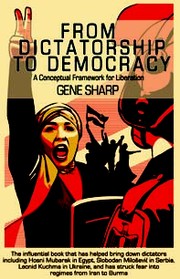
From Dictatorship to Democracy
Explains nonviolent resistance relevant to Slovenian protests.
Endnotes
1.
Source: cambridge.org
Link:https://www.cambridge.org/core/journals/politics-and-religion/article/abs/invented-religion-the-awakened-polis-and-sacred-disestablishment-the-case-of-slovenias-zombie-church/703A38F23E5CCC9FEDB1A155CE64C2B8
Source snippet
Cambridge University Press & AssessmentInvented Religion, the Awakened Polis, and Sacred Disestablishment: The Case of Slovenia's “Zombie...
2.
Source: counterfire.org
Title: Slovenia’s ‘Zombie uprising’ | Counterfire
Link:https://www.counterfire.org/article/slovenias-zombie-uprising/
Source snippet
Slovenia’s ‘Zombie uprising’ | Counterfire...
3.
Source: researchgate.net
Link:https://www.researchgate.net/publication/345492122_Invented_Religion_the_Awakened_Polis_and_Sacred_Disestablishment_The_Case_of_Slovenia%27s_Zombie_Church
4.
Source: old.delo.si
Title: Upasana in Zombi cerkev sta užalili del katoličanov
Link:https://old.delo.si/novice/slovenija/upasana-in-zombi-cerkev-sta-uzalili-del-katolicanov.html
5.
Source: cambridge.org
Title: Wadsworth, Aleš Črnič * Published online by Cambridg
Link:https://www.cambridge.org/core/journals/politics-and-religion/volume/862D4C566FE0A0A8D2B9687963B00BC6?pageNum=2
Source snippet
Politics and Religion: Volume 14 - | Cambridge CoreDecember 1, 2021 — ARTICLE [Input] * ### Invented Religion, the Awakened Polis, and Sa...
Published: December 1, 2021
6.
Source: cambridge.org
Link:https://www.cambridge.org/core/journals/politics-and-religion/article/divergent-trends-in-legal-recognition-of-religious-entities-in-europe-the-cases-of-slovenia-and-hungary/8024A8602D4B8EC22526C5A78918510E
7.
Source: researchgate.net
Link:https://www.researchgate.net/publication/277567857_Divergent_Trends_in_Legal_Recognition_of_Religious_Entities_in_Europe_The_Cases_of_Slovenia_and_Hungary
8.
Source: old.delo.si
Title: si Gregor Lesjak: Sedanja ureditev duhovne oskrbe ni v skladu z ustavo
Link:https://old.delo.si/ozadja/gregor-lesjak-sedanja-ureditev-duhovne-oskrbe-ni-v-skladu-z-ustavo.html
9.
Source: old.delo.si
Title: siČisto prava Cerkev. Zombi Cerkev
Link:https://old.delo.si/zgodbe/nedeljskobranje/cisto-prava-cerkev-zombi-cerkev.html
10.
Source: slovenskenovice.delo.si
Title: si Protestnika Dejana pretepli in zvezali kot živino-Slovenske novice
Link:https://slovenskenovice.delo.si/novice/kronika/doma/protestnika-dejana-pretepli-in-zvezali-kot-zivino
11.
Source: slovenskenovice.delo.si
Title: si FOT O: Zombiji zahtevajo odstop vlade-Slovenske novice
Link:https://slovenskenovice.delo.si/novice/slovenija/foto-zombiji-zahtevajo-odstop-vlade
12.
Source: researchgate.net
Title: 304684264 Unable to Heal Debate on the National Self in Post Socialist Slovenia
Link:https://www.researchgate.net/publication/304684264_Unable_to_Heal_Debate_on_the_National_Self_in_Post-Socialist_Slovenia
13.
Source: researchgate.net
Title: 304198467 Artivistic interventions as humorous re appropriations
Link:https://www.researchgate.net/publication/304198467_Artivistic_interventions_as_humorous_re-appropriations
Additional References
14.
Source: tandfonline.com
Link:https://www.tandfonline.com/doi/full/10.1080/09637494.2016.1194009
Source snippet
Get AccessJuly 19, 2016 — 196 Views 3 CrossRef citations to date 0 Altmetric Articles THE DECAPITATION OF SLOVENIA’S CATHOLIC CHURCH: SOC...
Published: July 19, 2016
15.
Source: mirovni-institut.si
Link:https://www.mirovni-institut.si/en/uprising-movements-analyzed-in-druzboslovne-razprave-journal/
Source snippet
October 25, 2016 — Peace Institute – Institute for Contemporary Social and Political Studies > Uprising movements analyzed in Družboslovn...
Published: October 25, 2016
16.
Source: pressto.amu.edu.pl
Link:https://pressto.amu.edu.pl/index.php/ssp/article/view/16897
Source snippet
(2013), Between Facebook and the Picket Line: Street Protests, Labour Strikes and the New Left in the Balkans, “Debatte: Journal of Conte...
17.
Source: tandfonline.com
Link:https://www.tandfonline.com/doi/abs/10.1080/09637494.2016.1194009
Source snippet
The decapitation of Slovenia’s Catholic Church: social factors and consequences: Religion, State and Society: Vol 44, No 2July 19, 2016 —...
Published: July 19, 2016
18.
Source: youtube.com
Title: prva masa v Kopru Čezvesoljska Zombi Cerkev blaženega zvonjenja
Link:https://www.youtube.com/watch?v=25sK0WhyvSc
Source snippet
druga maša v Kopru Čezvesoljska Zombi Cerkev...
19.
Source: rt.com
Link:https://www.rt.com/news/217235-slovenia-zombie-church-corruption/
20.
Source: ebrary.net
Link:https://ebrary.net/222567/education/uprising_ombies_slovenia_political_framework
21.
Source: mirovni-institut.si
Link:https://www.mirovni-institut.si/en/publications/uprising-movements-thematic-cluster-in-druzboslovne-razprave/
22.
Source: youtube.com
Title: druga maša v Kopru Čezvesoljska Zombi Cerkev
Link:https://www.youtube.com/watch?v=pjBc_SygEXI
Source snippet
Protests in Slovenia as government teeters...
23.
Source: youtube.com
Link:https://www.youtube.com/watch?v=BW0wL9Fql-Q
Source snippet
BONG za Palestino...
Topic Tree