Within Nigeria
Did Money Ritual Fears Reflect Real Crimes?
Real crimes helped sustain wider fears that occult networks could create wealth, despite no evidence that ritual practices had supernatural power.
On this page
- What Nigerians mean by money rituals
- Documented murders and unsupported supernatural claims
- How inequality and sudden wealth fuel suspicion
Page outline Jump by section
Introduction
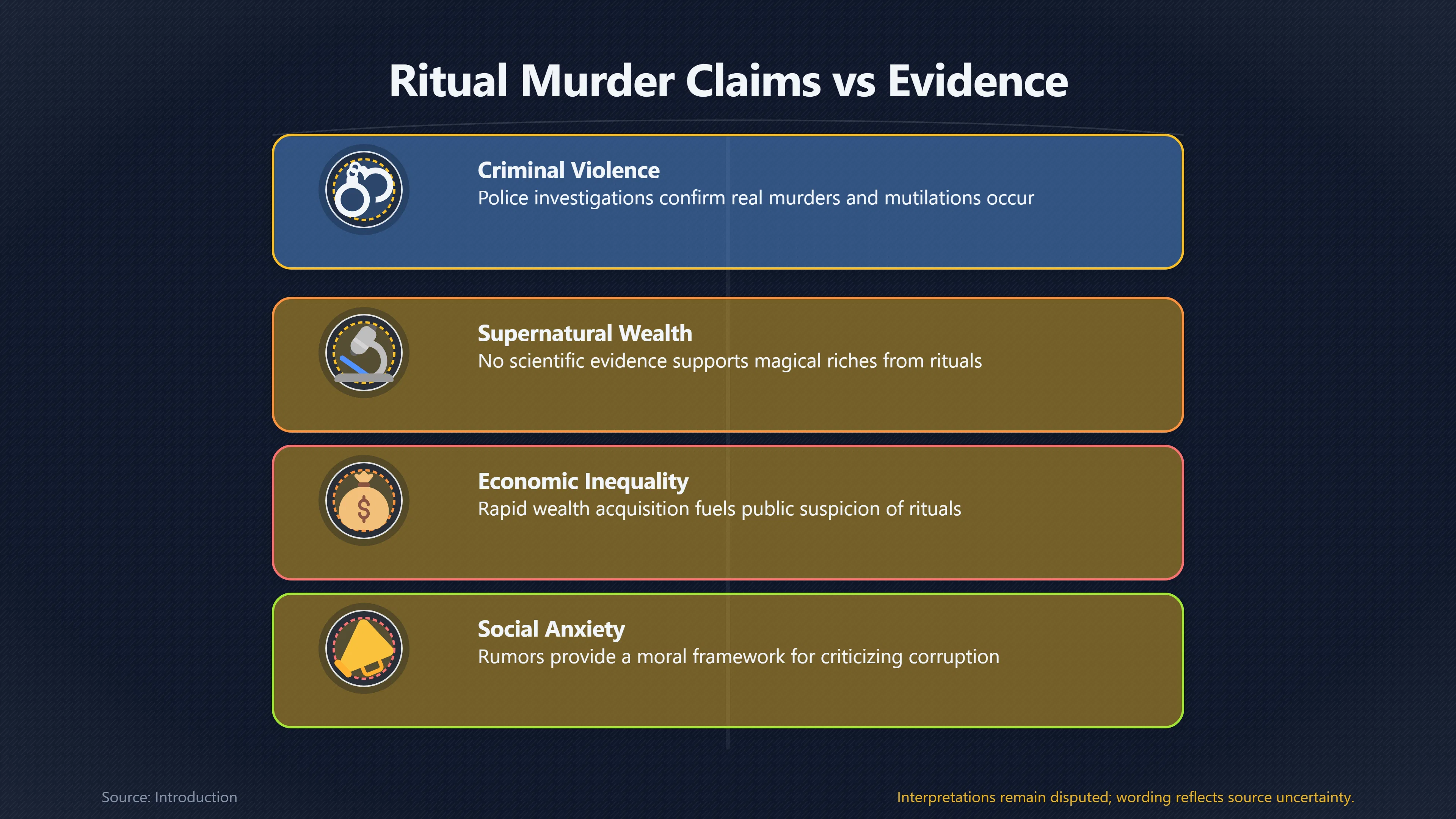
Stories about “money rituals” occupy a distinctive place in modern Nigerian public life because they combine two very different realities. On one hand, Nigeria has experienced genuine murders in which suspects were accused or convicted of killing victims for body parts believed to bring wealth, influence or business success. On the other hand, there is no credible scientific evidence that any ritual practice can produce supernatural riches. The result is a powerful public fear in which documented crimes, longstanding spiritual beliefs, economic inequality, corruption and rumour reinforce one another.
Understanding this distinction is essential. Ritual murders are real crimes when they occur, and they have caused profound suffering. The belief that such killings can magically generate wealth, however, remains unsupported by evidence. The persistence of that belief has shaped public suspicion, media reporting and everyday anxieties far beyond the number of documented criminal cases.[AnthroSource]anthrosource.onlinelibrary.wiley.comRitual Killing, 419, and Fast Wealth: Inequality and the Popular Imagination in Southeastern Nigeria - Smith - 2001 - America…
What Nigerians mean by money rituals
In everyday Nigerian usage, “money rituals” usually refers to the belief that human blood, body parts or human sacrifice can be used in occult practices to produce extraordinary wealth, commercial success or political influence. The idea appears in rumours, crime reporting, films, religious preaching and everyday conversation, although beliefs differ greatly between communities and individuals.
Researchers distinguish these beliefs from older forms of ritual practice. Contemporary discussions of money rituals generally concern criminal acts committed in pursuit of wealth rather than traditional religious ceremonies. The modern concept reflects anxieties about rapid enrichment, organised crime and corruption as much as it reflects older supernatural traditions.[ecoi.net]ecoi.netIRB – Immigration and Refugee Board of Canada (Author): “Nigeria: Prevalence of ritual killing and human sacrifice; state protection (201…
Anthropologist Daniel Jordan Smith argues that stories about ritual wealth became especially influential during periods of widening inequality and economic uncertainty. They expressed public concern about how some people appeared to acquire extraordinary riches despite widespread hardship. Rather than simply reflecting supernatural belief, such stories also became a way of criticising patronage, fraud and unexplained privilege.[AnthroSource]anthrosource.onlinelibrary.wiley.comRitual Killing, 419, and Fast Wealth: Inequality and the Popular Imagination in Southeastern Nigeria - Smith - 2001 - America…
Documented murders and unsupported supernatural claims
One of the greatest sources of confusion is the tendency to treat two separate claims as though they prove one another.
The first claim—that ritual murders occur—is supported by criminal investigations, police arrests and court cases. Nigeria has repeatedly experienced murders in which victims’ bodies were mutilated or body parts removed, with investigators alleging that perpetrators intended to use them in rituals connected to wealth or power. International agencies and country guidance documents recognise ritual killings as a genuine form of violent crime, even though they represent a small proportion of overall violent deaths.[European Union Agency for Asylum]euaa.europa.euOpen source on europa.eu.
The second claim—that these practices actually produce supernatural wealth—has no reliable evidential support. No scientific investigation has demonstrated that ritual killing can generate money or success through occult means. Criminal prosecutions establish homicide, not the effectiveness of magical beliefs.
This distinction matters because genuine crimes can unintentionally strengthen unsupported beliefs. Each highly publicised murder may persuade some observers that criminals would not commit such acts unless the rituals worked, even though other explanations—such as fraud, manipulation, coercion, desperation or sincere but mistaken belief—better explain offenders’ behaviour.
Why sudden wealth attracts suspicion
Money ritual fears are closely tied to social inequality.
Nigeria has experienced periods in which enormous wealth has existed alongside persistent poverty, unemployment and weak public confidence in political and legal institutions. In such circumstances, dramatic differences in living standards naturally provoke questions about how fortunes were acquired.
When someone appears to become wealthy unusually quickly, rumours sometimes attribute that success to occult practices rather than entrepreneurship, inheritance, crime or corruption. Smith argues that these stories reflect popular attempts to explain widening inequality through a moral framework: wealth obtained without visible labour becomes morally suspicious, and rumours of ritual killing become a language for expressing that suspicion.[AnthroSource]anthrosource.onlinelibrary.wiley.comRitual Killing, 419, and Fast Wealth: Inequality and the Popular Imagination in Southeastern Nigeria - Smith - 2001 - America…
These suspicions often intensify when:
- luxury lifestyles appear disconnected from obvious income;
- corruption scandals undermine confidence in public institutions;
- economic hardship increases competition for opportunities;
- disappearances or murders receive extensive publicity;
- communities believe police investigations are incomplete or ineffective.
In this way, real criminal cases become symbols for broader anxieties about fairness, justice and social change.

Public panic and the spread of rumours
Because ritual murders are both shocking and emotionally charged, individual cases frequently generate fears extending far beyond the available evidence.
Following reports of mutilated bodies or missing persons, rumours may circulate rapidly through neighbourhoods, traditional media and social media. Parents may restrict children’s movements, strangers become objects of suspicion, and ordinary disappearances are sometimes interpreted through the framework of money rituals before investigations establish what actually happened.
The resulting atmosphere can produce moral panic, where fear spreads more rapidly than verified information. This does not mean the underlying crimes are imaginary. Rather, genuine incidents become the basis for much broader assumptions that any unexplained death, disappearance or display of wealth is probably connected to ritual activity.
Researchers studying collective belief note that uncertainty and low institutional trust make rumours particularly resilient because official denials are often viewed with scepticism.[AnthroSource]anthrosource.onlinelibrary.wiley.comRitual Killing, 419, and Fast Wealth: Inequality and the Popular Imagination in Southeastern Nigeria - Smith - 2001 - America…
High-profile cases and changing public perceptions
Several widely reported episodes have reinforced public concern.
The discovery of numerous corpses at the Okija shrine in Anambra State in 2004 generated international attention and was widely interpreted by many Nigerians as evidence of ritual murder. Later historical analysis suggested that many of the bodies had probably been deposited at the shrine after death elsewhere rather than representing murders committed there. Nevertheless, revelations that prominent politicians had visited the shrine to swear oaths deepened public beliefs that political power and occult practices were closely connected. The episode illustrates how factual discoveries, political scandal and speculation can merge into a much larger public narrative.[Cambridge University Press & Assessment]cambridge.orgCambridge University Press & AssessmentTHE OKIJA SHRINE: DEATH AND LIFE IN NIGERIAN POLITICS* | The Journal of African History | Cambridg…
Other widely publicised murder investigations involving missing body parts have similarly reinforced fears, regardless of whether courts ultimately established ritual motives. Individual criminal cases therefore often become culturally significant beyond their legal findings.
Film, religion and popular culture
Money ritual beliefs have also been sustained through popular culture.
For decades, Nigerian films have frequently portrayed characters who gain wealth through occult bargains before suffering dramatic punishment. These stories generally function as moral warnings rather than endorsements of ritual practices, yet they also keep the imagery of money rituals familiar to audiences.
Religious preaching has had mixed effects. Many Christian and Muslim leaders explicitly condemn ritual killings and reject magical claims. Others, however, preach about powerful occult forces capable of influencing wealth, reinforcing a worldview in which supernatural explanations remain plausible even while condemning criminal violence.
This mixture of condemnation and spiritual interpretation helps explain why belief can remain widespread despite the absence of evidence for supernatural wealth creation.
What historians and social scientists conclude
Most scholars do not explain money ritual fears simply as irrational superstition. Instead, they see them as arising from the interaction of several forces:
- genuine murders committed for ritual purposes or believed by offenders to have ritual value;
- persistent economic inequality and youth unemployment;
- widespread concern about corruption and unexplained wealth;
- distrust of official investigations and criminal justice;
- religious and cultural traditions that treat unseen spiritual forces as socially meaningful;
- repeated circulation of rumours through media and popular culture.
This approach neither dismisses victims nor accepts supernatural claims. It recognises that documented crimes are real while understanding that the wider belief system surrounding money rituals has been shaped by social pressures as much as by criminal events.[wiley.com]anthrosource.onlinelibrary.wiley.comRitual Killing, 419, and Fast Wealth: Inequality and the Popular Imagination in Southeastern Nigeria - Smith - 2001 - America…

Why the fear remains influential
Money ritual fears continue to influence Nigerian public life because they answer questions that many people find emotionally compelling: why some individuals become rich so suddenly, why corruption appears difficult to punish, and why horrific murders occasionally involve mutilated bodies.
Real crimes have given these fears credibility in the public imagination. Yet the existence of ritual murders does not demonstrate that ritual practices possess supernatural power. The strongest available evidence instead suggests that the enduring influence of money ritual stories comes from the combination of genuine criminal violence, deep economic inequality, distrust of institutions and the human search for explanations when wealth and suffering seem distributed in ways that feel morally incomprehensible.[wiley.com]anthrosource.onlinelibrary.wiley.comRitual Killing, 419, and Fast Wealth: Inequality and the Popular Imagination in Southeastern Nigeria - Smith - 2001 - America…
Amazon book picks
Further Reading
Books and field guides related to Did Money Ritual Fears Reflect Real Crimes?. Use these as the next step if you want deeper reading beyond the article.

Extraordinary Popular Delusions and the Madness of Crowds
Rating: 4.0/5 from 5 Google Books ratings
Explains collective belief and rumor dynamics.
Endnotes
1.
Source: ecoi.net
Link:https://www.ecoi.net/en/document/2066535.html
Source snippet
IRB – Immigration and Refugee Board of Canada (Author): “Nigeria: Prevalence of ritual killing and human sacrifice; state protection (201...
2.
Source: cambridge.org
Link:https://www.cambridge.org/core/journals/journal-of-african-history/article/okija-shrine-death-and-life-in-nigerian-politics/104CC98D7536D0389CC6C608F74159B2
Source snippet
Cambridge University Press & AssessmentTHE OKIJA SHRINE: DEATH AND LIFE IN NIGERIAN POLITICS* | The Journal of African History | Cambridg...
3.
Source: ecoi.net
Link:https://www.ecoi.net/en/document/1278808.html
4.
Source: cambridge.org
Link:https://www.cambridge.org/core/journals/africa/article/abs/arrow-of-god-pentecostalism-inequality-and-the-supernatural-in-southeastern-nigeria/EF2B09B5CB9561F5217CDB8CEF6ACD5A
5.
Source: ecoi.net
Link:https://www.ecoi.net/en/document/1053400.html
6.
Source: anthrosource.onlinelibrary.wiley.com
Link:https://anthrosource.onlinelibrary.wiley.com/doi/10.1525/ae.2001.28.4.803
Source snippet
Ritual Killing, 419, and Fast Wealth: Inequality and the Popular Imagination in Southeastern Nigeria - Smith - 2001 - America...
7.
Source: euaa.europa.eu
Link:https://www.euaa.europa.eu/country-guidance-nigeria-2021/211-individuals-fearing-ritual-killing
Additional References
8.
Source: cfr.org
Link:https://www.cfr.org/articles/ritual-killings-nigeria-reflect-mounting-desperation-wealth-and-security-amid-creeping
Source snippet
Council on Foreign RelationsRitual Killings in Nigeria Reflect Mounting Desperation for Wealth and Security Amid Creeping Collapse of Law...
9.
Source: journals.co.za
Link:https://journals.co.za/doi/10.31920/2516-2713/2025/v8n3a1
Source snippet
pora StudiesSeptember 1, 2025 — EVALUATING THE PUBLIC’S PERCEPTION OF NEWSPAPER COVERAGE OF HUMAN KILLINGS FOR MONEY RITUALS IN NIGERIA *...
Published: September 1, 2025
10.
Source: skeptic.org.uk
Title: Catching Killers, Not Curses: how to investigate Africa’s ‘Money Ritual’ crimes
Link:https://www.skeptic.org.uk/2026/01/catching-killers-not-curses-how-to-investigate-africas-money-ritual-crimes/
Source snippet
The SkepticJanuary 28, 2026 — CATCHING KILLERS, NOT CURSES: HOW TO INVESTIGATE AFRICA’S ‘MONEY RITUAL’ CRIMES By Keith K Silika, Sani K B...
Published: January 28, 2026
11.
Source: feeds.bbci.co.uk
Title: bbci.co.uk Nigeria’s Black Axe mafia dealt ‘big blow’ by Interpol
Link:https://feeds.bbci.co.uk/news/articles/c984w8jr1glo
Source snippet
bbci.co.ukNigeria’s Black Axe mafia dealt 'big blow' by Interpol - BBC NewsAugust 28, 2024 — WORLD'S POLICE IN TECHNOLOGICAL ARMS RACE WI...
Published: August 28, 2024
12.
Source: ritualkillinginafrica.org
Title: Nigeria: The scourge of ritual killings | Ritual Killing In Africa
Link:https://www.ritualkillinginafrica.org/2026/06/04/nigeria-the-scourge-of-ritual-killings/
Source snippet
F.P.M. van der Kraaij The following article, below, resonates deeply with me. In recent years, I have written so often about ri...
13.
Source: youtube.com
Title: Money Rituals: Africa’s Deadliest Taboo
Link:https://www.youtube.com/watch?v=EjDe1D8NlOY
Source snippet
4 The Madman Who Terrified an Entire Nation | The Clifford Orji Story...
14.
Source: youtube.com
Title: Quick Money – A Look At Rising Cases Of Ritual Killings By Young Nigerians
Link:https://www.youtube.com/watch?v=aSEwQ37XRFY
Source snippet
2 Tackling Ritual Killings and Yahoo-Yahoo in Nigeria...
15.
Source: youtube.com
Title: The Madman Who Terrified an Entire Nation | The Clifford Orji Story
Link:https://www.youtube.com/watch?v=5WYfnGoPtL0
Source snippet
5 Ibadan Kidnappers Den: How Did It Go Unnoticed? Pt.1...
16.
Source: youtube.com
Title: Tackling Ritual Killings and Yahoo-Yahoo in Nigeria
Link:https://www.youtube.com/watch?v=NR01rdK-KIE
Source snippet
3 Money Rituals: Africa's Deadliest Taboo - BBC Africa Eye Documentary...
17.
Source: researchgate.net
Link:https://www.researchgate.net/publication/338220629_The_Growing_Phenomenon_of_Money_Rituals-Motivated_Killings_in_Nigeria_An_Empirical_Investigation_into_the_Factors_Responsible
Topic Tree