Within Austria's Collective Fears
Why Salzburg's Witch Hunt Kept Expanding
Salzburg's hunt for the Sorcerer Jackl grew through torture, denunciation and hostility towards mobile poor communities.
On this page
- The search for the Sorcerer Jackl
- Why children, beggars and labourers were targeted
- How torture manufactured a wider conspiracy
Page outline Jump by section
Introduction
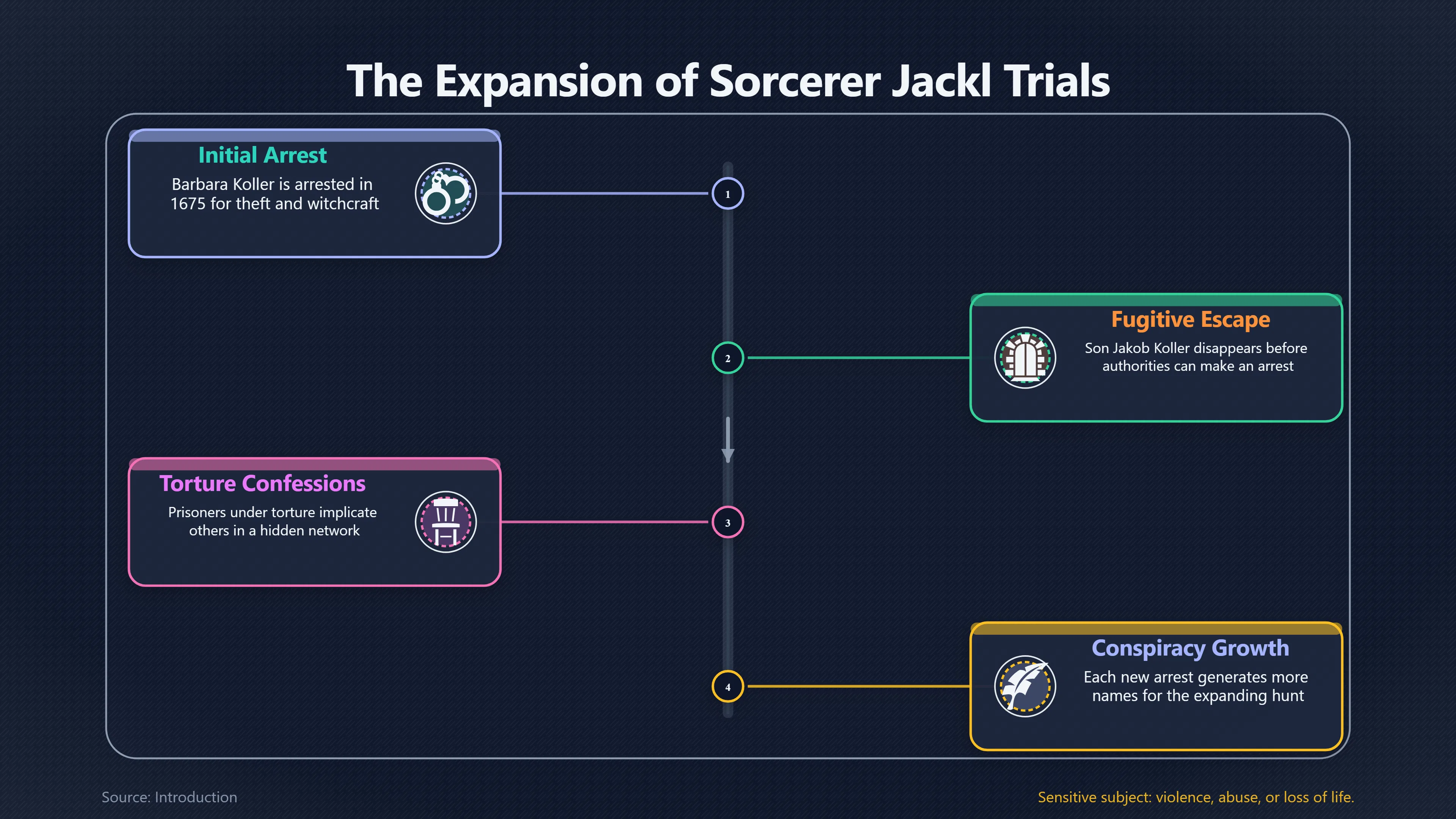
The Salzburg witch hunt commonly known as the Zauberer Jackl or Sorcerer Jackl trials stands out among European witch persecutions because its main targets were not wealthy householders or elderly women, but poor children, teenagers, young labourers and wandering beggars. Between 1675 and about 1690, authorities in the Prince-Archbishopric of Salzburg pursued an alleged network of witches supposedly led by a fugitive known as Sorcerer Jackl. He was never captured, yet the search for him expanded into one of Austria’s largest witch persecutions. Torture, repeated denunciations and deep suspicion of mobile poor communities transformed a search for one man into a widening conspiracy in which vulnerable young people became the primary victims. Historians now regard the trials as a striking example of how judicial methods, social prejudice and fear combined to manufacture an ever-growing imagined threat rather than uncover a real criminal organisation.[SciDok]scidok.sulb.uni-saarland.deOpen source on uni-saarland.de.

Why the search for Sorcerer Jackl kept expanding
The trials began after the arrest of Barbara Koller in 1675 on charges including theft and witchcraft. Under torture she implicated her son, Jakob Koller, later remembered as Sorcerer Jackl, claiming that he had entered a pact with the Devil. Barbara was executed, but Jakob disappeared before he could be arrested. His absence became crucial to the unfolding persecution.[Wikipedia]WikipediaZaubererjackl witch trialsZaubererjackl witch trials
Instead of weakening the case, Jackl’s disappearance encouraged authorities to believe they were facing a hidden organisation. Because the supposed leader could not be produced, investigators increasingly relied on the testimony of other suspects. Every confession appeared to confirm that Jackl had recruited followers across Salzburg, even though nearly all of these “proofs” came from prisoners being interrogated under torture.[Storicamente]storicamente.orgvoltmer link4Salzburger Zauberer-Jackl-Verfolgungen (1675-1679)…
The result was a self-reinforcing investigation. Each accused person was expected to identify more accomplices, who in turn were pressured to name others. Rather than narrowing the inquiry, every arrest generated additional arrests.
Why children, beggars and labourers were targeted
Unlike many other European witch hunts, the Salzburg trials focused overwhelmingly on people living at the margins of society.
Research based on surviving court records shows that roughly two-thirds of those accused were children or young adults, many drawn from the itinerant beggar population. Most of the defendants were male, another unusual feature compared with many early modern witch trials elsewhere in Europe.[SciDok]scidok.sulb.uni-saarland.deOpen source on uni-saarland.de.
Several social pressures made these young people particularly vulnerable:
- Poverty created suspicion. Wandering beggars lacked stable homes, employers and respected neighbours who might defend them.
- Mobility encouraged rumours. Travelling groups were easily imagined as belonging to secret criminal or magical networks because they moved between villages.
- Youth implied vulnerability. Authorities believed children could be recruited by the Devil or corrupted by older witches, making them plausible suspects within contemporary religious thinking.
- Social control mattered. Local rulers were already concerned about begging, theft and vagrancy. Witchcraft accusations offered another justification for policing those populations.[storicamente.org]storicamente.orgvoltmer link4Salzburger Zauberer-Jackl-Verfolgungen (1675-1679)…
Modern historians therefore see the persecution not simply as fear of magic, but also as an attempt to discipline socially marginal groups whose lifestyles already attracted official hostility.

How torture manufactured a wider conspiracy
The mechanism driving the Salzburg hunt was not independent evidence but the legal practice of extracting confessions through torture.
A pivotal moment came in 1677 with the interrogation of the disabled twelve-year-old beggar Dionysos Feldner. Under questioning he claimed to have recently met Jackl and described him as leader of a band of poor children and teenagers trained in black magic. These statements became the foundation for further arrests rather than being independently verified.[Wikipedia]WikipediaZaubererjackl witch trialsZaubererjackl witch trials
As more suspects entered prison, interrogators repeatedly demanded answers to familiar questions:
- Who had attended witches’ gatherings?
- Who had received magical instruction from Jackl?
- Who had made a pact with the Devil?
- Which other children belonged to the group?
Because prisoners faced extreme physical pain, many repeated stories already circulating within earlier interrogations or named acquaintances from the same impoverished communities. This produced a growing web of mutually reinforcing confessions that appeared convincing to judges because different prisoners repeated similar narratives. In reality, those similarities reflected the interrogation process itself rather than independent corroboration.[SciDok]scidok.sulb.uni-saarland.deOpen source on uni-saarland.de.
Researchers who have analysed the surviving trial records note that many stories also incorporated details from the children’s own difficult lives—family conflict, hunger, homelessness and experiences of begging—which became woven into fantastical accounts shaped by questioning.[SciDok]scidok.sulb.uni-saarland.deOpen source on uni-saarland.de.
The mythical figure who was never found
One of the most remarkable aspects of the persecution is that Sorcerer Jackl himself never appeared before the court.
As years passed, the missing fugitive became increasingly legendary. Witnesses attributed extraordinary powers to him, including invisibility, the ability to command animals, damage crops and weather, and organise secret gatherings across the countryside. Each failure to capture him appeared, paradoxically, to strengthen belief in his supernatural abilities rather than undermine the accusations.[Street Roots]streetroots.orgStreet Roots‘Sorcerer Jackl’ tells a dark chapter in Salzburg’s historyStreet Roots…
This pattern illustrates an important feature of many conspiracy panics. The absence of direct evidence did not weaken belief because the inability to find the supposed leader was interpreted as proof of his exceptional powers and the hidden nature of his organisation.

Human cost and historical importance
The Salzburg trials ultimately led to around 139 executions, making them among Austria’s largest witch persecutions. Many victims were children, adolescents and young adults, while almost all belonged to poor or itinerant communities. Jackl himself escaped capture and disappears from the historical record.[Wikipedia]WikipediaZaubererjackl witch trialsZaubererjackl witch trials
Today historians see the Zauberer Jackl trials as significant not because they revealed a genuine witch conspiracy, but because they demonstrate how judicial procedure could generate one. Torture encouraged confessions, confessions generated denunciations, denunciations justified further arrests, and social prejudice ensured that the expanding investigation concentrated on those least able to defend themselves.
Within Austria’s wider history of collective fear, the Salzburg hunt illustrates how beliefs about witchcraft merged with anxieties over poverty, vagrancy and youth. Rather than exposing an organised network of sorcerers, the trials reveal how vulnerable populations could become the focus of official persecution when fear, coercion and assumptions about social outsiders reinforced one another.[storicamente.org]storicamente.orgvoltmer link4Salzburger Zauberer-Jackl-Verfolgungen (1675-1679)…


Endnotes
1.
Source: storicamente.org
Title: voltmer link4
Link:https://storicamente.org/di/voltmer_link4
Source snippet
Salzburger Zauberer-Jackl-Verfolgungen (1675-1679)...
2.
Source: Wikipedia
Title: Zaubererjackl witch trials
Link:https://en.wikipedia.org/wiki/Zaubererjackl_witch_trials
3.
Source: Wikipedia
Title: Max Gandolph von Kuenburg
Link:https://en.wikipedia.org/wiki/Max_Gandolph_von_Kuenburg
4.
Source: scidok.sulb.uni-saarland.de
Link:https://scidok.sulb.uni-saarland.de/handle/20.500.11880/23665?locale=en
5.
Source: streetroots.org
Title: Street Roots‘Sorcerer Jackl’ tells a dark chapter in Salzburg’s history
Link:https://www.streetroots.org/culture/2021/10/06/sorcerer-jackl/
Source snippet
Street Roots...
6.
Source: wiki.sn.at
Title: Jakob Koller
Link:https://wiki.sn.at/wiki/Jakob_Koller
Source snippet
Koller – SALZBURGWIKIApril 28, 2025 — JAKOB KOLLER Zur Navigation springen Zur Suche springen Jakob Tischler (* um 1655 in Werfen^{[1]})...
Published: April 28, 2025
7.
Source: publikationen.sulb.uni-saarland.de
Title: de Publikationen der Ud S: Flights of (in)fancy: the child-witches of Salzburg
Link:https://publikationen.sulb.uni-saarland.de/handle/20.500.11880/23665
Additional References
8.
Source: salzburg.orf.at
Title: at Sonderschau: Jagd auf Evangelische und Hexen
Link:https://salzburg.orf.at/v2/news/stories/2891207/
Source snippet
orf.atSonderschau: Jagd auf Evangelische und Hexen - salzburg.ORF.atJanuary 23, 2018 — SONDERSCHAU: JAGD AUF EVANGELISCHE UND HEXEN Salzb...
Published: January 23, 2018
9.
Source: youtube.com
Title: Unveiling the Mystery of Moosham Castle | Mr. Explorer
Link:https://www.youtube.com/watch?v=ytyM3k1WF_Y
Source snippet
3 The Salzburg Witch Trials - Library of the Bizarre...
10.
Source: youtube.com
Title: The Salzburg Witch Trials
Link:https://www.youtube.com/watch?v=0ZPPXJcjDyo
Source snippet
4 The Witch Of Salzburg (ザルツブルグの魔女) PS1 Longplay [HD]...
11.
Source: oebv.at
Link:https://www.oebv.at/flippingbook/9783209091093/8/
12.
Source: sn.at
Link:https://www.sn.at/wiki/Hexenprozess
13.
Source: exulanten.com
Link:https://www.exulanten.com/jackl.html
14.
Source: cambridge.org
Link:https://www.cambridge.org/core/journals/continuity-and-change/article/devils-children-child-witchtrials-in-early-modern-germany/196AE61299E6FB7203FA863971A4CD63
15.
Source: youtube.com
Title: The Witch Of Salzburg (ザルツブルグの魔女) PS1 Longplay [HD]
Link:https://www.youtube.com/watch?v=FfeuuVrEa84
Source snippet
5 Trailer: Hast du den Zauberer Jackl gekannt?...
16.
Source: youtube.com
Title: The Dark History of Austria’s Witch Castle
Link:https://www.youtube.com/watch?v=ixKrerfXt-c
Source snippet
2 Unveiling the Mystery of Moosham Castle | Mr. Explorer...
17.
Source: books.google.com
Title: Verbrannte Kindheit
Link:https://books.google.com/books/about/Verbrannte_Kindheit.html?id=7Kx3DwAAQBAJ
Source snippet
Wolfgang Fürweger - Google BooksFebruary 25, 2015 — VERBRANNTE KINDHEIT: 1677-1679 DIE VERGESSENEN KINDER DER HEXENPROZESSE UM DEN ZAUBER...
Published: February 25, 2015
Topic Tree