Within Burundi Beliefs
Why Did the Businde Pilgrimage End in Bloodshed?
The Businde crisis grew from a disputed Marian movement, rival claims to religious authority and a lethal state response.
On this page
- Zebiya Ngendakumana and the claimed Marian visions
- Why church and state authorities opposed the movement
- The March 2013 shootings and the dispute over police force
Page outline Jump by section
Introduction
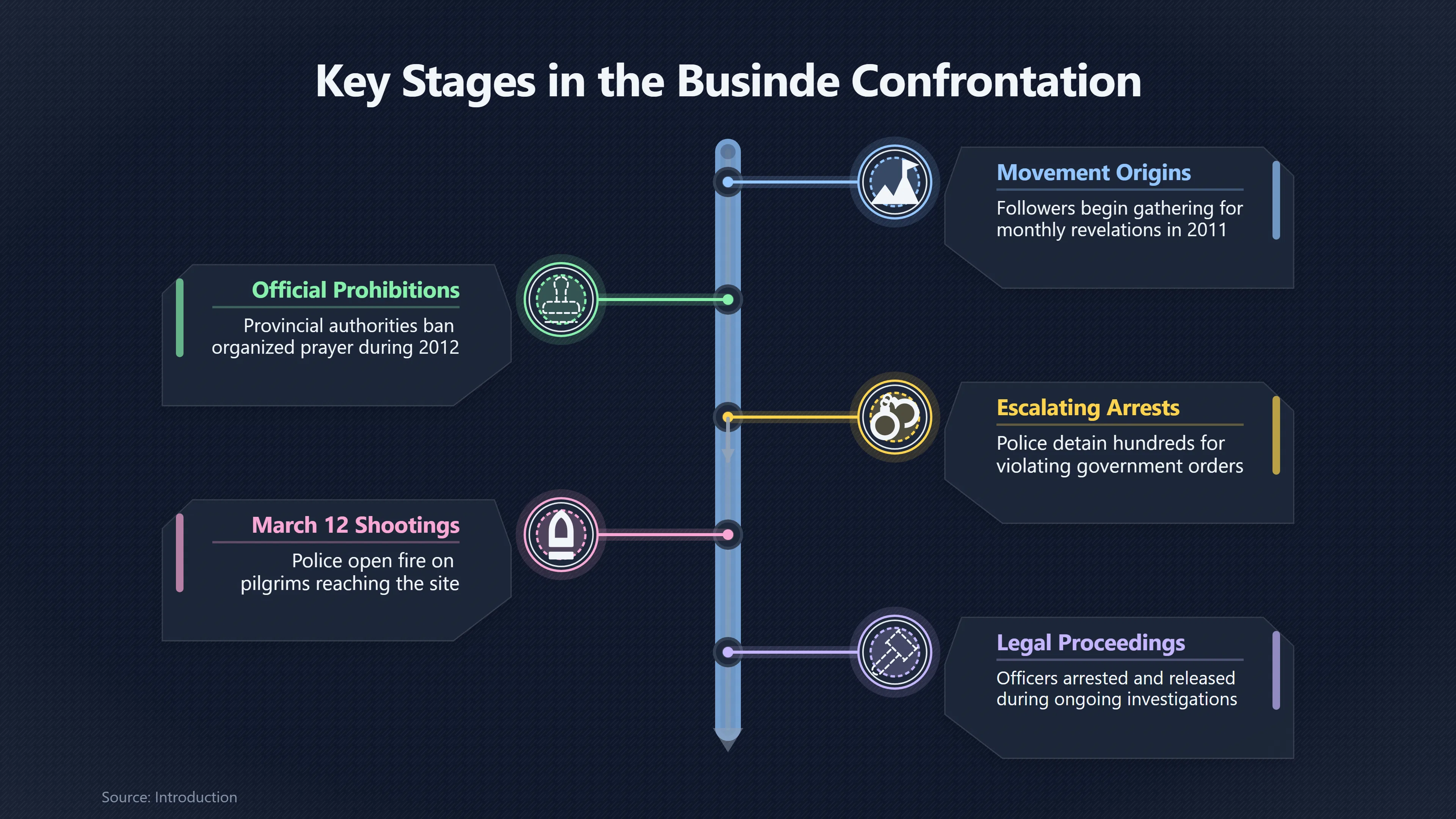
The Businde pilgrimage became one of Burundi’s most controversial religious confrontations because it combined disputed Marian visions, a struggle over religious authority and a deadly police operation. Beginning in 2011–2012, followers of the young visionary Zebiya (Eusébie) Ngendakumana travelled each month to Businde hill in Kayanza Province, believing that the Virgin Mary was communicating through her. The Roman Catholic Church refused to recognise the apparitions, while the Burundian government increasingly treated the gatherings as a threat to public order. The conflict reached its most violent point on 12 March 2013, when police opened fire on pilgrims attempting to reach the prayer site. The resulting deaths, injuries and allegations of abuse transformed what had begun as a dispute over religious claims into a major human rights controversy that continues to shape discussion of religious freedom and state power in Burundi.[Human Rights Watch]hrw.orgHuman Rights Watch Burundi: Shot, Beaten Near Prayer Site | Human Rights WatchHuman Rights WatchBurundi: Shot, Beaten Near Prayer Site | Human Rights WatchJuly 26, 2013…
Why did Businde become a centre of pilgrimage?
The Businde movement revolved around Zebiya Ngendakumana, a young Burundian woman whose followers believed she received regular messages from the Virgin Mary. Pilgrims gathered on the twelfth day of every month because they believed that was when new revelations would be delivered. Although the movement drew heavily on Catholic prayer, imagery and devotion to Mary, it operated independently of the Roman Catholic hierarchy.
Unlike recognised Marian shrines, Businde had no official ecclesiastical approval. Pilgrims nevertheless travelled from across Burundi and, according to several reports, from neighbouring countries. Human Rights Watch described the movement as loosely organised rather than tightly controlled, with participants including teachers, lawyers, students, civil servants and farmers, many of them women. This diversity complicates later portrayals of the movement simply as an isolated “cult”.[Human Rights Watch]hrw.orgHuman Rights Watch Burundi: Shot, Beaten Near Prayer Site | Human Rights WatchHuman Rights WatchBurundi: Shot, Beaten Near Prayer Site | Human Rights WatchJuly 26, 2013…
Why church and state authorities opposed the movement
The opposition to Businde came from two different institutions for different reasons.
The Roman Catholic Church rejected the claimed apparitions because it did not regard them as authentic private revelations. Church leaders instructed Catholics not to participate in worship at Businde, arguing that the movement threatened church unity and encouraged devotion outside recognised ecclesiastical authority. The disagreement was therefore primarily about who possessed the authority to determine whether supernatural claims were genuine.
Government officials approached the issue differently. Provincial authorities prohibited organised prayer at Businde during 2012, arguing that repeated gatherings created public-order problems. Officials proposed that if the followers wished to continue operating, they should establish a formally recognised religious organisation rather than presenting themselves as a Catholic movement rejected by the Church. The followers refused to abandon their monthly pilgrimages despite repeated warnings, arrests and police deployments.[Human Rights Watch]hrw.orgHuman Rights Watch Burundi: Shot, Beaten Near Prayer Site | Human Rights WatchHuman Rights WatchBurundi: Shot, Beaten Near Prayer Site | Human Rights WatchJuly 26, 2013…
The dispute therefore involved overlapping questions:
- whether the reported Marian visions were authentic;
- who possessed legitimate religious authority;
- whether the state could prohibit repeated religious gatherings;
- whether restrictions on Businde respected freedom of religion.
These issues remained unresolved before the violence of March 2013.
The road to confrontation
The March shootings did not occur without warning. During late 2012 and early 2013, police repeatedly attempted to prevent pilgrims reaching Businde. Witnesses described several earlier beatings, while hundreds of followers were arrested on accusations such as rebellion or violating government orders.
According to Human Rights Watch, many detainees were released only after promising not to return to Businde, while others refused to sign such commitments because they believed continuing the pilgrimage was a matter of religious conscience. These escalating confrontations created an atmosphere in which each monthly gathering became increasingly tense.[Human Rights Watch]hrw.orgHuman Rights Watch Burundi: Shot, Beaten Near Prayer Site | Human Rights WatchHuman Rights WatchBurundi: Shot, Beaten Near Prayer Site | Human Rights WatchJuly 26, 2013…
What happened on 12 March 2013?
In the early hours of 12 March, hundreds of worshippers approached Businde after travelling through the night. Police had already blocked access to the prayer site.
Witnesses interviewed by Human Rights Watch said that the pilgrims initially prayed and then began leaving after discovering the road was blocked. According to these accounts, police followed them before opening fire with live ammunition. Survivors also described officers systematically beating worshippers after the shooting, including people already wounded on the ground. Victims included women and children. Many suffered fractures and long-term injuries.[Human Rights Watch]hrw.orgHuman Rights Watch Burundi: Shot, Beaten Near Prayer Site | Human Rights WatchHuman Rights WatchBurundi: Shot, Beaten Near Prayer Site | Human Rights WatchJuly 26, 2013…
The precise death toll became disputed almost immediately. Government statements initially referred to fewer fatalities than independent investigations, while Human Rights Watch concluded that nine worshippers were killed and dozens injured. Other contemporary reporting cited figures ranging from six to ten deaths, reflecting the confusion during the immediate aftermath. Most later human rights reporting has adopted the figure of nine fatalities.[Human Rights Watch]hrw.orgHuman Rights Watch Burundi: Shot, Beaten Near Prayer Site | Human Rights WatchHuman Rights WatchBurundi: Shot, Beaten Near Prayer Site | Human Rights WatchJuly 26, 2013…
Why is the police response still disputed?
The central controversy concerns whether police acted in legitimate self-defence or used excessive and unlawful force.
Government officials maintained that officers encountered resistance from followers who threw stones and sticks and that police intervened to restore order. Some official accounts also suggested local residents had clashed with the pilgrims before police intervened.[cnidh.bi]cnidh.biDECLARATION DE LA CNIDH SUR LES EVENEMENTS DE LA COLLINE BUSINDE A KAYANZANovember 8, 2019…
Human Rights Watch reached a different conclusion after interviewing around twenty victims and witnesses. It found no evidence that pilgrims possessed firearms or presented a threat justifying lethal force. The organisation concluded that live ammunition was used disproportionately and that subsequent beatings constituted serious human rights abuses independent of whatever resistance officers may have encountered. It also documented allegations that wounded worshippers were assaulted after they had ceased posing any threat.[Human Rights Watch]hrw.orgHuman Rights Watch Burundi: Shot, Beaten Near Prayer Site | Human Rights WatchHuman Rights WatchBurundi: Shot, Beaten Near Prayer Site | Human Rights WatchJuly 26, 2013…
This disagreement remains important because it concerns not only the shootings themselves but also broader questions about policing peaceful religious gatherings.
Investigations and accountability
Following public criticism, three police officers, including the operational commander Bosco Havyarimana, were arrested. They faced accusations relating to the deaths and alleged mistreatment of worshippers.
However, the officers were provisionally released only a few months later while investigations continued. Human Rights Watch criticised the releases and argued that meaningful accountability had stalled. Subsequent reports continued to cite Businde as an example of impunity for excessive use of force by Burundian security services.[Human Rights Watch]hrw.orgHuman Rights Watch Burundi: Shot, Beaten Near Prayer Site | Human Rights WatchHuman Rights WatchBurundi: Shot, Beaten Near Prayer Site | Human Rights WatchJuly 26, 2013…
The incident also prompted condemnation from Burundi’s Independent National Human Rights Commission, which called for judicial investigations into the killings and surrounding violence, although disagreements persisted over the sequence of events and responsibility for the deaths.[cnidh.bi]cnidh.biDECLARATION DE LA CNIDH SUR LES EVENEMENTS DE LA COLLINE BUSINDE A KAYANZANovember 8, 2019…
What does Businde reveal about collective belief?
Businde is best understood as a conflict over competing sources of authority rather than a straightforward example of mass hysteria.
The followers demonstrated strong commitment to a charismatic visionary despite official prohibitions. That commitment encouraged repeated pilgrimages even after arrests and violence. Yet available evidence does not show a movement organised around violent action or collective psychological contagion in the classic sense.
Instead, several interacting factors produced the crisis:
- a charismatic claimant to supernatural authority;
- institutional rejection by the Catholic Church;
- government concern about unauthorised mass gatherings;
- repeated confrontations between determined pilgrims and police;
- increasing criminalisation of continued participation.
The deadly outcome arose when disagreements over religious legitimacy became intertwined with coercive state enforcement.
Why Businde remains significant
The Businde confrontation remains one of Burundi’s clearest examples of how disputes over religious authority can escalate into lethal conflict. It illustrates the dangers that arise when unofficial spiritual movements challenge established institutions and governments respond primarily through policing rather than dialogue.
For historians and scholars of religion, Businde demonstrates that contested visionary movements cannot be understood solely through labels such as “cult”. The crucial questions concern legitimacy, freedom of religion, state power and the proportional use of force. The movement’s beliefs, the Church’s refusal to authenticate the visions and the government’s security response were separate issues that became fatally entangled in March 2013, leaving Businde a lasting reference point in discussions of religious freedom, policing and governance in Burundi.[Human Rights Watch]hrw.orgHuman Rights Watch Burundi: Shot, Beaten Near Prayer Site | Human Rights WatchHuman Rights WatchBurundi: Shot, Beaten Near Prayer Site | Human Rights WatchJuly 26, 2013…
Amazon book picks
Further Reading
Books and field guides related to Why Did the Businde Pilgrimage End in Bloodshed?. Use these as the next step if you want deeper reading beyond the article.
The Varieties of Religious Experience
Examines visionary and mystical religious experiences.

The Spirit Catches You and You Fall Down
Illustrates clashes between belief, authority and institutions.
African religions and philosophy
Explains African religious landscapes surrounding new movements.
Endnotes
1.
Source: hrw.org
Title: Human Rights Watch Burundi: Shot, Beaten Near Prayer Site | Human Rights Watch
Link:https://www.hrw.org/news/2013/07/26/burundi-shot-beaten-near-prayer-site
Source snippet
Human Rights WatchBurundi: Shot, Beaten Near Prayer Site | Human Rights WatchJuly 26, 2013...
Published: July 26, 2013
2.
Source: hrw.org
Link:https://www.hrw.org/world-report/2014/country-chapters/burundi
Source snippet
Human Rights WatchWorld Report 2014: World Report 2014: Burundi | Human Rights Watch...
3.
Source: hrw.org
Link:https://www.hrw.org/news/2019/07/29/dr-congo-massacre-trial-puts-focus-justice
4.
Source: cnidh.bi
Link:https://www.cnidh.bi/publicationsview.php?article=18
Source snippet
DECLARATION DE LA CNIDH SUR LES EVENEMENTS DE LA COLLINE BUSINDE A KAYANZANovember 8, 2019...
Published: November 8, 2019
5.
Source: hrw.org
Link:https://www.hrw.org/news/2015/02/20/netherlands-should-demand-accountability-summary-executions-burundi
Source snippet
Netherlands Should Demand Accountability for Summary Executions in Burundi | Human Rights WatchFebruary 20, 2015 — Horrific though they a...
Published: February 20, 2015
6.
Source: hrw.org
Link:https://www.hrw.org/fr/news/2013/07/26/burundi-tirs-mortels-et-passages-tabac-pres-dun-lieu-de-priere
Additional References
7.
Source: ecoi.net
Link:https://www.ecoi.net/en/document/2021487.html
Source snippet
IRB – Immigration and Refugee Board of Canada (Author): “Burundi: Treatment of the followers of the religious leader Eusébie Ngendakumana...
8.
Source: youtube.com
Title: Burundi Situation: Report released suggests human rights violations
Link:https://www.youtube.com/watch?v=XkIDnGk2d6s
Source snippet
Burundi: Human Rights Watch urge investigation into Gitega central prison fire...
9.
Source: youtube.com
Title: Burundi: Human Rights Watch urge investigation into Gitega central prison fire
Link:https://www.youtube.com/watch?v=zTZMtHxRkfM
Source snippet
HRC33: Enhanced Interactive Dialogue on Burundi - John Fisher...
10.
Source: youtube.com
Title: HRC33: Enhanced Interactive Dialogue on Burundi
Link:https://www.youtube.com/watch?v=JyD8oqtbE3U
Source snippet
"Burundi" "police" 2013 Burundi violence politique 2013 NiheheMedia...
11.
Source: ecoi.net
Link:https://www.ecoi.net/en/document/2021488.html
12.
Source: catholicculture.org
Link:https://www.catholicculture.org/news/headlines/index.cfm?storyid=17295
13.
Source: youtube.com
Title: Burundi: Crimes against humanity
Link:https://www.youtube.com/watch?v=na2_fiezz2E
Source snippet
Burundi Situation: Report released suggests human rights violations...
14.
Source: iwacu-burundi.org
Title: eusbie et ses adeptes somms dabandonner leurs prires par le diocse de ngozi
Link:https://www.iwacu-burundi.org/eusbie-et-ses-adeptes-somms-dabandonner-leurs-prires-par-le-diocse-de-ngozi/
15.
Source: burundi-agnews.org
Title: Burundi: Des adeptes de “Zebiya” ou Eusébie tués par la Police
Link:https://burundi-agnews.org/burundi-des-adeptes-de-zebiya-ou-eusebie-tues-par-la-police/
16.
Source: concordia.ca
Link:https://www.concordia.ca/cunews/artsci/migs/media-monitoring/burundi/2013/03/12-18.html
Source snippet
Concordia UniversityMarch 12-18, 2013 | News - Concordia University...
Topic Tree