Within Comoros
When Religious Difference Became a State Threat
Official fears of division and radicalisation helped turn religious difference into a matter of state control and public suspicion.
On this page
- How official Islam shaped national identity
- Why minorities and dissenters drew suspicion
- Where security policy became moral panic
Page outline Jump by section
Introduction
In modern Comoros, fears about religious division have often been treated as questions of national security rather than simply matters of personal belief. Successive governments have argued that maintaining a single Sunni Muslim identity is essential to social cohesion in a small island state with a history of political instability. This has produced a legal and political framework in which religious minorities, converts and Muslims who follow traditions outside the officially recognised Sunni Shafi’i school face significant restrictions. The result is not a classic episode of mass hysteria, but a form of state-driven suspicion in which religious difference has repeatedly been portrayed as a potential threat to public order and national unity.[ecoi.net]ecoi.netUSDOS – US Department of State (Author): “2023 Report on International Religious Freedom: Comoros”, Document #2116198 - ecoi.netJune 26…
How official Islam shaped national identity
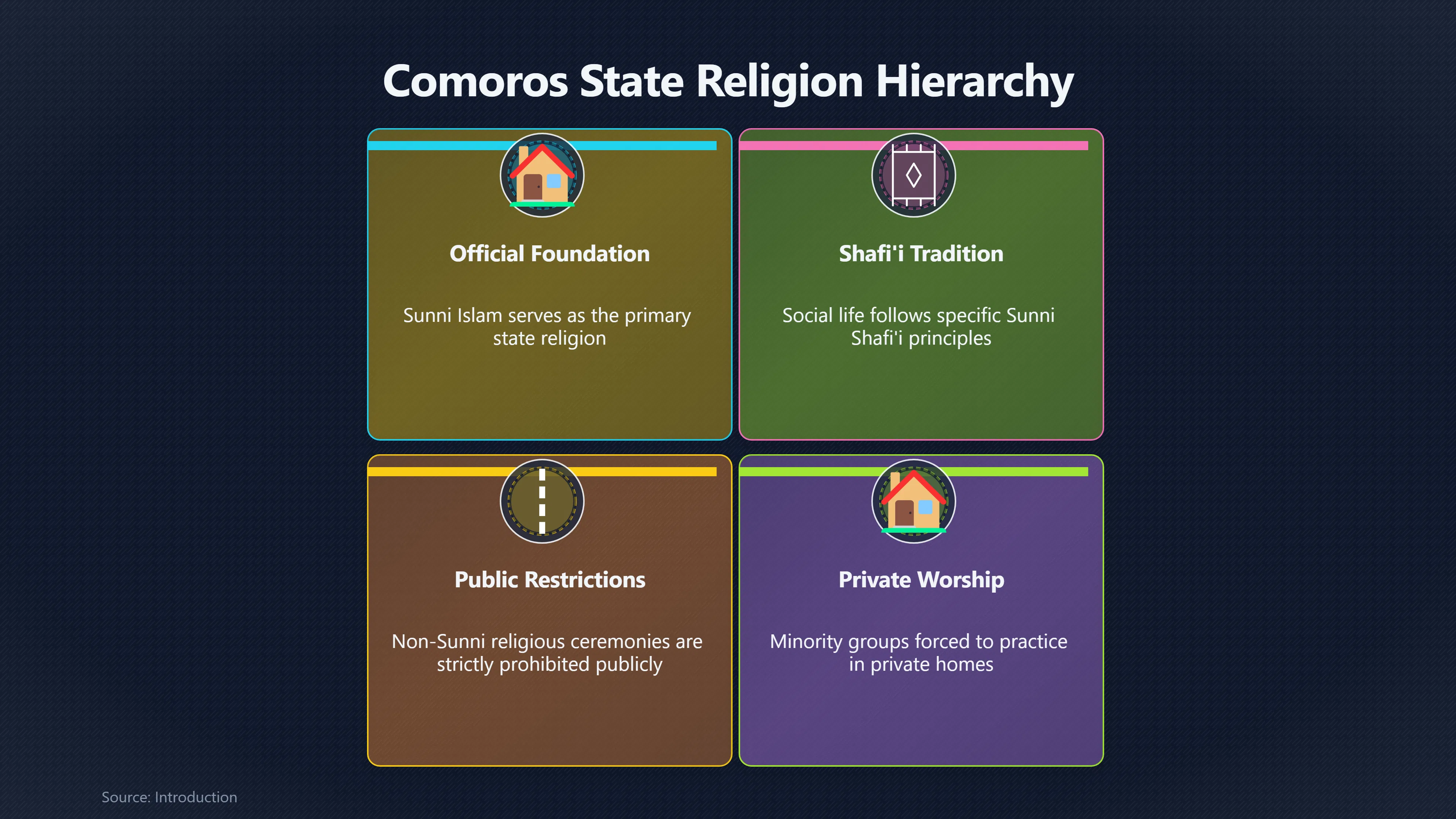
Religion occupies an unusually prominent place in the constitutional identity of Comoros. Constitutional reforms adopted under President Azali Assoumani strengthened the role of Sunni Islam as the state’s official religious foundation. The constitution defines Sunni Islam as the state religion and states that the country’s principles of worship and social life should follow the Sunni Shafi’i tradition, even while also declaring equality before the law regardless of belief.[ecoi.net]ecoi.netUSDOS – US Department of State (Author): “2023 Report on International Religious Freedom: Comoros”, Document #2116198 - ecoi.netJune 26…
This legal framework reflects more than theology. Since independence, Comorian leaders have often argued that religious unity helps preserve national stability in a country that has experienced repeated coups, separatist crises and institutional fragility. In official rhetoric, protecting a common religious identity has therefore been linked to protecting the state itself. Laws banning public non-Sunni religious ceremonies explicitly justify these restrictions as necessary to preserve “society’s cohesion” and “national unity”, illustrating how religious conformity became embedded in public policy rather than remaining a purely religious concern.[ecoi.net]ecoi.netUSDOS – US Department of State (Author): “2023 Report on International Religious Freedom: Comoros”, Document #2116198 - ecoi.netJune 26…
Unlike countries where religious pluralism developed gradually through constitutional debate, Comoros has generally treated visible religious diversity as something requiring careful control. This has encouraged an official assumption that alternative religious movements may introduce foreign political influence or social fragmentation rather than simply representing different forms of worship.[Freedom House]freedomhouse.orgfreedom worldFreedom HouseComoros: Freedom in the World 2024 Country Report | Freedom House…
Why minorities and dissenters drew suspicion
The practical consequences of this approach fall most heavily on religious minorities. Public proselytising is illegal for any religion other than Sunni Islam, while foreigners who engage in missionary activity may be deported. Public religious rituals by non-Sunni groups are prohibited, forcing most minority communities to worship privately.[ecoi.net]ecoi.netUSDOS – US Department of State (Author): “2023 Report on International Religious Freedom: Comoros”, Document #2116198 - ecoi.netJune 26…
The communities most frequently affected include:
- Shia Muslims, who have periodically faced surveillance, restrictions on places of worship and limits on public commemorations.
- Ahmadi Muslims, whose mosque on Anjouan was demolished by local authorities in 2017 and whose community has continued to report difficulties recovering the site.
- Christians, particularly Comorian converts from Islam, who often report practising discreetly because of both legal restrictions and fear of community rejection.
- Foreign non-Muslims, who generally worship with greater freedom provided they avoid attempts to convert Comorian citizens.[ecoi.net]ecoi.netUSDOS – US Department of State (Author): “2023 Report on International Religious Freedom: Comoros”, Document #2116198 - ecoi.netJune 26…
The distinction between law and everyday practice is important. Recent international religious freedom reports note relatively few incidents of direct physical violence by the state. Instead, minority believers commonly describe widespread self-censorship. Religious meetings are frequently held in private homes, and many individuals avoid discussing their beliefs publicly in order to prevent unwanted official attention or social hostility.[ecoi.net]ecoi.netUSDOS – US Department of State (Author): “2023 Report on International Religious Freedom: Comoros”, Document #2116198 - ecoi.netJune 26…
Social pressures reinforce the legal framework. Reports have consistently described community efforts to persuade converts to return to Sunni Islam, while many Christians avoid openly displaying their faith or even eating publicly during Ramadan in order to avoid attracting attention. These pressures are usually informal rather than organised campaigns, but they contribute to an atmosphere in which religious difference remains socially risky.[ecoi.net]ecoi.netUSDOS – US Department of State (Author): “2023 Report on International Religious Freedom: Comoros”, Document #2116198 - ecoi.netJune 26…

Where security policy became moral panic
The most revealing aspect of Comoros’ religious policy is how concerns about security became intertwined with fears of religious deviation.
Officials have repeatedly justified restrictions by arguing that visible religious diversity could encourage extremism, foreign interference or sectarian conflict. During periods of heightened regional tension between Sunni-majority and Shia-majority states in the Middle East, local authorities reportedly increased monitoring of Shia religious events. Although recent years have seen fewer reports of direct surveillance, earlier patterns demonstrate how international geopolitical rivalries influenced domestic perceptions of minority communities.[ecoi.net]ecoi.netUSDOS – US Department of State (Author): “2023 Report on International Religious Freedom: Comoros”, Document #2116198 - ecoi.netJune 26…
Older government reporting also reveals another dimension of official anxiety. Authorities expressed concern that young Comorians studying religion abroad might return with more hard-line interpretations of Islam capable of destabilising local traditions. One response was support for expanding domestic higher education so students would be less dependent on overseas religious training. Here, the perceived threat was not simply terrorism but the possibility that imported religious ideas could disrupt established patterns of religious authority.[Refworld]refworld.orgU.S. Department of State Annual Report on International Religious Freedom for 2005 - Comoros | Refworld…
This illustrates an important distinction. The evidence does not show widespread public panic about secret sects or hidden religious conspiracies. Rather, the concern originated largely within state institutions, where preserving religious uniformity became part of a broader strategy of political control and national integration. In this sense, the “panic” operated primarily through governance rather than spontaneous mass behaviour.
Is the threat supported by evidence?
Evidence for large-scale religious radicalisation inside Comoros remains limited.
International monitoring organisations continue to document legal discrimination against religious minorities, but they generally report relatively low levels of organised religious violence. Recent reports note that Shia religious observances have sometimes proceeded peacefully in private without interference, suggesting that enforcement varies over time and may depend partly on political circumstances and international diplomatic engagement.[ecoi.net]ecoi.netUSDOS – US Department of State (Author): “2023 Report on International Religious Freedom: Comoros”, Document #2116198 - ecoi.netJune 26…
This uneven enforcement complicates simple interpretations. Government officials frame restrictions as preventive measures intended to preserve harmony before conflict emerges. Critics, however, argue that suppressing peaceful religious diversity risks creating suspicion where little evidence of genuine security threats exists. Freedom House and successive international religious freedom assessments have therefore characterised the restrictions as significant limits on freedom of religion rather than necessary responses to documented extremist activity.[Freedom House]freedomhouse.orgfreedom worldFreedom HouseComoros: Freedom in the World 2024 Country Report | Freedom House…
Why this matters in Comoros’ wider history of collective fears
Within the broader history of collective belief in Comoros, religious unity fears differ from stories about spirit possession, sorcery or miracle claims. Those subjects concern shared beliefs held within communities. Religious policy concerns how governments interpret diversity itself as a potential danger.
The result has been a durable political narrative: that maintaining one officially recognised form of Islam protects the nation from instability. Whether viewed as prudent state-building or as an excessive restriction on religious freedom, this approach has shaped public life for decades. It demonstrates how fears of social fragmentation can become institutionalised through constitutions, legislation and everyday administrative practice, even in the absence of widespread public panic or documented campaigns of religious violence.[ecoi.net]ecoi.netUSDOS – US Department of State (Author): “2023 Report on International Religious Freedom: Comoros”, Document #2116198 - ecoi.netJune 26…
Amazon book picks
Further Reading
Books and field guides related to When Religious Difference Became a State Threat. Use these as the next step if you want deeper reading beyond the article.

African religions and philosophy
Places regional religious traditions in wider African context.
Endnotes
1.
Source: ecoi.net
Link:https://www.ecoi.net/en/document/2116198.html
Source snippet
USDOS – US Department of State (Author): “2023 Report on International Religious Freedom: Comoros”, Document #2116198 - ecoi.netJune 26...
2.
Source: refworld.org
Link:https://www.refworld.org/reference/annualreport/usdos/2017/en/118407
Source snippet
2016 Report on International Religious Freedom - Comoros | Refworld...
3.
Source: refworld.org
Link:https://www.refworld.org/reference/annualreport/usdos/2005/en/28853
Source snippet
U.S. Department of State Annual Report on International Religious Freedom for 2005 - Comoros | Refworld...
4.
Source: refworld.org
Link:https://www.refworld.org/reference/annualreport/usdos/2004/26025
Source snippet
U.S. Department of State Annual Report on International Religious Freedom for 2004 - Comoros | Refworld...
5.
Source: ecoi.net
Link:https://www.ecoi.net/en/document/2128482.html
Source snippet
USDOS – US Department of State (Author): “2024 Country Reports on Human Rights Practices: Comoros”, Document #2128482 - ecoi.netAugust 12...
6.
Source: refworld.org
Link:https://www.refworld.org/reference/annualreport/usdos/2016/en/111734
7.
Source: refworld.org
Link:https://www.refworld.org/reference/annualreport/usdos/2015/107681
8.
Source: refworld.org
Link:https://www.refworld.org/reference/annualreport/usdos/2014/100857
9.
Source: refworld.org
Link:https://www.refworld.org/reference/annualreport/usdos/2008/en/62291
10.
Source: refworld.org
Link:https://www.refworld.org/reference/annualreport/usdos/2007/en/49136
11.
Source: refworld.org
Link:https://www.refworld.org/reference/annualreport/usdos/2006/en/38682
12.
Source: refworld.org
Link:https://www.refworld.org/reference/annualreport/usdos/2004/en/26025
13.
Source: refworld.org
Link:https://www.refworld.org/reference/annualreport/usdos/2003/en/8252
14.
Source: 1997-2001.state.gov
Link:https://1997-2001.state.gov/global/human_rights/1999_hrp_report/comoros.html
15.
Source: state.gov
Title: Federated States of Micronesia
Link:https://www.state.gov/reports/2016-report-on-international-religious-freedom/federated-states-of-micronesia
16.
Source: 2021-2025.state.gov
Link:https://2021-2025.state.gov/reports/2023-report-on-international-religious-freedom/morocco/
17.
Source: 2021-2025.state.gov
Link:https://2021-2025.state.gov/report/custom/73cee70f2d/
18.
Source: 2021-2025.state.gov
Title: bab1b5532c 3
Link:https://2021-2025.state.gov/report/custom/bab1b5532c-3/
19.
Source: youtube.com
Title: THIS IS THE ISLAND NATION WITH THE LARGEST 100% MUSLIM POPULATION IN AFRICA
Link:https://www.youtube.com/watch?v=6kzK8jF00z0
Source snippet
Comoros - Minister for Foreign Affairs Addresses UN General Debate, 79th Session | #UNGA...
20.
Source: youtube.com
Link:https://www.youtube.com/watch?v=-LhjAumPrVs
21.
Source: freedomhouse.org
Title: freedom world
Link:https://freedomhouse.org/country/comoros/freedom-world/2024
Source snippet
Freedom HouseComoros: Freedom in the World 2024 Country Report | Freedom House...
22.
Source: freedomhouse.org
Title: freedom world
Link:https://freedomhouse.org/country/comoros/freedom-world/2026
23.
Source: freedomhouse.org
Title: freedom world
Link:https://freedomhouse.org/country/comoros/freedom-world/2023
24.
Source: freedomhouse.org
Title: freedom world
Link:https://freedomhouse.org/country/comoros/freedom-world/2018
25.
Source: freedomhouse.org
Title: freedom world
Link:https://freedomhouse.org/country/comoros/freedom-world/2020
Additional References
26.
Source: legalclarity.org
Title: Religion in Comoros: Legal Status and Religious Freedom
Link:https://legalclarity.org/religion-in-comoros-legal-status-and-religious-freedom/
Source snippet
December 14, 2025 — RELIGION IN COMOROS: LEGAL STATUS AND RELIGIOUS FREEDOM Explore the deep integration of Sunni Islam into...
Published: December 14, 2025
27.
Source: legistorm.com
Title: 2019 report on international religious freedom comoros
Link:https://www.legistorm.com/stormfeed/view_rss/2666784/organization/95126/title/2019-report-on-international-religious-freedom-comoros.html
Source snippet
Department of State Bureau of African Affairs Press release | LegiStormJune 8, 2020 — 2019 REPORT ON INTERNATIONAL RELIGIOUS FREEDOM: COM...
Published: June 8, 2020
28.
Source: researchgate.net
Title: 383123673 2024 Global Religious Recognition Report
Link:https://www.researchgate.net/publication/383123673_2024_Global_Religious_Recognition_Report
Source snippet
(PDF) 2024 Global Religious Recognition ReportAugust 15, 2024 — Conditions of state recognition and registration Protections: Explicit pr...
Published: August 15, 2024
29.
Source: youtube.com
Title: The Least Known Muslim Country In The World
Link:https://www.youtube.com/watch?v=qyQiTed_Ys8
Source snippet
THIS IS THE ISLAND NATION WITH THE LARGEST 100% MUSLIM POPULATION IN AFRICA - COMOROS...
30.
Source: youtube.com
Title: Pray Along Prayercast: COMOROS
Link:https://www.youtube.com/watch?v=dd7rPclW3ik
Source snippet
Unrest rocks Comoros after presidential polls | World Of Africa...
31.
Source: youtube.com
Title: Unrest rocks Comoros after presidential polls | World Of Africa
Link:https://www.youtube.com/watch?v=2TYTEARGpFg
Source snippet
The Least Known Muslim Country In The World...
Topic Tree