When Faith, Fear and Power Reshaped Tonga
Tonga does not have a well-documented equivalent of the Salem witch trials, a European dancing plague or a famous outbreak of mass psychogenic illness.
Page outline Jump by section
Introduction
These episodes were not simply outbreaks of irrational behaviour. They grew from civil war, rivalry between chiefs, foreign missionary competition, fear of political subversion and arguments over what counted as legitimate religion. Belief spread through kinship networks, royal authority, schools, literacy and military victory rather than through newspapers or modern broadcasting. The resulting history shows why terms such as “cult”, “panic” and “mass hysteria” must be used carefully. In Tonga, religious fear often accompanied genuine conflicts over sovereignty, law and social order, even when opponents exaggerated one another’s intentions.[persee.fr]persee.frpersecution of Christian converts by their heathen chiefs. missionariesPerséeThe case of the Wesleyan Mission in TongaJuly 14, 1969 — by S Latukefu · 1969 · Cited by 11 — the movement was a powerful factor in…
When conversion became part of civil war
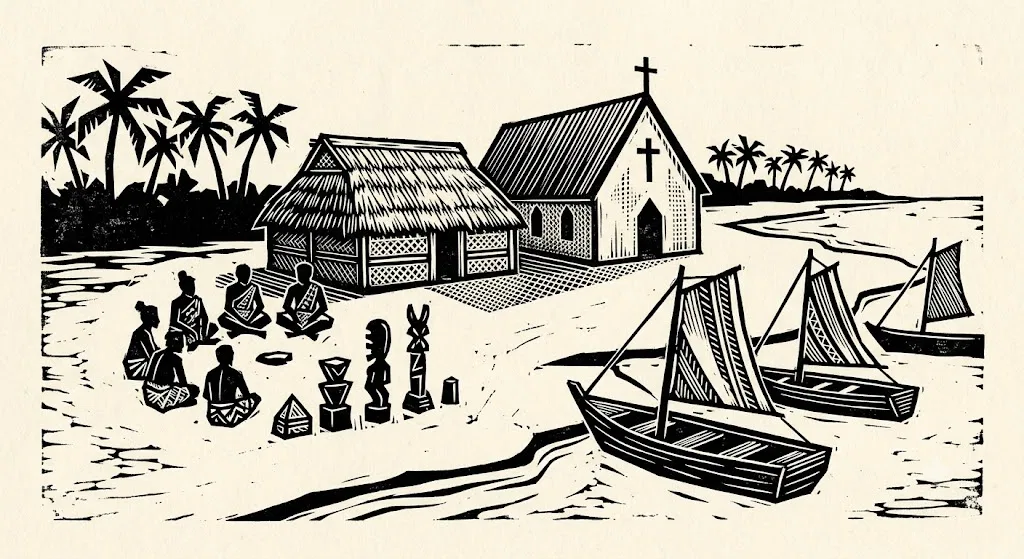
Christian missionaries first attempted to establish themselves in Tonga in the late eighteenth century, but the early missions were insecure. Three members of the London Missionary Society mission were killed amid the civil conflict of 1799–1800, and the remaining missionaries eventually left. Wesleyan Methodists returned more successfully in the 1820s, working in a kingdom already divided by prolonged struggles among chiefly factions.[facebook.com]facebook.comAs Tonga marks 200 years of Christianity, we warmly…During the civil war, in 1799 and 1800, three of the missionaries were kil…
The decisive figure was Tāufaʻāhau, the chief who later became King George Tupou I. His adoption of Wesleyan Christianity was both a religious commitment and part of a wider programme of political consolidation. Conversion gave his followers a new moral language, connections with missionaries and access to literacy, but it also marked political allegiance. Communities that retained older religious practices increasingly appeared not merely unconverted but opposed to the emerging Christian state.[biblicalstudies.org.uk]biblicalstudies.org.ukThey destroyed the objects of their traditional religion, and the houses in which they were…
This mixture of faith and power became especially destructive in 1837. Fighting between Tāufaʻāhau’s Christian forces and opponents centred on fortified settlements on Tongatapu. Wesleyan missionary John Thomas supported the Christian side, while the explorer Peter Dillon later accused the victors and their missionary allies of massacre and religious persecution. Historians still debate responsibility, numbers and motivation because surviving accounts were produced by interested parties: Wesleyans defending their mission, Catholics criticising Protestant aggression, and foreign observers interpreting a complex Tongan war through European sectarian rivalries.[jstor.org]jstor.orgparty who began to persecute Christians and to disruptHoly War: Peter Dillon and the 1837 Massacres in TongaJuly 14, 1977 — by HG Cummins · 1977 · Cited by 13 — They saw the Tongans as a…
The safest conclusion is that the violence cannot be reduced to a simple conflict between “Christianity” and “paganism”. Political loyalties, old grievances and competition for chiefly authority were already present. Christianity sharpened those divisions by giving them an absolute moral form. Enemies could now be described as opponents of divine truth, while military victories appeared to confirm the spiritual power of the winning side. That mechanism resembles a religious panic: danger is interpreted through a totalising belief system, and each act of resistance becomes further proof of the threat. Yet it was also a real civil war, not a collective delusion.[methodist.org.uk]media.methodist.org.ukmissionary history daly tongan civil war 2010establish Christianity in 1796, 1837 Massacres…
The moral remaking of everyday life
Wesleyan conversion did more than change formal worship. Missionaries attempted to regulate recreation, sexuality, clothing, work and the weekly calendar. Historian Sione Latukefu noted that missionaries condemned practices including dancing, sporting activities and smoking because they considered them harmful to Christian discipline. Religious reform therefore entered daily life through rules about respectable behaviour as well as through sermons and baptism.[Persée]persee.frpersecution of Christian converts by their heathen chiefs. missionariesPerséeThe case of the Wesleyan Mission in TongaJuly 14, 1969 — by S Latukefu · 1969 · Cited by 11 — the movement was a powerful factor in…
Objects and places associated with older worship were destroyed or abandoned in some Christian-controlled areas. Missionary narratives presented this as liberation from false gods; a modern social historian is more likely to see a politically supported transformation in which indigenous sacred authority was displaced and surviving practices were reclassified as superstition, heathenism or evil.[biblicalstudies.org.uk]biblicalstudies.org.ukThey destroyed the objects of their traditional religion, and the houses in which they were…
This is important for any history of “witchcraft” or supernatural fear in Tonga. Pre-Christian Tongan religion included gods, ancestral powers, sacred specialists and ideas about an unseen world. These traditions should not automatically be translated into European categories such as devil worship or witchcraft. Much of what early missionaries called darkness, idolatry or magic reflected a hostile Christian description of a different religious system. The source language often reveals the missionary campaign more clearly than it reveals what ordinary Tongans themselves believed.[jstor.org]jstor.orgOpen source on jstor.org.
Royal authority helped make the new moral order durable. The Constitution of 1875 protected freedom of worship, but it also declared the Christian Sabbath sacred. The present constitutional text still guarantees religious practice while stating that worship cannot be used to violate the law or peace of the land, and it continues to require Sunday to be kept holy. Tonga’s religious settlement therefore combines pluralism with an enduring Christian definition of public time.[ago.gov.to]ago.gov.toConstitution of TongaConstitution of Tonga
The anti-Mormon scare of 1922
Tonga’s clearest twentieth-century religious scare concerned the Church of Jesus Christ of Latter-day Saints, whose missionaries had entered the kingdom in the 1890s. The movement established congregations and schools, but it also faced opposition from older churches and political leaders who regarded foreign missionaries with suspicion.[The Church of Jesus Christ]churchofjesuschrist.orgOpen source on churchofjesuschrist.org.
On 29 June 1922, the Legislative Assembly enacted a measure that prohibited members of the Latter-day Saint church from entering Tonga. Historian R. Lanier Britsch’s study of the episode describes extensive discussion involving Tongan officials, British colonial authorities and American representatives. The controversy was therefore not a spontaneous village rumour. It became a formal state response to claims that a religious minority threatened political loyalty and social order.[BYU ScholarsArchive]scholarsarchive.byu.eduOpen source on byu.edu.
Several allegations circulated in support of exclusion. Opponents associated the church with polygamy, disrespect for government and improper claims to exclusive religious authority. Some also feared that American missionaries and their Tongan followers might become instruments of foreign influence at a time when Tonga’s monarchy was navigating internal political tensions and its protected relationship with Britain.[BYU ScholarsArchive]scholarsarchive.byu.eduBYU ScholarsArchiveMormon Intruders in Tonga: The Passport Act of 1922by RL Britsch · 2016 · Cited by 4 — Tonga enacted a law that prohib…
The charge of polygamy was especially powerful because it connected an unfamiliar church with sexual disorder and disobedience. The Latter-day Saint church had officially ended new plural marriages decades earlier, but the older image remained available as a moral warning. This is a common feature of religious panics: a disputed or outdated practice becomes a shorthand for the imagined character of an entire group.
The episode should nevertheless not be treated as a perfect example of baseless mass hysteria. Institutional rivalry was real, Tonga’s leaders did have concerns about foreign influence, and the church actively sought converts in a small society where denominational affiliation carried political and family significance. What made the response panic-like was its disproportionality: a whole religious category was excluded on the assumption that its members shared dangerous beliefs and intentions.[BYU ScholarsArchive]scholarsarchive.byu.eduOpen source on byu.edu.
The prohibition also had an unintended effect. With foreign missionaries restricted, Tongan members assumed more responsibility for congregations and missionary work. The movement survived rather than disappearing, and it later became one of the kingdom’s largest denominations. Tonga’s 2021 census recorded 19,534 Latter-day Saints, about 19.6 per cent of the population, second only to the Free Wesleyan Church.[ilo.org]webapps.ilo.orgOpen source on ilo.org.
Why the “cult” label obscures more than it explains
The groups involved in Tonga’s major religious conflicts were churches, chiefly coalitions and missionary organisations, not secretive apocalyptic communes of the kind often imagined by the word “cult”. Calling nineteenth-century Wesleyans or twentieth-century Latter-day Saints cults would reproduce the language of their opponents rather than analyse what happened.
Three distinctions help clarify the history:
- Religious conflict describes competition over doctrine, converts, land, education and political influence.
- Moral panic describes a reaction in which a group is represented as a serious threat to the social order and exceptional controls appear justified.
- Mass hysteria or mass psychogenic illness usually refers to collectively shared symptoms or behaviour without an identified physical cause. No comparably well-evidenced national Tongan episode appears in the major historical and medical literature.
The 1837 violence belongs primarily to the history of civil war and coercive conversion, although demonising religious language intensified it. The 1922 exclusion fits the moral-panic model more closely because political and denominational anxieties were concentrated upon a minority and converted into a blanket legal restriction. Neither case is best understood as a population suddenly losing contact with reality.
There is also no strong evidence for a large, organised witch-hunting movement in the Kingdom of Tonga comparable to those documented in early modern Europe or parts of modern Melanesia. References to Tongan “witchcraft” are often scattered through missionary descriptions, folklore collections or broad surveys of Pacific religion. Without court records, victim lists or closely documented accusation chains, it would be misleading to manufacture a national witch panic from isolated supernatural beliefs.
What made collective belief powerful in Tonga
Tonga’s scale and social organisation helped religious change travel quickly. Authority was concentrated through chiefly rank, kinship and later the monarchy. When an influential ruler converted, the decision affected dependants, allies and rival communities. Mission schools reinforced the process by connecting Christianity with reading, writing and new routes to social advancement.[persee.fr]persee.frpersecution of Christian converts by their heathen chiefs. missionariesPerséeThe case of the Wesleyan Mission in TongaJuly 14, 1969 — by S Latukefu · 1969 · Cited by 11 — the movement was a powerful factor in…
Military success also acted as persuasive evidence. In a world where political and sacred power were not neatly separated, victory could demonstrate that the Christian God favoured a ruler. Once Tāufaʻāhau’s authority expanded, conversion became increasingly tied to membership in the emerging national order. Belief spread because it was preached, taught and sincerely accepted, but also because it was attached to the victorious state.
Foreign rivalry added another layer. Wesleyan, Catholic and later Latter-day Saint missionaries did not enter a neutral religious marketplace. They accused one another of error, competed for communities and cultivated relationships with political leaders. Catholic settlement at Pea, for example, became entangled with communities resisting Wesleyan influence. European denominational competition could therefore reinforce existing Tongan divisions rather than simply replacing them.[missiontheologyanglican.org]missiontheologyanglican.orgOpen source on missiontheologyanglican.org.
Finally, Tonga’s relative success in preserving its sovereignty made religious regulation part of nation-building. Christianity was not imposed through ordinary colonial annexation. Tongan rulers adopted, adapted and enforced it while constructing a centralised kingdom capable of resisting foreign takeover. This makes the story more complicated than either a missionary triumph or a tale of passive cultural destruction. Tongans were active participants, but their choices were made within unequal relationships involving chiefs, monarchs, missionaries and competing foreign powers.[cambridge.org]cambridge.orgCambridge University Press & AssessmentThe Colonial Era in the Pacific (Part X)11 Nov 2022 — Because of the importance of Christian conve…
From religious monopoly to denominational pluralism
Modern Tonga remains overwhelmingly Christian, but no single denomination controls the entire religious landscape. The 2021 census counted the Free Wesleyan Church at roughly 34.2 per cent of the population, Latter-day Saints at 19.6 per cent, Roman Catholics at 13.7 per cent and the Free Church of Tonga at 11.3 per cent, alongside several smaller Christian and non-Christian communities.[tongastats.gov.to]tongastats.gov.tocensus tablescensus tables
Contemporary religious-freedom assessments generally describe relations among faiths as peaceful. The constitutional protection of worship remains in force, although Sunday restrictions express the continuing privilege of Christian social norms. Religious organisations do not have to register simply to exist, but registration is required for benefits such as tax exemptions and authority to conduct legally recognised marriages.[ago.gov.to]ago.gov.toConstitution of TongaConstitution of Tonga
The contrast with 1922 is striking. A church once formally treated as an imported danger is now a major Tongan institution. That change does not mean the earlier fear was imaginary in every respect; it shows that claims about a group’s permanent disloyalty or incompatibility can collapse as the group becomes locally led, embedded in families and familiar through everyday contact.
Why this history still matters
Tonga’s history warns against searching only for spectacular outbreaks of collective irrationality. The most consequential episodes may look ordinary at first: sermons describing opponents as evil, restrictions defended as protection, royal conversions treated as national destiny, or rumours about a minority converted into law.
The nineteenth-century Christian conflicts show how a new faith can spread through conviction and education while also becoming a weapon of political unification. The anti-Mormon campaign shows how foreignness, sexual suspicion and denominational rivalry can create a moral panic even without frenzied crowds. Together they demonstrate that collective fear becomes most powerful when religious language, state authority and genuine social uncertainty reinforce one another.
They also show why later accounts require caution. Missionary victories were often written as the defeat of superstition, while critics sometimes described all conversion as forced cultural erasure. The evidence supports a more difficult picture: sincere belief, strategic alliance, coercion, resistance and adaptation were present at the same time. Tonga’s experience is therefore less a catalogue of bizarre delusions than a case study in how societies decide which beliefs are sacred, which are dangerous and who has the authority to tell the difference.
Amazon book picks
Further Reading
Books and field guides related to When Faith, Fear and Power Reshaped Tonga. Use these as the next step if you want deeper reading beyond the article.
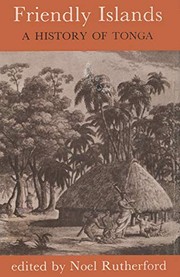

A History of Tonga
Broad coverage of nineteenth-century political and religious history.
Endnotes
1.
Source: media.methodist.org.uk
Title: missionary history daly tongan civil war 2010
Link:https://media.methodist.org.uk/media/documents/missionary-history-daly-tongan-civil-war-2010.pdf
Source snippet
establish Christianity in 1796, 1837 Massacres...
2.
Source: scholarsarchive.byu.edu
Link:https://scholarsarchive.byu.edu/mphs/vol37/iss1/12/
Source snippet
BYU ScholarsArchiveMormon Intruders in Tonga: The Passport Act of 1922by RL Britsch · 2016 · Cited by 4 — Tonga enacted a law that prohib...
3.
Source: facebook.com
Link:https://www.facebook.com/australiaintonga/posts/as-tonga-marks-200-years-of-christianity-we-warmly-congratulate-the-people-of-to/1472419214917408/
Source snippet
As Tonga marks 200 years of Christianity, we warmly...During the civil war, in 1799 and 1800, three of the missionaries were kil...
4.
Source: biblicalstudies.org.uk
Link:https://www.biblicalstudies.org.uk/pdf/mjt/23-1_22.pdf
Source snippet
They destroyed the objects of their traditional religion, and the houses in which they were...
5.
Source: cambridge.org
Link:https://www.cambridge.org/core/books/cambridge-history-of-the-pacific-ocean/colonial-era-in-the-pacific/6E5938229A742552FADB8F5895D1C337
Source snippet
Cambridge University Press & AssessmentThe Colonial Era in the Pacific (Part X)11 Nov 2022 — Because of the importance of Christian conve...
6.
Source: jstor.org
Title: party who began to persecute Christians and to disrupt
Link:https://www.jstor.org/stable/25168277
Source snippet
Holy War: Peter Dillon and the 1837 Massacres in TongaJuly 14, 1977 — by HG Cummins · 1977 · Cited by 13 — They saw the Tongans as a...
Published: July 14, 1977
7.
Source: trove.nla.gov.au
Link:https://trove.nla.gov.au/newspaper/article/31731746
8.
Source: cambridge.org
Title: University Press & Assessment5
Link:https://www.cambridge.org/core/books/unearthly-powers/conversion-of-kings-under-the-conditions-of-immanentism-constantine-to-cakobau/59AD6B30F405C856AC279D680558F1BD
9.
Source: Wikipedia
Title: Tongan religion
Link:https://en.wikipedia.org/wiki/Tongan_religion
10.
Source: jstor.org
Link:https://www.jstor.org/stable/20707392
11.
Source: ago.gov.to
Title: Constitution of Tonga
Link:https://ago.gov.to/cms/images/LEGISLATION/PRINCIPAL/1988/1988-0002/ConstitutionofTonga.pdf_3.pdf
12.
Source: rsc.byu.edu
Title: Religious Studies Center Church Growth in Tonga | Religious Studies Center
Link:https://rsc.byu.edu/regional-studies-latter-day-saint-church-history-pacific-isles/church-growth-tonga
13.
Source: scholarsarchive.byu.edu
Link:https://scholarsarchive.byu.edu/cgi/viewcontent.cgi?article=1355&context=mphs
14.
Source: Wikipedia
Title: The Church of Jesus Christ of Latter-day Saints in Tonga
Link:https://en.wikipedia.org/wiki/The_Church_of_Jesus_Christ_of_Latter-day_Saints_in_Tonga
15.
Source: tongastats.gov.to
Title: census tables
Link:https://tongastats.gov.to/census-2/population-census-3/census-tables/
16.
Source: state.gov
Link:https://www.state.gov/reports/2023-report-on-international-religious-freedom/tonga
17.
Source: missiontheologyanglican.org
Link:https://www.missiontheologyanglican.org/article-mt/church-history-and-the-catholic-church-mission-in-tonga-looking-afresh-early-missionary-approaches/
18.
Source: jstor.org
Link:https://www.jstor.org/content/pdf/oa_book_monograph/j.ctt2jbhxk
19.
Source: jstor.org
Link:https://www.jstor.org/stable/pdf/43041541.pdf
20.
Source: jstor.org
Link:https://www.jstor.org/stable/pdf/23605827.pdf
21.
Source: jstor.org
Link:https://www.jstor.org/stable/pdf/j.ctt19jcg63.pdf
22.
Source: jstor.org
Link:https://www.jstor.org/content/pdf/oa_book_monograph/10.2307/j.ctvp2n4g9.pdf
23.
Source: jstor.org
Link:https://www.jstor.org/content/pdf/oa_book_monograph/10.2307/j.ctt1gk08c5.pdf
24.
Source: jstor.org
Link:https://www.jstor.org/content/pdf/oa_book_monograph/10.2307/j.ctt9qfkzh.pdf
25.
Source: resolve.cambridge.org
Title: the ideological world remade
Link:https://resolve.cambridge.org/core/services/aop-cambridge-core/content/view/AB84B86A4013D88FC5F01365C7474FCD/9781139055574c12_p397-438_CBO.pdf/the-ideological-world-remade.pdf
26.
Source: cambridge.org
Link:https://www.cambridge.org/core/books/decolonisation-and-the-pacific/introduction/8986D6E9683A90708FB171E1E2E709BF
27.
Source: cambridge.org
Link:https://www.cambridge.org/core/books/unearthly-powers/religion-as-the-fabric-of-the-state/A703A5C4ECA136224EF7E4C097C52131
28.
Source: cambridge.org
Link:https://www.cambridge.org/core/books/cambridge-history-of-the-pacific-ocean/authority-identity-and-place-in-the-pacific-ocean-and-its-hinterlands-c-1200-to-c-2000/D26AEBAB8832255D30D58C58E12E7C38
29.
Source: cambridge.org
Link:https://www.cambridge.org/core/books/unearthly-powers/two-forms-of-sacred-kingship-divinisation-and-righteousness/9B267C7754F23A7A9E5AEA7C552DA142
30.
Source: cambridge.org
Title: Oceania (Eleven)
Link:https://www.cambridge.org/core/books/sacred-mountains-of-the-world/oceania/5FEBFDC4F4E311C3CE06EF428FD50A79
31.
Source: cambridge.org
Title: Cases (Part II)
Link:https://www.cambridge.org/core/books/converting-rulers/cases/B827122FFD493AAA64632CAC948948BB/core-reader
32.
Source: cambridge.org
Link:https://www.cambridge.org/core/books/decolonisation-and-the-pacific/saltwater-the-separation-of-people-and-territory/1927CEBC2272645E87C034690E73A0D4
33.
Source: facebook.com
Link:https://www.facebook.com/smithsonianmagazine/posts/fueled-by-xenophobia-religious-extremism-and-long-brewing-social-tensions-the-wi/702684705057056/
34.
Source: facebook.com
Link:https://www.facebook.com/groups/batonga/posts/10160308469964258/
35.
Source: facebook.com
Link:https://www.facebook.com/groups/Pacificnewsroom/posts/1798245710762257/
36.
Source: facebook.com
Link:https://www.facebook.com/100063477886576/posts/tongan-witchcraft-women-/1637415141717733/
37.
Source: facebook.com
Link:https://www.facebook.com/groups/batonga/posts/10161467745404258/
38.
Source: facebook.com
Link:https://www.facebook.com/PeopleDailyKe/posts/two-arrested-over-witchcraft-rumours-that-sparked-mob-attack-on-evangelistspdupd/1590739769724236/
39.
Source: facebook.com
Link:https://www.facebook.com/100090398382151/posts/one-of-the-worlds-biggest-earthquakes-endtimes-earthquake-bible-prophecy-tsunami/717511624605444/
40.
Source: facebook.com
Link:https://www.facebook.com/groups/309364629155920/posts/4789578561134482/
41.
Source: facebook.com
Link:https://www.facebook.com/groups/batonga/posts/10158945158689258/
42.
Source: facebook.com
Link:https://www.facebook.com/apostleamoakoattah/posts/two-months-ago-in-prophecy-the-lord-revealed-to-me-of-a-tsunami-coming-and-i-spo/1393150976147783/
43.
Source: facebook.com
Link:https://www.facebook.com/groups/700425253919996/posts/1803825383579972/
44.
Source: facebook.com
Link:https://www.facebook.com/tongastats/posts/%EF%B8%8F-stats-of-the-week-religion-in-tonga%EF%B8%8Fwondering-about-religious-affiliations-in-/875807547920115/
45.
Source: facebook.com
Title: the holy wars of tonga in 1837new episode of the offside show every monday
Link:https://www.facebook.com/plus64studio/videos/the-holy-wars-of-tonga-in-1837new-episode-of-the-offside-show-every-monday/3150432308452934/
46.
Source: Wikipedia
Title: List of mass panic cases
Link:https://en.wikipedia.org/wiki/List_of_mass_panic_cases
47.
Source: Wikipedia
Title: Witch trials in the early modern period
Link:https://en.wikipedia.org/wiki/Witch_trials_in_the_early_modern_period
48.
Source: Wikipedia
Link:https://en.wikipedia.org/wiki/Apocalypticism
49.
Source: Wikipedia
Title: Religion in Tonga
Link:https://en.wikipedia.org/wiki/Religion_in_Tonga
50.
Source: 2009-2017.state.gov
Link:https://2009-2017.state.gov/j/drl/rls/irf/2006/71360.htm
51.
Source: 2009-2017.state.gov
Link:https://2009-2017.state.gov/documents/organization/171675.pdf
52.
Source: 2009-2017.state.gov
Link:https://2009-2017.state.gov/j/drl/rls/irf/2001/5739.htm
53.
Source: ago.gov.to
Link:https://ago.gov.to/cms/images/LEGISLATION/PRINCIPAL/1964/1964-0010/PassportAct_3.pdf
54.
Source: nationalarchives.gov.uk
Link:https://www.nationalarchives.gov.uk/education/resources/early-modern-witch-trials/
55.
Source: ons.gov.uk
Link:https://www.ons.gov.uk/peoplepopulationandcommunity/culturalidentity/religion/bulletins/religionenglandandwales/census2021
57.
Source: persee.fr
Title: persecution of Christian converts by their heathen chiefs. missionaries
Link:https://www.persee.fr/doc/jso_0300-953x_1969_num
Source snippet
PerséeThe case of the Wesleyan Mission in TongaJuly 14, 1969 — by S Latukefu · 1969 · Cited by 11 — the movement was a powerful factor in...
Published: July 14, 1969
58.
Source: faolex.fao.org
Link:https://faolex.fao.org/docs/pdf/ton132921.pdf
59.
Source: fot.humanists.international
Title: Freedom of Thought Report Tonga
Link:https://fot.humanists.international/countries/oceania-polynesia/tonga/
60.
Source: churchofjesuschrist.org
Link:https://www.churchofjesuschrist.org/learn/facts-statistics/tonga?lang=eng
61.
Source: webapps.ilo.org
Link:https://webapps.ilo.org/surveyLib/index.php/catalog/8238/variable/FA_TON_CENSUS_2021_FULL/VA42?name=religion
62.
Source: healthline.com
Title: mass hysteria
Link:https://www.healthline.com/health/mental-health/mass-hysteria
63.
Source: digitalcollections.sit.edu
Link:https://digitalcollections.sit.edu/cgi/viewcontent.cgi?article=1546&context=isp_collection
64.
Source: ehrafworldcultures.yale.edu
Link:https://ehrafworldcultures.yale.edu/cultures/ou09/documents/068
Additional References
65.
Source: youtube.com
Title: This Tiny Island Has More Mormons Than Utah — Here’s Why
Link:https://www.youtube.com/watch?v=eEk4l0s5I_8
Source snippet
How a Small Island Became One of the Most Mormon Places on Earth...
66.
Source: youtube.com
Title: How a Small Island Became One of the Most Mormon Places on Earth
Link:https://www.youtube.com/watch?v=zDQA46eaNME
Source snippet
Tales of Taonga - the Tongan goddess Hikule'o...
67.
Source: academia.edu
Link:https://www.academia.edu/34723074/The_Quest_for_the_Historical_Jesus_in_Tonga
68.
Source: academia.edu
Link:https://www.academia.edu/115246955/Tonga_religious_life_in_the_twentieth_century
69.
Source: researchgate.net
Link:https://www.researchgate.net/publication/354930137_Blaming_the_father_witchcraft_de-industrialisation_and_generation_in_South_Africa
70.
Source: passport-collector.com
Link:https://www.passport-collector.com/a-rare-kingdom-of-tonga-passport/
71.
Source: scribd.com
Link:https://www.scribd.com/document/624995540/23
72.
Source: sapiens.org
Link:https://www.sapiens.org/teaching-unit/colonialism-and-christianity-in-the-south-pacific/
73.
Source: reddit.com
Link:https://www.reddit.com/r/history/comments/4o8dkd/examples_of_mass_hysteria_through_the_ages/
74.
Source: instagram.com
Link:https://www.instagram.com/reel/DMt6qbpMqcr/
Topic Tree
Follow this branch
Related pages 192
- Antigua and Barbuda
- Argentina Belief Scares
- Azerbaijan Belief
- Bahrain Beliefs
- North Korea
- +187 more in sidebar