Within Gabon
What Is Proven About Gabon's Ritual Killings?
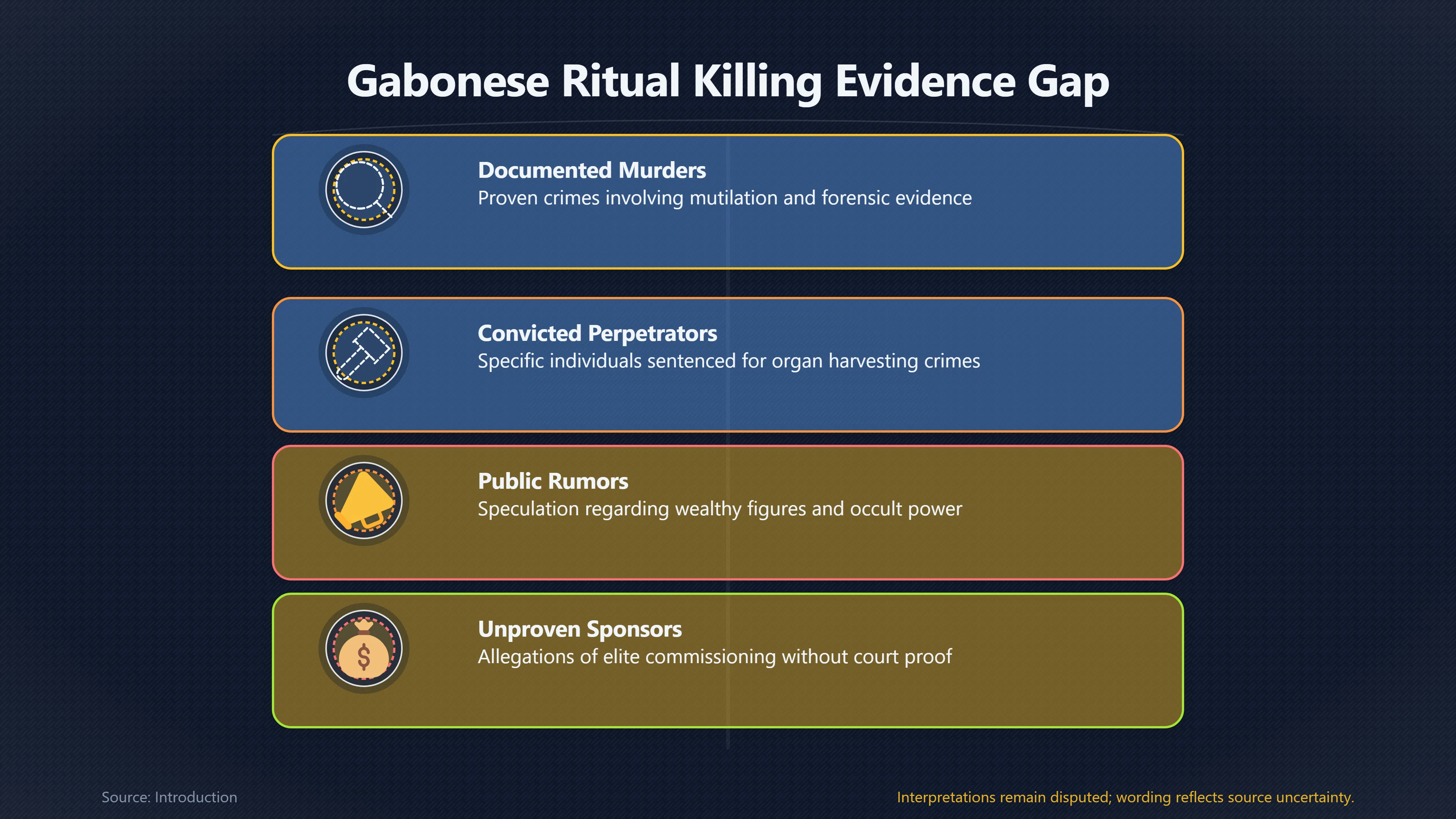
Documented mutilation murders fed wider claims about occult sponsors, especially during elections, but many accusations remain unproved.
On this page
- Documented murders and criminal investigations
- How election rumours widened public fear
- Why proven crimes and alleged sponsors differ
Page outline Jump by section
Introduction
Ritual killings are one of Gabon’s most sensitive and disputed public issues because they combine two very different kinds of evidence. On one hand, there are documented murders in which victims were found mutilated, criminal investigations were opened, and some perpetrators were convicted. On the other hand, there are persistent claims that powerful political or business figures secretly commission such crimes for occult purposes, especially during election periods. The first category is supported by police investigations, court cases and human rights reporting. The second is far harder to prove and often rests on rumours, witness allegations or public suspicion rather than evidence tested in court. Understanding this distinction is essential for explaining both the reality of ritual crime and the wider climate of fear it has created in Gabon.
What is firmly documented?
The existence of ritual killings in Gabon is not simply a rumour. For many years, human rights reports have documented murders in which bodies were discovered with organs or other body parts removed, often involving children. These reports consistently describe such crimes as a serious law enforcement problem rather than folklore.[Refworld]refworld.org2009 Country Reports on Human Rights Practices - Gabon | RefworldMarch 11, 2010…
Reports by the United States Department of State, drawing partly on information from the Gabonese NGO Association to Fight Ritual Crimes (Association de Lutte Contre les Crimes Rituels, ALCR), repeatedly recorded victims of ritual killings while noting that many additional cases may never reach official statistics because they are either not reported or are classified differently. The reports also observed that investigations often failed to result in prosecutions, particularly during the late 2000s and early 2010s.[Refworld]refworld.org2010 Country Reports on Human Rights Practices - Gabon | RefworldApril 8, 2011…
Several criminal cases demonstrate that courts have treated ritual killings as ordinary murder cases supported by forensic and testimonial evidence rather than by claims about supernatural forces. For example:
- In 2012, Aristide Pambo Moussounda was convicted and sentenced to life imprisonment for murdering 12-year-old Beverly Bilemba Mouenguela.
- In 2014, Jacques Bitsi received a lengthy prison sentence after being convicted of murdering Lena Marcelle and removing internal organs from her body.
- More recent human rights reporting notes further life sentences under legislation specifically criminalising ritual killing and organ harvesting.[Refworld]refworld.org2014 Country Reports on Human Rights Practices - Gabon | RefworldJune 25, 2015…
These convictions establish that some murders involving deliberate mutilation have been proven in court.
How election rumours widened public fear
While documented murders are real, public discussion in Gabon has often gone much further than the evidence available in individual criminal cases.
Periods surrounding elections have repeatedly seen rumours that wealthy or politically connected individuals obtain human body parts to gain power, wealth or electoral success through occult practices. These beliefs draw upon broader Central African ideas linking hidden spiritual power with political authority and unexplained success. Because mutilated bodies are genuine crime scenes, they become powerful symbols that appear to confirm existing suspicions about elites.
Public concern became especially visible after a series of highly publicised killings prompted demonstrations in Libreville during 2013. Protesters demanded stronger investigations and greater political accountability, reflecting widespread distrust of state institutions as much as fear of the crimes themselves. President Ali Bongo publicly promised tougher action against those responsible.[Trust.org]news.trust.org20130608115255 g0ihnsenator arrested in ritual killing caseJune 8, 2013…
Human rights organisations also noted that public confidence suffered because many cases remained unsolved or progressed slowly through the courts. In such circumstances, speculation frequently filled the information gap left by incomplete investigations.[Refworld]refworld.org2011 Country Reports on Human Rights Practices - Gabon | Refworld…
Why proven crimes and alleged sponsors are different questions
The greatest evidence divide concerns the alleged sponsors of ritual killings.
Many Gabonese believe influential politicians, senior officials or wealthy business figures commission murders carried out by intermediaries. This belief has been reinforced by occasional testimony from convicted offenders claiming they acted on behalf of more powerful individuals.
The best-known example involved former senator Gabriel Eyeghe Ekomie. After a convicted murderer alleged during his trial that the killing had been carried out on the senator’s instructions, investigators questioned and later arrested the senator. However, the case illustrates why suspicion and proof are not the same. The senator was ultimately released because prosecutors did not have sufficient evidence to sustain the allegations, and no court convicted him of organising the crime.[Trust.org]news.trust.org20130608115255 g0ihnsenator arrested in ritual killing caseJune 8, 2013…
This distinction matters because:
- The murder itself may be proven. A victim exists, forensic evidence can be examined, and perpetrators may be convicted.
- The alleged sponsor may remain unproven. Testimony from one defendant or widespread public belief does not automatically establish criminal responsibility.
- Political distrust can magnify rumours. Where confidence in police and courts is weak, unresolved cases easily become associated with broader accusations against governing elites.
For this reason, journalists and researchers generally distinguish between documented ritual murders and claims about hidden organisers unless courts or independently verifiable evidence establish the latter.
Why the evidence gap persists
Several factors make these cases unusually difficult to investigate.
First, many crimes occur in isolated areas where forensic resources are limited. Crime scenes may be disturbed before investigators arrive, reducing the quality of physical evidence.
Second, witnesses may fear retaliation, particularly if they believe influential people are involved. Even where no elite involvement is proven, that perception alone can discourage testimony.
Third, prolonged delays in investigations or trials encourage alternative explanations. When official information is scarce, rumours circulate through families, local communities and increasingly through social media, where dramatic claims spread more quickly than verified facts.
Finally, organisations documenting ritual crimes have often argued that official figures underestimate the true scale of the problem because some disappearances or suspicious deaths are never classified as ritual killings. Human rights reports acknowledge this possibility while also noting that exact numbers remain uncertain.[refworld.org]refworld.org2011 Country Reports on Human Rights Practices - Gabon | Refworld…
What historians and social scientists emphasise
Researchers studying Central African politics generally do not dismiss popular fears as simple superstition. Instead, they argue that beliefs about occult power often reflect genuine concerns about inequality, corruption and the hidden exercise of authority.
In this interpretation, reports of ritual killings become socially powerful because they connect visible crimes with deeper anxieties about how wealth and political influence are obtained. Even when specific accusations cannot be proved, the rumours reveal widespread mistrust of institutions and perceptions that justice operates unevenly.
This approach does not validate allegations against unnamed sponsors. Rather, it explains why documented murders can generate much broader narratives that persist long after individual criminal cases have ended.
The central lesson
The evidence surrounding Gabon’s ritual killings falls into two clearly different categories.
The first consists of documented murders involving mutilation, criminal investigations and a number of successful prosecutions. These crimes are established historical facts.
The second consists of allegations that powerful individuals secretly ordered or benefited from such killings. Although these claims have repeatedly influenced public opinion, especially during politically tense periods, only a small number have ever reached court, and many have not been supported by sufficient evidence to secure convictions.
Keeping these categories separate allows the issue to be understood without minimising either the reality of the murders or the uncertainty surrounding many of the wider accusations that have grown around them.
Amazon book picks
Further Reading
Books and field guides related to What Is Proven About Gabon's Ritual Killings?. Use these as the next step if you want deeper reading beyond the article.
African Religions A Very Short Introduction
Explains indigenous belief systems often misunderstood by colonial authorities.
The Lucifer Effect
Explores how violence can emerge within social and institutional settings.


African traditional religions in contemporary society
First published 1991. Subjects: Religion, Study and teaching, Congresses, Étude et enseignement, PRO Shaw, Gwendolyn Dubois, 1968- (donor).
Endnotes
1.
Source: refworld.org
Link:https://www.refworld.org/reference/annualreport/usdos/2010/72371
Source snippet
2009 Country Reports on Human Rights Practices - Gabon | RefworldMarch 11, 2010...
Published: March 11, 2010
2.
Source: refworld.org
Link:https://www.refworld.org/reference/annualreport/usdos/2012/86488
Source snippet
2011 Country Reports on Human Rights Practices - Gabon | Refworld...
3.
Source: ecoi.net
Link:https://www.ecoi.net/en/document/2089482.html
Source snippet
USDOS – US Department of State (Author): “2022 Country Report on Human Rights Practices: Gabon”, Document #2089482 - ecoi.net...
4.
Source: refworld.org
Link:https://www.refworld.org/reference/annualreport/usdos/2011/en/78707
Source snippet
2010 Country Reports on Human Rights Practices - Gabon | RefworldApril 8, 2011...
Published: April 8, 2011
5.
Source: 2017-2021.state.gov
Link:https://2017-2021.state.gov/reports/2016-country-reports-on-human-rights-practices/gabon/
Source snippet
United States Department of State...
6.
Source: refworld.org
Link:https://www.refworld.org/reference/annualreport/usdos/2015/en/105973
Source snippet
2014 Country Reports on Human Rights Practices - Gabon | RefworldJune 25, 2015...
Published: June 25, 2015
7.
Source: news.trust.org
Title: 20130608115255 g0ihn
Link:https://news.trust.org/item/20130608115255-g0ihn
Source snippet
senator arrested in ritual killing caseJune 8, 2013...
Published: June 8, 2013
8.
Source: ecoi.net
Link:https://www.ecoi.net/en/document/1456242.html
9.
Source: ecoi.net
Link:https://www.ecoi.net/en/document/1394732.html
10.
Source: refworld.org
Link:https://www.refworld.org/reference/annualreport/usdos/2017/en/116414
11.
Source: news.trust.org
Title: 20150127163809 nkr9r
Link:https://news.trust.org/item/20150127163809-nkr9r
12.
Source: ecoi.net
Link:https://www.ecoi.net/en/document/1034774.html
13.
Source: ecoi.net
Link:https://www.ecoi.net/en/document/1343553.html
14.
Source: ecoi.net
Link:https://www.ecoi.net/en/document/1311042.html
15.
Source: refworld.org
Link:https://www.refworld.org/reference/annualreport/amnesty/1995/en/20617
16.
Source: 2021-2025.state.gov
Link:https://2021-2025.state.gov/reports/2017-country-reports-on-human-rights-practices/gabon/
17.
Source: ritualkillinginafrica.org
Link:https://www.ritualkillinginafrica.org/category/libreville/
Additional References
18.
Source: gabonreview.com
Link:https://www.gabonreview.com/les-crimes-rituels-au-gabon-louvrage-qui-bouscule-les-consciences-et-la-justice/
Source snippet
July 21, 2024 — «LES CRIMES RITUELS AU GABON»: L’OUVRAGE QUI BOUSCULE LES CONSCIENCES ET LA JUSTICE poste par Brice GOTOA / 21 juillet...
Published: July 21, 2024
19.
Source: c3rd.fr
Title: Publication: “La protection des enfants face aux crimes rituels au Gabon”
Link:https://www.c3rd.fr/la-protection-des-enfants-face-aux-crimes-rituels-au-gabon/
Source snippet
Publication: "La protection des enfants face aux crimes rituels au Gabon"July 4, 2026 — LA PROTECTION DES ENFANTS FACE AUX CRIMES...
Published: July 4, 2026
20.
Source: youtube.com
Title: Gabon: le spectre des “crimes rituels” ressurgit
Link:https://www.youtube.com/watch?v=-kus1e1YTWo
Source snippet
Money Rituals: Africa's Deadliest Taboo - BBC Africa Eye Documentary...
21.
Source: fnac.com
Link:https://www.fnac.com/livre-numerique/a21563413/Association-de-lutte-contre-les-crimes-r-Les-crimes-rituels-au-Gabon
22.
Source: africa-press.net
Link:https://www.africa-press.net/gabon/culture-et-art/les-crimes-rituels-au-gabon-approche-criminologique-et-judiciaire-du-phenomene-louvrage-diagnostic-du-dr-eddy-minang
23.
Source: youtube.com
Title: The terrifying reality of ritual crimes in Gabon
Link:https://www.youtube.com/watch?v=gE2S08HVUmQ
Source snippet
Gabon: le spectre des "crimes rituels" ressurgit...
24.
Source: gabonreview.com
Link:https://www.gabonreview.com/gabon-aux-sources-crimes-dits-rituels/
25.
Source: youtube.com
Title: Gabon, Lutte contre les crimes rituels
Link:https://www.youtube.com/watch?v=hNWMsAVb1IU
Source snippet
Tackling Ritual Killings and Yahoo-Yahoo in Nigeria...
26.
Source: youtube.com
Title: Money Rituals: Africa’s Deadliest Taboo
Link:https://www.youtube.com/watch?v=EjDe1D8NlOY
Source snippet
Gabon, Lutte contre les crimes rituels...
27.
Source: epi-revel.univ-cotedazur.fr
Title: fr La protection des enfants face aux crimes rituels au Gabon · epi-revel
Link:https://epi-revel.univ-cotedazur.fr/publication/item/2836
Topic Tree