Within Saint Lucia
Why Are Occult Objects Still Banned?
Saint Lucia decriminalised obeah yet still bans many occult-linked imports, leaving an unresolved conflict between liberty and control.
On this page
- What changed when obeah was decriminalised
- How customs law still restricts occult materials
- Freedom of religion, fraud and demonstrable harm
Page outline Jump by section
Introduction
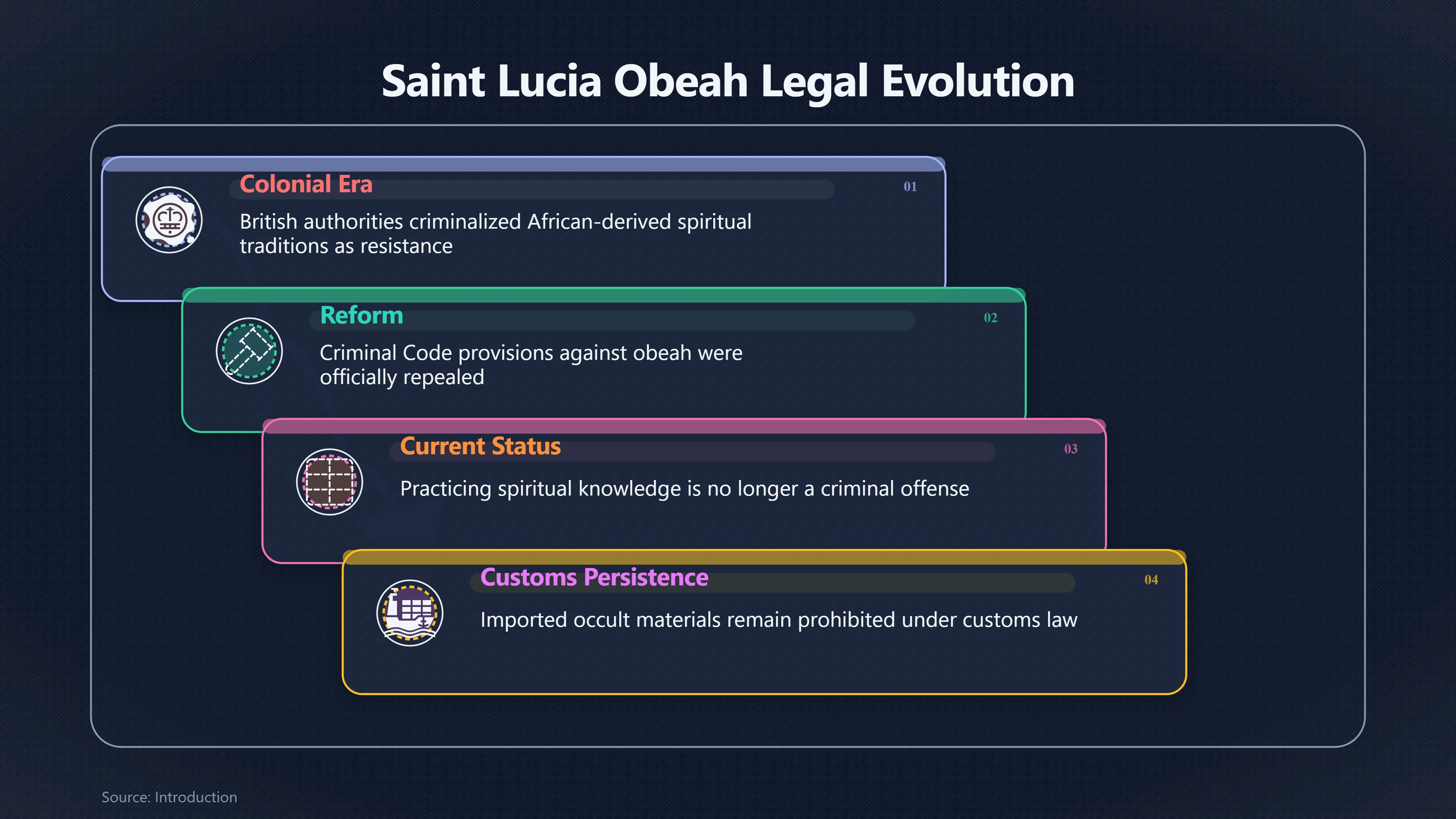
Saint Lucia removed the criminal offences relating to obeah in 2004, ending the long-standing practice of prosecuting people simply for engaging in spiritual practices labelled as “obeah”. Yet one striking legal restriction survived. Under the country’s customs legislation, publications, articles and other materials associated with “black magic, secret magic, obeah, witchcraft or other magical arts and occultism” remain prohibited imports. As a result, a person may no longer commit a criminal offence merely by practising obeah, but imported objects connected with those practices can still be seized by Customs. This apparent contradiction reflects the way different parts of Saint Lucia’s legal system evolved rather than a single modern policy decision. It also illustrates an unresolved debate over religious freedom, consumer protection and the state’s role in regulating objects believed to have spiritual significance.[Attorney General Chambers]attorneygeneralchambers.comOpen source on attorneygeneralchambers.com.
What changed when obeah was decriminalised?
The repeal of the Criminal Code provisions against obeah marked an important shift away from colonial-era criminalisation of African-derived spiritual traditions. The change recognised that merely practising or claiming spiritual knowledge should not, by itself, be treated as a criminal offence.
However, the reform was relatively narrow. It removed criminal offences but did not comprehensively review every law in which colonial assumptions about occult practices appeared. The Customs (Control and Management) Act therefore continued to list occult-related materials among prohibited imports, leaving two different legal approaches operating at the same time.[Attorney General Chambers]attorneygeneralchambers.comOpen source on attorneygeneralchambers.com.
For many legal commentators, this is less a deliberate attempt to recriminalise spiritual practice than an example of legislative inheritance. Caribbean legal systems often contain older customs schedules that have remained largely unchanged for decades while criminal law has been modernised separately.
How customs law still restricts occult materials
Saint Lucia’s prohibited imports schedule contains unusually broad wording. It bans:
“All publications, articles or other matter associated with black magic, secret magic obeah, witchcraft or other magical arts and occultism.”
The wording does not distinguish between:
- books explaining occult beliefs;
- ritual objects;
- symbolic items;
- objects intended for religious or spiritual ceremonies;
- commercial products marketed for magical purposes.
Instead, the prohibition is framed around association with occult practices rather than any demonstrated physical danger. The same schedule also prohibits clearly different categories such as narcotics, counterfeit currency and obscene material, reflecting an older legislative approach in which perceived moral threats sat alongside public health and security risks.[Attorney General Chambers]attorneygeneralchambers.comOpen source on attorneygeneralchambers.com.
In practice, customs officers have considerable discretion because the legislation does not define precisely what qualifies as an article associated with occultism. That creates uncertainty for importers and raises questions about consistency of enforcement.
Why the prohibition was never simply about dangerous objects
Unlike restrictions on firearms, explosives or controlled drugs, the occult import ban is not based on an object’s inherent physical risk.
Historically, laws of this kind reflected several overlapping concerns:
- Colonial suspicion of African-derived religions. British colonial governments frequently treated obeah as a source of deception, disorder or resistance rather than as a legitimate religious tradition.
- Christian moral assumptions. Legislators often regarded magical texts and ritual objects as spiritually harmful even where no physical injury could be demonstrated.
- Fear of fraud. Authorities were concerned that imported ritual materials might be used by people claiming supernatural powers to obtain money or manipulate vulnerable clients.
- Public order. Earlier governments sometimes believed that suppressing occult practices would reduce social conflict arising from accusations of curses or spiritual attacks.
These historical assumptions became embedded in customs schedules and often survived long after the wider legal philosophy changed.[Attorney General Chambers]attorneygeneralchambers.comOpen source on attorneygeneralchambers.com.
Freedom of religion versus protection from fraud
The modern debate is not really about whether magic is real. Instead, it concerns how far the state should regulate beliefs and symbolic objects.
Those who favour removing the customs prohibition generally argue that:
- spiritual books and ritual objects are forms of religious or cultural expression;
- governments should regulate harmful conduct rather than beliefs;
- banning symbolic objects is difficult to reconcile with constitutional protections for freedom of conscience and religion.
Those who favour retaining some restriction usually emphasise different concerns:
- imported materials may be marketed alongside fraudulent claims of supernatural powers;
- vulnerable people can be financially exploited by individuals claiming magical abilities;
- governments have a legitimate interest in preventing deception even where belief itself is protected.
The important distinction is that fraud can already be prosecuted using ordinary criminal law. Critics therefore question whether a separate ban on occult-associated objects remains necessary when existing laws already address demonstrable harm.
Why the issue continues to matter
The surviving customs prohibition has attracted renewed attention because it appears increasingly out of step with Saint Lucia’s wider legal framework. Public discussion intensified after customs enforcement involving imported occult-related objects demonstrated that the prohibition is not merely a forgotten historical provision but can still be invoked in practice. That has highlighted the gap between decriminalising spiritual practice and continuing to regulate imported objects associated with it.[customs.gov.lc]customs.gov.lcSaint Lucia Customs & Excise DepartmentSaint Lucia Customs & Excise Department
For historians of religion and moral panic, the continuing ban illustrates how legal systems can preserve older fears even after the beliefs that originally justified them have weakened. Colonial anxieties about obeah as a hidden social danger no longer dominate criminal law, yet traces of those assumptions remain embedded in customs legislation.
An unresolved legal contradiction
Saint Lucia today occupies an unusual middle ground. A person is no longer criminally liable simply for practising obeah, but customs legislation still treats many occult-associated imports as prohibited goods. This creates an unresolved tension between two principles:
- Individual liberty, including freedom of belief and religious practice.
- Government regulation, aimed at preventing fraud and protecting the public from activities viewed as socially harmful.
Whether that contradiction should be resolved by repealing the customs prohibition, narrowing it to fraudulent commercial practices, or retaining it as a symbolic safeguard remains a matter of legal and political judgement. What is clear is that the current law reflects both the country’s colonial legal inheritance and its ongoing effort to balance religious freedom with public protection in a society where beliefs about spiritual power continue to carry cultural significance.

Amazon book picks
Further Reading
Books and field guides related to Why Are Occult Objects Still Banned?. Use these as the next step if you want deeper reading beyond the article.

Obeah and other powers
Explains the colonial legal legacy behind surviving restrictions.
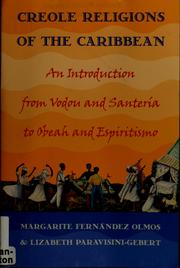
Creole religions of the Caribbean
Discusses Caribbean magical and religious traditions.
The fear of French negroes
First published 2012. Subjects: Blacks, Influence, Migrations, Race identity, History.
Endnotes
1.
Source: customs.gov.lc
Title: Saint Lucia Customs & Excise Department
Link:https://customs.gov.lc/travel-information/prohibited-imports
2.
Source: customs.gov.lc
Link:https://www.customs.gov.lc/uploads/customs_control_and_management_act_cap_15_05_f1ec58be23.pdf
3.
Source: stlucia.gov.lc
Link:https://www.stlucia.gov.lc/visiting-saint-lucia
5.
Source: customs.gov.lc
Link:https://customs.gov.lc/travel-information/restrictions-imports-exports
6.
Source: customs.gov.lc
Link:https://www.customs.gov.lc/returning-nationals/exemptions-household
7.
Source: asycuda.customs.gov.lc
Link:https://asycuda.customs.gov.lc/portal/services/tariff/hs6.jsf?c=9999
8.
Source: aw.customs.gov.lc
Link:https://aw.customs.gov.lc/portal/services/tariff/hs6.jsf?c=9999
9.
Source: attorneygeneralchambers.com
Link:https://attorneygeneralchambers.com/laws-of-saint-lucia/customs-control-and-management-act/part-1-prohibited-imports
10.
Source: attorneygeneralchambers.com
Link:https://attorneygeneralchambers.com/laws-of-saint-lucia/customs-control-and-management-act/schedule
11.
Source: attorneygeneralchambers.com
Link:https://attorneygeneralchambers.com/laws-of-saint-lucia/customs-control-and-management-act/part-2-restricted-imports
12.
Source: attorneygeneralchambers.com
Link:https://attorneygeneralchambers.com/laws-of-saint-lucia/customs-control-and-management-act/section-84
13.
Source: attorneygeneralchambers.com
Link:https://attorneygeneralchambers.com/laws-of-saint-lucia/customs-control-and-management-act/schedule
14.
Source: attorneygeneralchambers.com
Link:https://attorneygeneralchambers.com/laws-of-saint-lucia/customs-control-and-management-act/schedule-1
15.
Source: attorneygeneralchambers.com
Title: schedule 01
Link:https://attorneygeneralchambers.com/laws-of-saint-lucia/customs-control-and-management-act/schedule-01
16.
Source: attorneygeneralchambers.com
Title: section 3
Link:https://attorneygeneralchambers.com/laws-of-saint-lucia/external-trade-act/section-3
17.
Source: importlicensing.wto.org
Title: saint lucia
Link:https://importlicensing.wto.org/members/saint-lucia
Additional References
18.
Source: stluciatimes.com
Title: Social Media Influencer Fined for Having Occult-Related Items
Link:https://stluciatimes.com/169755/2025/03/social-media-influencer-fined-for-having-occult-related-items/
Source snippet
Lucia TimesMarch 26, 2025 — SOCIAL MEDIA INFLUENCER FINED FOR HAVING OCCULT-RELATED ITEMS By Keira St. Rose 15Comment(s) March 26, 2025 N...
Published: March 26, 2025
19.
Source: govt.lc
Title: ELECTRONICS ARE EXPLICITLY EXCLUDED. Image Be infor
Link:https://www.govt.lc/news/christmas-non-commercial-trade-concessions
Source snippet
Web Portal of the Government of Saint LuciaNovember 7, 2024 — Christmas non-commercial trade concessions Thursday, November 7, 2024 by Cu...
Published: November 7, 2024
20.
Source: govt.lc
Title: barrel concessions for the 2024 christmas season
Link:https://www.govt.lc/news/barrel-concessions-for-the-2024-christmas-season
Source snippet
Web Portal of the Government of Saint LuciaNovember 1, 2024 — Barrel concessions for the 2024 Christmas season Friday, November 1, 2024 b...
Published: November 1, 2024
21.
Source: govt.lc
Title: Web Portal of the Government of Saint Lucia
Link:https://www.govt.lc/news/statement-on-the-joint-ministerial-task-force-of-tariffs
Source snippet
April 3, 2025 — Statement on the joint Ministerial Task Force of Tariffs Thursday, April 3, 2025 by Office of the Prime Minister THE PUBL...
Published: April 3, 2025
22.
Source: unaids.org
Title: 20250730 saint lucia
Link:https://www.unaids.org/en/resources/presscentre/pressreleaseandstatementarchive/2025/july/20250730_saint-lucia
Source snippet
UNAIDS hails historic court ruling in St Lucia decriminalizing consensual same-sex relations | UNAIDSJuly 30, 2025 — PRESS RELEASE UNAIDS...
Published: July 30, 2025
23.
Source: opm.govt.lc
Title: lc Saint Lucia News
Link:https://opm.govt.lc/news/christmas-barrel-concessions
Source snippet
Lucia News - Christmas Barrel ConcessionsNovember 4, 2024 — SAINT LUCIA NEWS CHRISTMAS BARREL CONCESSIONS Monday, November 4, 2024 by Min...
Published: November 4, 2024
24.
Source: youtube.com
Title: Dancehall, Obeah & Protection Rituals: Inside Jamaica’s Guard Ring Culture
Link:https://www.youtube.com/watch?v=yNtWInEeTdY
Source snippet
Is Obeah Evil? Trailer to Caribbean Thought Lecture 9...
25.
Source: saintluciaconsulateny.org
Link:https://saintluciaconsulateny.org/information-for-visitors
26.
Source: youtube.com
Title: FAMOUS OBEAH CASES IN JAMAICA
Link:https://www.youtube.com/watch?v=70DFUDwOkvQ
Source snippet
Dancehall, Obeah & Protection Rituals: Inside Jamaica's Guard Ring Culture...
27.
Source: youtube.com
Title: Is Obeah Evil? Trailer to Caribbean Thought Lecture 9
Link:https://www.youtube.com/watch?v=0a2p27sQiQ0
Source snippet
OBEAH MAN IN JAMAICA?...
Topic Tree