When Belief Reshaped Life in Paraguay
Paraguay has no well-documented equivalent of the Salem witch trials, the European dancing plagues or the large school fainting epidemics reported elsewhere.
Page outline Jump by section
Introduction
These episodes should not all be called “mass hysteria”. Some involved genuine religious conviction, some were struggles over land and authority, some were folklore used to explain frightening or socially awkward events, and some became moral panics in which rumours about a supposedly dangerous “sect” exceeded the available evidence. The Paraguayan record is therefore valuable less as a catalogue of spectacular outbreaks than as a study of how collective belief operates in a bilingual, religiously diverse society marked by colonisation, war, rural isolation and repeated experiments in building ideal communities.
Prophecy and the “Land Without Evil”
Long before modern Paraguay existed, Guaraní-speaking communities held traditions concerning a perfect or protected realm commonly translated as the “Land Without Evil”. Accounts differ between communities and historical periods, but the idea has often involved escape from suffering, hunger, illness or a coming catastrophe. Prophetic leaders could give religious meaning to migration, ritual discipline and resistance to unwanted authority. Scholars therefore sometimes classify related movements as millenarian: they anticipated a radical transformation of ordinary life rather than merely offering personal salvation after death.[cambridge.org]cambridge.orgUniversity Press & Assessment Migration by Land (Part IVGuarani Prophetism in search of the “Land without Evil,” a term found among the Guarani of the region between the south of Brazil and Par…
This tradition needs careful handling. It was not a single, fixed doctrine shared identically by all Guaraní people, nor was it a “cult” in the modern pejorative sense. Much of what historians know was recorded by missionaries, colonial officials and later anthropologists, each working with their own assumptions. Recent scholarship has questioned attempts to use one neat myth to explain every Guaraní migration or prophetic movement. The useful historical point is that visions of an earthly refuge could become especially powerful during invasion, enslavement, epidemic disease and social disruption.[Cambridge University Press & Assessment]resolve.cambridge.orgcrises and transformations of invaded societies the la plata basin 15351650Cambridge University Press & AssessmentTHE LA PLATA BASIN (1535-1650)In the former group the pro- phetic phenomenon is one of protest aga…
Conversion, catastrophe and competing sacred authority
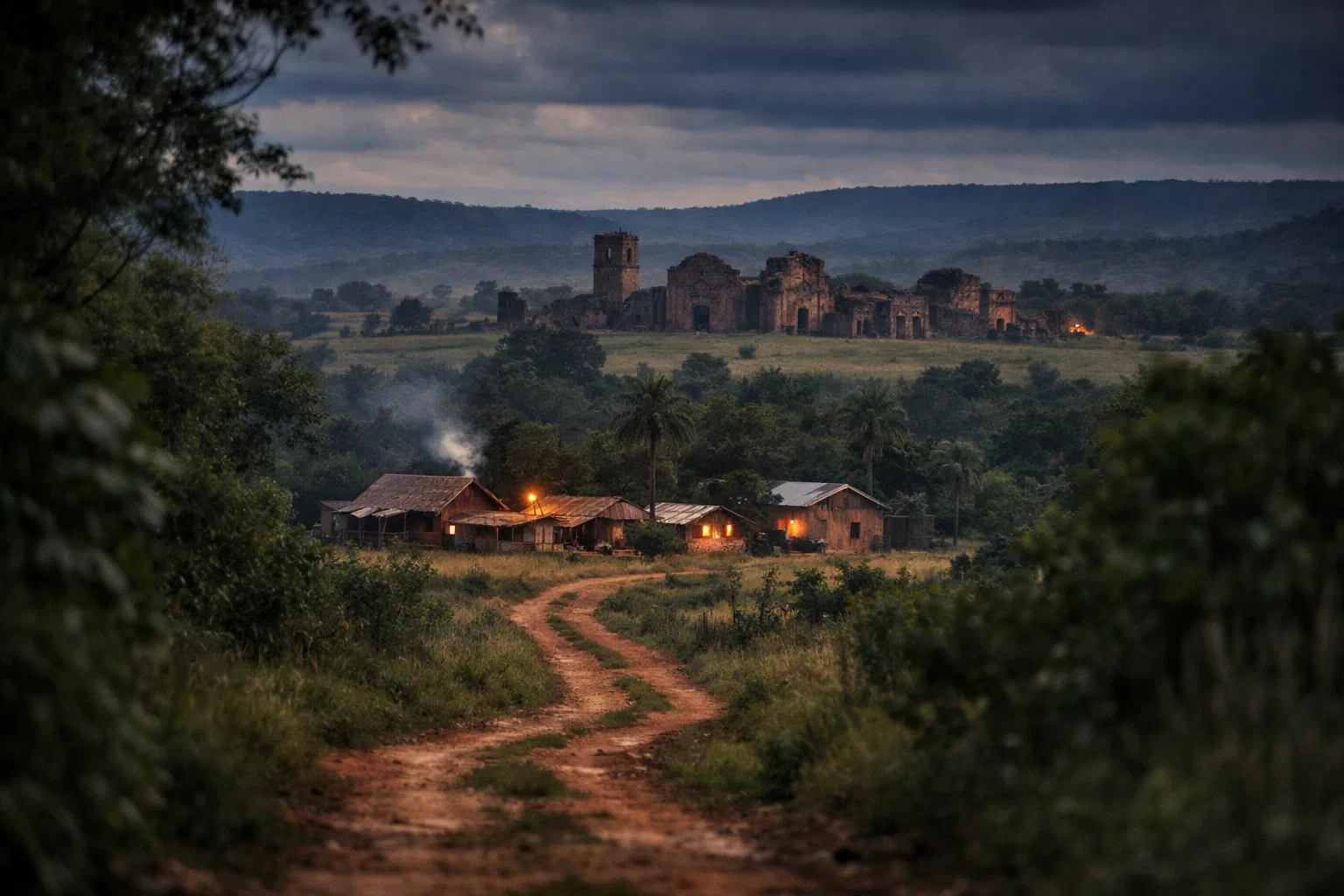
The Jesuit mission system began in the region in the early seventeenth century. Missions gathered Indigenous residents into planned settlements, offered some protection from colonists and slave raiders, and pursued intensive Christian conversion. Seven surviving or ruined mission sites lie within present-day Paraguay, while the wider mission network extended across areas now divided among Paraguay, Argentina and Brazil.[unesco.org]whc.unesco.orgOpen source on unesco.org.
Mission life emerged during genuine catastrophe. Epidemics killed large numbers of Guaraní people, while slave-hunting expeditions destroyed settlements and carried captives away. Under such conditions, Christian teachings about judgement, divine protection and eternal life encountered Indigenous ideas about sacred places, prophetic authority and world renewal. This was not simply a clash between “reason” and “superstition”. It was a struggle between religious systems, both of which interpreted illness, disaster and political power through a supernatural framework.[Wikipedia]WikipediaJesuit missions among the GuaraníJesuit missions among the Guaraní
Jesuit sources frequently portrayed Indigenous ritual specialists as deceivers, sorcerers or agents of the devil, particularly when they opposed mission discipline. Those descriptions cannot be accepted uncritically: calling a rival leader a witch or false prophet was also a way of discrediting resistance. Conversely, Indigenous opposition to missionaries could be violent and politically organised. The missions themselves were neither harmonious utopias nor straightforward prisons; historians describe them as negotiated communities containing protection, coercion, adaptation and internal conflict at the same time.[University of Münster]uni-muenster.deOpen source on uni-muenster.de.
The later romantic image of the missions as a ready-made “Land Without Evil” is therefore misleading. They offered security from some dangers, but they also concentrated populations, altered political authority and exposed residents to mission rules and epidemic transmission. Their significance for Paraguay’s history of collective belief lies in this mixture: apocalyptic fear, hope for sanctuary and institutional control became inseparable.
The Pombero: folklore, fear and social explanation
Paraguay’s best-known supernatural figure is the Pombero, a nocturnal being associated with forests, farms and isolated rural paths. Stories describe whistling in the darkness, disturbed animals, stolen provisions, frightening encounters and punishment for those who mock or neglect him. Some families traditionally leave tobacco, alcohol or food to secure his goodwill. The stories vary, but the figure remains one of the most recognisable elements of Paraguayan and wider Guaraní folklore.[The Asunción Times]asunciontimes.comThe Asunción Times Guaraní Legends #1, The Pombero: Lord Of The NightThe Asunción Times Guaraní Legends #1, The Pombero: Lord Of The Night
Belief in the Pombero is not in itself a mass panic. Most stories function as folklore: they communicate rules about respecting the forest, returning home before dark, caring for animals and avoiding dangerous places. A frightening noise can acquire a shared explanation because listeners already know the narrative. That process resembles contagious belief, but it does not require an entire community to become irrational or medically unwell.
The darker part of the tradition concerns sexuality and pregnancy. Some accounts blame the Pombero for pregnancies outside marriage or describe him as assaulting women. In a conservative rural setting, such an explanation could conceal consensual relationships, reduce direct blame on a woman, disguise incest or abuse, or make sense of a pregnancy whose circumstances could not safely be discussed. It could also stigmatise mothers and children. The supernatural story may therefore perform several contradictory roles: protection, avoidance, accusation and silence.[The Asunción Times]asunciontimes.comThe Asunción Times Guaraní Legends #1, The Pombero: Lord Of The NightThe Asunción Times Guaraní Legends #1, The Pombero: Lord Of The Night
This is where folklore becomes socially consequential. A belief need not produce a dramatic crowd outbreak to shape behaviour. Fear of the Pombero can influence when children go outside, how adults interpret strange sounds and how families discuss sexual violence or unexplained pregnancy. Yet it would be a mistake to assume that every person who tells the story accepts it literally. People may joke about the Pombero, use the tale metaphorically or preserve it as cultural heritage while remaining sceptical.
Similar caution applies to claims about harmful magic, commonly described through ideas of sorcery, curses or ritual power. Accusations can grow during illness, family disputes and unexplained misfortune, but Paraguay lacks a securely documented national witch panic comparable to early modern Europe. Individual accusations, religious healing practices and popular belief should not be inflated into a nonexistent wave of witch trials.
Nueva Germania and the dream of a racial utopia
One of Paraguay’s clearest examples of a closed ideological experiment was Nueva Germania, founded in the 1880s by the German nationalist Bernhard Förster and his wife, Elisabeth Förster-Nietzsche. They hoped to establish an antisemitic colony removed from Jewish influence and dedicated to what they imagined as pure Germanic culture. Poor German families were recruited to settle in an unfamiliar rural environment, where grand promises collided with disease, inadequate preparation, agricultural difficulty and isolation.[klassik-stiftung.de]klassik-stiftung.deOpen source on klassik-stiftung.de.
Nueva Germania is sometimes described casually as a “cult colony”. It certainly had features associated with utopian and high-control movements: an ambitious founder, ideological purity, separation from ordinary society and the promise that a chosen community would demonstrate a superior way of life. Yet it was not primarily a new religion. Its central doctrine was racial nationalism, reinforced by romantic ideas about settlement, nature and national regeneration.
Förster’s project failed rapidly. He abandoned the settlement and died by suicide in 1889, only a few years after its establishment. The colony survived, but not as the racially pure society its founders imagined. Residents intermarried, adapted to Paraguayan life and developed mixed German-Paraguayan identities. Archaeological and historical research now treats the settlement as a material record of failed utopian planning rather than as proof that its ideology succeeded.[wikipedia.org]WikipediaNueva GermaniaNueva Germania
The episode demonstrates how collective delusion can be institutional rather than momentarily hysterical. The founders did not simply misunderstand one event; they built a settlement around false racial assumptions and unrealistic expectations of environmental mastery. The harm included financial loss, hardship for recruited families and the attempted transplantation of organised antisemitism into Paraguay.
Later storytelling has sometimes added claims that Nazi fugitives such as Josef Mengele lived in Nueva Germania. Mengele did spend time in Paraguay, but evidence that he resided in this particular colony is weak. The rumour persists because Nueva Germania’s actual racist foundation makes later Nazi associations seem plausible. It is a good example of myth attaching itself to an already extraordinary history and becoming difficult to separate from documented fact.[Wikipedia]WikipediaNueva GermaniaNueva Germania
The Unification Church land controversy
A more recent Paraguayan scare developed after organisations connected with Sun Myung Moon’s Unification movement purchased a vast property in the Chaco around the riverside community of Puerto Casado. The movement had long attracted the hostile label “Moonies” and was frequently described by critics as a cult. Its theology, mass wedding ceremonies, business network and political connections made it appear unfamiliar and secretive to many outsiders.
The Paraguayan dispute, however, was not merely an irrational fear of strange religion. Local residents worried about land tenure, displacement, employment and control of territory. Demonstrators marched to Asunción, politicians considered expropriation, and critics questioned why a foreign religious organisation should command such an extensive holding in a poor and sparsely governed region. Church representatives promised investment and development, while opponents accused the movement of exploiting local desperation and failing to deliver sufficient benefits.[wsj.com]wsj.comThe Wall Street Journal Rev. Moon's Holdings Raise Paraguayans' IreThe Wall Street Journal Rev. Moon's Holdings Raise Paraguayans' Ire
The case acquired the emotional shape of a “sect panic” because several anxieties fused together:
- fear that followers of a foreign messianic leader might establish an autonomous enclave;
- anger over insecure land rights and economic inequality;
- suspicion of opaque corporate ownership;
- concern about national sovereignty in a remote border region;
- memories of earlier foreign colonies claiming to transform Paraguayan territory.
Some claims were speculative, but the underlying land conflict was real. The most useful distinction is therefore between moral panic and legitimate scrutiny. Labelling the movement a cult could simplify a complicated property dispute into a story of brainwashed outsiders. At the same time, rejecting every objection as religious prejudice would ignore residents’ material grievances.
The story did not end with Moon’s death in 2012. His movement divided into rival branches, producing legal disputes over ownership. A Reuters investigation published in 2023 reported that drug traffickers had increasingly exploited the poorly controlled territory, showing that the greatest danger to local people was not necessarily the apocalyptic takeover once imagined. Weak governance, contested ownership and organised crime proved more concrete than the most dramatic religious rumours.[Reuters]reuters.comparaguay drugs unification churchparaguay drugs unification church
Why classic “mass hysteria” cases are scarce
Searches of medical literature and major news archives do not reveal a firmly established Paraguayan case of mass psychogenic illness on the scale of the well-studied school or factory outbreaks elsewhere. That absence should not be turned into a claim that such episodes have never occurred. Mass psychogenic illness is frequently under-reported, misdiagnosed or remembered locally as poisoning, possession or unexplained fainting. Researchers define it as the spread of real symptoms through a cohesive group when investigation finds no adequate organic cause; stress, social observation and alarming communication can all contribute.[PMC]pmc.ncbi.nlm.nih.govPMCMass psychogenic illness and the social networkPMCMass psychogenic illness and the social network
A responsible diagnosis requires more than several people feeling ill at once. Investigators must first consider infection, contaminated food or water, heat, pesticides, industrial exposure and other physical causes. The phrase “mass hysteria” is especially unhelpful when used prematurely, because it can trivialise genuine suffering and has historically been applied dismissively to women, children and marginalised communities.
Paraguay’s fragmented records also matter. Rural incidents may receive limited medical investigation or remain confined to local-language radio, community memory and short-lived news coverage. Symptoms interpreted through possession, sorcery or fear of a supernatural being may never enter psychiatric or epidemiological literature. The evidence therefore supports a cautious conclusion: Paraguay has a rich history of collective supernatural belief and moral alarm, but no nationally famous psychogenic outbreak has been verified well enough to serve as its defining case.
What these episodes reveal
Paraguay’s history does not fit a simple progression from superstition to modern reason. Indigenous prophecy, Catholic conversion, forest folklore, racial utopianism and suspicion of foreign religious movements belong to different eras, but each offered a way to explain danger and imagine safety.
The most important recurring pressures were concrete:
- Displacement and invasion: visions of sanctuary became more compelling when communities faced slavery, epidemic disease or loss of land.
- Rural isolation: supernatural narratives helped organise behaviour where official protection, medicine or reliable information was distant.
- Sexual and family stigma: folklore could provide an indirect language for pregnancy, assault and prohibited relationships.
- Economic insecurity: unfamiliar groups appeared most threatening when they controlled land or promised miraculous development.
- Weak institutions: rumours flourished when ownership, policing and public authority were uncertain.
- Mythmaking after the event: later retellings attached Nazis to Nueva Germania or imagined total religious control in the Chaco because these additions suited the emotional logic of the story.
The distinction between belief and panic is crucial. Guaraní prophecy was not simply collective madness. Pombero stories are not evidence that an entire country mistakes folklore for fact. Nueva Germania was a failed ideological colony, not a fainting epidemic. The Puerto Casado controversy combined exaggerated fears with a genuine struggle over land.
Paraguay’s contribution to the wider history of cults, panics and contagious belief is therefore a lesson in classification. The most dramatic label is often the least illuminating. Asking who benefited from a story, what danger was real, what evidence was missing and which voices were dismissed produces a clearer history than calling every unusual movement a cult or every communal fear “mass hysteria”.

Amazon book picks
Further Reading
Books and field guides related to When Belief Reshaped Life in Paraguay. Use these as the next step if you want deeper reading beyond the article.

Magic, witchcraft, and religion
Explains comparative approaches to supernatural belief.
The Guarani Under Spanish Rule in the Rio De La Plata
First published 2003. Subjects: Missions, Guarani Indians, Government relations, Seven Reductions, War of the, 1754-1756, Guarani (Indiens).
Oxford Handbook of the Incas
Provides wider South American Indigenous religious context.
Endnotes
1.
Source: cambridge.org
Title: University Press & Assessment Migration by Land (Part IV)
Link:https://www.cambridge.org/core/books/cambridge-history-of-global-migrations/migration-by-land/4D427240992241136A0620132FD2E3FD
Source snippet
Guarani Prophetism in search of the “Land without Evil,” a term found among the Guarani of the region between the south of Brazil and Par...
2.
Source: jstor.org
Link:https://www.jstor.org/stable/482479
Source snippet
A Comparative Study of Utopian Renewal in Amazoniaby MF Brown · 1991 · Cited by 109 — The pre-Conquest origins of Tupi-Guarani mille...
3.
Source: resolve.cambridge.org
Title: crises and transformations of invaded societies the la plata basin 15351650
Link:https://resolve.cambridge.org/core/services/aop-cambridge-core/content/view/68520CF1C69E9A1D8AFE34C03C35CBF1/9780521630764c1_p1-58_CBO.pdf/crises_and_transformations_of_invaded_societies_the_la_plata_basin_15351650.pdf
Source snippet
Cambridge University Press & AssessmentTHE LA PLATA BASIN (1535-1650)In the former group the pro- phetic phenomenon is one of protest aga...
4.
Source: researchgate.net
Title: Research Gate(PDF) The Origin Myth of a Myth
Link:https://www.researchgate.net/publication/385413582_The_Origin_Myth_of_a_Myth_The_Land_Without_Evil_Revisited
Source snippet
The “Land Without Evil”...9 Dec 2024 — This text suggests a significant connection between a particular belief and more general facts su...
5.
Source: whc.unesco.org
Link:https://whc.unesco.org/en/list/648/
6.
Source: Wikipedia
Title: Jesuit missions among the Guaraní
Link:https://en.wikipedia.org/wiki/Jesuit_missions_among_the_Guaran%C3%AD
7.
Source: Wikipedia
Link:https://en.wikipedia.org/wiki/Pombero
8.
Source: klassik-stiftung.de
Link:https://www.klassik-stiftung.de/en/your-visit/exhibition/die-prinzessin-von-neu-germanien/
9.
Source: Wikipedia
Title: Nueva Germania
Link:https://en.wikipedia.org/wiki/Nueva_Germania
10.
Source: researchgate.net
Title: 386138042 Nueva Germania Paraguay Siedlungsgeographie einer utopischen Kolonie
Link:https://www.researchgate.net/publication/386138042_Nueva_Germania_Paraguay_Siedlungsgeographie_einer_utopischen_Kolonie
11.
Source: economist.com
Title: promised land
Link:https://www.economist.com/the-americas/2005/08/11/promised-land
12.
Source: reuters.com
Title: paraguay drugs unification church
Link:https://www.reuters.com/investigates/special-report/paraguay-drugs-unification-church/
13.
Source: pmc.ncbi.nlm.nih.gov
Title: PMCMass psychogenic illness and the social network
Link:https://pmc.ncbi.nlm.nih.gov/articles/PMC3536509/
14.
Source: Wikipedia
Title: UFO religion
Link:https://en.wikipedia.org/wiki/UFO_religion
15.
Source: Wikipedia
Title: List of mass panic cases
Link:https://en.wikipedia.org/wiki/List_of_mass_panic_cases
16.
Source: Wikipedia
Title: Satanic panic
Link:https://en.wikipedia.org/wiki/Satanic_panic
17.
Source: Wikipedia
Title: Moral panic
Link:https://en.wikipedia.org/wiki/Moral_panic
18.
Source: Wikipedia
Link:https://en.wikipedia.org/wiki/Ra%C3%ABlism
19.
Source: Wikipedia
Title: Mass psychogenic illness
Link:https://en.wikipedia.org/wiki/Mass_psychogenic_illness
20.
Source: Wikipedia
Title: Doomsday cult
Link:https://en.wikipedia.org/wiki/Doomsday_cult
21.
Source: Wikipedia
Title: Unification Church
Link:https://en.wikipedia.org/wiki/Unification_Church
22.
Source: Wikipedia
Title: Yvy marã e’ỹ
Link:https://en.wikipedia.org/wiki/Yvy_mar%C3%A3_e%27%E1%BB%B9
23.
Source: jstor.org
Link:https://www.jstor.org/stable/645637
24.
Source: jstor.org
Link:https://www.jstor.org/stable/3513169
25.
Source: jstor.org
Link:https://www.jstor.org/stable/25766988
26.
Source: jstor.org
Link:https://www.jstor.org/stable/j.ctv1xg5hpf
27.
Source: jstor.org
Link:https://www.jstor.org/stable/2503952
28.
Source: jstor.org
Link:https://www.jstor.org/stable/3134938
29.
Source: jstor.org
Link:https://www.jstor.org/content/pdf/oa_book_monograph/jj.2915804
30.
Source: jstor.org
Link:https://www.jstor.org/stable/40463557
31.
Source: jstor.org
Link:https://www.jstor.org/stable/156943
32.
Source: jstor.org
Link:https://www.jstor.org/stable/1354715
33.
Source: researchgate.net
Link:https://www.researchgate.net/publication/309550088_When_we_enter_into_my_Father%27s_spacecraft_Cargoistic_hopes_and_millenarian_cosmologies_in_new_religious_UFO_movements
34.
Source: researchgate.net
Title: 403681331 The Guarani Missions in the Jesuit Province of Paraguay 1609 1800
Link:https://www.researchgate.net/publication/403681331_The_Guarani_Missions_in_the_Jesuit_Province_of_Paraguay
35.
Source: cambridge.org
Link:https://www.cambridge.org/core/books/cambridge-history-of-global-migrations/indigenous-mobility-in-the-lowlands-of-south-america/5CD12BE3EE3A90A1AEE5CEA5B4B4EE58
36.
Source: cambridge.org
Link:https://www.cambridge.org/core/services/aop-cambridge-core/content/view/C664F9B27AE0B43048CCE2F74CE3AAD0/S0003161500025360a.pdf/-building-and-builders-in-hispanic-california-1769-1850-by-mardith-k-schuetz-miller-santa-barbara-santa-barbara-trust-for-history-1995-pp-xii-231-illustrations-bibliography-index-3700.pdf
37.
Source: cambridge.org
Link:https://www.cambridge.org/core/journals/comparative-studies-in-society-and-history/article/ethics-politics-and-host-space-a-comparative-case-study-from-the-south-american-chaco/1684B438C222B33B4CD9F2FA4FC0E369
38.
Source: cambridge.org
Link:https://www.cambridge.org/core/journals/journal-of-ecclesiastical-history/article/expecting-pears-from-an-elm-tree-franciscan-missions-on-the-chiriguano-frontier-in-the-heart-of-south-america-18301949-by-erick-d-langer-pp-xiv376-incl-1-map-12-figs-and-18-tables-durhamlondon-duke-university-press-2009-77-cloth-1899-paper-978-0-8223-4504-6/45EDD60454928347A59338B6A572D080
39.
Source: resolve.cambridge.org
Title: messianic and revitalization movements
Link:https://resolve.cambridge.org/core/services/aop-cambridge-core/content/view/95DB2E13B7813F9F341E375F18B15646/9781139032698c14_p207-219_CBO.pdf/messianic-and-revitalization-movements.pdf
40.
Source: cambridge.org
Link:https://www.cambridge.org/core/services/aop-cambridge-core/content/view/B6DE5D504EE8A18E9EC1F2A27148F040/S0003161500086478a.pdf/paraguay_reader_history_culture_politics_edited_by_peter_lambert_and_andrew_nickson_durham_duke_university_press_2012_pp_ix_488_illustrations_index_2795_paper_9995_cloth.pdf
41.
Source: cambridge.org
Link:https://www.cambridge.org/core/books/making-of-brazilian-amazonian-societies/indigenous-worlds-on-the-amazon-river-and-the-origins-of-the-european-sphere-in-the-sixteenth-century/ECE3B3E3AEFF4C7DE0B8D0BBED99B055
42.
Source: resolve.cambridge.org
Title: ethnography in south america the first two hundred years
Link:https://resolve.cambridge.org/core/services/aop-cambridge-core/content/view/0829810E6E7A6FE812513FEF775EFB24/9780521630757c2_p96-187_CBO.pdf/ethnography_in_south_america_the_first_two_hundred_years.pdf
43.
Source: whc.unesco.org
Link:https://whc.unesco.org/en/tentativelists/6613/
44.
Source: revista.drclas.harvard.edu
Title: Re Vista Imagining Guaranis and Jesuits | Re Vista
Link:https://revista.drclas.harvard.edu/imagining-guaranis-and-jesuits/
Source snippet
They spoke the Guarani language for the most part, and it became the basic means for conversion to the Christian...
45.
Source: uni-muenster.de
Link:https://www.uni-muenster.de/imperia/md/content/mittellatein/forschung/intersections/35kapitel_8_-_guillermo_wilde.pdf
46.
Source: asunciontimes.com
Title: The Asunción Times Guaraní Legends #1, The Pombero: Lord Of The Night
Link:https://asunciontimes.com/culture/paraguayan-history/the-pombero-lord-of-the-night-guardian-of-the-guarani-wilds/
47.
Source: english.elpais.com
Link:https://english.elpais.com/international/2023-05-09/nueva-germania-the-aryan-utopia-of-nietzsches-sister-and-bernhard-forster-in-paraguay.html
48.
Source: wsj.com
Title: The Wall Street Journal Rev. Moon’s Holdings Raise Paraguayans’ Ire
Link:https://www.wsj.com/articles/SB112164287628387867
49.
Source: monster.fandom.com
Link:https://monster.fandom.com/wiki/Pombero
50.
Source: sajp.org.za
Link:https://sajp.org.za/index.php/sajp/article/view/1671/2648
51.
Source: nepjol.info
Link:https://www.nepjol.info/index.php/JPAN/article/view/74911/57429
Additional References
52.
Source: ehrafworldcultures.yale.edu
Link:https://ehrafworldcultures.yale.edu/cultures/sm04/documents/007
Source snippet
eHRAF World CulturesThe Land-without-Evil: Tupí-Guaraní prophetismby H Clastres · 1995 · Cited by 167 — The major emphasis in this work i...
53.
Source: youtube.com
Title: The FASCINATING Guarani Civilization – 2,000 Years of Guarani History
Link:https://www.youtube.com/watch?v=q27LVBA86mA
Source snippet
The German towns in Paraguay with a surge in European immigrants – BBC News...
54.
Source: youtube.com
Title: The German towns in Paraguay with a surge in European immigrants – BBC News
Link:https://www.youtube.com/watch?v=R-x46MkYr5Q
Source snippet
I Found an Australian Colony in Paraguay | S4, EP16...
55.
Source: youtube.com
Title: Meet The Paraguayan Descendants Of Australian Socialists
Link:https://www.youtube.com/watch?v=Pb3DQ4uCJSc
Source snippet
The FASCINATING Guarani Civilization – 2,000 Years of Guarani History...
56.
Source: youtube.com
Title: Why did Nietzsche live in Paraguay for 6 years?
Link:https://www.youtube.com/watch?v=m8y-VNCjPCM
Source snippet
Meet The Paraguayan Descendants Of Australian Socialists...
57.
Source: facebook.com
Link:https://www.facebook.com/news.com.au/posts/satanic-panic-is-sweeping-the-nation-and-its-scarier-than-ever/1378756284287677/
58.
Source: academia.edu
Link:https://www.academia.edu/2395018/Apocalypse_in_Early_UFO_and_Alien_Based_Religions_Christian_and_Theosophical_Themes
59.
Source: academia.edu
Link:https://www.academia.edu/125932603/Natascha_Mehler_und_Attila_D%C3%A9szi_Nueva_Germania_Paraguay_Siedlungsgeographie_einer_utopischen_Kolonie
60.
Source: reddit.com
Link:https://www.reddit.com/r/Paraguay/comments/1m30u5s/existe_el_pombero/?tl=en
61.
Source: scribd.com
Link:https://www.scribd.com/document/972782500/The-Pombero
Topic Tree
Follow this branch
Related pages 192
- Antigua and Barbuda
- Argentina Belief Scares
- Azerbaijan Belief
- Bahrain Beliefs
- North Korea
- +187 more in sidebar