Within Slovakia
How Blood Libel Destroyed Slovak Jewish Communities
False ritual-murder accusations made entire Jewish communities targets of torture, execution, expulsion and collective blame.
On this page
- The accusations at Trnava and Pezinok
- How torture manufactured impossible confessions
- Why collective guilt made persecution self justifying
Page outline Jump by section
Introduction
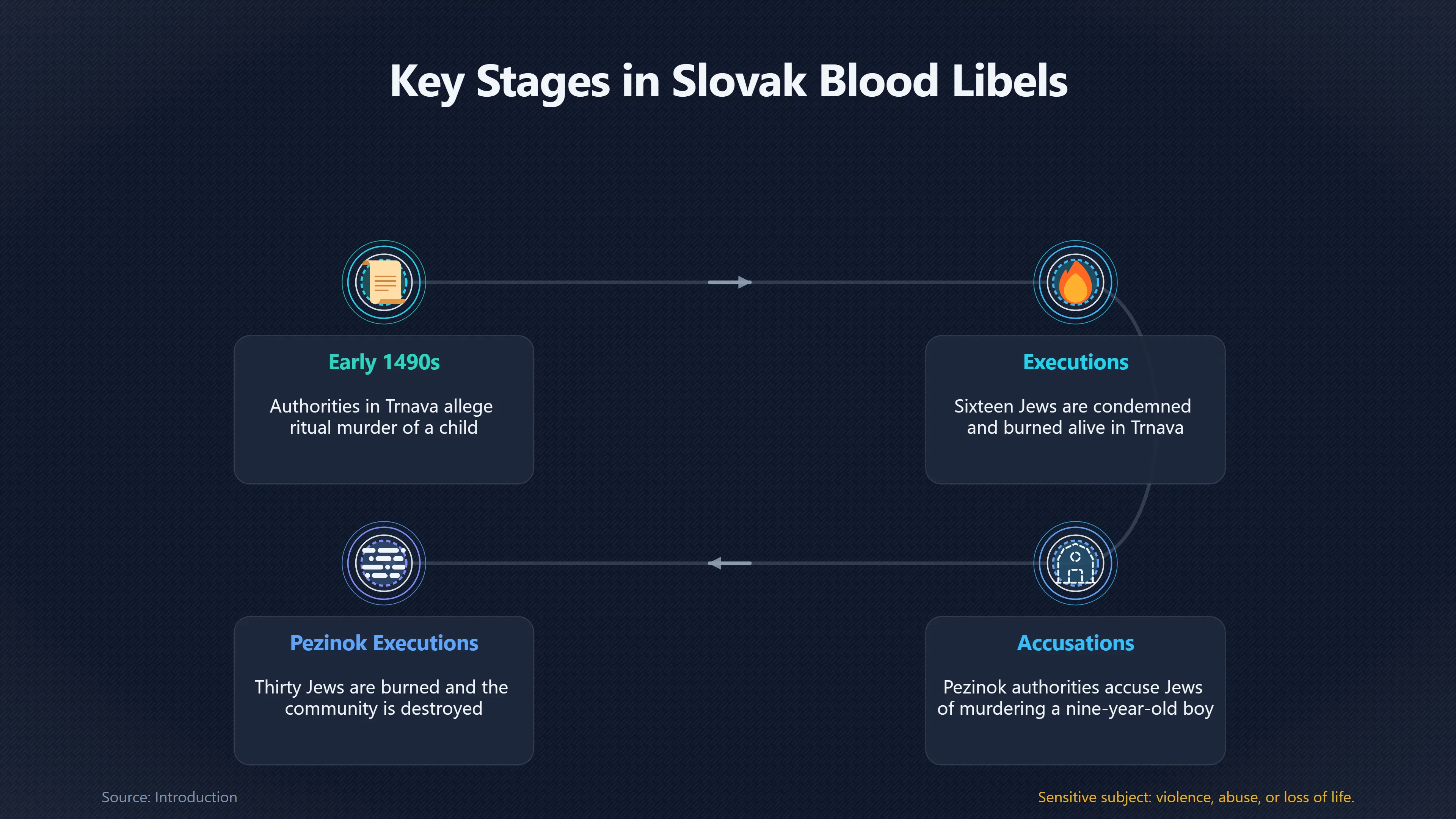
The blood libel persecutions at Trnava and Pezinok rank among the most devastating episodes in the history of the medieval Jewish communities of what is now Slovakia. In both cases, Jewish residents were falsely accused of murdering Christian children to obtain their blood for religious rituals—a conspiracy theory with no basis in Jewish belief or practice. These accusations led to torture, forced confessions, executions and the destruction of long-established communities. Rather than isolated criminal investigations, the cases reveal how fear, religious prejudice and political interests combined to turn rumour into judicial violence. They remain important not only as episodes of antisemitic persecution but also as examples of how courts and local authorities could legitimise collective punishment through impossible accusations.[Holocaust Encyclopedia]encyclopedia.ushmm.orgHolocaust Encyclopedia Blood Libel: History and Impact | Holocaust EncyclopediaHolocaust Encyclopedia Blood Libel: History and Impact | Holocaust Encyclopedia

The accusations at Trnava and Pezinok
Jewish communities had existed in both Trnava and Pezinok for centuries before the persecutions. They were economically important as merchants, traders and moneylenders, but they also faced growing hostility from urban guilds and local elites who viewed them as commercial competitors. This atmosphere of resentment provided fertile ground for conspiracy theories when unexplained deaths or disappearances occurred.[Encyclopedia.com]encyclopedia.comTrnava | Encyclopedia.comTrnava | Encyclopedia.com
Trnava
The Trnava case occurred in the early 1490s, with most historical accounts placing the executions in 1491, although some later summaries refer to the accusation being formulated in 1494. According to Jewish historical sources, local authorities alleged that Jews had murdered a Christian child for ritual purposes. Sixteen Jews—twelve men and four women—were condemned and burned alive after proceedings that relied on torture rather than credible evidence. The accusations did not stop with claims of ritual murder. Forced confessions were expanded into increasingly fantastic stories, including fabricated assertions that Jews required Christian blood as medicine or religious necessity.[jewishgen.org]jewishgen.orgJewish Gen Encyclopaedia of Jewish communities. SlovakiaJewish Gen Encyclopaedia of Jewish communities. Slovakia
The persecution devastated one of the oldest Jewish communities in the Kingdom of Hungary. Restrictions intensified afterwards, and later royal measures expelled Jews from the town for long periods. The episode became part of a wider pattern in which economic rivalry, religious hostility and legal persecution reinforced one another.[Encyclopedia.com]encyclopedia.comTrnava | Encyclopedia.comTrnava | Encyclopedia.com
Pezinok
A generation later, in 1529, Pezinok experienced an even more destructive blood libel. Authorities accused the town’s Jews of murdering a nine-year-old Christian boy. Under torture, prisoners “confessed” to the alleged crime despite the complete absence of reliable evidence. Around thirty Jews were publicly burned at the stake, while surviving members of the community fled the town, effectively ending Jewish life there for generations.[jewishgen.org]jewishgen.orgJewish Gen Encyclopaedia of Jewish communities. SlovakiaJewish Gen Encyclopaedia of Jewish communities. Slovakia
Like the Trnava case, the Pezinok accusations emerged within an already hostile social climate. They were not spontaneous outbreaks of collective madness but judicial persecutions in which authorities accepted and amplified an antisemitic conspiracy theory that had circulated across medieval Europe.[Holocaust Encyclopedia]encyclopedia.ushmm.orgHolocaust Encyclopedia Blood Libel: History and Impact | Holocaust EncyclopediaHolocaust Encyclopedia Blood Libel: History and Impact | Holocaust Encyclopedia
How torture manufactured impossible confessions
One of the clearest lessons from both cases is the central role of torture in creating the appearance of evidence. Medieval courts commonly regarded confessions as the strongest form of proof, yet they frequently authorised torture to obtain them.
Under these conditions, the accused admitted not only to impossible crimes but also to increasingly elaborate stories that reflected what interrogators expected to hear. In Trnava, the alleged confessions included claims that Jewish men menstruated, that Christian blood healed wounds caused by circumcision, cured illness, inspired affection between people and had to be collected as part of a secret religious obligation. These claims were biologically impossible, contradicted Jewish law and mirrored wider European myths rather than any authentic Jewish practice.[encyclopedia.com]encyclopedia.comBlood Libel | Encyclopedia.comBlood Libel | Encyclopedia.com
Modern historians treat such statements not as evidence of genuine belief among the accused but as examples of torture producing narratives that confirmed existing prejudices. Once courts assumed that ritual murder existed, denial itself could be interpreted as proof of guilt, making acquittal almost impossible.[Holocaust Encyclopedia]encyclopedia.ushmm.orgHolocaust Encyclopedia Blood Libel: History and Impact | Holocaust EncyclopediaHolocaust Encyclopedia Blood Libel: History and Impact | Holocaust Encyclopedia
Why collective guilt made persecution self-justifying
Neither Trnava nor Pezinok focused solely on identifying an individual suspect. Instead, the accusation rapidly expanded into collective guilt.
The underlying logic was circular:
- A supposed ritual murder required cooperation by an entire Jewish community.
- Any denial could be dismissed as evidence of a secret conspiracy.
- Tortured confessions were treated as confirmation of the conspiracy.
- Executions and expulsions then appeared to be necessary acts of public protection.
This reasoning transformed an alleged crime into justification for punishing an entire religious minority. The destruction of communities became the expected outcome rather than an unintended consequence.
Economic motives also intersected with religious prejudice. Urban guilds often competed with Jewish merchants, while confiscated property could benefit local authorities or private individuals. Historians therefore see these persecutions as products of multiple pressures rather than purely theological disputes. Religious myths supplied the language of accusation, while political and economic incentives helped sustain them.[encyclopedia.com]encyclopedia.comTrnava | Encyclopedia.comTrnava | Encyclopedia.com
Why these cases mattered in Slovakia
The Trnava and Pezinok persecutions had consequences that extended far beyond the immediate executions.
Both episodes contributed to the collapse or long interruption of Jewish communal life in important towns of Upper Hungary. Following the upheavals of the early sixteenth century, including the Ottoman victory at Mohács in 1526, expulsions and repeated persecution left many older Slovak Jewish communities fragmented or abandoned. Historians of Slovak Jewry identify these blood libels as turning points that severely disrupted centuries of continuous settlement.[JewishGen]jewishgen.orgJewish Gen Encyclopaedia of Jewish communities. SlovakiaJewish Gen Encyclopaedia of Jewish communities. Slovakia
These cases also demonstrate that medieval blood libels were not isolated local legends. Similar accusations appeared across Europe, following recognisable patterns in which missing children, Easter or Passover, torture and public executions combined to reinforce antisemitic myths. Trnava and Pezinok represent the Slovak branch of this wider European phenomenon while remaining distinctive because of the scale of destruction inflicted on local Jewish communities.[Holocaust Encyclopedia]encyclopedia.ushmm.orgHolocaust Encyclopedia Blood Libel: History and Impact | Holocaust EncyclopediaHolocaust Encyclopedia Blood Libel: History and Impact | Holocaust Encyclopedia

How historians interpret the persecutions today
Modern scholarship rejects the blood libel as a fabricated conspiracy theory. Jewish law explicitly forbids both murder and the consumption of blood, making the accusations fundamentally incompatible with Judaism. Historians therefore study the Trnava and Pezinok cases not as mysteries about ritual crime but as examples of how fear, prejudice and coercive legal procedures produced false convictions.[Holocaust Encyclopedia]encyclopedia.ushmm.orgHolocaust Encyclopedia Blood Libel: History and Impact | Holocaust EncyclopediaHolocaust Encyclopedia Blood Libel: History and Impact | Holocaust Encyclopedia
For the history of Slovakia, these persecutions illustrate a recurring pattern found in many societies: moments of uncertainty or social conflict encouraged authorities to embrace explanations that identified a vulnerable minority as a hidden threat. The resulting violence was not driven by evidence but by beliefs that courts, civic leaders and ordinary citizens reinforced together. Their legacy serves as a reminder of the dangers posed when conspiracy narratives are accepted as legal fact and when entire communities are judged through collective suspicion rather than individual evidence.[JewishGen]jewishgen.orgJewish Gen Encyclopaedia of Jewish communities. SlovakiaJewish Gen Encyclopaedia of Jewish communities. Slovakia
Amazon book picks
Further Reading
Books and field guides related to How Blood Libel Destroyed Slovak Jewish Communities. Use these as the next step if you want deeper reading beyond the article.

The Penguin book of witches
Illustrates judicial persecution driven by supernatural belief.
The Devil and The Jews The Medieval Conception of The Jew and...
First published 1945.
Endnotes
1.
Source: jewishgen.org
Title: Jewish Gen Encyclopaedia of Jewish communities. Slovakia
Link:https://www.jewishgen.org/yizkor/pinkas_slovakia/Slo0XI.html
2.
Source: encyclopedia.com
Title: Trnava | Encyclopedia.com
Link:https://www.encyclopedia.com/religion/encyclopedias-almanacs-transcripts-and-maps/trnava
4.
Source: encyclopedia.com
Title: Blood Libel | Encyclopedia.com
Link:https://www.encyclopedia.com/religion/encyclopedias-almanacs-transcripts-and-maps/blood-libel
5.
Source: Wikipedia
Title: Blood libel
Link:https://en.wikipedia.org/wiki/Blood_libel
6.
Source: encyclopedia.ushmm.org
Title: Holocaust Encyclopedia Blood Libel: History and Impact | Holocaust Encyclopedia
Link:https://encyclopedia.ushmm.org/content/en/article/blood-libel
7.
Source: jewishvirtuallibrary.org
Link:https://jewishvirtuallibrary.org/jsource/judaica/ejud_0002_0003_0_03147.html
8.
Source: antisemitism.adl.org
Link:https://antisemitism.adl.org/blood/
Additional References
9.
Source: cambridge.org
Link:https://www.cambridge.org/core/journals/austrian-history-yearbook/article/abs/cultivating-an-orderly-society-physical-and-mental-landscapes-on-the-habsburgs-southern-frontiers/03C1ACD0C0175298038D896450A736A8
Source snippet
70 ^{70} The earliest accusation of blood libel in the Hungarian lands occurred in 1494 in Nagyszombat (today's Trnava, Slovakia). When a...
10.
Source: degruyterbrill.com
Link:https://www.degruyterbrill.com/document/doi/10.4159/9780674243545-016/html?lang=en
Source snippet
Archival and Printed Primary SourcesJanuary 1, 2019 — Chapter Image: Cite this Cite this ARCHIVAL AND PRINTED PRIMARY SOURCES * [Button...
Published: January 1, 2019
11.
Source: encyclopedia.yivo.org
Title: “Blood Libels and Host Desecration Accusations.”
Link:https://encyclopedia.yivo.org/article/322
Source snippet
Libels and Host Desecration Accusations - YIVO EncyclopediaFebruary 12, 2010 — Blood Libels and Host Desecration Accusations To cite this...
Published: February 12, 2010
12.
Source: youtube.com
Link:https://www.youtube.com/watch?v=OrB-xldFKus
Source snippet
Blood Libel: An Investigation Into The Origins of the Anti-Semitic Conspiracy Theory with E.M. Rose...
13.
Source: youtube.com
Link:https://www.youtube.com/watch?v=BFO01z0J2cw
Source snippet
The Body in the Woods: A Medieval Murder Mystery...
14.
Source: alamoana.net
Title: Federation Of Jewish Communities In Slovakia
Link:https://alamoana.net/info/en/?search=Federation_of_Jewish_Communities_in_Slovakia
Source snippet
Federation Of Jewish Communities In Slovakia - Encyclopedia Information...
15.
Source: youtube.com
Title: The History of Antisemitism: Blood Libel
Link:https://www.youtube.com/watch?v=NMJ4oPOvW0o
Source snippet
The Blood Libel: New Media and Conspiracy Theories with Professors Magda Teter and David Myers...
16.
Source: youtube.com
Title: Blood Libel: On the Trail of an Antisemitic Myth, talk by Magda Teter
Link:https://www.youtube.com/watch?v=Y4Cb0zGNH0o
Source snippet
The History of Antisemitism: Blood Libel...
17.
Source: please.untaint.us
Title: us Blood libel
Link:https://please.untaint.us/?url=https%3A%2F%2Fen.wikipedia.org%2Fwiki%2FBlood_libel
Source snippet
Above: The murdered body of Simon of Trent. Below: The "Judensau" In Ravensburg in 1430, a blood libel saw most of the city's J...
18.
Source: degruyterbrill.com
Link:https://www.degruyterbrill.com/document/doi/10.4159/9780674243545-016/html
Topic Tree