When Fear and Belief Shook Albania
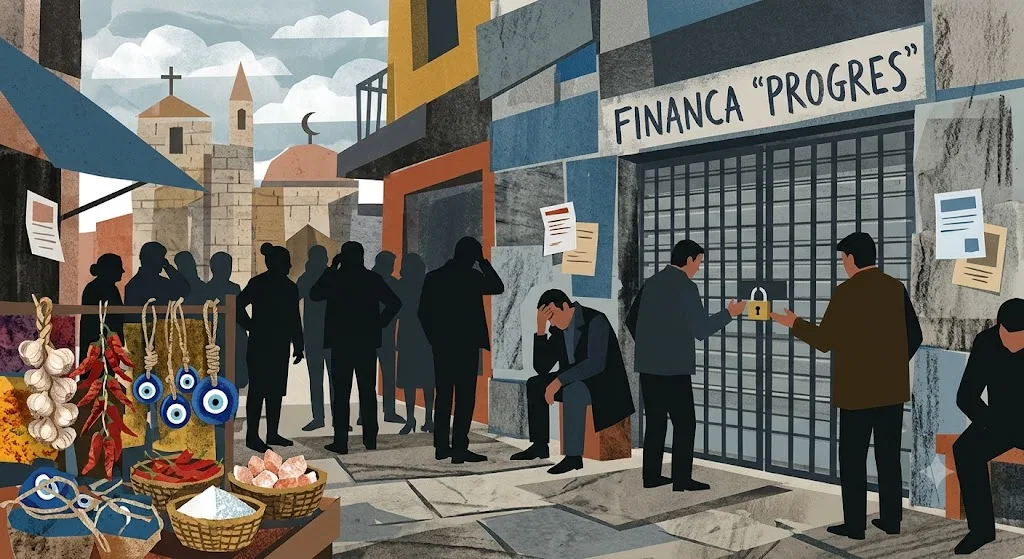
Albania’s clearest episode of contagious collective belief was not a witch craze or an outbreak of unexplained illness. It was the nationwide investment fever that preceded the collapse of fraudulent financial schemes in 1996–97.
Page outline Jump by section
Introduction
Other Albanian cases require more caution. Folklore contains witches, vampires and protective magic, but evidence for organised witch trials is exceptionally thin. Communist Albania, meanwhile, created its own state-driven campaign against supposedly backward religious beliefs. More recently, the presence of the Iranian opposition organisation MEK has generated competing claims about coercive control, security threats and politically motivated labelling. Albania’s history therefore shows why “mass hysteria” is often too crude a term: the relevant episodes range from fraud and political panic to folklore, repression and contested descriptions of closed groups.
When an investment belief consumed a country
After communist rule ended in the early 1990s, Albania entered capitalism with weak banks, little regulatory experience and a population largely unfamiliar with private finance. Formal banks could not meet the demand for credit, so informal lending networks expanded, often using money sent home by migrants. Some companies conducted real business alongside deposit-taking; others simply paid existing investors with money collected from newcomers. This blurred the boundary between plausible enterprise and outright fraud.[IMF]imf.orgThe Rise and Fall of Albania's Pyramid SchemesAt their peak, the nominal value of the pyramid schemes' liabilities amounted to almost half of the country's GDP.Read more…
The schemes spread because they appeared to work. Early investors received unusually large payments and told relatives, neighbours and colleagues. Visible offices, employees, shops and business ventures gave certain operators an air of substance. Senior politicians attended company events, some schemes contributed to the governing party, and the authorities failed to issue a firm public warning when international institutions raised concerns. Official tolerance made private suspicion easier to dismiss.[IMF]imf.orgThe Rise and Fall of Albania's Pyramid SchemesAt their peak, the nominal value of the pyramid schemes' liabilities amounted to almost half of the country's GDP.Read more…
By 1996, competition between operators had produced extraordinary promises. Some offered double-digit monthly returns; one promised to triple deposits within three months. People sold livestock and homes to invest. The nominal value of the schemes’ liabilities reached roughly $1.2 billion, while Albania’s population was only about 3.5 million. The phenomenon was not simply individual greed. Many households had endured decades of deprivation and isolation, and rapid economic change seemed to prove that previously unimaginable gains were possible.[IMF]imf.orgThe Rise and Fall of Pyramid Schemes in AlbaniaThe Rise and Fall of Pyramid Schemes in Albania - WP/99/98…
This is where the language of collective delusion becomes tempting but incomplete. Investors were not all irrational, and some schemes had real assets or had made regular payments for years. Participants also had reason to infer official approval from the government’s public behaviour. The belief became socially self-reinforcing: every successful withdrawal appeared to validate the system, while sceptics seemed to be missing a rare opportunity. In a confidence scheme, evidence of success is manufactured until the inflow of new money slows.

From confidence to panic
The first major defaults began late in 1996. Once depositors feared that others would withdraw first, the same social mechanism that had driven investment reversed direction. Confidence did not decline gently; it collapsed. Demonstrations intensified as people demanded repayment and accused the government of protecting or benefiting from the operators.[IMF]imf.orgThe Rise and Fall of Albania's Pyramid SchemesAt their peak, the nominal value of the pyramid schemes' liabilities amounted to almost half of the country's GDP.Read more…
By March 1997, government authority had broken down across much of southern Albania. Soldiers and police deserted, armouries were looted and vast quantities of weapons entered civilian hands. Public offices were attacked, economic activity was interrupted and the government resigned. Contemporary and retrospective estimates commonly place the death toll at around 2,000, although the violence included accidents, revenge killings, criminal disputes and political conflict rather than one simple confrontation between two organised sides.[IMF]imf.orgThe Rise and Fall of Albania's Pyramid SchemesAt their peak, the nominal value of the pyramid schemes' liabilities amounted to almost half of the country's GDP.Read more…
The crisis should therefore not be reduced to “a nation going mad”. Fraud created the losses, but institutional failure transformed those losses into a collapse of legitimacy. The authorities had not clearly separated lawful businesses from insolvent deposit-takers, had delayed action despite warnings, and could not convincingly present themselves as neutral protectors once the system failed. Anger spread through communities in which investors, police officers, soldiers and officials had often lost money together.
International forces later entered Albania to help secure humanitarian operations and elections, while foreign specialists assisted with the liquidation of the companies. The state refused a general bailout, partly because repaying every claimed deposit would have imposed enormous further costs. Output fell, inflation rose and thousands were impoverished, but the deepest injury was to trust: in government, finance and the promise that post-communist transition would bring predictable rules.[worldbank.org]documents1.worldbank.orgmulti pagemulti page
Witch belief without a national witch hunt
Albanian folklore contains many supernatural figures, including a vampiric witch believed to attack infants, revenants and spirits associated with illness, nightmares or the household. Protective practices recorded by folklorists included amulets, salt, garlic and religious prayers. Such traditions belong to oral culture and domestic explanations of misfortune; their existence does not prove that Albania experienced the kind of judicial witch panic found in parts of early modern Europe.[Wikipedia]WikipediaOpen source on wikipedia.org.
The most frequently repeated Albanian witch-persecution story concerns a woman killed near Kastrat in northern Albania around 1895. The account is traced to the French diplomat and traveller Alexandre Degrand, who reported that a husband accused his wife of witchcraft and burned her in a wooden tower. Important details remain uncertain, and the story is sometimes described as Albania’s only documented witch killing. That description should be treated cautiously: one traveller’s report can establish that an allegation circulated, but it cannot support claims about a broader organised hunt.[Wikipedia]WikipediaWitch of KastratiWitch of Kastrati
The distinction matters because later retellings often import the imagery of Salem or European witch trials into settings where the legal and social pattern was very different. Albania had harmful supernatural accusations, but the surviving evidence points more towards isolated violence, local folklore and family power than towards a sustained court-led campaign. The victim’s gender is nevertheless significant. Witch accusations have often provided culturally accepted explanations for illness or bad fortune while directing blame towards socially vulnerable women.
Folklore also changed as it passed into books, television and online entertainment. A traditional witch associated with childhood sickness can become a generic horror monster, detached from the conditions in which the belief once made sense. Modern popularity therefore demonstrates cultural survival, not continuing evidence of widespread literal belief.
The state campaign against religion and “superstition”
Under Enver Hoxha, Albania pursued one of communist Europe’s most sweeping anti-religious programmes. Religious institutions had faced restrictions and confiscation from the late 1940s, but the decisive campaign came in 1967, when organised worship was effectively prohibited and religious buildings were closed, repurposed or destroyed. The state presented religious practice, customary belief and clerical authority as obstacles to socialist modernity and national unity.[Country Studies]countrystudies.usCountry Studies Hoxha's Antireligious CampaignCountry Studies Hoxha's Antireligious Campaign
This was not a spontaneous moral panic from below. It was a centrally directed political campaign that used propaganda, youth mobilisation, surveillance and punishment. Yet it belongs in Albania’s history of contagious fear because the regime repeatedly constructed internal enemies whose supposed backwardness or disloyalty threatened the collective future. Religious people could be portrayed not merely as mistaken but as politically suspect.
The campaign also reveals a paradox. A government determined to eradicate “superstition” created an official belief system of its own: the party was treated as uniquely truthful, dissent was interpreted as treachery, and national survival was said to depend on ideological vigilance. The authorities replaced a diverse religious landscape with compulsory certainty rather than open scepticism.
Private practices did not disappear entirely. Families preserved prayers, rituals and identities in secret or disguised them as custom. When restrictions eased near the end of communist rule, religious observance re-emerged, demonstrating that public conformity had not always reflected private conviction. Albania’s state atheism is therefore best understood as coerced ideological discipline, not proof that an entire population freely abandoned belief.
When “cult” becomes a contested political label
The most prominent closed organisation currently associated with Albania is the People’s Mojahedin Organization of Iran, usually called the MEK. Thousands of its members were relocated from Iraq to Albania from 2013 onwards, eventually concentrating at a large compound near Manëz. The organisation presents itself as a democratic Iranian opposition movement. Critics, former members and some journalists have described it as authoritarian or cult-like, citing allegations of enforced separation, intense ideological discipline and punishment of dissent. The MEK rejects such descriptions and argues that they echo Iranian government propaganda.[hrw.org]hrw.orgmojahedin e khalq organization cooperate unmojahedin e khalq organization cooperate un
The evidence must be separated by time and place. Human Rights Watch documented abuses reported by former members of the organisation’s earlier camps in Iraq. More recent accounts from defectors describe continuing psychological pressure and restrictions, but access to the Albanian compound has been limited and claims are entangled in a hostile conflict between the MEK and the Iranian state. “Cult” may identify genuine concerns about coercive control, yet it can also become a weapon used to discredit political opponents.[hrw.org]hrw.orgmojahedin e khalq organization cooperate unmojahedin e khalq organization cooperate un
Albania’s role has also become a national-security issue. Albanian authorities accused Iran of involvement in planned attacks against MEK members and later blamed Tehran for major cyberattacks. In June 2023, Albanian police raided the MEK compound under a court order and seized computer equipment allegedly connected to activities prohibited under the group’s residence arrangements. The MEK disputed the authorities’ account, while the United States said Albania had the right to enforce its laws.[reuters.com]reuters.comAlbania says it foiled Iranian plot to attack exiled dissidentsAlbania says it foiled Iranian plot to attack exiled dissidents
This is not a conventional Albanian cult scare in which a new religion frightened the general public. It is a transnational conflict hosted on Albanian soil, involving refugees, political lobbying, cyberwarfare, security fears and allegations of internal coercion. The case demonstrates why neutral descriptions such as “exiled opposition organisation” or “closed political movement” are often more useful until a particular claim is specified and supported.
What Albania’s cases have in common
Albania’s episodes differ greatly, but several recurring conditions made contagious belief or fear more powerful.
Uncertainty created openings for confident explanations. Folklore explained illness or infant death; communism explained social difficulty through ideological enemies; pyramid operators claimed to reveal the secret of sudden prosperity.
Authority shaped credibility. A neighbour’s successful payout mattered, but the apparent approval of politicians mattered more. Communist propaganda had greater force because punishment backed it. Claims about the MEK carry different weight depending on whether they come from former members, the organisation itself, Albanian prosecutors or the Iranian state.
Closed information environments increased dependence. Hoxha’s Albania had been isolated from outside economic knowledge before the pyramid boom. The communist state tightly controlled public information. Closed movements can likewise restrict members’ ability to test leadership claims against independent sources.
Real grievances became attached to simplified stories. Poverty, institutional weakness, insecurity and political conflict were genuine. The mistake was not necessarily believing that a problem existed, but accepting a single cause, saviour or enemy without adequate scrutiny.
The 1997 disaster remains Albania’s most important example because collective belief had measurable national consequences. It was simultaneously a fraud epidemic, a confidence bubble, a political legitimacy crisis and a social panic. Witch folklore, state atheism and disputes over the MEK illuminate other parts of the same history, but they should not be forced into one diagnosis. Albania’s record is most revealing when each case is named precisely: isolated supernatural persecution, state-directed ideological repression, contagious financial speculation or contested allegations of coercive control.
Amazon book picks
Further Reading
Books and field guides related to When Fear and Belief Shook Albania. Use these as the next step if you want deeper reading beyond the article.
The Balkans: Nationalism, War and the Great Powers,
Places Albania's crises in regional historical context.

Free: Coming of Age at the End of History
Describes life through Albania's transition from communism.
Endnotes
1.
Source: imf.org
Title: The Rise and Fall of Albania’s Pyramid Schemes
Link:https://www.imf.org/external/pubs/ft/fandd/2000/03/pdf/jarvis.pdf
Source snippet
At their peak, the nominal value of the pyramid schemes' liabilities amounted to almost half of the country's GDP.Read more...
2.
Source: imf.org
Link:https://www.imf.org/en/news/articles/2015/09/14/01/49/pr9751
Source snippet
Press Release: IMF Approves Emergency Post Conflict...7 Nov 1997 — Despite warnings by the IMF and the World Bank, financial pyramid...
3.
Source: imf.org
Title: The Rise and Fall of Pyramid Schemes in Albania
Link:https://www.imf.org/external/pubs/ft/wp/1999/wp9998.pdf
Source snippet
The Rise and Fall of Pyramid Schemes in Albania - WP/99/98...
4.
Source: 1997-2001.state.gov
Link:https://1997-2001.state.gov/global/human_rights/1997_hrp_report/albania.html
5.
Source: Wikipedia
Link:https://en.wikipedia.org/wiki/Shtriga
6.
Source: Wikipedia
Title: Albanian folklore
Link:https://en.wikipedia.org/wiki/Albanian_folklore
7.
Source: Wikipedia
Title: Witch of Kastrati
Link:https://en.wikipedia.org/wiki/Witch_of_Kastrati
8.
Source: Wikipedia
Title: Irreligion in Albania
Link:https://en.wikipedia.org/wiki/Irreligion_in_Albania
9.
Source: reuters.com
Title: Albania says it foiled Iranian plot to attack exiled dissidents
Link:https://www.reuters.com/article/world/albania-says-it-foiled-iranian-plot-to-attack-exiled-dissidents-idUSKBN1X22CM/
10.
Source: Wikipedia
Title: Mass psychogenic illness
Link:https://en.wikipedia.org/wiki/Mass_psychogenic_illness
11.
Source: Wikipedia
Title: List of mass panic cases
Link:https://en.wikipedia.org/wiki/List_of_mass_panic_cases
12.
Source: Wikipedia
Title: 1997 Albanian civil unrest
Link:https://en.wikipedia.org/wiki/1997_Albanian_civil_unrest
13.
Source: Wikipedia
Title: Lev Tahor
Link:https://en.wikipedia.org/wiki/Lev_Tahor
14.
Source: Wikipedia
Title: Camp Ashraf 3
Link:https://en.wikipedia.org/wiki/Camp_Ashraf_3
15.
Source: state.gov
Link:https://www.state.gov/report/custom/5b173842aa
16.
Source: state.gov
Link:https://www.state.gov/report/custom/e353311b58
17.
Source: state.gov
Link:https://www.state.gov/report/custom/305c0462b7
18.
Source: state.gov
Title: north macedonia
Link:https://www.state.gov/reports/2022-country-reports-on-human-rights-practices/north-macedonia
19.
Source: state.gov
Title: ALBANIA 2018 INTERNATIONAL RELIGIOUS FREEDOM REPORT
Link:https://www.state.gov/wp-content/uploads/2019/05/ALBANIA-2018-INTERNATIONAL-RELIGIOUS-FREEDOM-REPORT.pdf
20.
Source: 2001-2009.state.gov
Link:https://2001-2009.state.gov/g/drl/rls/irf/2005/51536.htm
21.
Source: elibrary.imf.org
Title: article A001 en.xml
Link:https://www.elibrary.imf.org/view/journals/024/2000/002/article-A001-en.xml
22.
Source: elibrary.imf.org
Title: article A014 en.xml
Link:https://www.elibrary.imf.org/view/journals/023/0028/021/article-A014-en.xml
23.
Source: elibrary.imf.org
Title: article A001 en.xml
Link:https://www.elibrary.imf.org/view/journals/001/2010/077/article-A001-en.xml
24.
Source: elibrary.imf.org
Title: article A001 en.xml
Link:https://www.elibrary.imf.org/view/journals/002/1999/069/article-A001-en.xml
25.
Source: elibrary.imf.org
Link:https://www.elibrary.imf.org/display/book/9781616353810/ch022.xml
26.
Source: elibrary.imf.org
Title: article A001 en.xml
Link:https://www.elibrary.imf.org/view/journals/002/2005/088/article-A001-en.xml
27.
Source: imf.org
Link:https://www.imf.org/external/pubs/ft/scr/2004/cr04206.pdf
28.
Source: reuters.com
Title: albania drug trafficking network dismantled by european police 2023 06 23
Link:https://www.reuters.com/world/europe/albania-drug-trafficking-network-dismantled-by-european-police-2023-06-23/
29.
Source: history.com
Title: what was satanic panic 1980s
Link:https://www.history.com/articles/what-was-satanic-panic-1980s
30.
Source: researchbriefings.files.parliament.uk
Title: RP97 59
Link:https://researchbriefings.files.parliament.uk/documents/RP97-59/RP97-59.pdf
Source snippet
Research BriefingsAlbania Research Paper 97/59 14 May 199714 May 1997 — At the beginning of 1997 the collapse of several fraudulent pyram...
Published: May 1997
31.
Source: documents1.worldbank.org
Title: World Bank Albania Country Assistance Evaluation
Link:https://documents1.worldbank.org/curated/en/746131468768319009/pdf/Albania-Country-assistance-evaluation.pdf
Source snippet
World BankAlbania Country Assistance Evaluation - World Bank Document15 Jul 1998 — Until the collapse of the pyramid schemes at the end o...
32.
Source: documents1.worldbank.org
Title: multi page
Link:https://documents1.worldbank.org/curated/en/758781468009309865/pdf/multi-page.pdf
33.
Source: countrystudies.us
Title: Country Studies Hoxha’s Antireligious Campaign
Link:https://countrystudies.us/albania/56.htm
34.
Source: hrw.org
Title: mojahedin e khalq organization cooperate un
Link:https://www.hrw.org/news/2011/11/30/iraq/mojahedin-e-khalq-organization-cooperate-un
35.
Source: lemonde.fr
Link:https://www.lemonde.fr/en/international/article/2024/06/23/we-the-child-soldiers-of-the-people-s-mujahedeen-of-iran_6675506_4.html
36.
Source: apnews.com
Title: albania mek iranian opposition police raid 851dcb5fc32cd6bc60206e342eea7b16
Link:https://apnews.com/article/albania-mek-iranian-opposition-police-raid-851dcb5fc32cd6bc60206e342eea7b16
37.
Source: apnews.com
Link:https://apnews.com/article/cc1a03b58bd753bbe935ad74f1abc0f7
38.
Source: hrw.org
Title: iran two kurdish women risk execution
Link:https://www.hrw.org/news/2025/01/22/iran-two-kurdish-women-risk-execution
39.
Source: hrw.org
Title: us holding detainees ten major facilities across iraq
Link:https://www.hrw.org/news/2004/05/07/us-holding-detainees-ten-major-facilities-across-iraq
40.
Source: documents1.worldbank.org
Title: multi page
Link:https://documents1.worldbank.org/curated/en/380281468006293107/pdf/multi-page.pdf
41.
Source: documents1.worldbank.org
Link:https://documents1.worldbank.org/curated/en/129641468005980890/pdf/multi0page.pdf
42.
Source: documents1.worldbank.org
Link:https://documents1.worldbank.org/curated/en/771871468768318379/pdf/262530AL0ICR.pdf
43.
Source: documents1.worldbank.org
Link:https://documents1.worldbank.org/curated/en/900451468768316767/pdf/29638.pdf
44.
Source: documents1.worldbank.org
Title: multi page
Link:https://documents1.worldbank.org/curated/en/952321468768673016/pdf/multi-page.pdf
45.
Source: documents1.worldbank.org
Link:https://documents1.worldbank.org/curated/en/310511468004501891/pdf/multi0page.pdf
46.
Source: documents1.worldbank.org
Link:https://documents1.worldbank.org/curated/en/180221468009308906/pdf/34329.pdf
47.
Source: documents1.worldbank.org
Title: multi page
Link:https://documents1.worldbank.org/curated/en/285261468204576078/pdf/multi-page.pdf
48.
Source: ebsco.com
Title: moral panic
Link:https://www.ebsco.com/research-starters/social-sciences-and-humanities/moral-panic
49.
Source: unnaturalworld.fandom.com
Link:https://unnaturalworld.fandom.com/wiki/Shtriga
50.
Source: youtube.com
Link:https://www.youtube.com/watch?v=_Gpf7lhUKiQ
51.
Source: markberepeterson.com
Link:https://markberepeterson.com/2021/04/24/shtriga/
Additional References
52.
Source: ft.com
Link:https://www.ft.com/content/199b6c9f-fe1a-402f-9ea1-c77ea8cba334
Source snippet
Hosted by Robin Wigglesworth and Ortenca Aliaj, the episode recounts how Albania's transition from an isolated communist regime to a free...
53.
Source: youtube.com
Title: The Scam That Collapsed a Country | Albania Pyramid Scheme | Sketchy Economics
Link:https://www.youtube.com/watch?v=okJQKM9yXCc
Source snippet
Albania pyramid schemes 1997 financial crisis The Ponzi Scam That Turned Albania Into WAR | 1997 Collapse Historic Wealth...
54.
Source: theguardian.com
Title: The Guardian Terrorists, cultists
Link:https://www.theguardian.com/news/2018/nov/09/mek-iran-revolution-regime-trump-rajavi
Source snippet
Over the years, the MEK evolved into a cult-like organization, accused by defectors and human rights groups of authoritarian control, tor...
55.
Source: youtube.com
Link:https://www.youtube.com/watch?v=yHtWfJDFxA8
Source snippet
The Scam That Collapsed a Country | Albania Pyramid Scheme | Sketchy Economics...
56.
Source: youtube.com
Title: ALBANIA: 13TH DAY OF PROTESTS OVER PYRAMID INVESTMENT SCHEME
Link:https://www.youtube.com/watch?v=ee5mXEjdVUY
Source snippet
Albania 1997: The Ponzi Scheme That Destroyed a Country | Ponzinomics Ep.11...
57.
Source: youtube.com
Link:https://www.youtube.com/watch?v=772nzWsSK5g
Source snippet
The Pyramid Scheme That Ruined A Country...
58.
Source: instagram.com
Link:https://www.instagram.com/p/DHRBx-QgW9A/?hl=en
59.
Source: researchgate.net
Link:https://www.researchgate.net/publication/320587525The_Activity_of_Pyramid_Schemes_in_Albania_1992-_1997_and_the_Effects_of_Their_Decline
60.
Source: unhcr.org
Link:https://www.unhcr.org/sites/default/files/2024-05/2023_OSE_Mapping-Prt-Services_v12_en.pdf
61.
Source: reddit.com
Link:https://www.reddit.com/r/europe/comments/1dr83cr/albania_is_no_longer_a_muslim_majority_country/
Topic Tree
Follow this branch
Related pages 192
- Antigua and Barbuda
- Argentina Belief Scares
- Azerbaijan Belief
- Bahrain Beliefs
- North Korea
- +187 more in sidebar