Within Nepal Belief Panics
Why Do Illness Outbreaks Spread Through Schools?
Nepal's school outbreaks show how real physical symptoms can spread through fear, expectation and shared social pressure.
On this page
- What pupils experienced during the outbreaks
- How symptoms spread without a clear physical cause
- What schools and health teams can do
Page outline Jump by section
Introduction
Nepal has some of the best-documented recurring school outbreaks of mass psychogenic illness (MPI), sometimes historically described as “mass hysteria”. These episodes involve genuine physical and emotional symptoms that spread rapidly through groups of pupils despite investigations finding no infectious disease, poisoning or other single physical cause. The symptoms are real, but the pattern points towards a combination of psychological distress, social contagion and cultural expectations rather than a contagious pathogen. Repeated outbreaks in Nepali schools have therefore become an important case study for psychiatrists, psychologists and public health researchers seeking to understand how distress can spread through close-knit communities.[Frontiers]frontiersin.orgFrontiersFrontiers | Characteristics of Adolescents Affected by Mass Psychogenic Illness Outbreaks in Schools in Nepal: A Case-Control St…
Unlike isolated incidents elsewhere, Nepal has experienced multiple outbreaks over many years, allowing researchers to compare cases, examine possible risk factors and observe why some schools experience repeated episodes while others do not. The evidence suggests that these events are best understood as interactions between individual vulnerability, stressful social environments and locally meaningful ways of interpreting illness, rather than as simple examples of either supernatural belief or individual mental illness.[Frontiers]frontiersin.orgFrontiersFrontiers | Characteristics of Adolescents Affected by Mass Psychogenic Illness Outbreaks in Schools in Nepal: A Case-Control St…
What pupils experienced during the outbreaks
Across documented Nepali school outbreaks, pupils have reported remarkably similar experiences. Common symptoms include:
- Sudden fainting or collapse.
- Crying, screaming or shouting.
- Trembling and shaking.
- Apparent seizures or uncontrolled body movements.
- Weakness or inability to stand.
- Temporary loss of responsiveness.
- Trance-like behaviour or confusion.
- Difficulty breathing or chest discomfort.
These symptoms can be frightening for pupils, teachers and families because they closely resemble neurological disease, poisoning or epilepsy. Medical investigators therefore stress that physical causes must always be excluded before concluding that an outbreak represents mass psychogenic illness.[PMC]pmc.ncbi.nlm.nih.govPMCRecurrent mass hysteria in schoolchildren in Western NepalPMCRecurrent mass hysteria in schoolchildren in Western Nepal
One of Nepal’s best-known episodes occurred in a rural school in Pyuthan District. The outbreak reportedly began when a nine-year-old girl developed intense crying and shouting during school hours. Other children rapidly developed similar symptoms, and 47 pupils were affected on the same day, including 37 girls and 10 boys. What made this case particularly important was not simply its size but the fact that similar episodes reportedly returned over several consecutive years, making it an unusually well-documented example of recurrent school outbreaks.[PMC]pmc.ncbi.nlm.nih.govPMCRecurrent mass hysteria in schoolchildren in Western NepalPMCRecurrent mass hysteria in schoolchildren in Western Nepal
More recently, clinicians described another recurrent outbreak in a secondary school in Palpa. An initial student diagnosed with severe psychological illness was followed within days by similar symptoms among classmates, culminating in a larger episode during a school assembly. The case illustrates how recurring outbreaks continue to occur despite growing medical awareness of the phenomenon.[Jnma]jnma.com.npRecurrent Mass Hysteria in A Secondary School in Nepal: A Case Report | Journal of Nepal Medical AssociationSeptember 28, 2025…
How symptoms spread without a clear physical cause
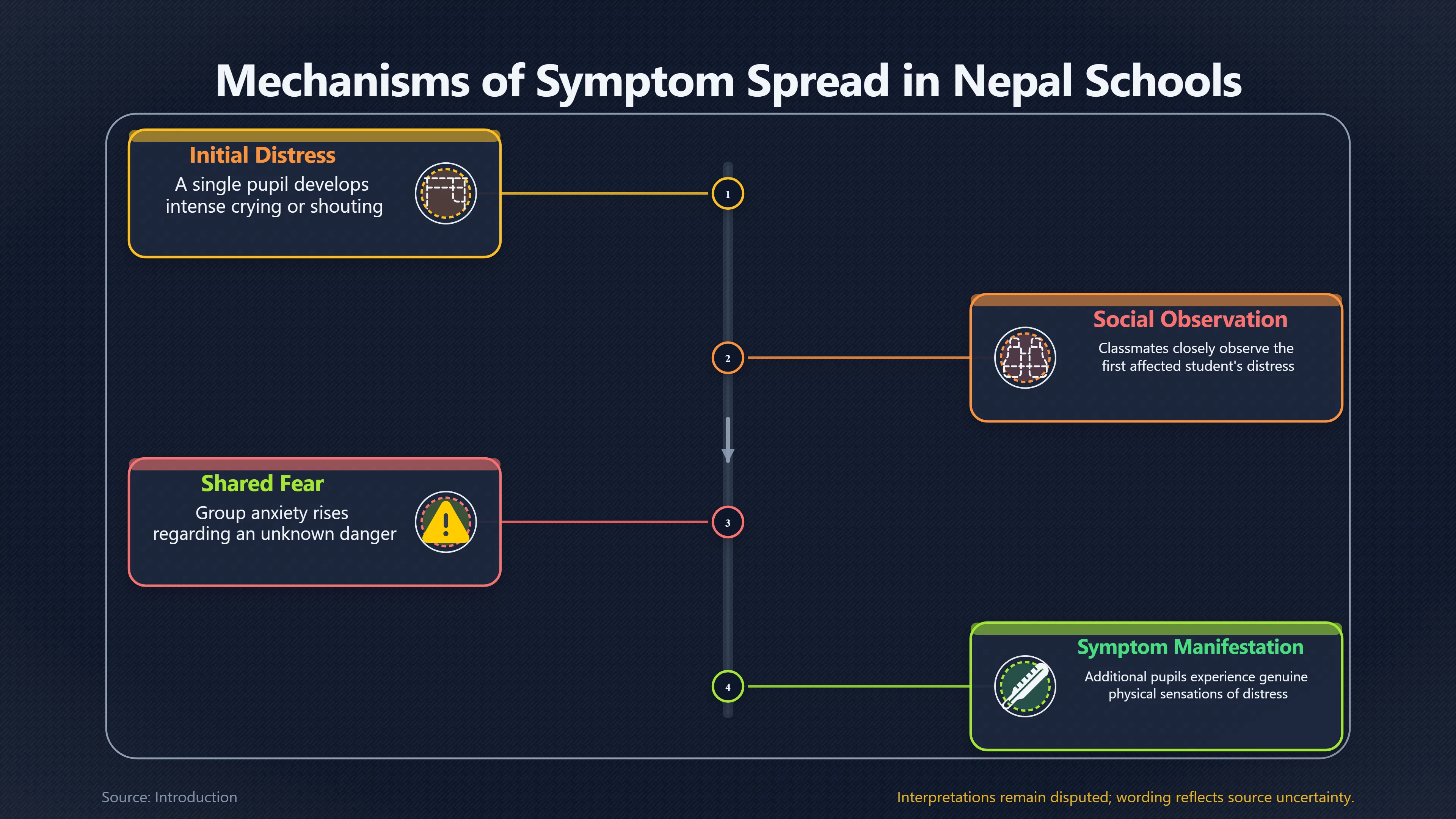
Researchers describe these events as examples of mass psychogenic illness because symptoms appear to spread through social contact rather than through bacteria, viruses or toxins. The first affected pupil often becomes the focus of intense attention. Other pupils witness distress, interpret it through shared expectations and may begin experiencing similar symptoms themselves.
This process does not involve conscious imitation. Instead, researchers argue that stress, fear and heightened attention to bodily sensations interact with normal neurological processes. In tightly connected environments such as classrooms, children constantly observe one another’s emotional reactions. Once concern spreads through the group, additional pupils may genuinely experience dizziness, weakness, trembling or loss of control.[Frontiers]frontiersin.orgFrontiersFrontiers | Characteristics of Adolescents Affected by Mass Psychogenic Illness Outbreaks in Schools in Nepal: A Case-Control St…
Nepali researchers emphasise that the spread depends on several interacting influences rather than a single trigger:
- Close observation of affected classmates.
- Shared fear that an unknown danger is present.
- Existing emotional stress.
- Cultural expectations about possession, spirits or unexplained illness.
- Intense media or community attention after the first cases.
- Repeated discussion among pupils, teachers and families.
Because schools bring together large groups of adolescents who share similar routines and social networks, they provide conditions in which emotional contagion can spread rapidly once anxiety becomes established.[Frontiers]frontiersin.orgFrontiersFrontiers | Characteristics of Adolescents Affected by Mass Psychogenic Illness Outbreaks in Schools in Nepal: A Case-Control St…
Why some schools experience repeated outbreaks
One of the most interesting features of Nepal’s experience is recurrence. Many outbreaks are not isolated events but return to the same schools months or years later.
Researchers do not believe recurrence means that schools become permanently “infected” by psychogenic illness. Instead, previous episodes may create expectations that another outbreak could happen. Teachers, pupils and parents remember earlier events, making unusual symptoms easier to interpret through the same framework. This expectation may lower the threshold for another episode when new stresses emerge.[PMC]pmc.ncbi.nlm.nih.govPMCRecurrent mass hysteria in schoolchildren in Western NepalPMCRecurrent mass hysteria in schoolchildren in Western Nepal
The surrounding community also plays an important role. In some areas, unexplained illness may be interpreted through beliefs involving spirits, possession or supernatural influence. These interpretations are meaningful within local culture and shape decisions about whether families seek hospital treatment, traditional healing, religious rituals or several approaches simultaneously. Researchers argue that these explanatory models influence how outbreaks develop without implying that cultural beliefs themselves cause the symptoms.[Frontiers]frontiersin.orgFrontiersFrontiers | Characteristics of Adolescents Affected by Mass Psychogenic Illness Outbreaks in Schools in Nepal: A Case-Control St…
What research has found about affected pupils
Nepal has produced unusually strong evidence because researchers carried out the first systematic case-control study of school-based mass psychogenic illness in the country. The study compared 194 affected pupils with 190 unaffected classmates from 12 public schools.
Several characteristics appeared more common among affected pupils, including:
- Greater exposure to childhood neglect or abuse.
- Higher levels of depressive symptoms.
- More symptoms associated with post-traumatic stress.
- More dissociative experiences.
- Greater likelihood of living in nuclear rather than extended families.
However, no single factor consistently predicted who would become ill. Even variables that showed strong statistical associations failed to explain most cases when analysed together. The researchers concluded that existing theories based solely on dissociation or personality traits cannot fully account for these outbreaks and that broader social, cultural, family and school influences remain essential to understanding them.[Frontiers]frontiersin.orgFrontiersFrontiers | Characteristics of Adolescents Affected by Mass Psychogenic Illness Outbreaks in Schools in Nepal: A Case-Control St…
This finding is important because it challenges older stereotypes that dismissed such episodes simply as “hysteria”. Instead, the evidence suggests that multiple forms of vulnerability interact with stressful environments and social contagion.
What schools and health teams can do
Experience from Nepal has gradually shifted responses away from fear and towards coordinated assessment.
Health teams generally recommend several priorities:
- Exclude genuine medical causes first. Potential poisoning, infection, epilepsy and environmental hazards should always be investigated before diagnosing mass psychogenic illness.[PMC]pmc.ncbi.nlm.nih.govPMCRecurrent mass hysteria in schoolchildren in Western NepalPMCRecurrent mass hysteria in schoolchildren in Western Nepal
- Reduce panic. Calm communication with pupils, staff and parents helps prevent anxiety from escalating.
- Provide reassurance without dismissing symptoms. The physical experiences are genuine, even when no physical disease is identified.
- Limit unnecessary crowding and observation. Large audiences and intense attention may unintentionally reinforce symptom spread.
- Offer psychological support. Counselling for affected pupils and attention to broader school stressors may reduce future vulnerability.
- Work with local communities. Effective responses recognise local beliefs while also providing clear medical explanations, rather than treating cultural interpretations with contempt.[Frontiers]frontiersin.orgFrontiersFrontiers | Characteristics of Adolescents Affected by Mass Psychogenic Illness Outbreaks in Schools in Nepal: A Case-Control St…
Researchers also argue that improving adolescent mental health services, strengthening relationships between schools and families and reducing stigma surrounding emotional distress may lessen the conditions that allow recurrent outbreaks to develop.[Frontiers]frontiersin.orgFrontiersFrontiers | Characteristics of Adolescents Affected by Mass Psychogenic Illness Outbreaks in Schools in Nepal: A Case-Control St…
Why these outbreaks remain important
Nepal’s recurring school outbreaks have become internationally significant because they provide unusually detailed evidence about how collective distress develops. They demonstrate that physical symptoms can spread through shared fear, expectation and social interaction without implying that affected children are pretending or imagining their illness.
The country’s experience has also encouraged a more balanced understanding of mass psychogenic illness. Rather than viewing it as either a mysterious supernatural event or a simple psychological curiosity, current research presents it as a complex interaction between individual distress, school environments, cultural meaning and group dynamics. That combination explains why Nepal’s recurring school outbreaks continue to be cited as some of the clearest documented examples of contagious distress in educational settings.[frontiersin.org]frontiersin.orgFrontiersFrontiers | Characteristics of Adolescents Affected by Mass Psychogenic Illness Outbreaks in Schools in Nepal: A Case-Control St…
Amazon book picks
Further Reading
Books and field guides related to Why Do Illness Outbreaks Spread Through Schools?. Use these as the next step if you want deeper reading beyond the article.

It's All in Your Head
Provides a compassionate explanation of how psychological distress can produce real neurological and bodily symptoms without identifiable...

Mass psychogenic illness
Focuses explicitly on the theories, research methods and social-psychological mechanisms behind mass psychogenic illness outbreaks.

The Sleeping Beauties
Explores genuine physical symptoms without a clear organic cause, including illnesses shaped by psychological, social and cultural forces.
Little Green Men, Meowing Nuns and Head-Hunting Panics
Directly examines mass psychogenic illness in schools, workplaces and communities, explaining how symptoms and fears spread through groups.
Endnotes
1.
Source: pmc.ncbi.nlm.nih.gov
Title: PMCRecurrent mass hysteria in schoolchildren in Western Nepal
Link:https://pmc.ncbi.nlm.nih.gov/articles/PMC7368451/
2.
Source: pmc.ncbi.nlm.nih.gov
Title: PMCRecurrent Mass Hysteria in a Secondary School in Nepal: A Case Report
Link:https://pmc.ncbi.nlm.nih.gov/articles/PMC12860665/
Source snippet
2025 Sep 1;63(290):773–775. doi: 10.31729/jnma.v63i290.9205 RECURRENT MASS HYSTERIA IN A SECONDARY SCHOOL IN NEPAL: A CASE REPORT Samata...
3.
Source: who.int
Link:https://www.who.int/southeastasia/news/feature-stories/detail/from-outbreak-to-control-a-rapid-reactive-ocv-campaign-in-madhesh-province-nepal
Source snippet
April 17, 2026 — FROM OUTBREAK TO CONTROL: A RAPID, REACTIVE OCV CAMPAIGN IN MADHESH PROVINCE, NEPAL 17 April 2026 Reading time: On 22 Au...
Published: April 17, 2026
4.
Source: who.int
Title: How early action contained a measles outbreak in Nepal’s Sarlahi
Link:https://www.who.int/nepal/news/detail/16-02-2026-how-early-action-contained-a-measles-outbreak-in-nepal-s-sarlahi
Source snippet
February 16, 2026 — HOW EARLY ACTION CONTAINED A MEASLES OUTBREAK IN NEPAL’S SARLAHI 16 February 2026 Nepal’s rapid detection and respons...
Published: February 16, 2026
5.
Source: who.int
Title: Measles – Nepal
Link:https://www.who.int/emergencies/disease-outbreak-news/item/2023-DON446
6.
Source: frontiersin.org
Link:https://www.frontiersin.org/journals/psychiatry/articles/10.3389/fpsyt.2020.493094/full
Source snippet
FrontiersFrontiers | Characteristics of Adolescents Affected by Mass Psychogenic Illness Outbreaks in Schools in Nepal: A Case-Control St...
7.
Source: jnma.com.np
Link:https://jnma.com.np/jnma/index.php/jnma/article/view/9205
Source snippet
Recurrent Mass Hysteria in A Secondary School in Nepal: A Case Report | Journal of Nepal Medical AssociationSeptember 28, 2025...
Published: September 28, 2025
8.
Source: pubmed.ncbi.nlm.nih.gov
Link:https://pubmed.ncbi.nlm.nih.gov/33312130/
Source snippet
Characteristics of Adolescents Affected by Mass Psychogenic Illness Outbreaks in Schools in Nepal: A Case-Control Study - PubMed...
9.
Source: pubmed.ncbi.nlm.nih.gov
Link:https://pubmed.ncbi.nlm.nih.gov/41783641/
Source snippet
2025 Oct;63(290):773-775. doi: 10.31729/jnma.v63i290.9205. Epub 2025 Sep 1. RECURRENT MASS HYSTERIA IN A SECONDARY SCHOOL IN NEPAL: A CAS...
10.
Source: pmc.ncbi.nlm.nih.gov
Link:https://pmc.ncbi.nlm.nih.gov/articles/PMC7704439/
11.
Source: frontiersin.org
Title: Mass Psychogenic Illness | List of Frontiers open access articles
Link:https://www.frontiersin.org/subjects/mass-psychogenic-illness
12.
Source: doi.org
Link:https://doi.org/10.3389/fpsyt.2020.493094?urlappend=%3Futm_source%3Dresearchgate.net%26utm_medium%3Darticle
13.
Source: frontiersin.org
Link:https://www.frontiersin.org/subjects/psychogenic
Additional References
14.
Source: researchgate.net
Link:https://www.researchgate.net/publication/372510216_A_Systematic_Review_of_Research_Developments_in_Mass_Psychogenic_Illness
15.
Source: researchgate.net
Link:https://www.researchgate.net/publication/345758317_Characteristics_of_Adolescents_Affected_by_Mass_Psychogenic_Illness_Outbreaks_in_Schools_in_Nepal_A_Case-Control_Study
16.
Source: sciencedirect.com
Link:https://www.sciencedirect.com/science/article/pii/S2667242123000416
17.
Source: mendeley.com
Link:https://www.mendeley.com/catalogue/392de242-0b23-36a9-831a-af6b5cf3910b/
18.
Source: patrinum.ch
Link:https://patrinum.ch/record/479474
19.
Source: research.usc.edu.au
Link:https://research.usc.edu.au/esploro/outputs/journalArticle/Characteristics-of-Adolescents-Affected-by-Mass/991105844202621
20.
Source: researchgate.net
Title: (PDF) Recurrent mass hysteria in schoolchildren in Western Nepal
Link:https://www.researchgate.net/publication/341408747_Recurrent_mass_hysteria_in_schoolchildren_in_Western_Nepal
21.
Source: youtube.com
Link:https://www.youtube.com/watch?v=3BD0_2Ehfsc
22.
Source: youtube.com
Link:https://www.youtube.com/watch?v=DOH1gqrw9UI
23.
Source: youtube.com
Link:https://www.youtube.com/watch?v=JcKL8ihDL2Y
Topic Tree