Within Serbian Panics
How Serbian Vampire Scares Conquered Europe
Village deaths, opened graves and military reports turned Serbian vampire fears into a sensation across eighteenth-century Europe.
On this page
- The Kisiljevo and Medvedja outbreaks
- Why villagers opened and destroyed graves
- How Habsburg reports spread the vampire story
Page outline Jump by section
Introduction
The best-known vampire stories in European culture did not begin with Gothic novels or Count Dracula. They emerged from a series of real investigations in Serbian villages during the 1720s and early 1730s, when clusters of unexplained deaths convinced frightened communities that the dead were returning to kill the living. What made these episodes historically unusual was not simply the belief itself, but the fact that Habsburg military officers and surgeons documented the events in official reports. Those reports travelled across Europe, turning local fears into an international debate among doctors, theologians and journalists. Within a few years, the “Serbian vampire” had become one of the Enlightenment’s most discussed supernatural mysteries, laying the foundations for the modern European vampire legend.[Cambridge University Press & Assessment]cambridge.orgCambridge University Press & AssessmentVampire Country: Borders of Culture and Power in Central Europe (Chapter 1) - Metamorphoses of the…

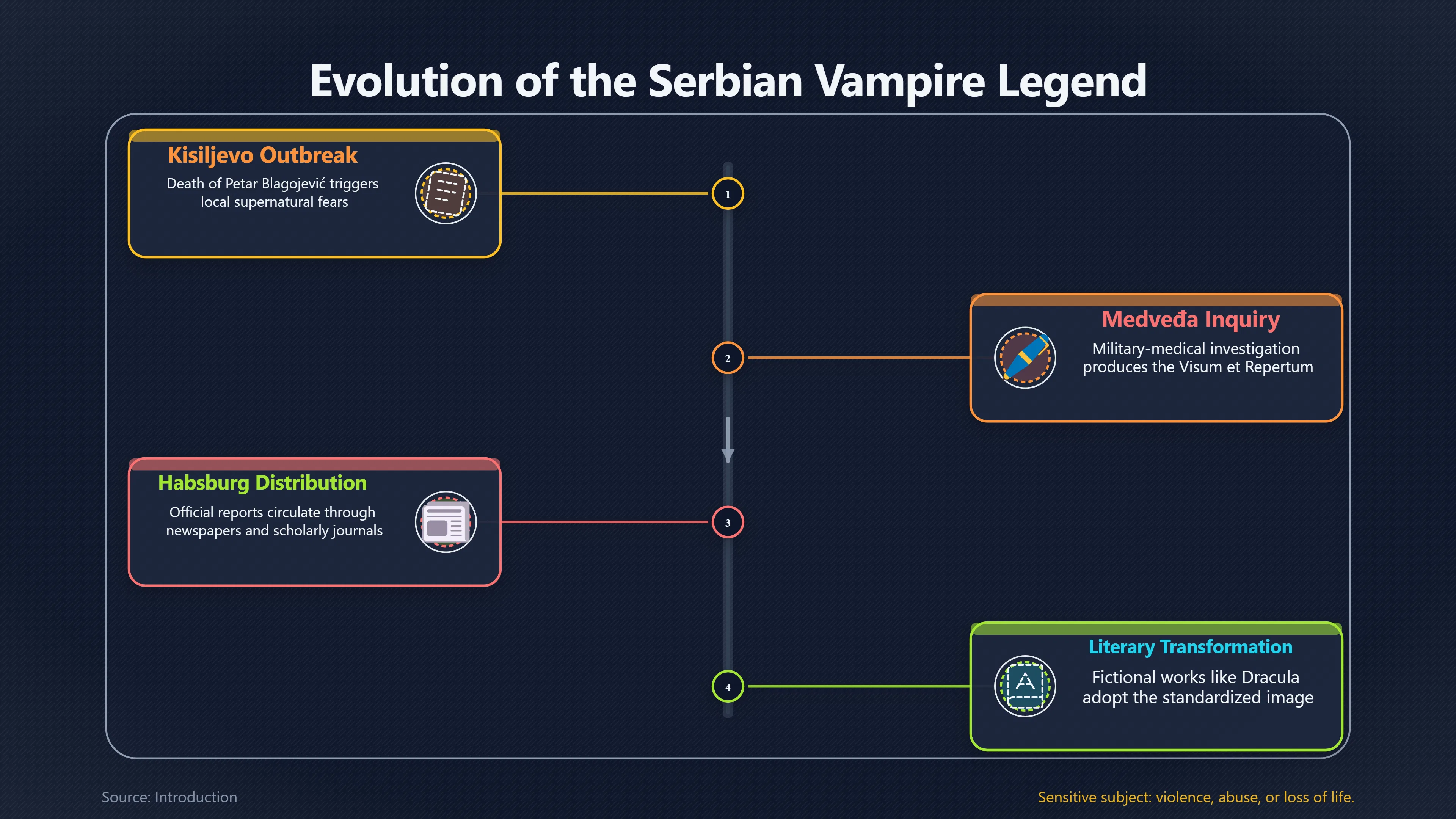
The Kisiljevo and Medveđa outbreaks
Two investigations transformed scattered folklore into a European phenomenon.
The first occurred in Kisiljevo in 1725 after the death of the peasant Petar Blagojević. Villagers claimed that several people died shortly after reporting nocturnal attacks by the deceased. They insisted that Austrian official Ernst Frombald witness the exhumation. His report described a body that appeared unusually well preserved, with apparent fresh blood around the mouth and features that villagers interpreted as proof of vampirism. Although Frombald did not endorse their supernatural explanation, he recorded the villagers’ testimony and acknowledged that refusing their demands might provoke panic or even cause the settlement to be abandoned.[Cambridge University Press & Assessment]cambridge.orgCambridge University Press & AssessmentVampire Country: Borders of Culture and Power in Central Europe (Chapter 1) - Metamorphoses of the…
The second and even more influential case unfolded near Medveđa several years later. Villagers blamed the former soldier Arnold (Arnod) Paole for a succession of deaths after claiming he had previously been attacked by a vampire himself. His grave had already been opened once, but renewed deaths prompted a formal military-medical inquiry in 1732. The resulting report, known as Visum et Repertum, described several exhumed bodies that investigators considered remarkably undecayed and containing liquid blood. Rather than remaining a local administrative document, the report circulated widely through the Habsburg Empire and beyond, becoming one of the most influential texts in the history of vampire belief.[PubMed]pubmed.ncbi.nlm.nih.govPub Med The frightening borderlands of Enlightenment: the vampire problemThe frightening borderlands of Enlightenment: the vampire problem - PubMed…
These cases differed from many earlier folk traditions because they generated written evidence produced by state officials. Readers across Europe encountered what appeared to be eyewitness testimony from surgeons and military administrators rather than anonymous village legends.
Why villagers opened and destroyed graves
Modern readers often imagine vampire hunts as irrational violence, yet within eighteenth-century Serbian villages the exhumations followed a recognisable local logic.
Communities faced sudden clusters of deaths at a time when epidemics, poor nutrition and limited medical knowledge made mortality unpredictable. If several healthy people died in rapid succession, villagers searched for an explanation that connected the deaths into a single narrative. The vampire offered precisely that explanation.
Opening graves served several purposes at once:
- It identified a supposed cause of the deaths.
- It allowed neighbours to inspect the body for recognised signs of vampirism, such as apparent lack of decay or blood around the mouth.
- It provided a practical remedy through staking, decapitation or burning, actions believed to end the attacks.
- It reassured the surviving community that something effective had been done.
Many of the physical features described as evidence of vampirism are now understood as ordinary stages of decomposition. Bodies buried during cold weather or in particular soil conditions can decompose slowly. Skin retracting from nails and hair can create the illusion of growth, while gases produced during decomposition may force blood-stained fluids from the mouth. These natural processes were poorly understood by eighteenth-century observers, including many trained physicians.[PubMed]pubmed.ncbi.nlm.nih.govPub Med The frightening borderlands of Enlightenment: the vampire problemThe frightening borderlands of Enlightenment: the vampire problem - PubMed…
The villagers were therefore interpreting genuine physical observations through the medical and religious knowledge available to them rather than inventing evidence from nothing.
How Habsburg reports spread the vampire story
The vampire scares became famous because they occurred on the Habsburg military frontier, where bureaucratic administration required written reports.
Officials investigating unexplained deaths produced correspondence for higher authorities in Belgrade and Vienna. Military surgeons examined corpses, local priests witnessed exhumations, and administrators documented villagers’ testimony. Once copied and circulated, these reports entered newspapers, pamphlets and scholarly journals throughout Central Europe.[Cambridge University Press & Assessment]cambridge.orgCambridge University Press & AssessmentVampire Country: Borders of Culture and Power in Central Europe (Chapter 1) - Metamorphoses of the…
For educated readers during the Enlightenment, this created an unusual dilemma. The reports carried official signatures and appeared to describe careful observation, yet they supported conclusions that challenged accepted ideas about nature. Rather than dismissing the stories immediately, physicians, philosophers and theologians debated whether the observations reflected fraud, misunderstanding, disease or genuine supernatural events.
The discussions spread rapidly across German-speaking Europe and France. Medical treatises analysed the reports, while satirists mocked both popular belief and learned attempts to explain it. The controversy helped introduce both the word “vampire” and a more standardised image of the creature into European intellectual life.[Cambridge University Press & Assessment]cambridge.orgCambridge University Press & AssessmentVampires and Satire in the Enlightenment and Romanticism (Chapter 2) - Metamorphoses of the Vampir…
Why the panic spread beyond the villages
The Serbian outbreaks were not simply examples of isolated superstition. Several broader historical conditions helped transform local fears into an international sensation.
The affected settlements had only recently passed from Ottoman to Habsburg rule after years of warfare. Frontier communities experienced population movement, insecurity and periodic disease outbreaks, while imperial authorities were still establishing administrative control. In this environment, village customs met an expanding state bureaucracy that preserved local beliefs in official documents instead of allowing them to disappear into oral tradition.[Cambridge University Press & Assessment]cambridge.orgCambridge University Press & AssessmentVampire Country: Borders of Culture and Power in Central Europe (Chapter 1) - Metamorphoses of the…
Equally important was the tension between Enlightenment rationalism and persistent folk belief. Educated Europeans increasingly expected natural explanations for unusual events, yet the vampire reports appeared to come from credible officials rather than storytellers. The resulting controversy reflected not simply belief in monsters but uncertainty about the limits of contemporary medical knowledge.
Historians therefore view the vampire scares as episodes where social fear, unfamiliar disease, incomplete scientific understanding and expanding state administration reinforced one another rather than as straightforward examples of collective irrationality.

From Serbian village scare to European legend
The vampire that entered nineteenth-century literature was very different from the figure feared in eighteenth-century Serbia.
The Serbian vampire was usually imagined as a recently deceased neighbour who returned to attack relatives or fellow villagers during outbreaks of unexplained illness. It was a communal threat rooted in everyday rural life rather than an aristocratic predator.
As the stories travelled west, writers transformed this figure into a more sophisticated literary character. The vampire became mysterious, seductive and psychologically complex in works such as John Polidori’s The Vampyre and, later, Bram Stoker’s Dracula. Although these fictional vampires differed greatly from the Serbian originals, the chain of influence can be traced back to the official reports from Kisiljevo and Medveđa, which first persuaded European readers that “vampires” were a subject worthy of serious discussion.[Cambridge University Press & Assessment]cambridge.orgCambridge University Press & AssessmentThe Mutation of the Vampire in Nineteenth-Century Gothic (2.3) - The Cambridge History of the Goth…
How historians interpret the scares today
Modern scholarship generally rejects supernatural explanations while taking the historical events themselves very seriously.
Researchers broadly agree that the investigations were genuine administrative responses to sincere community fears rather than fabricated legends. The reports reveal how ordinary people interpreted disease and death before modern pathology, how governments managed local crises, and how official documentation could amplify regional beliefs into continent-wide debates.[PubMed]pubmed.ncbi.nlm.nih.govPub Med The frightening borderlands of Enlightenment: the vampire problemThe frightening borderlands of Enlightenment: the vampire problem - PubMed…
Rather than treating the episodes as simple examples of gullibility, historians view them as a meeting point between folk tradition, frontier politics, emerging scientific inquiry and bureaucratic record-keeping. Without those Habsburg investigations, the Serbian vampire might have remained a local tradition. Instead, it became one of Europe’s most enduring legends, influencing folklore, medicine, literature and popular culture for the next three centuries.
Amazon book picks
Further Reading
Books and field guides related to How Serbian Vampire Scares Conquered Europe. Use these as the next step if you want deeper reading beyond the article.
Vampires, burial, and death
Examines historical vampire scares, exhumations, and the cultural beliefs behind them.

The witch
Places eighteenth-century vampire panics within the wider history of European supernatural fears.
The Vampire Book
Covers Serbian vampire traditions alongside the broader development of vampire legends.
The Vampire: A New History
Explains how early eighteenth-century Serbian vampire reports shaped the modern vampire tradition.
Endnotes
1.
Source: cambridge.org
Link:https://www.cambridge.org/core/books/metamorphoses-of-the-vampire-in-literature-and-film/vampire-country-borders-of-culture-and-power-in-central-europe/448526EC12F36C6B627FD63205F4428C
Source snippet
Cambridge University Press & AssessmentVampire Country: Borders of Culture and Power in Central Europe (Chapter 1) - Metamorphoses of the...
2.
Source: cambridge.org
Link:https://www.cambridge.org/core/books/metamorphoses-of-the-vampire-in-literature-and-film/vampires-and-satire-in-the-enlightenment-and-romanticism/BAA42A62B62710FD58695899772DD659
Source snippet
Cambridge University Press & AssessmentVampires and Satire in the Enlightenment and Romanticism (Chapter 2) - Metamorphoses of the Vampir...
3.
Source: cambridge.org
Link:https://www.cambridge.org/core/books/abs/cambridge-history-of-the-gothic/mutation-of-the-vampire-in-nineteenthcentury-gothic/EF37D91D490E85F97AC91F802856BF73
Source snippet
Cambridge University Press & AssessmentThe Mutation of the Vampire in Nineteenth-Century Gothic (2.3) - The Cambridge History of the Goth...
4.
Source: cambridge.org
Title: Dracula: Vampiric Contagion in the Late Nineteenth Century (Chapter 4)
Link:https://www.cambridge.org/core/books/metamorphoses-of-the-vampire-in-literature-and-film/dracula-vampiric-contagion-in-the-late-nineteenth-century/1CA9DF4A621932EE371D816B1A934B12
5.
Source: pubmed.ncbi.nlm.nih.gov
Title: Pub Med The frightening borderlands of Enlightenment: the vampire problem
Link:https://pubmed.ncbi.nlm.nih.gov/22578376/
Source snippet
The frightening borderlands of Enlightenment: the vampire problem - PubMed...
6.
Source: Wikipedia
Title: Petar Blagojević
Link:https://en.wikipedia.org/wiki/Petar_Blagojevi%C4%87
7.
Source: skriptorijum.blogspot.com
Title: Petar Blagojević
Link:https://skriptorijum.blogspot.com/2012/05/petar-blagojevic-prvi-srpski-vampir.html
Additional References
8.
Source: science-et-vie.com
Link:https://www.science-et-vie.com/science-et-culture/archeologie/lhistoire-troublante-de-petar-blagojevic-un-paysan-serbe-qui-a-inspire-le-mythe-des-vampires-pres-de-2-siecles-avant-dracula-206530.html
Source snippet
près de 2 siècles avant Dracula - Science et vieAugust 1, 2025 — L'HISTOIRE TROUBLANTE DE PETAR BLAGOJEVIĆ, UN PAYSAN SERBE QUI A INSPIRÉ...
Published: August 1, 2025
9.
Source: scmp.com
Link:https://www.scmp.com/news/world/europe/article/3316339/dracula-sleepy-serbian-village-stakes-claim-home-original-vampire
Source snippet
June 30, 2025 — BEFORE DRACULA: SLEEPY SERBIAN VILLAGE STAKES CLAIM AS HOME OF THE ORIGINAL VAMPIRE Historical records detail villagers i...
Published: June 30, 2025
10.
Source: radionis.rs
Title: visum et repertum kada je bec istrazivao vampire u srbiji
Link:https://www.radionis.rs/visum-et-repertum-kada-je-bec-istrazivao-vampire-u-srbiji/
Source snippet
Visum et Repertum: kada je Beč istraživao vampire u Srbiji - RADIO NIŠMay 19, 2026 — VISUM ET REPERTUM: KADA JE BEČ ISTRAŽIVAO VAMPIRE U...
Published: May 19, 2026
11.
Source: youtube.com
Title: The Vampire of Medveđa: The Cursed True Story of Arnold Paole
Link:https://www.youtube.com/watch?v=W1Su0no3RLs
Source snippet
The First Vampire Attack: The Peter Plogojowitz Vampire Case...
12.
Source: youtube.com
Title: The First Vampire Attack: The Peter Plogojowitz Vampire Case
Link:https://www.youtube.com/watch?v=O5bYC97Q6U8
Source snippet
VAMPIRE Outbreak & The Real-Life Investigation That Followed...
13.
Source: youtube.com
Title: VAMPIRE Outbreak & The Real-Life Investigation That Followed
Link:https://www.youtube.com/watch?v=Owc0kE6FM6E
Source snippet
The First Vampire – The True Story of Petar Blagojević...
14.
Source: sfshaw.com
Title: F. Shaw *
Link:https://sfshaw.com/2026/06/05/vampire-who-return-vampire-folklore-history/
Source snippet
The Vampire That Returned Twice – Vampire Folklore HistoryJune 5, 2026 — Image: The Vampire Who Came Back Twice – A True Story from Vampi...
Published: June 5, 2026
15.
Source: youtube.com
Title: The Real History of the 18th Century Vampire Panic
Link:https://www.youtube.com/watch?v=IWjQt56EZVk
Source snippet
The Vampire of Medveđa: The Cursed True Story of Arnold Paole...
16.
Source: researchgate.net
Link:https://www.researchgate.net/publication/356768871THE_VAMPIRLIJA_HILL_IN_THE_VILLAGE_OF_MIJAJLOVAC_TRSTENIK_A_POSSIBLE_LOCATION_FOR_THE_BIRTHPLACE_OF_EUROPEAN%27VAMPIROLOGY%27/download
17.
Source: degruyterbrill.com
Link:https://www.degruyterbrill.com/document/doi/10.1515/9781571138170-004/html
Topic Tree