When Fear and Belief Spread Across Nepal
Nepal’s clearest documented history of contagious belief and collective fear does not centre on a single famous “cult” or nationwide panic.
Page outline Jump by section
Introduction
These cases should not be collapsed into the vague label “mass hysteria”. School outbreaks may fit the clinical idea of mass psychogenic illness, in which real symptoms spread without an identified infectious or toxic cause. Witchcraft cases are acts of social violence, not shared hallucinations. The following around the ascetic Ram Bahadur Bomjon involved religious authority, media spectacle and allegations of abuse, but “cult” remains a contested description. The rumours surrounding Nepal’s 2001 royal massacre were political responses to secrecy, shock and distrust. Together, they show how distress becomes contagious when people share close surroundings, familiar supernatural explanations or deep suspicion of authority.[frontiersin.org]frontiersin.orgFrontiersFrontiers | Characteristics of Adolescents Affected by Mass Psychogenic Illness Outbreaks in Schools in Nepal: A Case-Control Study…
Why Nepal’s school outbreaks keep recurring
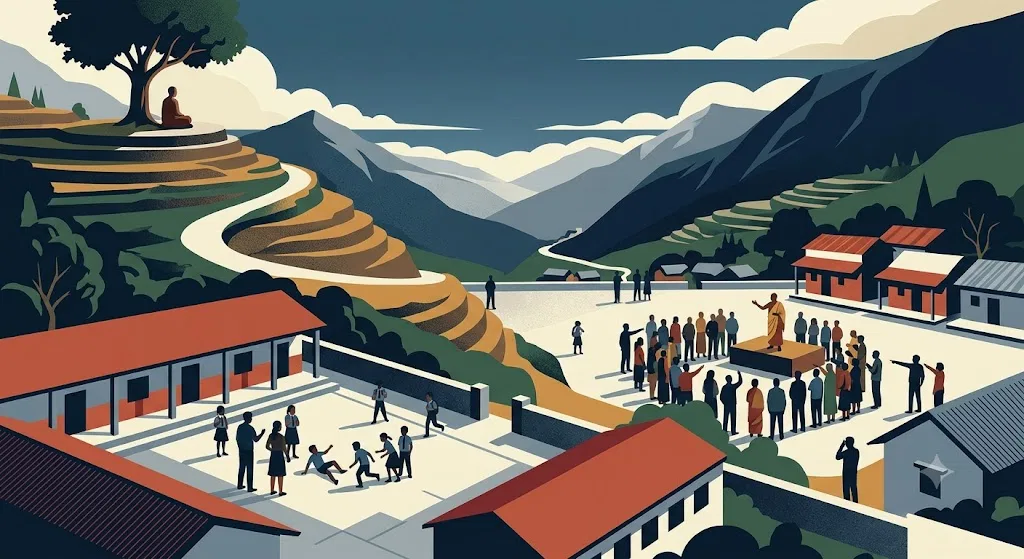
The strongest body of scientific evidence concerns outbreaks among pupils, especially adolescent girls in rural public schools. Reported symptoms have included fainting, crying, shouting, trembling, weakness, trance-like behaviour, uncontrolled movements and apparent fits. They are not imaginary: affected pupils genuinely experience distress and loss of bodily control. The disputed question is what produces the symptoms and allows them to spread so rapidly.
Doctors and researchers commonly describe these episodes as mass psychogenic illness. This means that a group develops symptoms resembling neurological, infectious or toxic illness, but investigation finds no adequate physical agent to explain the pattern. Symptoms often begin with one pupil and spread through sight, sound, expectation and anxiety within a closely connected group. Before accepting that explanation, however, clinicians must exclude epilepsy, poisoning, infection and environmental hazards.[Frontiers]frontiersin.orgFrontiersFrontiers | Characteristics of Adolescents Affected by Mass Psychogenic Illness Outbreaks in Schools in Nepal: A Case-Control Study…
A much-discussed outbreak occurred in western Nepal’s Pyuthan district. Researchers reported that a nine-year-old girl began crying and shouting at school, after which other pupils developed similar symptoms in quick succession. Forty-seven children were affected that day, including 37 girls and ten boys. Comparable outbreaks reportedly returned at the school over several years, making the episode unusual not simply for its size but for its recurrence.[Lippincott Journals]journals.lww.comrecurrent mass hysteria in schoolchildren in.14.aspxLippincott JournalsRecurrent mass hysteria in schoolchildren in Western Nepalby R Poudel · 2020 · Cited by 12 — The aim was to study the…
A later case-control study examined 194 affected pupils and 190 unaffected classmates, aged 11 to 18, across 12 Nepali public schools. The affected group more frequently reported childhood neglect or abuse, depressive and post-traumatic symptoms, dissociative experiences and particular family circumstances. Yet the researchers found no single personality trait or psychological mechanism that adequately explained who became ill. Even the strongest statistical associations did not amount to a complete cause.[Frontiers]frontiersin.orgFrontiersFrontiers | Characteristics of Adolescents Affected by Mass Psychogenic Illness Outbreaks in Schools in Nepal: A Case-Control Study…
That finding matters because “hysteria” has often been used dismissively, especially towards girls and women. The Nepali research instead points towards interacting pressures: fear, trauma, strict school environments, family stress, limited mental-health support and culturally familiar ways of expressing distress. A pupil who cannot safely describe anxiety or conflict may communicate suffering through the body. When classmates recognise the behaviour, fear it or interpret it through the same cultural framework, symptoms can spread.
Local explanations may involve possession, spirits, divine displeasure or epilepsy-like illness. Such beliefs are not merely decorative additions to an otherwise medical event. They can determine whether families seek a hospital, a healer, a religious ritual or all three. They may also shape the symptoms pupils expect to see. Researchers therefore warn against treating psychogenic illness as either deliberate performance or simple superstition. It is better understood as a real mind–body response occurring in a social setting.[Frontiers]frontiersin.orgFrontiersFrontiers | Characteristics of Adolescents Affected by Mass Psychogenic Illness Outbreaks in Schools in Nepal: A Case-Control Study…
Authorities have sometimes closed affected schools, separated symptomatic pupils or called medical teams. Temporary closure may interrupt visible contagion, but it can also strengthen rumours that the building is poisoned, cursed or haunted. More promising responses combine medical screening with calm communication, private support for distressed pupils, reduced publicity and education explaining how stress can create physical symptoms. A 2023 Nepali study found that a one-day neuroscience education programme could improve understanding among girls in schools with a history of such outbreaks, suggesting that explanation itself may reduce fear and stigma.[ScienceDirect]sciencedirect.comAdvantage of neuroeducation in managing mass…by S Dhungel · 2023 · Cited by 4 — In this study, we evaluated the impact of…
Witchcraft fear as persecution rather than mass illness
Witchcraft accusations are among Nepal’s most serious examples of harmful collective belief. Victims, predominantly women, have been blamed for illness, infertility, death, crop failure and other misfortunes. Accusations can become communal events in which relatives, neighbours, healers and local power-holders reinforce one another’s suspicions. The results have included beatings, humiliation, forced feeding of degrading substances, banishment, torture and death.[PubMed]pubmed.ncbi.nlm.nih.govA form of violence against women in Nepalby A Atreya · 2021 · Cited by 8 — Accusations of witchcraft and witch-hunting activities r…
This is not mass psychogenic illness. Nor is it best described as a spontaneous panic in every case. Witchcraft persecution often serves recognisable social purposes: settling property disputes, punishing women who resist authority, targeting widows or socially isolated people, and explaining illness where healthcare is inaccessible or distrusted. Gender inequality, caste discrimination, poverty and weak local protection make some people especially vulnerable. Researchers also stress that official figures understate the harm because victims may fear retaliation or doubt that police will protect them.[PubMed]pubmed.ncbi.nlm.nih.govA form of violence against women in Nepalby A Atreya · 2021 · Cited by 8 — Accusations of witchcraft and witch-hunting activities r…
Nepal enacted a specific law against witchcraft accusations and related violence in 2015. The legislation criminalises not only physical assault but the accusation and degrading treatment itself, recognising that public labelling can place a person in continuing danger. Nepal Police now records witchcraft allegations within its gender-based violence statistics. Its national fact sheet for the financial year running from 2023 to 2024 listed 166 registered cases, a figure that indicates continuing enforcement concerns while capturing only incidents that reached the authorities.[Nepal Law Commission]lawcommission.gov.npOpen source on lawcommission.gov.np.
The persistence of these cases despite criminalisation shows why education alone is insufficient. A belief can survive even when the state formally rejects it, particularly where an accuser has greater wealth, caste status, family influence or religious authority than the accused. Effective prevention therefore depends on rapid police action, safe housing, legal assistance, medical care and protection against renewed retaliation.
It is also important not to portray all Nepali healing traditions as witch-hunting. Ritual specialists and spiritual explanations occupy varied places within Nepal’s religious life, and many practices are not coercive. The relevant dividing line is harm: whether a person is accused without evidence, deprived of liberty, assaulted, humiliated or denied medical treatment. Treating every non-biomedical practice as superstition would obscure both religious diversity and the specific power relations behind persecution.
The rise and fall of the “Buddha Boy” image
Ram Bahadur Bomjon became internationally famous in 2005 after, as a teenager, he spent prolonged periods meditating beneath a tree in Bara district. Followers and visiting crowds attributed extraordinary abilities to him, including claims that he could remain in meditation without ordinary food, water or sleep. Tens of thousands reportedly travelled to see him, while international coverage transformed a local ascetic into the figure widely nicknamed the “Buddha Boy”. Buddhist scholars questioned claims that he was a reincarnation or equivalent of the historical Buddha.[Reuters]reuters.comNepal police arrest 'Buddha boy' over allegations of rape,Nepal police arrest 'Buddha boy' over allegations of rape,
The case illustrates how charismatic authority can be built jointly by followers, spectacle and media repetition. A distant observer did not need to understand Bomjon’s teachings to become fascinated by the apparently impossible physical feat. Crowds themselves became evidence: if so many people had travelled to see him, the event appeared to demand belief or at least investigation. Photographs and reports could circulate much faster than careful verification of whether he had truly remained without food or water.
Over time, Bomjon established religious communities and attracted followers to ashrams. Former associates and residents later made allegations involving disappearance, violence and sexual abuse. Nepali police arrested him in January 2024 after a prolonged search. In July that year, a district court sentenced him to ten years in prison in a child sexual abuse case.[Reuters]reuters.comNepal police arrest 'Buddha boy' over allegations of rape,Nepal police arrest 'Buddha boy' over allegations of rape,
The legal position subsequently changed. In March 2025, the Janakpur High Court overturned the conviction because the complaint had been lodged after the applicable limitation period. The court expressly did not decide the factual merits of the allegations; it held that the prosecution was procedurally out of time and that later child-protection legislation could not be applied retroactively. Describing this simply as either “proved guilty” or “proved innocent” would therefore misrepresent the judicial history.[Kathmandu Post]kathmandupost.comKathmandu Post High Court acquits Ram Bahadur Bomjan on child sexual abuse caseKathmandu Post High Court acquits Ram Bahadur Bomjan on child sexual abuse case
Whether Bomjon’s movement should be called a cult depends on how the term is being used. Journalists and critics may use it to emphasise extreme devotion, isolation, alleged coercion or concentrated authority. Followers regard him as a spiritual teacher. A more precise public description is a charismatic religious movement organised around an ascetic leader whose extraordinary claims attracted mass attention and whose institutions later faced grave allegations.
The broader lesson is not that intense religious devotion automatically leads to abuse. It is that claims of holiness can make scrutiny difficult. Followers may interpret criticism as persecution, while outsiders may dismiss all adherents as gullible. Both reactions can obscure the practical questions that matter: who controls money and movement, whether followers can leave freely, whether children are protected, and whether complaints are investigated independently.
The royal massacre and a crisis of believable authority
On 1 June 2001, King Birendra, Queen Aishwarya and other members of Nepal’s royal family were killed inside Narayanhiti Palace. The official inquiry concluded that Crown Prince Dipendra carried out the shootings before turning a gun on himself. Yet public disbelief appeared almost immediately, and alternative stories became one of modern Nepal’s most enduring bodies of conspiracy belief.[SOAS Research Online]soas-repository.worktribe.comSOAS Research Online
The rumours did not arise in an informational vacuum. Early official communication was confused, including an initial claim that an automatic weapon had discharged accidentally. The subsequent investigating commission was small, the opposition representative withdrew, and journalists were not allowed to question officials when the main findings were presented. A popular prince had been accused of destroying a widely respected royal family, while most witnesses were palace insiders. For many citizens, the explanation felt emotionally unbearable and institutionally untrustworthy.[SOAS Research Online]soas-repository.worktribe.comSOAS Research Online
Rumours blamed rival royals, palace guards, the army, Indian intelligence, the United States and masked gunmen. Others claimed that drinking water or milk had been poisoned, that far more people had died inside the palace, or that evidence had already been removed. These stories contradicted one another, but contradiction did not necessarily weaken the wider conviction that the truth was being concealed.[SOAS Research Online]soas-repository.worktribe.comSOAS Research Online
Scholar Michael Hutt argues that believers built more elaborate theories from apparent gaps or inconsistencies in the official account. In this pattern, missing evidence supports suspicion, but additional official evidence may also be treated as proof of a cover-up. The theory becomes difficult to disprove because both silence and denial can be absorbed into it.[SOAS Research Online]soas-repository.worktribe.comSOAS Research Online
Popular books helped preserve and reshape the suspicions. Some authors presented alternative accounts through fiction or semi-investigative “street literature”, benefiting from widespread public appetite for explanations. One bestselling author later acknowledged that he had used prevailing disbelief and sought to damage King Gyanendra’s reputation during debate over the monarchy’s future. This does not establish that every official conclusion was correct. It does show how political goals, commercial publishing and genuine uncertainty became entangled.[SOAS Research Online]soas-repository.worktribe.comSOAS Research Online
The massacre remains culturally important because it damaged more than the royal family. It exposed the consequences of secretive government communication during national trauma. The persistence of conspiracy theories reflects unresolved questions, but also a collapse of confidence in the institutions charged with answering them. Nepal abolished the monarchy in 2008, and memory of the massacre became part of the story through which many citizens interpreted the old royal order’s decline.
Miracles, rumours and the limits of the record
Nepal also participated in wider South Asian waves of miracle belief. During the “milk-drinking statue” episode of September 1995, reports spread rapidly that statues of Hindu deities were consuming milk offered from spoons. The claim travelled through telephone calls, word of mouth and news coverage from India to Hindu communities abroad, including Nepal. Scientists examining the effect argued that surface tension and capillary action drew liquid from the spoon and allowed it to run over the statue, creating the appearance of consumption.[Los Angeles Times]latimes.comLos Angeles Times India: Many believe milk-drinking statues are an act of GodLos Angeles Times India: Many believe milk-drinking statues are an act of God
Evidence for Nepal’s precise role is thinner than for India, where crowds, shortages and official demonstrations were documented in greater detail. It is therefore safer to describe Nepal as part of the transnational circulation of the claim rather than to invent a distinct Nepali panic with a well-established national chronology. The episode nevertheless demonstrates how religious news can cross an open cultural border almost instantly when people share deities, pilgrimage networks, languages and media.
Nepal’s historical record contains many stories of omens, crying statues, divine dreams and supernatural warnings, but documentation varies sharply. Some are local folklore; some are retrospective embellishments; others may record sincerely experienced religious events. Popularity alone cannot establish that an event occurred as described, while scientific uncertainty does not automatically justify a supernatural conclusion.
The same caution applies to claims about secret sects, satanic scares or UFO religions. There is little strong evidence that Nepal has experienced a nationally significant satanic panic, organised UFO religion or classic apocalyptic cult comparable with better-documented cases elsewhere. Including such categories merely because they fit an international checklist would distort the country’s actual record.
What links these episodes — and what does not
Nepal’s cases share conditions that help fear or belief travel: close social networks, trusted personal testimony, dramatic uncertainty and institutions that do not provide credible information quickly enough. Yet their mechanisms and moral stakes differ.
- School outbreaks involve real physical and psychological symptoms spreading through social contact and shared expectation.
- Witchcraft accusations turn supernatural blame into persecution, often reinforcing gender, caste and economic inequality.
- Charismatic movements depend on authority, devotion and claims that may be difficult for followers to test independently.
- Conspiracy theories grow when traumatic events meet secrecy, political conflict and an official account many people regard as inadequate.
- Miracle rumours can spread rapidly across religious and media networks without requiring a central leader.
The most useful interpretation is therefore not that Nepali society is unusually irrational. Similar processes occur worldwide. Nepal’s particular history — religious pluralism, uneven access to healthcare, rural isolation, civil conflict, social hierarchy, fast-changing media and repeated crises of political legitimacy — gives them local form.
Nor should traditional belief be treated as the sole cause. A school outbreak may be intensified by supernatural interpretation, but it may originate in stress, abuse or institutional pressure. A witchcraft accusation may employ spiritual language while serving a property dispute or enforcing obedience. A conspiracy theory may contain unsupported claims while also expressing a reasonable objection to opaque government conduct.

Why the history still matters
These episodes matter because labels determine responses. Calling distressed pupils “possessed” may delay medical care; calling them fraudulent may deepen shame. Treating witchcraft violence as harmless tradition protects perpetrators. Calling every unconventional religious community a cult can stigmatise minorities, but refusing to examine coercive authority can leave followers unprotected. Dismissing all royal-massacre doubts as madness ignores the communication failures that made suspicion plausible.
The clearest reforms are correspondingly practical: medically investigate unexplained illness before announcing a psychogenic cause; provide confidential mental-health support in schools; enforce anti-witchcraft laws while protecting survivors; regulate residential religious institutions where children are present; and communicate openly during national emergencies.
Nepal’s history of collective fear is ultimately a history of trust. Symptoms, accusations and rumours spread most readily when people rely on one another because official systems feel distant, inaccessible or unbelievable. The most effective answer is not ridicule. It is credible investigation, humane care and institutions willing to explain what they know, what they do not know and how they reached their conclusions.
Amazon book picks
Further Reading
Books and field guides related to When Fear and Belief Spread Across Nepal. Use these as the next step if you want deeper reading beyond the article.

Crazy like us
Explores how culture, shared beliefs and outside explanations shape the expression and spread of psychological distress across societies,...

Cultish
Provides a commercially strong framework for understanding charismatic authority, group identity and persuasive language without casually...

Suspicious minds
Explains the cognitive and social tendencies that make conspiracy narratives persuasive, helping readers understand why distrust and inco...

The Sleeping Beauties
Directly examines communities affected by outbreaks of mysterious, socially patterned illness, making it the closest general-reader match...
Endnotes
1.
Source: soas-repository.worktribe.com
Title: SOAS Research Online
Link:https://soas-repository.worktribe.com/OutputFile/432145
2.
Source: sciencedirect.com
Link:https://www.sciencedirect.com/science/article/pii/S2667242123000416
Source snippet
Advantage of neuroeducation in managing mass...by S Dhungel · 2023 · Cited by 4 — In this study, we evaluated the impact of...
3.
Source: reuters.com
Title: Nepal police arrest ‘Buddha boy’ over allegations of rape,
Link:https://www.reuters.com/world/asia-pacific/nepal-police-arrest-buddha-boy-over-allegations-rape-sexual-abuse-2024-01-10/
4.
Source: reuters.com
Link:https://www.reuters.com/world/asia-pacific/nepalese-court-finds-buddha-boy-guilty-child-sexual-abuse-2024-06-25/
5.
Source: reuters.com
Link:https://www.reuters.com/world/asia-pacific/nepal-court-sentences-buddha-boy-10-years-jail-sexual-abuse-2024-07-01/
6.
Source: persecution.org
Link:https://www.persecution.org/wp-content/uploads/2023/11/Nepal-Report.pdf
7.
Source: persecution.org
Title: Nepal Persecution 101 1
Link:https://www.persecution.org/wp-content/uploads/2026/03/Nepal-Persecution-101-1.pdf
8.
Source: frontiersin.org
Link:https://www.frontiersin.org/journals/psychiatry/articles/10.3389/fpsyt.2020.493094/full
Source snippet
FrontiersFrontiers | Characteristics of Adolescents Affected by Mass Psychogenic Illness Outbreaks in Schools in Nepal: A Case-Control Study...
9.
Source: pubmed.ncbi.nlm.nih.gov
Link:https://pubmed.ncbi.nlm.nih.gov/33632014/
Source snippet
A form of violence against women in Nepalby A Atreya · 2021 · Cited by 8 — Accusations of witchcraft and witch-hunting activities r...
10.
Source: kathmandupost.com
Title: Kathmandu Post High Court acquits Ram Bahadur Bomjan on child sexual abuse case
Link:https://kathmandupost.com/national/2025/04/17/high-court-acquits-ram-bahadur-bomjan-on-child-sexual-abuse-case
11.
Source: journals.lww.com
Title: recurrent mass hysteria in schoolchildren in.14.aspx
Link:https://journals.lww.com/indianjpsychiatry/fulltext/2020/62030/recurrent_mass_hysteria_in_schoolchildren_in.14.aspx
Source snippet
Lippincott JournalsRecurrent mass hysteria in schoolchildren in Western Nepalby R Poudel · 2020 · Cited by 12 — The aim was to study the...
12.
Source: Wikipedia
Title: Mass psychogenic illness
Link:https://en.wikipedia.org/wiki/Mass_psychogenic_illness
13.
Source: lawcommission.gov.np
Link:https://lawcommission.gov.np/content/12930/12930-witchcraft-accusation-crime-a/
14.
Source: nepalpolice.gov.np
Link:https://www.nepalpolice.gov.np/media/filer_public/57/33/5733d531-91bb-4450-8fb2-d2dd21d9022e/fy_2080-81annual_infographics-_en.pdf
15.
Source: latimes.com
Title: Los Angeles Times India: Many believe milk-drinking statues are an act of God
Link:https://www.latimes.com/archives/la-xpm-1995-09-23-mn-49166-story.html
16.
Source: Wikipedia
Title: Ram Bahadur Bomjon
Link:https://en.wikipedia.org/wiki/Ram_Bahadur_Bomjon
17.
Source: en.setopati.com
Link:https://en.setopati.com/social/166368
18.
Source: nepalpolice.gov.np
Link:https://www.nepalpolice.gov.np/media/filer_public/bc/d0/bcd064f5-284a-492a-b424-def0a6800de2/fy-2078-79-annual-infographics-en.pdf
19.
Source: nepalpolice.gov.np
Title: police mirror f 2022
Link:https://www.nepalpolice.gov.np/media/filer_public/71/ed/71edd99d-a91a-47e5-9e86-a0626d52198e/police-mirror-f-2022.pdf
20.
Source: nepalpolice.gov.np
Title: 2016 police mirror 2016 final for web
Link:https://www.nepalpolice.gov.np/media/filer_public/af/58/af585084-3efb-45e4-8ab3-b94b546cc126/2016-police-mirror-2016-final-for_-web.pdf
21.
Source: nepalpolice.gov.np
Title: police mirror 2019
Link:https://www.nepalpolice.gov.np/media/filer_public/c6/4c/c64c77b2-7302-4215-a2da-d27ee138711b/police-mirror-2019.pdf
22.
Source: nepalpolice.gov.np
Title: police mirror 2018
Link:https://www.nepalpolice.gov.np/media/filer_public/1d/2c/1d2cc460-bebd-4eb4-a808-7a6163336c7a/police-mirror-2018.pdf
23.
Source: cid.nepalpolice.gov.np
Title: cid magazine 2074
Link:https://cid.nepalpolice.gov.np/media/filer_public/67/42/6742f2e2-53a5-451a-a9a3-126a91aabcfb/cid-magazine-2074.pdf
24.
Source: kathmandupost.com
Title: rights groups laud witchcraft act
Link:https://kathmandupost.com/national/2015/08/01/rights-groups-laud-witchcraft-act
25.
Source: pmc.ncbi.nlm.nih.gov
Link:https://pmc.ncbi.nlm.nih.gov/articles/PMC12860665/
26.
Source: pubmed.ncbi.nlm.nih.gov
Link:https://pubmed.ncbi.nlm.nih.gov/28792075/
27.
Source: en.nepalkhabar.com
Link:https://en.nepalkhabar.com/news/detail/13475/
Additional References
28.
Source: ohchr.org
Link:https://www.ohchr.org/en/special-procedures/ie-albinism/witchcraft-and-human-rights
Source snippet
Witchcraft and human rightsWitchcraft related beliefs and practices have resulted in serious violations of human rights including, b...
29.
Source: journals.sagepub.com
Link:https://journals.sagepub.com/doi/10.1177/00258172211018380
Source snippet
Sage JournalsWitchcraft allegations and untouchability as forms of...6 Jul 2021 — It is estimated that 90 women die annually due to witc...
30.
Source: youtube.com
Link:https://www.youtube.com/watch?v=UHbxrXm0d1Q
Source snippet
2 Women accused of witchcraft in Nepal tortured...
31.
Source: researchgate.net
Link:https://www.researchgate.net/publication/277774465_Gendered_injustice_A_comparative_analysis_of_witchcraft_beliefs_and_witchcraft-related_violence_in_Ghana_and_Nepal
32.
Source: researchgate.net
Link:https://www.researchgate.net/publication/303279352_Online_Convergence_Behavior_Social_Media_Communications_and_Crisis_Response_An_Empirical_Study_of_the_2015_Nepal_Earthquake_Police_Twitter_Project
33.
Source: researchgate.net
Link:https://www.researchgate.net/publication/353038547_Witchcraft_allegations_and_untouchability_as_forms_of_violence_upon_women_in_Nepal_A_7-year_study
34.
Source: researchgate.net
Link:https://www.researchgate.net/publication/292866336_After_the_massacre_secrecy_disbelief_and_the_public_sphere_in_Nepal
35.
Source: facebook.com
Link:https://www.facebook.com/southasianrights/posts/balendra-shah-a-35-year-old-rapper-was-sworn-in-on-friday-and-immediately-moved-/965662459450967/
36.
Source: researchgate.net
Link:https://www.researchgate.net/publication/26416760_Epidemic_of_Hysteria_in_a_School_of_Rural_Eastern_Nepal_A_Case_Report
37.
Source: instagram.com
Link:https://www.instagram.com/reel/DapuLFDsq3n/
Topic Tree
Follow this branch
Related pages 192
- Antigua and Barbuda
- Argentina Belief Scares
- Azerbaijan Belief
- Bahrain Beliefs
- North Korea
- +187 more in sidebar