Within Sierra Leone Beliefs
Could Kamajor Fighters Really Stop Bullets?
Kamajor fighters used initiation, protective objects and claims of bullet resistance to build courage, discipline and fear during the civil war.
On this page
- Who the Kamajors were during the civil war
- Initiation, magical jackets and rules of protection
- Psychological power, battlefield fear and deadly limits
Page outline Jump by section
Introduction
During Sierra Leone’s civil war, the Kamajors became famous for claims that properly initiated fighters could survive gunfire through ritual protection. These beliefs were not simply colourful folklore. They played a practical role in recruiting combatants, strengthening discipline, boosting confidence and intimidating enemies. At the same time, the belief that rituals, charms and strict behavioural rules could make a person “bulletproof” sometimes encouraged fighters to take extreme risks, with fatal consequences. Historians and investigators therefore view Kamajor war magic as both a powerful psychological force and an example of how traditional beliefs were reshaped for modern warfare, rather than as evidence that supernatural protection literally worked.[wur.nl]research.wur.nlWUR Research PortalFighting for the Rain Forest: war, youth and resources in Sierra Leone. - Research Portal - Wageningen University & Re…
Could Kamajor fighters really stop bullets?
The available evidence says no. There is no credible military, medical or forensic evidence that Kamajor rituals provided physical immunity from bullets. Nevertheless, thousands of fighters and many civilians believed that initiation could provide extraordinary protection if the initiate obeyed strict ritual rules.
Understanding why this belief spread requires recognising the conditions of the war. Rural communities faced attacks from the Revolutionary United Front (RUF) and other armed groups while government forces often proved unable to protect them. In that environment, confidence and cohesion could become as important as weapons. Believing that one’s comrades possessed supernatural protection reduced fear, encouraged aggressive action and projected an image of invincibility that could influence opponents before a battle even began.[WUR Research Portal]research.wur.nlWUR Research PortalFighting for the Rain Forest: war, youth and resources in Sierra Leone. - Research Portal - Wageningen University & Re…
Who the Kamajors were during the civil war
The Kamajors formed the largest component of Sierra Leone’s Civil Defence Forces (CDF), militias that fought mainly in support of the elected government against the RUF and later the Armed Forces Revolutionary Council (AFRC). Their roots lay in traditions associated with hunting societies, particularly among Mende-speaking communities, where hunters were respected for their knowledge of forests, animals and medicinal plants.
As the war expanded, however, the wartime Kamajors became something different from traditional hunting associations. Recruitment accelerated, military responsibilities grew, and initiation rituals were adapted to create large numbers of fighters. The Truth and Reconciliation Commission (TRC) later argued that wartime leaders transformed respected cultural practices into mechanisms for military mobilisation, extending initiation far beyond its earlier social role.[wikipedia.org]WikipediaCivil Defence ForcesCivil Defence Forces
Initiation, magical jackets and rules of protection
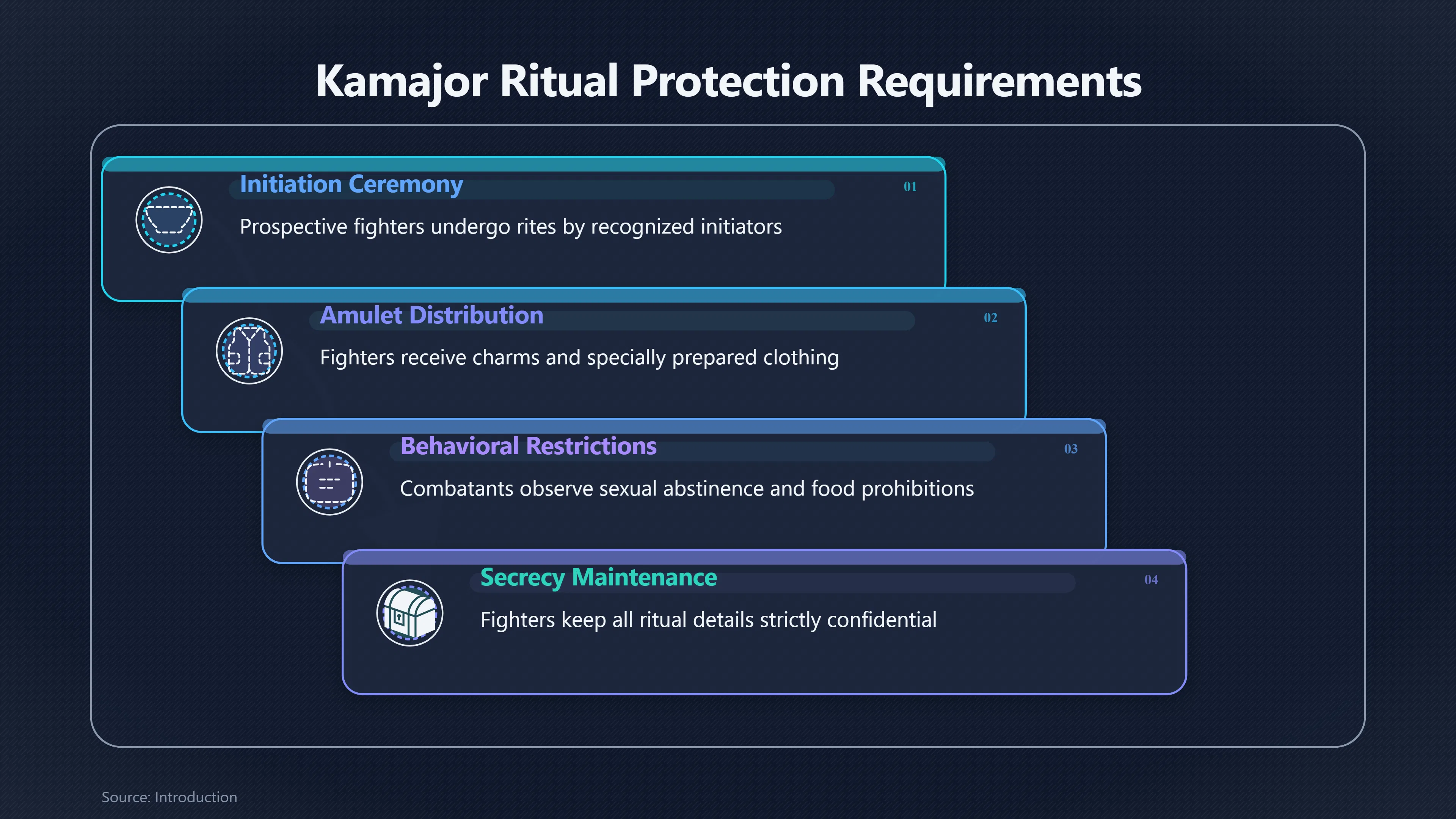
Initiation lay at the centre of Kamajor claims of supernatural protection. Prospective fighters underwent ceremonies conducted by recognised initiators, after which they received charms, amulets or specially prepared clothing that were believed to shield them in combat.
Protection was rarely presented as automatic. Instead, it depended on following numerous ritual rules. Although accounts differ between witnesses and regions, common themes included:
- Wearing protective jackets or amulets prepared during initiation.
- Applying herbal medicines or ritual substances to the body.
- Observing behavioural restrictions before battle, sometimes involving sexual abstinence or prohibitions on particular foods.
- Maintaining secrecy about the rituals.
- Remaining morally disciplined and obedient to initiators.
Within this belief system, failure of protection could always be explained. A fighter wounded or killed might be said to have broken a ritual rule, failed to observe a prohibition or lost spiritual favour rather than proving that the protection itself was ineffective. Such explanations helped preserve confidence in the system even after battlefield losses.[sierraleonetrc.org]sierraleonetrc.orgSierra Leone TRCVolume Three A, Chapter Three…

Why the belief mattered on the battlefield
The military importance of these beliefs did not depend on literal bulletproof skin. Their value lay in psychology and social organisation.
For individual fighters, initiation reduced fear by creating a sense that survival depended on spiritual discipline rather than chance alone. Newly initiated combatants often entered battle believing they possessed advantages unavailable to uninitiated enemies.
For commanders, the rituals reinforced obedience. Since protection supposedly depended upon following prescribed rules, military discipline acquired religious and moral significance. Disobedience risked not merely punishment from commanders but loss of supernatural protection.
For communities, initiation also demonstrated commitment to local defence. Villages sometimes encouraged young men to undergo initiation because it symbolised readiness to defend families and farmland when state protection was absent.[WUR Research Portal]research.wur.nlWUR Research PortalFighting for the Rain Forest: war, youth and resources in Sierra Leone. - Research Portal - Wageningen University & Re…
Fear as a weapon
Belief in Kamajor invulnerability also influenced opponents. Rumours that fighters could not be killed easily spread through civilian populations and among enemy combatants. In civil wars, where information is often fragmentary and rumours travel quickly, stories of supernatural powers can magnify uncertainty.
Anthropologists studying African conflicts have noted that such beliefs frequently operate as forms of psychological warfare. Whether opponents accepted the claims completely was less important than creating hesitation, confusion or exaggerated perceptions of an adversary’s strength. In Sierra Leone, war magic became part of the conflict’s symbolic landscape alongside uniforms, songs, ceremonies and displays of courage.[WUR Research Portal]research.wur.nlWUR Research PortalFighting for the Rain Forest: war, youth and resources in Sierra Leone. - Research Portal - Wageningen University & Re…
The deadly limits of believing in invincibility
The same beliefs that inspired courage also carried obvious dangers.
The Sierra Leone Truth and Reconciliation Commission concluded that initiation ceremonies encouraged some Kamajors to believe they were genuinely immune to bullets. According to the Commission, this misplaced confidence contributed to unnecessary battlefield deaths because fighters sometimes exposed themselves to enemy fire believing ritual protection would save them. The Commission therefore described wartime initiation as a form of psychological manipulation rather than genuine supernatural protection.[sierraleonetrc.org]sierraleonetrc.orgSierra Leone TRCVolume Two, Chapter Two…
The TRC also criticised the way wartime leaders altered older initiation traditions for military purposes. It argued that respected cultural practices became entangled with recruitment, coercion and armed conflict, damaging institutions that had previously served broader social functions. Some testimony further alleged disturbing abuses associated with certain wartime initiation centres, although these accounts relate specifically to the conflict period rather than to traditional hunting societies generally.[sierraleonetrc.org]sierraleonetrc.orgSierra Leone TRCVolume Three A, Chapter Three…

Belief versus historical evidence
Modern scholarship generally rejects two simplistic interpretations.
The first is that the Kamajors were merely irrational people who believed impossible things. Researchers instead argue that ritual protection functioned within a coherent cultural framework that addressed fear, uncertainty and trust under extreme conditions. The beliefs had real social and military consequences regardless of whether they had supernatural effects.[WUR Research Portal]research.wur.nlWUR Research PortalFighting for the Rain Forest: war, youth and resources in Sierra Leone. - Research Portal - Wageningen University & Re…
The second misconception is that every Kamajor literally believed himself invulnerable. Wartime experiences varied considerably. Some fighters expressed absolute confidence, while others viewed charms and rituals as sources of courage, identity or divine favour rather than guarantees of survival. As with many wartime belief systems, certainty existed alongside doubt, practical experience and adaptation.[WUR Research Portal]research.wur.nlWUR Research PortalFighting for the Rain Forest: war, youth and resources in Sierra Leone. - Research Portal - Wageningen University & Re…
Why Kamajor war magic remains important
Kamajor beliefs about bulletproof protection remain one of the best-known examples of wartime supernatural belief in modern African history because they illustrate how spiritual traditions can be reshaped during armed conflict.
The historical importance lies not in whether bullets were actually stopped, but in how collective belief altered behaviour. Rituals strengthened solidarity, reduced fear and helped organise community defence, while also encouraging dangerous overconfidence and legitimising the authority of initiators. For historians of Sierra Leone, Kamajor war magic therefore represents an intersection of traditional belief, military necessity and the psychology of collective conflict, showing how ideas about supernatural protection can influence real decisions on the battlefield even when they provide no physical immunity.[sierraleonetrc.org]sierraleonetrc.orgSierra Leone TRCVolume Two, Chapter Two…
Amazon book picks
Further Reading
Books and field guides related to Could Kamajor Fighters Really Stop Bullets?. Use these as the next step if you want deeper reading beyond the article.
King Leopold's ghost
Broadens understanding of colonial legacies affecting regional conflicts.
The mask of anarchy
Explores supernatural beliefs and warfare closely related to Kamajor traditions.
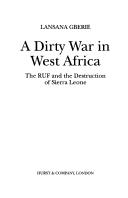
A dirty war in West Africa
Explains the Kamajors, civil war context and beliefs about protection.
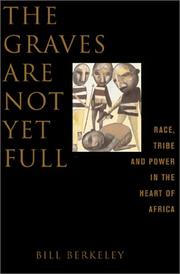
The graves are not yet full
Provides broader context on violence, ethnicity and civil conflict.
Endnotes
1.
Source: research.wur.nl
Link:https://research.wur.nl/en/publications/fighting-for-the-rain-forest-war-youth-and-resources-in-sierra-le/
Source snippet
WUR Research PortalFighting for the Rain Forest: war, youth and resources in Sierra Leone. - Research Portal - Wageningen University & Re...
2.
Source: sierraleonetrc.org
Title: Sierra Leone TRC
Link:https://www.sierraleonetrc.org/index.php/view-report-text-vol-2/item/volume-three-a-chapter-three
Source snippet
Volume Three A, Chapter Three...
3.
Source: sierraleonetrc.org
Title: Sierra Leone TRC
Link:https://www.sierraleonetrc.org/index.php/view-report-text-vol-2/item/volume-two-chapter-two
Source snippet
Volume Two, Chapter Two...
4.
Source: Wikipedia
Title: Civil Defence Forces
Link:https://en.wikipedia.org/wiki/Civil_Defence_Forces
5.
Source: sierraleonetrc.org
Title: Sierra Leone TRC
Link:https://www.sierraleonetrc.org/index.php/view-report-text-vol-3b/item/volume-three-b-chapter-four?category_id=9
Source snippet
Volume Three B, Chapter Four...
6.
Source: hrw.org
Link:https://www.hrw.org/legacy/reports98/sierra/old/Sier988-03.htm
Additional References
7.
Source: sahistory.org.za
Link:https://sahistory.org.za/article/sierra-leones-pre-colonial-and-colonial-era-military-and-security-forces
Source snippet
The Poro was a religious organisation into which men from different classes and different towns were initiated...
8.
Source: cambridge.org
Link:https://www.cambridge.org/core/books/violent-resistance/conclusion/06A4396B02D4C26FED8859F722088622
Source snippet
Conclusion (Chapter 8) - Violent ResistanceJanuary 13, 2022 8.3 BEYOND MOZAMBIQUE Grassroots initiatives, which seek to protect the loc...
Published: January 13, 2022
9.
Source: books.google.com
Title: Books Fighting for the Rain Forest: War, Youth & Resources in Sierra Leone
Link:https://books.google.com/books/about/Fighting_for_the_Rain_Forest.html?id=7HcMAQAAMAAJ
Source snippet
Google BooksFighting for the Rain Forest: War, Youth & Resources in Sierra Leone - Paul Richards, International African Institute - Googl...
10.
Source: youtube.com
Link:https://www.youtube.com/watch?v=j74E40n1LSk
Source snippet
2 African MYSTICAL TRADITIONS! 'EGBA no. 3' Hunting Society, (Sierra Leone)...
11.
Source: youtube.com
Link:https://www.youtube.com/watch?v=X5jkxXu_o-A
Source snippet
5 An Honest Explanation of Sierra Leone's Civil War...
12.
Source: crwflags.com
Link:https://www.crwflags.com/fotw/flags/sl%7Dkamaj.html
Source snippet
movement, Sierra LeoneNovember 30, 2013 KAMAJORS/C.D.F. MOVEMENT, SIERRA LEONE Last modified: 2013-11-30 by rob raeside image by Antni...
Published: November 30, 2013
13.
Source: link.springer.com
Link:https://link.springer.com/book/10.1057/9780230103344
Source snippet
and Warfare: Appearance and Reality in Contemporary African Conflict and Beyond | Springer Nature LinkDecember 18, 2009 MAGIC AND WARFA...
Published: December 18, 2009
14.
Source: scienceopen.com
Link:https://www.scienceopen.com/hosted-document?doi=10.1080%2F03056240601119042
15.
Source: hrw.org
Link:https://www.hrw.org/reports/1999/sierra/SIERLE99-04.htm
16.
Source: nhbs.com
Link:https://www.nhbs.com/en/fighting-for-the-rain-forest-book
Topic Tree