Within Israel
When Prophecy Targets Jerusalem's Holiest Site
Religious prophecy becomes politically explosive when activists connect redemption to control, worship and rebuilding at Jerusalem's holy sites.
On this page
- The Al Aqsa fire and Denis Rohan
- Temple movements and religious nationalism
- Why sacred geography raises the stakes
Page outline Jump by section
Introduction
Few places on earth concentrate religious expectation, political sovereignty and international attention as intensely as Jerusalem’s Temple Mount, known to Muslims as the Haram al-Sharif. For many Jews it is the location of the First and Second Temples; for Muslims it contains the Al-Aqsa Mosque and the Dome of the Rock, making it one of Islam’s holiest sites. Because of this overlapping sacred geography, apocalyptic beliefs about the end times or the coming of the Messiah can become politically explosive when they move from private conviction to organised activism.
Most people who believe that a future Jewish Temple will be rebuilt do not advocate violence. However, a small number of activists and individuals have argued that human action should help fulfil biblical prophecy rather than wait for divine intervention. Israeli authorities have repeatedly regarded attempts to alter the status of the Temple Mount as a major security concern because even isolated acts can trigger regional unrest and international crises. Scholars therefore treat Temple Mount activism as an important example of how millenarian belief can intersect with nationalism, religious identity and conflict rather than as a simple story of religious extremism.[Journal.fi]journal.fiJanuary 1, 2006…
The Al-Aqsa fire and Denis Rohan
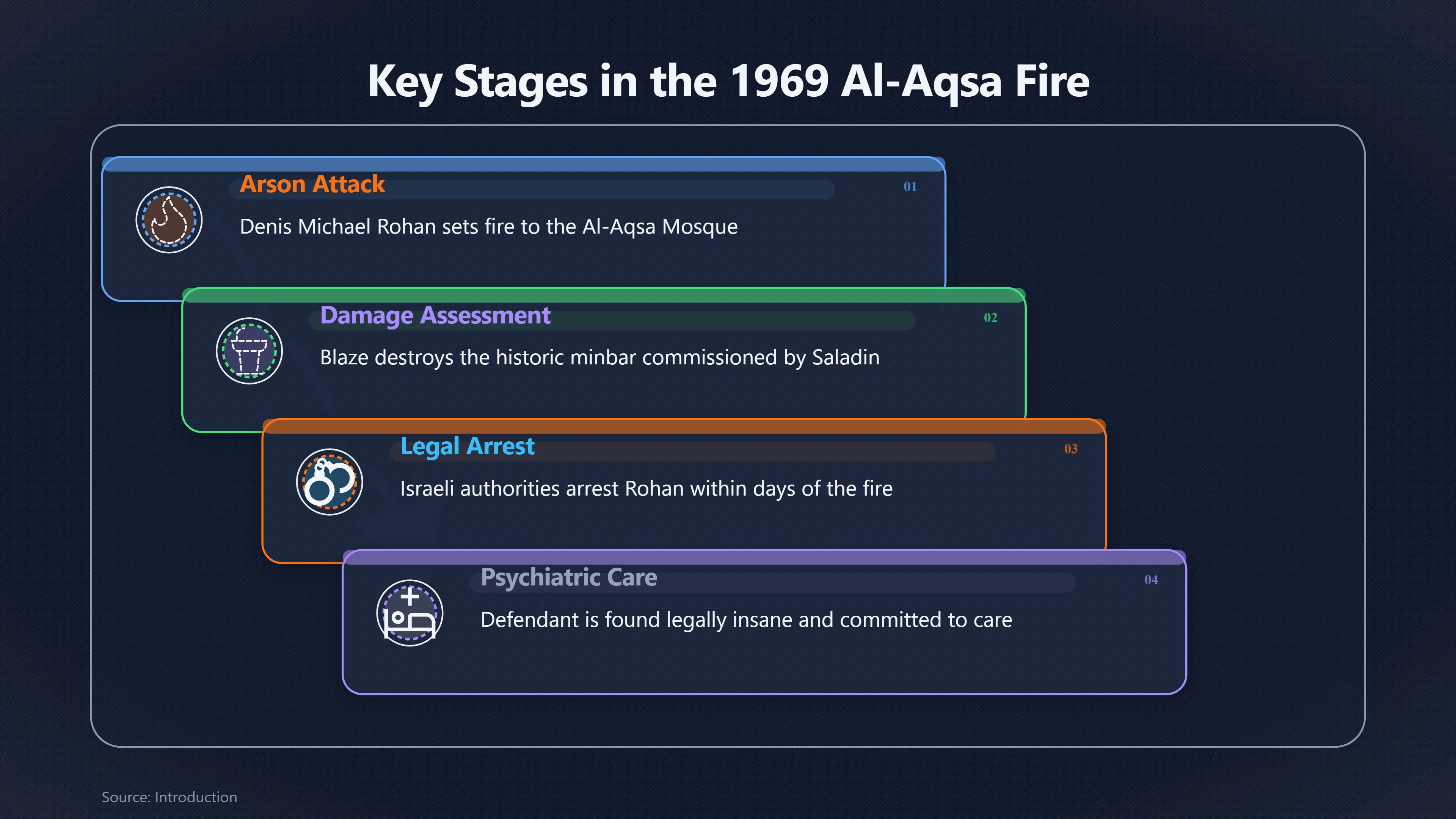
The event that demonstrated the global consequences of apocalyptic activism occurred on 21 August 1969, when Australian Christian Denis Michael Rohan set fire to the Al-Aqsa Mosque. The blaze destroyed the historic minbar (pulpit) commissioned by Saladin and damaged part of one of Islam’s holiest buildings. Israeli authorities arrested Rohan within days, and he later admitted responsibility before being found legally insane and committed to psychiatric care.[Jewish Telegraphic Agency]jta.orgJewish Telegraphic AgencyInterest Fades in Mosque Fire Trial After Defendant Confesses Guilt - Jewish Telegraphic AgencyOctober 10, 1969…
Rohan was not acting on behalf of Israel or any Jewish organisation. Instead, he held an apocalyptic Protestant belief that removing the mosque would help clear the way for rebuilding the Jewish Temple, thereby hastening the Second Coming of Christ. His actions illustrate how end-times theology can inspire direct political action when sacred places are understood as essential steps in a prophetic timetable.[Creighton University CDR]cdr.creighton.eduUniversity CDRJournal of Religion & SocietyCreighton University CDRJournal of Religion & Society…
The consequences extended far beyond the crime itself. Across the Muslim world, many people believed the attack reflected wider Israeli intentions towards the sanctuary despite Israel’s arrest and prosecution of the Australian arsonist. The incident intensified distrust, contributed to the creation of new forms of international Islamic political cooperation, and permanently heightened sensitivity to any perceived threat against the site. Subsequent rumours and conspiracy theories have often drawn on memories of the 1969 fire even when later events were unrelated.[Calhoun]calhoun.nps.eduCalhoun Religious desecration and ethnic violenceCalhoun Religious desecration and ethnic violence
Temple movements and religious nationalism
The Temple Mount occupies an unusual position because theological hopes have also inspired organised political movements rather than only isolated individuals. Several Jewish organisations advocate greater Jewish prayer rights at the site, while others actively prepare for a possible future Temple by researching priestly rituals, producing ceremonial objects or training descendants of the ancient priesthood.
These movements differ significantly from one another. Some emphasise religious education and symbolic preparation while accepting that any rebuilding must await divine intervention. Others argue that human beings have a duty to advance redemption by taking practical steps in the present. Academic studies stress that these distinctions matter because outside observers sometimes treat very different organisations as though they shared identical goals or methods.[Journal.fi]journal.fiJanuary 1, 2006…
Among the most prominent activists has been Gershon Salomon and the Temple Mount Faithful movement, which has organised demonstrations advocating construction of a Third Temple. Although the movement has generally pursued public campaigns rather than violent action, its activities have repeatedly generated security concerns because symbolic attempts to place foundation stones or conduct ceremonies near the compound have been interpreted by Palestinians and the wider Muslim world as possible threats to the existing Islamic holy places.[Journal.fi]journal.fiJanuary 1, 2006…
Israeli security services have also disrupted more militant conspiracies. During the 1980s, members of the Jewish Underground planned attacks on the Islamic shrines in the hope that their destruction would transform Israeli politics and hasten redemption. The plot was prevented before it could be carried out, illustrating that although such movements remained marginal, authorities regarded them as capable of triggering catastrophic regional consequences.[Journal.fi]journal.fiJanuary 1, 2006…
Why sacred geography raises the stakes
The Temple Mount differs from many sacred sites because multiple religious traditions attach ultimate historical significance to exactly the same physical location.
For some religious Jews, the site is where God’s presence dwelt in the ancient Temple and where a future Temple may stand again. For Muslims, the same compound contains the Al-Aqsa Mosque and Dome of the Rock and commemorates the Prophet Muhammad’s Night Journey. Questions about access, prayer rights, archaeology or construction therefore become inseparable from competing claims about sovereignty, identity and sacred history.
This overlap creates an unusually powerful feedback loop.
- Religious expectations shape political activism.
- Political disputes reinforce religious fears.
- Rumours about threats to the site spread rapidly because they fit existing historical memories.
- Security responses themselves become evidence for competing narratives.
As a result, relatively minor incidents can rapidly acquire apocalyptic significance far beyond their immediate facts. Scholars of religion frequently describe the Temple Mount as an example of sacred space where symbolic meaning dramatically magnifies political risk.[Journal.fi]journal.fiJanuary 1, 2006…
Private visions versus organised activism
Researchers also distinguish between lone individuals driven by personal revelation and organised religious movements.
Some incidents—including Denis Rohan’s attack—have been linked to severe mental illness combined with apocalyptic religious ideas. These cases should not be treated as representative of wider religious communities. The fact that an individual frames their actions in biblical or prophetic language does not mean those beliefs are shared or encouraged by most believers.[Creighton University CDR]cdr.creighton.eduUniversity CDRJournal of Religion & SocietyCreighton University CDRJournal of Religion & Society…
Organised Temple movements, by contrast, are better understood as religious-nationalist activism. They involve networks of supporters, public campaigns, educational projects and political lobbying rather than purely individual visions. While critics often describe such groups as dangerous or extremist, scholars caution against treating all organisations seeking greater Jewish religious presence on the Temple Mount as identical. Their objectives, methods and willingness to accept existing legal arrangements vary considerably.[Journal.fi]journal.fiJanuary 1, 2006…

Why Temple Mount activism remains culturally important
Temple Mount activism demonstrates how apocalyptic belief can become a force in public life without representing the views of most believers. The issue is not simply theology but the interaction between prophecy, territory and political power.
The legacy of the 1969 Al-Aqsa fire means that many Muslims interpret even symbolic Temple-related initiatives through the memory of an actual attack on one of Islam’s holiest sites. At the same time, many Jewish activists view restrictions around the Temple Mount as obstacles to religious freedom or to eventual redemption. Those competing narratives make compromise exceptionally difficult because each side often understands the site through sacred history rather than only contemporary politics.
For historians of collective belief, the Temple Mount is therefore less a story of mass hysteria than of how deeply held religious expectations can transform symbolic acts into international crises. It shows how sacred geography allows private visions, organised activism and political conflict to reinforce one another, ensuring that even small actions around Jerusalem’s holiest sites can have consequences far beyond the city itself.
Amazon book picks
Further Reading
Books and field guides related to When Prophecy Targets Jerusalem's Holiest Site. Use these as the next step if you want deeper reading beyond the article.

Jerusalem: The Biography
Provides essential background on the Temple Mount and competing sacred claims.
Zealot - the life and times of Jesus of Nazareth
Explores the world of messianic expectation in the Holy Land.
Endnotes
1.
Source: journal.fi
Link:https://journal.fi/scripta/article/view/67309
Source snippet
January 1, 2006...
Published: January 1, 2006
2.
Source: cdr.creighton.edu
Title: University CDRJournal of Religion & Society
Link:https://cdr.creighton.edu/bitstream/handle/10504/64615/2007-5.pdf
Source snippet
Creighton University CDRJournal of Religion & Society...
3.
Source: jta.org
Link:https://www.jta.org/archive/interest-fades-in-mosque-fire-trial-after-defendant-confesses-guilt
Source snippet
Jewish Telegraphic AgencyInterest Fades in Mosque Fire Trial After Defendant Confesses Guilt - Jewish Telegraphic AgencyOctober 10, 1969...
Published: October 10, 1969
4.
Source: calhoun.nps.edu
Title: Calhoun Religious desecration and ethnic violence
Link:https://calhoun.nps.edu/server/api/core/bitstreams/22ec34e6-b796-4d35-b9ac-6acd824540f5/content
5.
Source: jta.org
Title: Rohan Tells Court God Intended to Make Him ‘king of Jerusalem and Judaea’
Link:https://www.jta.org/archive/rohan-tells-court-god-intended-to-make-him-king-of-jerusalem-and-judaea
6.
Source: jta.org
Link:https://www.jta.org/archive/inadequacy-of-arab-security-measures-at-el-aksa-mosque-described-to-jerusalem-court
Additional References
7.
Source: researchgate.net
Link:https://www.researchgate.net/publication/403063027_The_Destruction_of_the_Al-Aqsa_Mosque_Geopolitical_Destabilization_False_Flag_Operations_and_the_Architecture_of_the_Third_Temple
Source snippet
March 23, 2026 — 3.4 The 1969 Arson and the "Madman" Precedent Perhaps the most significant historical precursor to a total destrucon sce...
Published: March 23, 2026
8.
Source: tandfonline.com
Link:https://www.tandfonline.com/doi/abs/10.1080/09557571.2026.2657512
Source snippet
Affairs: Vol 0, No 0April 25, 2026 — Research Article INDIVISIBILITY OF ONTIC SPACES AS CONFLICT CATALYST: TEMPLE MOUNT IN THE ISRAELI–PA...
Published: April 25, 2026
9.
Source: tandfonline.com
Link:https://www.tandfonline.com/doi/full/10.1080/09557571.2026.2657512
Source snippet
Affairs: Vol 0, No 0 - Get AccessApril 25, 2026 — Cambridge Review of International Affairs Latest Articles Submit an article Journal hom...
Published: April 25, 2026
10.
Source: youtube.com
Title: SYND 31-12-69 DENNIS ROHAN, FOUND GUILTY OF SETTING FIRE TO THE AL AQSA MOSQUE
Link:https://www.youtube.com/watch?v=4LWkw73b0YE
Source snippet
Will the Third Temple Be Built in 2026? Bible Prophecy Explained...
11.
Source: youtube.com
Link:https://www.youtube.com/watch?v=-UKuLGyc6ac
Source snippet
Right wing Israeli rabbi accused of provocation at Jerusalem's holiest sites...
12.
Source: youtube.com
Title: 55th Anniversary of Al-Aqsa Arson Attack
Link:https://www.youtube.com/watch?v=FoLxPcFBpzs
Source snippet
SYND 31-12-69 DENNIS ROHAN, FOUND GUILTY OF SETTING FIRE TO THE AL AQSA MOSQUE...
13.
Source: tandfonline.com
Link:https://www.tandfonline.com/doi/abs/10.1080/13569317.2024.2356529
14.
Source: palestine-studies.org
Link:https://www.palestine-studies.org/ar/node/198545
15.
Source: ariel.ac.il
Link:https://www.ariel.ac.il/wp/mecarc/the-evolving-falsification-of-muslim-and-jewish-temple-mount-narratives/
16.
Source: cris.huji.ac.il
Link:https://cris.huji.ac.il/en/publications/the-temple-mountal-aqsa-in-zionist-and-palestinian-national-consc-2/
Topic Tree