Within Botswana Panics
Can Witchcraft Laws Reduce Fear or Reinforce It?
Botswana's witchcraft law tries to curb fraud and harm, yet its language may also preserve the fears it was meant to control.
On this page
- What Botswana's Witchcraft Act criminalises
- How accusations can lead to real world harm
- The legal paradox of regulating supernatural claims
Page outline Jump by section
Introduction
Botswana’s laws on witchcraft sit at an unusual crossroads. They were largely inherited from the colonial period and were designed not to confirm the existence of supernatural powers, but to reduce the social harm caused by accusations, fraudulent claims and fear. At the same time, the law still uses the language of witchcraft, creating a long-running debate about whether it calms public anxiety or unintentionally reinforces the idea that witchcraft is a legal reality rather than a social belief. This tension remains important because accusations of witchcraft can destroy reputations, provoke violence and deepen suspicion after unexplained deaths, illnesses or economic misfortune. Understanding Botswana’s Witchcraft Act therefore means understanding not only what the law prohibits, but also the difficult balance between public order, inherited colonial legislation and deeply rooted beliefs about supernatural harm.[Cambridge University Press & Assessment]cambridge.orgCambridge University Press & AssessmentWitchcraft Accusations and the Tort of Defamation in Anglophone Africa | International Journal of…
What Botswana’s Witchcraft Act criminalises
Botswana’s Witchcraft Act dates from the colonial era and has remained substantially intact since independence, despite amendments over time. Rather than declaring that witchcraft exists, the Act focuses on conduct that the state considers socially dangerous. The legislation treats accusations and claims of supernatural powers as public-order problems rather than supernatural facts.[Cambridge University Press & Assessment]cambridge.orgCambridge University Press & AssessmentWitchcraft Accusations and the Tort of Defamation in Anglophone Africa | International Journal of…
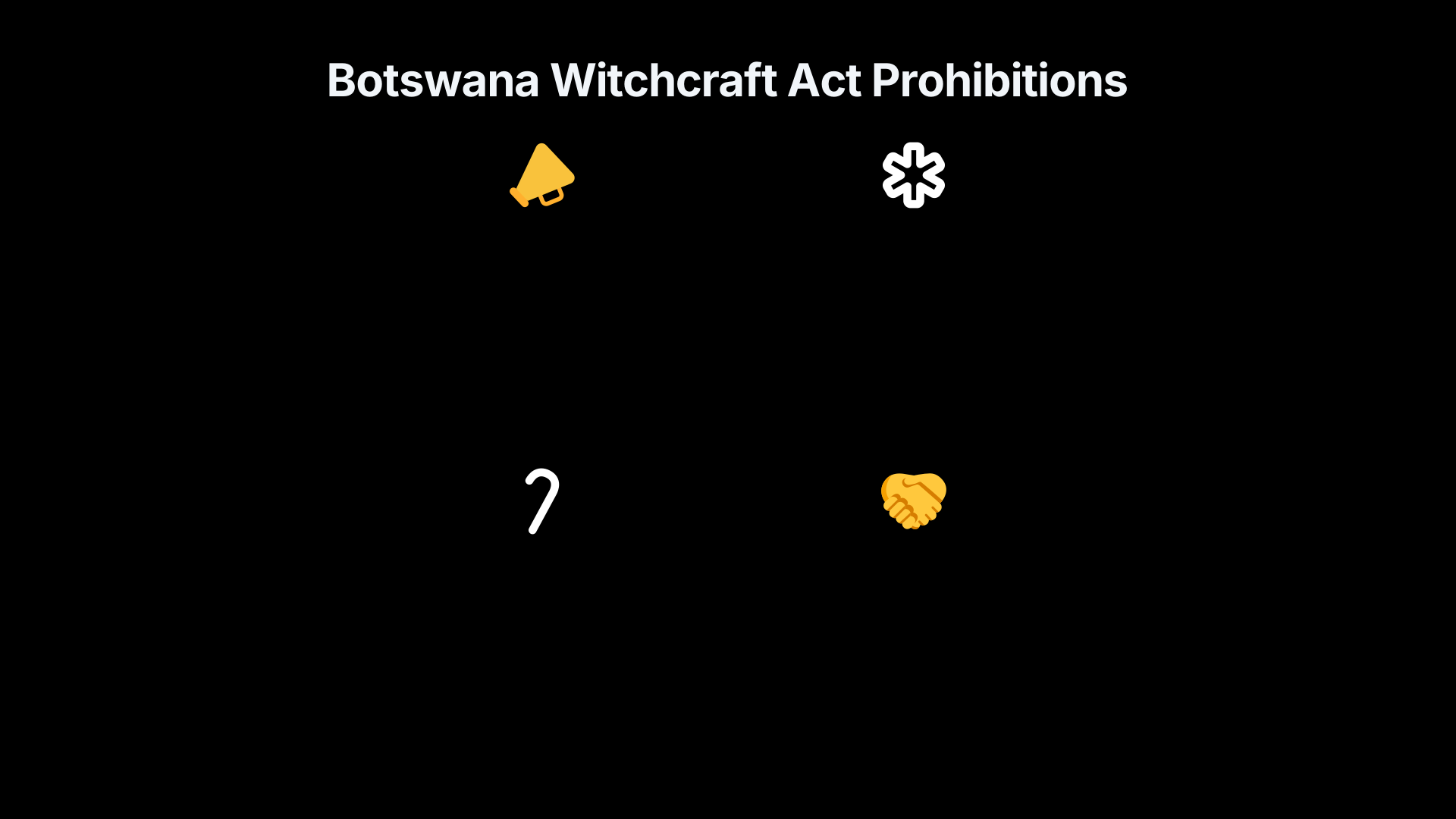
The Act makes it an offence to:
- accuse another person of causing illness, injury or damage through supernatural means;
- identify someone publicly as a witch or wizard;
- claim, through supposed supernatural powers, to identify the person responsible for misfortune;
- act as a witch-finder or witch doctor after making such accusations; and
- in some circumstances, employ a witch doctor for prohibited purposes under the Act.[Cambridge University Press & Assessment]cambridge.orgCambridge University Press & AssessmentWitchcraft Accusations and the Tort of Defamation in Anglophone Africa | International Journal of…
The language reflects a distinctive legal approach. Instead of trying to determine whether supernatural powers are real, the law assumes that accusations themselves can create tangible harm. In that sense, the legislation is aimed less at invisible forces than at visible social consequences.
How accusations become real-world harm
The reasoning behind the law becomes clearer when viewed alongside Botswana’s social history. In many communities, unexpected illness, livestock deaths, business failure or sudden prosperity may be interpreted through beliefs about harmful supernatural action. Even where no violence follows, being labelled a witch can result in exclusion from community life, family conflict or lasting damage to a person’s reputation.[Cambridge University Press & Assessment]cambridge.orgCambridge University Press & AssessmentWitchcraft Accusations and the Tort of Defamation in Anglophone Africa | International Journal of…
In more serious cases, accusations have contributed to wider public fear surrounding alleged ritual killings. Although courts require ordinary criminal evidence, public discussion may quickly move beyond what investigators can prove. The 1994 murder of schoolgirl Segametsi Mogomotsi illustrates this pattern. Her killing was real and brutal, but public suspicion expanded into broader allegations about ritual murder, powerful conspirators and occult practices that were never established in court. The episode demonstrated how belief, rumour and genuine crime can become intertwined, increasing pressure on both police and government.[Cambridge University Press & Assessment]cambridge.orgCambridge University Press & AssessmentWitchcraft Accusations and the Tort of Defamation in Anglophone Africa | International Journal of…
The law therefore attempts to interrupt one of the earliest stages in this process by discouraging public accusations before they escalate into intimidation, retaliation or mob justice.
Courts recognise the harm caused by accusations
Botswana’s courts have generally treated witchcraft accusations as damaging regardless of whether anyone believes the accusation to be true. Legal scholars note that both criminal law and civil defamation cases have recognised that calling someone a witch is capable of seriously harming their dignity and standing within the community.[Cambridge University Press & Assessment]cambridge.orgCambridge University Press & AssessmentWitchcraft Accusations and the Tort of Defamation in Anglophone Africa | International Journal of…
One frequently discussed case involved a dispute after cattle died unexpectedly. The livestock owners accused neighbouring farmers of using witchcraft to kill the animals. The court rejected attempts to minimise the accusation and held that describing someone as a witch carried an inherently defamatory meaning within Botswana’s social context. The judgment reflected an important principle: the law protects reputation because accusations can produce real social consequences, regardless of whether supernatural explanations are accepted as factual.[Cambridge University Press & Assessment]cambridge.orgCambridge University Press & AssessmentWitchcraft Accusations and the Tort of Defamation in Anglophone Africa | International Journal of…
This illustrates an important feature of Botswana’s legal system. Courts need not determine whether witchcraft exists in order to recognise that accusing someone of practising it may cause measurable harm.
The legal paradox of regulating supernatural claims
Botswana’s approach has long attracted criticism from legal scholars because it appears to contain an internal contradiction.
On one hand, the law adopts the sceptical tradition inherited from British colonial legislation. It does not attempt to prove supernatural powers in court and instead treats claims of magical ability as pretended or fraudulent. Colonial lawmakers across British Africa generally sought to suppress practices that they believed encouraged fear, extortion or violence rather than recognising witchcraft as a legal reality.[Cambridge University Press & Assessment]cambridge.orgCambridge University Press & AssessmentWitchcraft and British Colonial Law | Africa | Cambridge Core…
On the other hand, by repeatedly referring to witches, witch doctors and witch-finders, the legislation keeps those concepts within the legal vocabulary. Critics argue that this may unintentionally reinforce public perceptions that witchcraft is an object of legal regulation because it exists, rather than because belief in it can have dangerous social effects.[Cambridge University Press & Assessment]cambridge.orgCambridge University Press & AssessmentWitchcraft Accusations and the Tort of Defamation in Anglophone Africa | International Journal of…
This has produced an enduring policy dilemma:
- If the law ignores witchcraft entirely, communities may feel abandoned when accusations lead to intimidation or violence.
- If the law regulates witchcraft explicitly, it risks appearing to legitimise supernatural explanations rather than encouraging evidence-based investigation.
Neither approach completely resolves the underlying social tensions.

Why the debate continues
Botswana today combines a modern criminal justice system with diverse religious and cultural beliefs. Many citizens reject witchcraft entirely, while others continue to regard supernatural harm as part of everyday reality. The law therefore operates within a society where belief itself cannot simply be legislated away.
Modern commentators increasingly argue that the greatest danger lies not in alleged supernatural acts but in the consequences of fear: false accusations, fraud by self-proclaimed specialists, exploitation of vulnerable people and violence against suspected witches. In that sense, the practical objective of the Witchcraft Act remains relevant even if opinions differ about its language or underlying assumptions.[Cambridge University Press & Assessment]cambridge.orgCambridge University Press & AssessmentWitchcraft Accusations and the Tort of Defamation in Anglophone Africa | International Journal of…
The continuing debate is less about whether Botswana should protect people from harm than about how it should do so. Some scholars favour updating colonial-era wording to focus explicitly on intimidation, fraud, threats and incitement, while others believe the existing legislation still serves as a useful warning against accusations that can spiral into persecution. Either way, the law illustrates a broader challenge faced in several southern African countries: how to reduce fear generated by supernatural beliefs without giving those beliefs greater legal authority than the state intends.[Cambridge University Press & Assessment]cambridge.orgCambridge University Press & AssessmentWitchcraft Accusations and the Tort of Defamation in Anglophone Africa | International Journal of…
Amazon book picks
Further Reading
Books and field guides related to Can Witchcraft Laws Reduce Fear or Reinforce It?. Use these as the next step if you want deeper reading beyond the article.
Witchcraft, Violence, and Democracy in South Africa
Highly relevant to legal responses to witchcraft accusations.
Endnotes
1.
Source: cambridge.org
Link:https://www.cambridge.org/core/journals/international-journal-of-legal-information/article/witchcraft-accusations-and-the-tort-of-defamation-in-anglophone-africa/22930E9DEDD422B529CE891441433B33
Source snippet
Cambridge University Press & AssessmentWitchcraft Accusations and the Tort of Defamation in Anglophone Africa | International Journal of...
2.
Source: cambridge.org
Link:https://www.cambridge.org/core/journals/africa/article/abs/witchcraft-and-british-colonial-law/18C65EF64367A657D70D626DA53B544C
Source snippet
Cambridge University Press & AssessmentWitchcraft and British Colonial Law | Africa | Cambridge Core...
3.
Source: cambridge.org
Link:https://www.cambridge.org/core/journals/journal-of-african-law/article/effects-of-matrimonial-causes-legislation-in-botswana/9819A4A1922D67E4348B377EC5DA2696
Additional References
4.
Source: ritualkillinginafrica.org
Link:https://www.ritualkillinginafrica.org/2026/03/25/after-the-discovery-of-mutilated-bodies-there-is-no-such-thing-as-ritual-killings-in-our-laws-says-minister-for-state-president-defence-and-security-moeti-mohwasa-botswana/
Source snippet
ence, and Security Moeti Mohwasa (Botswana) | Ritual Killing In AfricaMarch 25, 2026 — AFTER THE DISCOVERY OF MUTILATED BODIES – ‘THERE I...
Published: March 25, 2026
5.
Source: investigative-malawi.org
Title: Malawi’s century-old witchcraft law leaves door open to mob killings
Link:https://www.investigative-malawi.org/3336/witchcraft-mob-justice/
Source snippet
Center for Investigative Journalism MalawiMay 13, 2026 — MALAWI’S CENTURY-OLD WITCHCRAFT LAW LEAVES DOOR OPEN TO MOB KILLINGS Posted by t...
Published: May 13, 2026
6.
Source: mmegi.bw
Title: There is no such thing as ritual killings in our laws- Mohwasa
Link:https://www.mmegi.bw/ampArticle/121876
Source snippet
March 24, 2026 — THERE IS NO SUCH THING AS RITUAL KILLINGS IN OUR LAWS- MOHWASA Staff Writer | Tuesday March 24, 2026 17:17 Mohwasa This...
Published: March 24, 2026
7.
Source: mg.co.za
Title: Photo: Macmillan Mhone Seven people were ki
Link:https://mg.co.za/news/africa/2026-05-13-malawi-s-century-old-witchcraft-law-leaves-door-open-to-mob-killings/
Source snippet
Malawi’s century-old witchcraft law leaves door open to mob killingsMay 13, 2026 — MALAWI’S CENTURY-OLD WITCHCRAFT LAW LEAVES DOOR OPEN T...
Published: May 13, 2026
8.
Source: youtube.com
Link:http://www.youtube.com/watch?v=fNVoaEElP9Q
Source snippet
Witchcraft law Africa Firsthand Accounts of African Witchcraft - Rev. Jean-Marie Malengala | Theology, Things & Stuff #023 Theology, Thin...
9.
Source: dailynews.gov.bw
Title: Daily News
Link:https://dailynews.gov.bw/news-detail/90126
Source snippet
February 19, 2026 — WITCHCRAFT MURDER APPEAL BORDERS ON DEATH PENALTY Image Image 19 Feb 2026 A mistaken identity murder stemmin...
Published: February 19, 2026
10.
Source: dailynews.gov.bw
Title: Daily News
Link:https://dailynews.gov.bw/news-detail/90777
Source snippet
March 30, 2026 — MPS BACK TOUGHER SENTENCES FOR POSSESSION OF HUMAN REMAINS 30 Mar 2026 Convicted offenders found in possession...
Published: March 30, 2026
11.
Source: researchgate.net
Link:https://www.researchgate.net/publication/379562854_Witchcraft_Accusations_and_the_Tort_of_Defamation_in_Anglophone_Africa
12.
Source: botswanalaws.com
Link:https://botswanalaws.com/consolidated-statutes/principle-legislation/penal-code
13.
Source: scielo.org.za
Link:https://www.scielo.org.za/scielo.php?pid=S1011-76012015000100003&script=sci_arttext
Topic Tree