Within Greece Panics
Did a Heavenly Cross Confirm the Old Calendar?
Reports of a luminous cross over Athens gave divine meaning to a calendar dispute and helped sustain a lasting Orthodox schism.
On this page
- Why the calendar reform became a crisis of tradition
- The reported cross over Mount Hymettus
- Growth, division and state pressure on Old Calendarists
Page outline Jump by section
Introduction
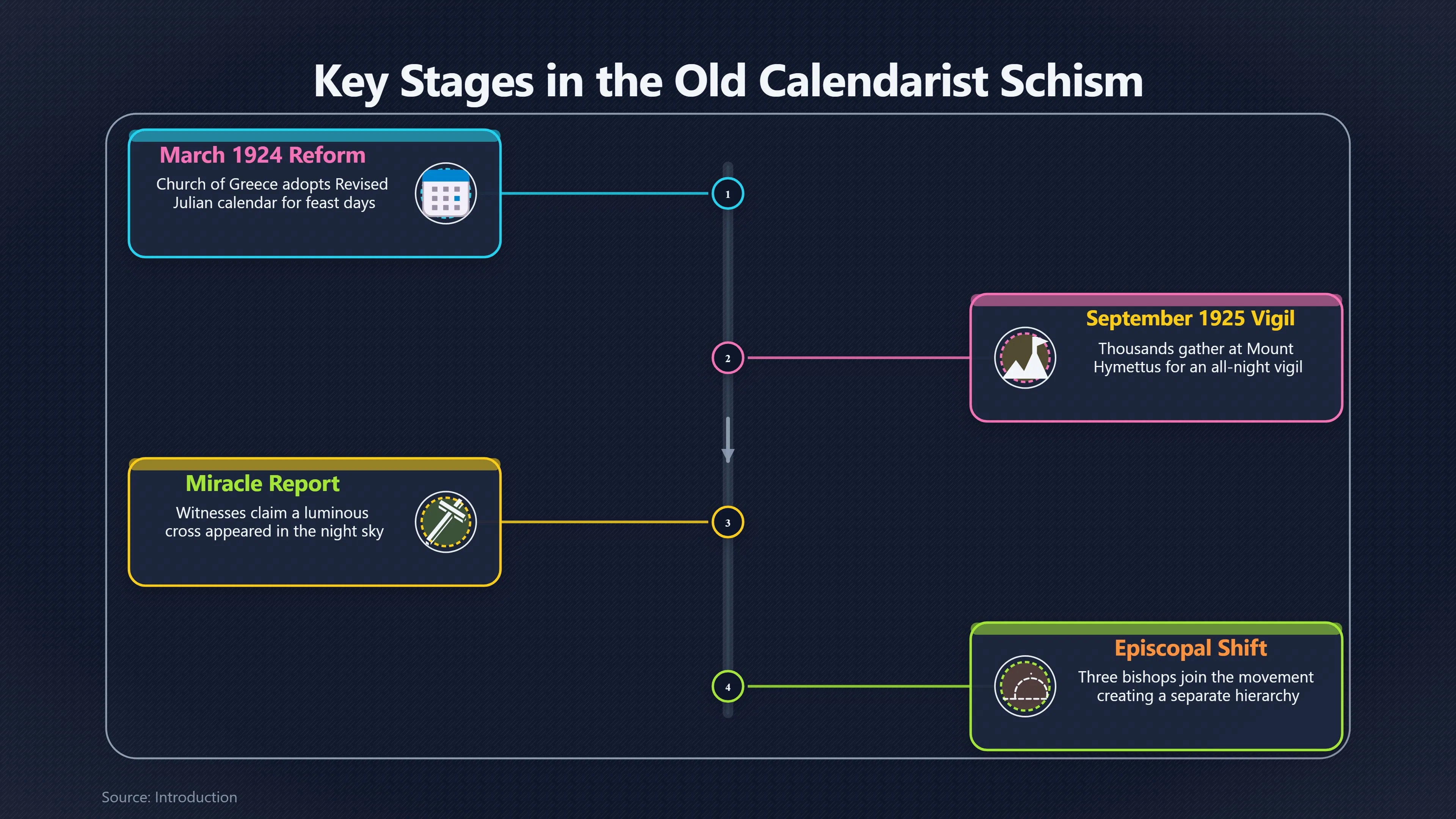
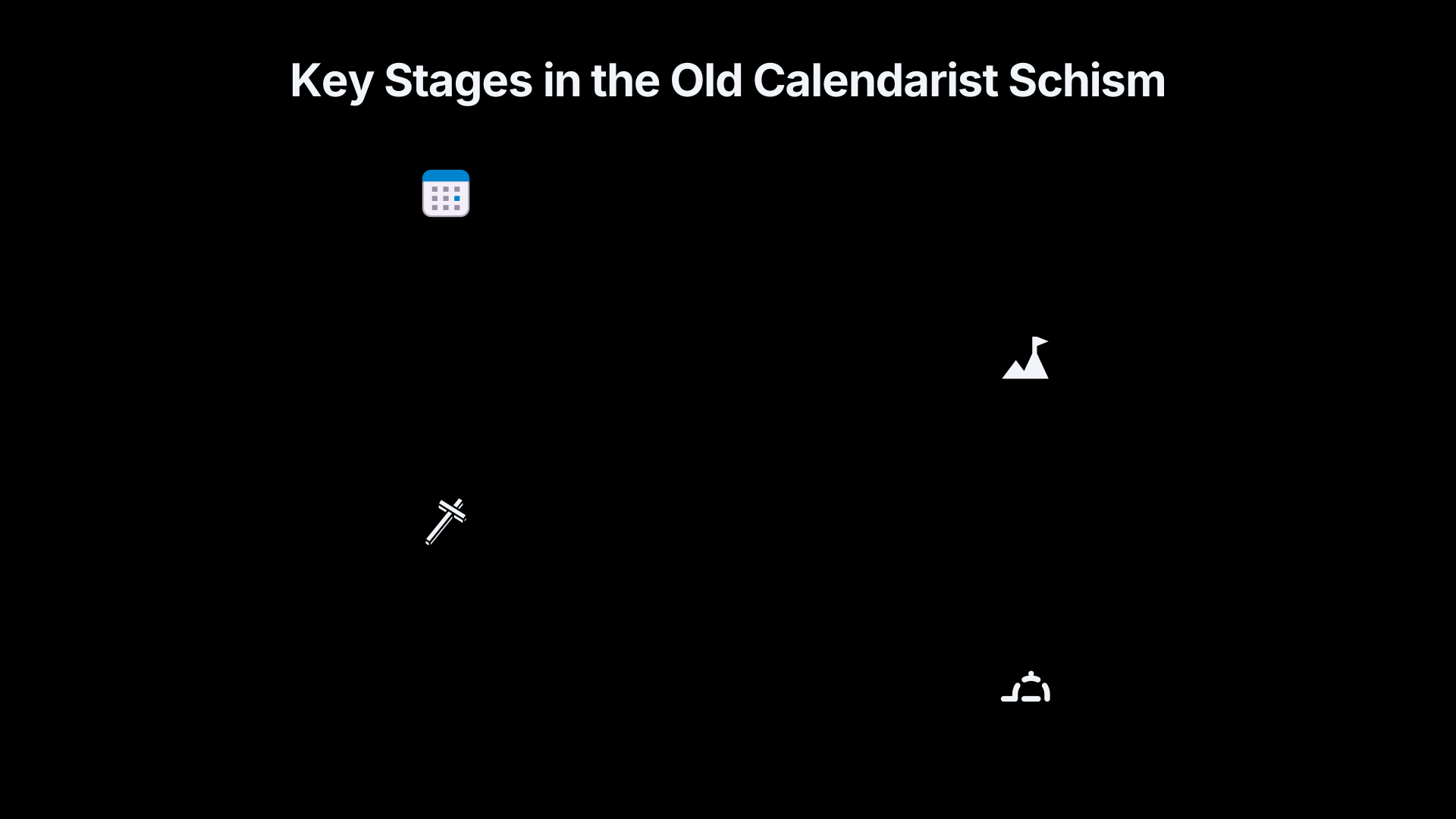
The Old Calendarist movement in Greece began as a dispute over church authority and religious tradition, but it acquired lasting emotional force through a reported miracle. In September 1925, thousands of worshippers gathered for an all-night vigil at a small chapel on Mount Hymettus, near Athens, where many later claimed to have witnessed a luminous cross in the night sky. For believers, the event was a divine confirmation that the Church of Greece had been wrong to abandon the traditional Julian calendar. For sceptics and historians, it illustrates how an extraordinary religious experience can strengthen an existing movement without settling the historical or theological dispute.
The episode remains significant because it shows how a conflict over what might appear to be a technical question—a church calendar—became a struggle over identity, continuity and religious legitimacy. The reported heavenly sign helped sustain a schism that has endured, in different forms, for a century.
Why the calendar reform became a crisis of tradition
The immediate cause of the controversy was the decision by the Church of Greece in March 1924 to adopt the Revised Julian calendar for fixed feast days. The reform followed discussions at the 1923 Pan-Orthodox Congress in Constantinople and brought many church festivals into line with the civil calendar used across Europe, while retaining the traditional calculation of Easter. Not every Orthodox Church accepted the change, and several continued using the older Julian calendar.[Wikipedia]WikipediaOld CalendaristsOld Calendarists
For supporters of the reform, the change was an administrative and pastoral adjustment rather than a change in doctrine. For opponents, however, the issue was never simply about counting days. Many feared that altering the inherited calendar without universal Orthodox agreement represented a dangerous break with sacred tradition and an accommodation to Western Christian influence. The reform arrived during a period of profound instability following the Greco-Turkish War, population exchanges and political upheaval, making questions of continuity and national identity especially sensitive.[Wikipedia]WikipediaOld CalendaristsOld Calendarists
Resistance initially came from lay believers, parish clergy, monks and some communities on Mount Athos. Their concern was that preserving the traditional calendar symbolised fidelity to Orthodoxy itself. This conviction gradually produced separate congregations that worshipped according to the old calendar even before they possessed their own bishops.[Wikipedia]WikipediaOld CalendaristsOld Calendarists
The reported cross over Mount Hymettus
The defining event in the movement’s early history occurred during the vigil for the Feast of the Exaltation of the Holy Cross on the night of 26–27 September 1925 (13–14 September according to the Julian calendar observed by the Old Calendarists).
According to numerous accounts preserved within the movement, more than 2,000 people had gathered at the Church of St John the Theologian on Mount Hymettus outside Athens. Police had reportedly been sent to disperse what authorities regarded as an unauthorised religious gathering and to arrest the officiating priest. During the service, many witnesses claimed that a brilliant cross appeared above the chapel and remained visible long enough for the crowd—and the police present—to observe it.[OrthodoxInfo]orthodoxinfo.comcross sign.aspxThe Appearance of the Sign of the Cross Near Athens in 1925…
Believers interpreted the appearance as unmistakable divine approval of their defence of the traditional calendar. The miracle rapidly became one of the movement’s central narratives, appearing in sermons, publications and later histories. Accounts often emphasised that hostile or neutral observers, including police officers, were also said to have seen the phenomenon, strengthening its credibility within the community.[OrthodoxInfo]orthodoxinfo.comcross sign.aspxThe Appearance of the Sign of the Cross Near Athens in 1925…
From a historical perspective, however, the event is difficult to verify independently. Contemporary documentation outside Old Calendarist circles is limited, and surviving descriptions largely come from supporters who regarded the event as miraculous. Historians therefore distinguish between the historical certainty that the reports circulated widely and the separate question of whether the reported supernatural event can be established as an objective historical fact.[Wikipedia]WikipediaOld CalendaristsOld Calendarists
Why the miracle mattered even if opinions differed
Religious movements often become more resilient when participants believe that divine intervention has confirmed their cause. The Mount Hymettus reports served precisely that function.
Rather than creating the movement, the miracle gave existing convictions a powerful symbolic centre. It transformed a disagreement about ecclesiastical authority into a story of heavenly vindication. For many adherents, remaining faithful to the old calendar became not merely an act of conservatism but a response to what they believed God had publicly revealed.
This helps explain why the calendar dispute proved remarkably resistant to compromise. Once the conflict became associated with a perceived miracle, changing one’s position could appear to believers as rejecting divine confirmation rather than merely accepting a different administrative system. Historians of religion frequently note that claimed miracles can reinforce group cohesion because they provide emotionally compelling evidence that believers interpret through an already established religious framework.[ROCOR Studies]rocorstudies.orgROCOR Studies The Old Calendar Movement in Greece: An Historical SurveyROCOR StudiesThe Old Calendar Movement in Greece: An Historical Survey - ROCOR Studies…
Growth, division and state pressure on Old Calendarists
The reported miracle did not end the conflict. Instead, it encouraged the expansion of Old Calendarist communities throughout Greece.
During the late 1920s and early 1930s, Old Calendarists established churches, monasteries and charitable institutions despite legal and administrative obstacles. Relations with the official Church and state authorities were frequently tense. Worship was sometimes disrupted, clergy faced arrests or restrictions, and disputes arose over access to church buildings. Some government measures later permitted Old Calendarist communities greater freedom to worship and construct their own churches, although tensions remained.[ROCOR Studies]rocorstudies.orgROCOR Studies The Old Calendar Movement in Greece: An Historical SurveyROCOR StudiesThe Old Calendar Movement in Greece: An Historical Survey - ROCOR Studies…
A major turning point came in 1935 when three bishops left the Church of Greece and joined the movement, giving it an episcopal hierarchy capable of ordaining clergy and expanding independently. This transformed what had largely been a grassroots protest into a separate ecclesiastical body.[Wikipedia]WikipediaOld CalendaristsOld Calendarists
Ironically, the movement itself later fragmented into competing jurisdictions over questions of theology, authority and relations with other Orthodox churches. As a result, “Old Calendarist” today refers not to a single unified church but to several bodies sharing a common origin in the calendar dispute while differing over later developments.[Wikipedia]WikipediaOld CalendaristsOld Calendarists
How historians interpret the episode
The Old Calendarist miracle differs from classic cases of mass hysteria or moral panic. There was no widespread fear of an invisible enemy, nor was the movement driven by rumours of hidden conspiracies. Instead, the episode centred on a positive religious sign that believers interpreted as confirming an existing conviction.
Several interpretations coexist:
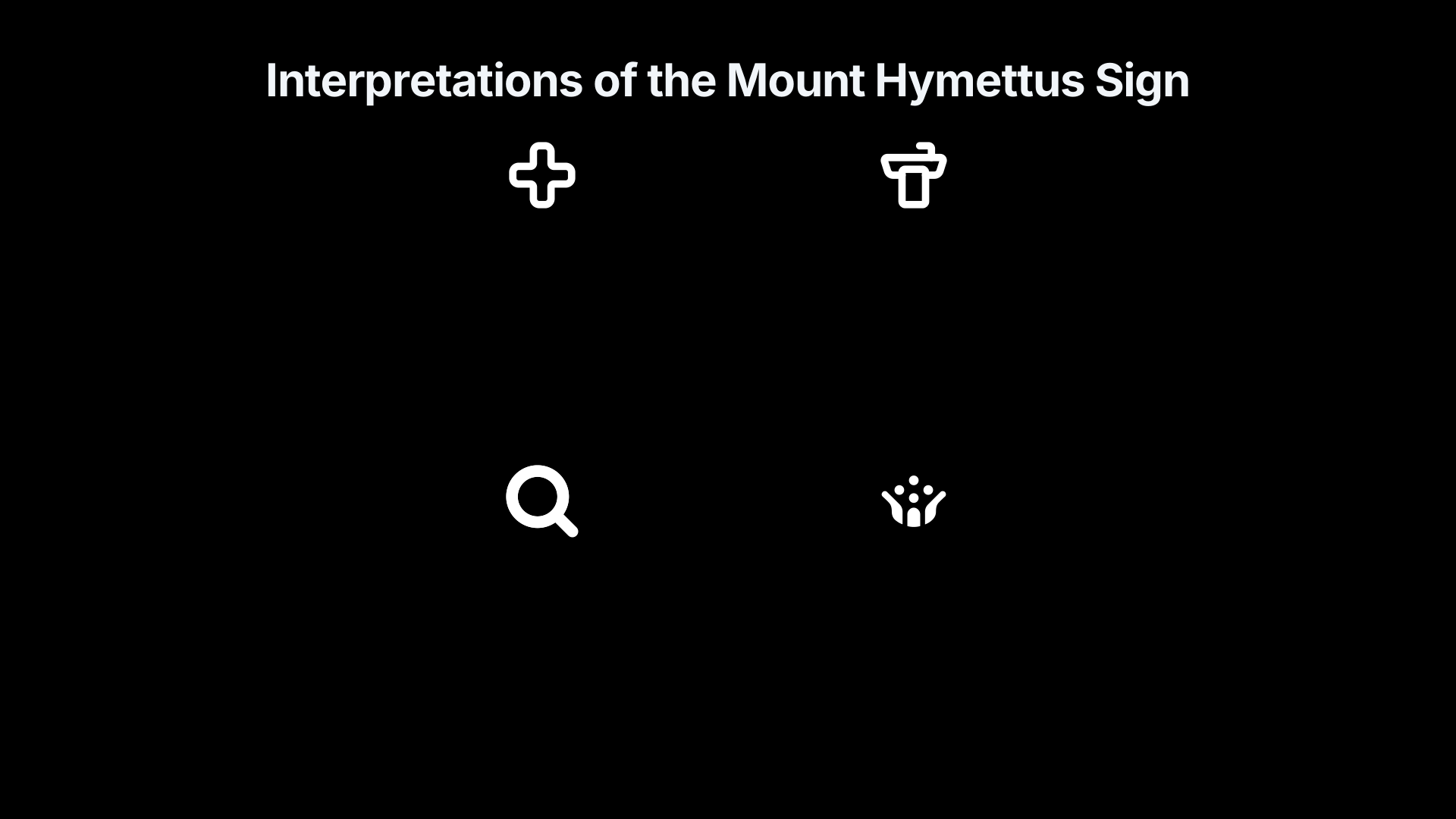
- Within Old Calendarist tradition, the cross over Mount Hymettus remains a genuine miracle demonstrating divine approval of the traditional calendar.
- Within the mainstream Orthodox Church, views vary. Some regard the reports with caution or scepticism while considering the calendar dispute itself a matter that should not justify permanent schism.
- Among historians and scholars of religion, the key point is less whether a miracle objectively occurred than how reports of the event strengthened group identity, legitimised resistance to reform and sustained a religious movement through periods of official pressure.[Wikipedia]WikipediaOld CalendaristsOld Calendarists
This distinction is important. Historians can document the spread and influence of miracle reports even when they cannot determine the supernatural nature of the event itself.

Why the episode still matters
The Mount Hymettus miracle remains one of modern Greece’s most influential examples of collective religious belief shaping institutional history. It demonstrates how symbolic events can transform administrative disagreements into enduring questions of faith, authority and identity.
Within the broader history of collective belief in Greece, the episode stands apart from vampire scares, blood-libel accusations or later Satanic panics. Rather than spreading fear through rumours of hidden threats, it spread conviction through the belief that heaven had visibly intervened in an ongoing religious controversy. Whether understood as miracle, shared religious experience or powerful communal narrative, the reported cross became one of the defining symbols of a schism that continues to influence Greek Orthodox life today.
Amazon book picks
Further Reading
Books and field guides related to Did a Heavenly Cross Confirm the Old Calendar?. Use these as the next step if you want deeper reading beyond the article.

Purity and danger
First published 1966. Subjects: Purity, Ritual, Ritual Purity, Taboo, Pollution, Cultural Anthropology.


Magic, science, and religion, and other essays
First published 1948. Subjects: Anthropology, Religion, Ethnology, Essays (single author), Magic.

The Orthodox way
First published 1979. Subjects: Christianity, Essence, genius, nature, Doctrines, Orthodox Eastern Church, Eastern church Theology.
Endnotes
1.
Source: Wikipedia
Title: Old Calendarists
Link:https://en.wikipedia.org/wiki/Old_Calendarists
2.
Source: orthodoxinfo.com
Title: cross sign.aspx
Link:https://orthodoxinfo.com/ecumenism/cross_sign.aspx
Source snippet
The Appearance of the Sign of the Cross Near Athens in 1925...
3.
Source: orthodoxinfo.com
Link:https://orthodoxinfo.com/ecumenism/cal_letter.aspx
4.
Source: rocorstudies.org
Title: ROCOR Studies The Old Calendar Movement in Greece: An Historical Survey
Link:https://www.rocorstudies.org/2025/11/28/the-old-calendar-movement-in-greece-an-historical-survey/
Source snippet
ROCOR StudiesThe Old Calendar Movement in Greece: An Historical Survey - ROCOR Studies...
5.
Source: goctoronto.org
Title: A Divine Confirmation | Metropolis of Toronto
Link:https://goctoronto.org/a-divine-confirmation/
6.
Source: orthodoxwiki.org
Title: Old Calendarists
Link:https://orthodoxwiki.org/Old_Calendarists
7.
Source: stmarkgoc.ca
Link:https://www.stmarkgoc.ca/orthodox-calendar
8.
Source: religion.fandom.com
Title: Old Calendarists
Link:https://religion.fandom.com/wiki/Old_Calendarists
9.
Source: attalus.org
Link:https://www.attalus.org/names/h/hymettus.html
Additional References
10.
Source: researchgate.net
Link:https://www.researchgate.net/publication/343187280_Quand_la_coordination_temporelle_mondiale_nuit_a_l%27eurythmie_locale_L%27adoption_du_calendrier_gregorien_et_les_anciens_calendaristes_en_Grece
Source snippet
s en GrèceDecember 1, 2019 — l’autre à l’intérieur du champ religieux!: alors que les uns craignent que le futur soit sombre s’ils baisse...
Published: December 1, 2019
11.
Source: orthodoxtraditionalist.com
Link:https://www.orthodoxtraditionalist.com/post/persecutions-of-the-greek-old-calendarists-by-the-official-church-during-the-first-years-of-the-cale
12.
Source: goctoronto.org
Link:https://goctoronto.org/2197-2/
Source snippet
July 14, 2025 — ΤHE FAST OF THE HOLY APOSTLES AND THE TRANSGRESSION OF THE NEW CALENDARISTS A review of an article of Bishop Chrysostomos...
Published: July 14, 2025
13.
Source: orthodoxmiscellany.blogspot.com
Link:https://orthodoxmiscellany.blogspot.com/2025/05/a-brief-history-of-goc.html
Source snippet
George Xyrotagaros in Faliro also had a dramatic ordeal. The intervention of the Gendarmerie forces, under the pretext that the Republic...
14.
Source: trueorthodox.eu
Link:https://trueorthodox.eu/100-years-since-the-third-appearance-of-the-holy-cross-on-mount-hymettus/
15.
Source: scribd.com
Link:https://www.scribd.com/document/385330488/Genuine-orthodox-church-of-greece-History-pdf
16.
Source: mospat.ru
Link:https://mospat.ru/en/authors-analytics/87148/
17.
Source: startingontheroyalpath.blogspot.com
Link:https://startingontheroyalpath.blogspot.com/2010/10/bottom-line-on-calendar.html
18.
Source: egoch.org
Link:https://egoch.org/some-english-texts/why-i-am-an-old-calendarist/
19.
Source: youtube.com
Link:https://www.youtube.com/watch?v=8iQWHQ7E3o4
Source snippet
Fr. Peter, Why Don't You Join the Old Calendarists?...
Topic Tree