Within Laos Belief Panics
Why Did Hmong Deliverer Movements Keep Returning?
From Pa Chay to later Chao Fa movements, sacred leadership offered Hmong communities a vision of justice, unity and survival under stronger states.
On this page
- Pa Chay and the rebellion of 1918 to 1921
- What Hmong messianism promised followers
- Prophecy, war and the politics of hostile labels
Page outline Jump by section
Introduction
Hmong messianic movements have appeared repeatedly in the highlands of Laos because many Hmong communities experienced long periods of political marginalisation, heavy taxation, warfare and displacement. Rather than representing irrational outbreaks of collective belief, these movements combined religion, politics and hopes for survival. Charismatic leaders claimed divine authority, promised the arrival of a deliverer or restored kingdom, and offered followers a vision in which foreign rulers and hostile governments would be overthrown. For supporters, these promises addressed real hardships. For colonial governments and later the Lao state, however, the same movements were often viewed primarily as dangerous rebellions or security threats. Historians therefore treat them as both religious movements and political responses to unequal power, rather than simply as examples of “cults” or mass hysteria.[Cambridge University Press & Assessment]cambridge.orgCambridge University Press & AssessmentOf Grasshoppers, Caterpillars, and Beans: A Historical Perspective on Hmong Messianism | TRaNS: Tr…
Why did Hmong deliverer movements keep returning?
Across more than a century, remarkably similar expectations have reappeared despite changing political circumstances. Whether under French colonial rule, during the Cold War or after the communist victory in Laos, prophetic leaders repeatedly claimed that an era of suffering was about to end.
Several conditions encouraged these movements:
- Highland communities had limited influence over governments centred in the lowlands.
- Taxes, labour obligations and opium regulations under French rule generated deep resentment.
- Warfare repeatedly displaced villages and disrupted traditional authority.
- Oral traditions already contained expectations of a future Hmong ruler or divinely chosen leader who would restore justice.
- Periods of crisis encouraged people to interpret dreams, visions and prophecies as signs that deliverance was near.[cambridge.org]cambridge.orgCambridge University Press & AssessmentOf Grasshoppers, Caterpillars, and Beans: A Historical Perspective on Hmong Messianism | TRaNS: Tr…
Anthropologists emphasise that these expectations were not fixed doctrines. Different prophets adapted familiar themes to new circumstances, sometimes drawing on older Hmong traditions, sometimes incorporating Buddhist or Christian ideas, and sometimes combining several religious influences into new forms.[Cambridge University Press & Assessment]cambridge.orgCambridge University Press & AssessmentOf Grasshoppers, Caterpillars, and Beans: A Historical Perspective on Hmong Messianism | TRaNS: Tr…
Pa Chay and the rebellion of 1918 to 1921
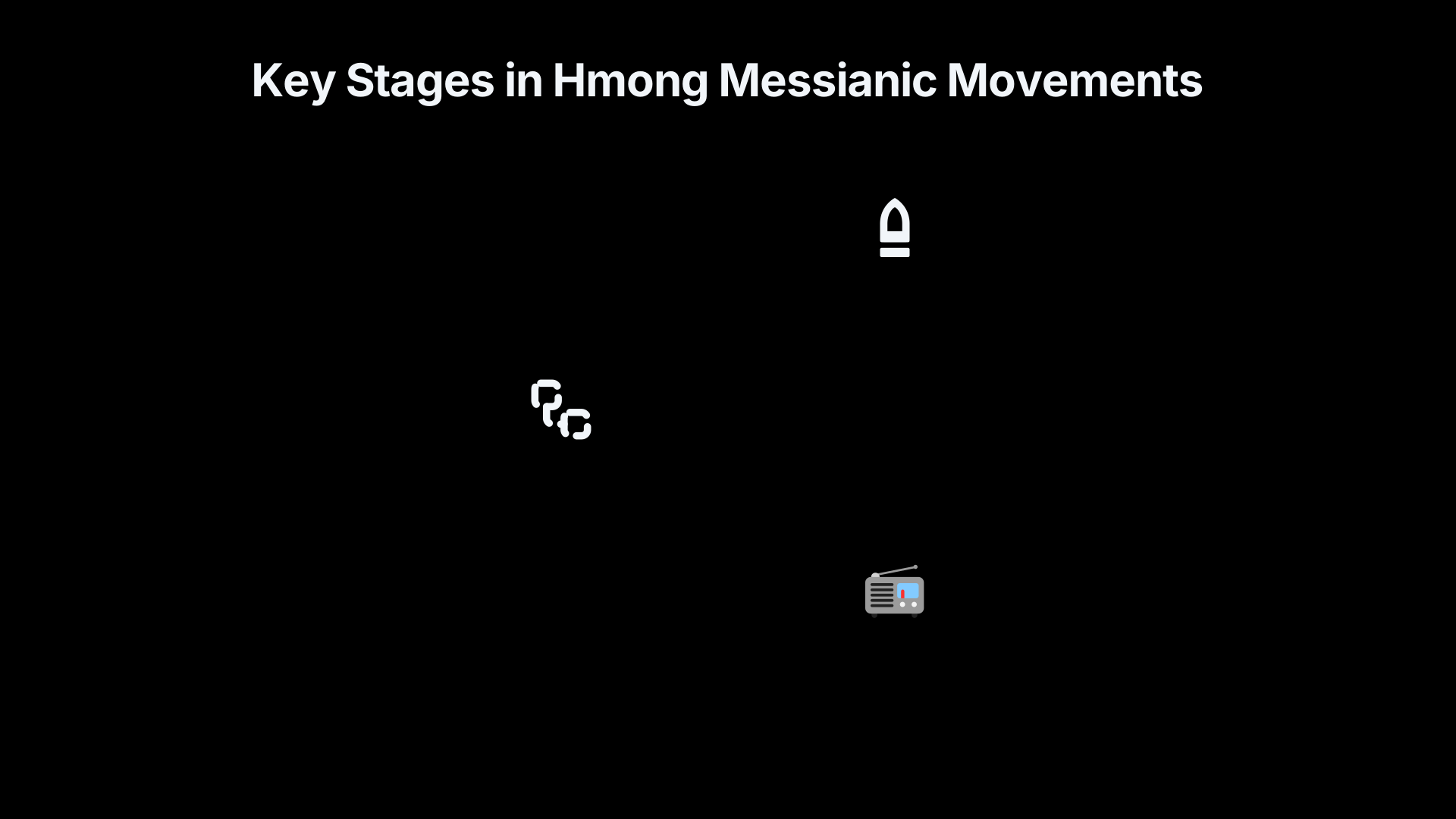
The best-known Hmong prophetic uprising was led by Pa Chay (often written Pa Chay Vue or Batchai), whose rebellion spread across northern Laos and neighbouring north-west Vietnam between 1918 and 1921.
French colonial officials described him as a false prophet or impostor. Hmong supporters remembered him very differently: as a divinely inspired leader chosen to restore Hmong dignity and autonomy. Modern historians generally avoid accepting either portrayal uncritically, instead examining how religious belief and anti-colonial resistance reinforced one another.[Cambridge University Press & Assessment]cambridge.orgCambridge University Press & AssessmentIs This Pa Chay Vue? A Study in Three Frames | Journal of the Royal Asiatic Society | Cambridge Core…
Pa Chay’s movement emerged during a period when Hmong communities faced:
- increasing colonial taxation;
- tighter control of the lucrative opium trade;
- rule through allied Tai and Lao officials;
- military pressure from French authorities.
His message promised that existing power structures would collapse and that Hmong followers would regain freedom. Like many millenarian movements elsewhere, supernatural expectations strengthened morale. Some followers reportedly believed divine protection would make them invulnerable in battle or prevent enemy weapons from working effectively. These beliefs helped sustain resistance against a vastly stronger military force, although they could not overcome French firepower.[Cambridge University Press & Assessment]cambridge.orgcultivating subjects opium and rule in post colonial vietnamCambridge University Press & AssessmentModern Asian Studies 51, 4 (2017) pp. 879–918. C…
The rebellion ultimately failed militarily after extensive colonial campaigns, and Pa Chay was killed in 1921. Yet his reputation endured in Hmong historical memory, especially among later generations seeking symbols of resistance against outside domination. Recent scholarship has also challenged older colonial narratives by showing that French reports often simplified complex negotiations and political relationships surrounding Pa Chay’s leadership.[Cambridge University Press & Assessment]cambridge.orgCambridge University Press & AssessmentIs This Pa Chay Vue? A Study in Three Frames | Journal of the Royal Asiatic Society | Cambridge Core…

What Hmong messianism promised followers
Although each movement differed, recurring promises appear throughout the historical record.
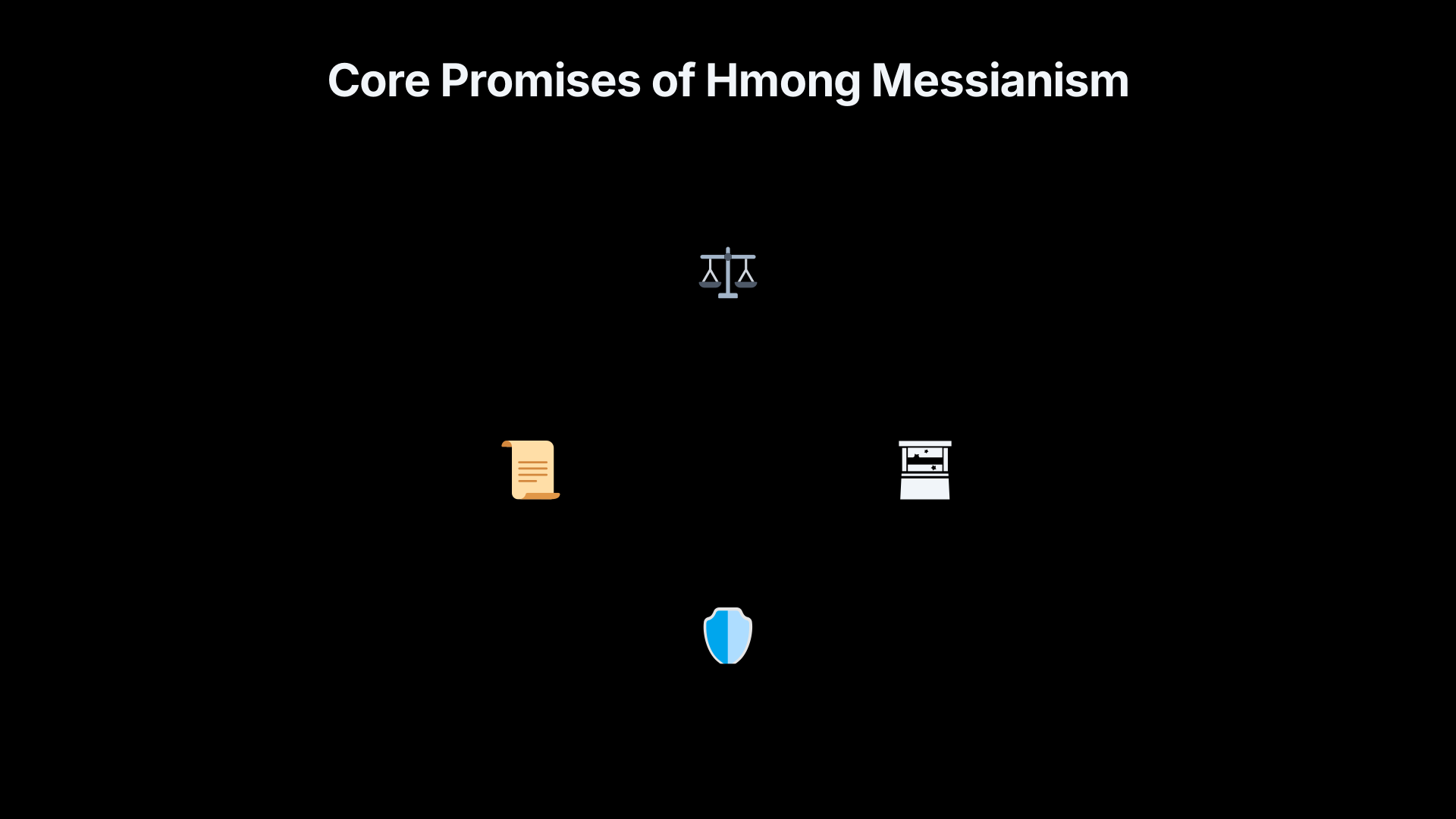
The first was justice. Followers believed present suffering resulted from an unjust political order rather than inevitable fate. A divinely appointed leader would therefore restore moral balance.
The second was unity. Hmong communities were geographically dispersed across Laos, Vietnam, Thailand and southern China. Prophetic movements imagined a future in which these scattered communities would again become one people under legitimate leadership.[Cambridge University Press & Assessment]cambridge.orgCambridge University Press & AssessmentOf Grasshoppers, Caterpillars, and Beans: A Historical Perspective on Hmong Messianism | TRaNS: Tr…
The third was survival. During periods of war and persecution, belief itself became a practical resource. Confidence that divine intervention was approaching could strengthen solidarity, reduce fear and encourage collective action even when military victory seemed unlikely.
Finally, many movements promised cultural restoration rather than merely political independence. Prophecies often imagined a future in which Hmong language, customs and authority would flourish without domination by outsiders. Scholars therefore interpret these movements as expressions of ethnic identity as much as religious expectation.[Cambridge University Press & Assessment]cambridge.orgCambridge University Press & AssessmentOf Grasshoppers, Caterpillars, and Beans: A Historical Perspective on Hmong Messianism | TRaNS: Tr…
From colonial rebellion to the Chao Fa movements
Messianic expectations did not disappear after French rule ended.
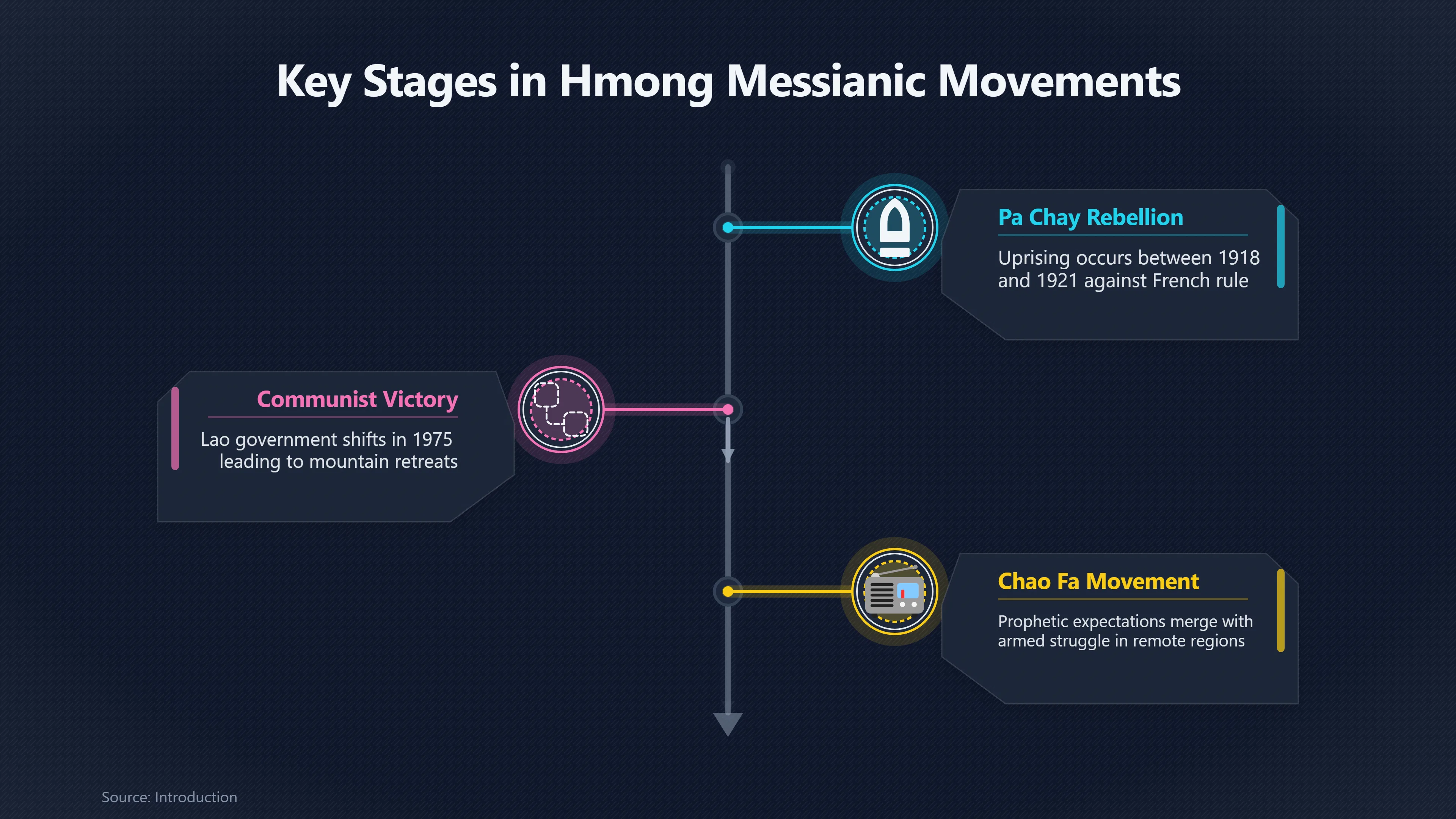
Following the communist victory in Laos in 1975, some Hmong groups retreated into remote mountain regions rather than surrender. Among sections of this resistance, prophetic expectations merged with armed struggle in what became known as the Chao Fa movement.
The term “Chao Fa” has been used in different ways by different observers. Some participants understood it primarily in religious terms, referring to a divinely guided leader. Government authorities generally treated Chao Fa groups as insurgents, while outside observers have debated how much influence religious belief actually exercised compared with military and political goals.[garyyialee]garyyialee.comGary Yia Lee | Topical | Hmong Rebellion in LaosGary Yia Lee | Topical | Hmong Rebellion in LaosJanuary 1, 2008…
Some resistance leaders reportedly promised supernatural protection, divine intervention or the imminent arrival of a transformed Hmong society. These expectations echoed earlier prophetic traditions but developed within the entirely different context of Cold War conflict, refugee movements and the destruction experienced by Hmong communities after decades of war.[garyyialee]garyyialee.comGary Yia Lee | Topical | Hmong Rebellion in LaosGary Yia Lee | Topical | Hmong Rebellion in LaosJanuary 1, 2008…
Because reliable access to remote conflict zones was often limited, reports concerning Chao Fa beliefs sometimes mixed documented evidence with rumours, government claims and exile accounts. Historians therefore distinguish carefully between well-supported descriptions of specific movements and broader popular legends that developed around them.[asianethnology.scholasticahq.com]asianethnology.scholasticahq.comIan G. BairdIan G. Baird
Prophecy, war and the politics of hostile labels
Authorities have frequently described Hmong prophetic movements as fanatical sects or irrational cults. Such labels served political purposes.
French colonial officials used prophetic language to portray resistance as evidence of native superstition rather than opposition to colonial exploitation. Later governments similarly emphasised security threats while paying less attention to the historical grievances that encouraged support for prophetic leaders.[Cambridge University Press & Assessment]cambridge.orgCambridge University Press & AssessmentIs This Pa Chay Vue? A Study in Three Frames | Journal of the Royal Asiatic Society | Cambridge Core…
Modern scholarship takes a more balanced approach. Researchers acknowledge that some leaders made extraordinary supernatural claims and that followers sometimes expected miraculous intervention. At the same time, they argue these beliefs cannot be separated from poverty, political exclusion, forced migration and repeated warfare.
This perspective helps explain why remarkably similar movements appeared across generations. Rather than spreading because people were unusually gullible, prophetic expectations became persuasive whenever ordinary political solutions seemed impossible. Religion supplied a language through which communities interpreted injustice, organised resistance and imagined a future beyond present suffering.[Cambridge University Press & Assessment]cambridge.orgCambridge University Press & AssessmentOf Grasshoppers, Caterpillars, and Beans: A Historical Perspective on Hmong Messianism | TRaNS: Tr…
Why these movements remain important
Hmong messianic movements occupy an unusual place in the history of Laos because they blur familiar distinctions between religion, politics and ethnic identity.
To governments, they often appeared as security threats. To many Hmong communities, they represented repeated attempts to preserve autonomy under overwhelming pressure. Neither perspective alone fully explains their persistence.
For historians of collective belief, these movements demonstrate that prophetic expectations are often rooted in concrete social conditions rather than simple credulity. Visions of a coming deliverer gained strength precisely because generations of Hmong communities experienced conquest, displacement and unequal treatment. The religious message gave those experiences meaning while offering hope that history itself could be reversed.
Seen in this light, the recurring search for a Hmong deliverer belongs not primarily to the history of irrational panic but to the broader history of how marginalised peoples have used prophecy to imagine justice, unity and survival in times of profound crisis.[cambridge.org]cambridge.orgCambridge University Press & AssessmentOf Grasshoppers, Caterpillars, and Beans: A Historical Perspective on Hmong Messianism | TRaNS: Tr…
Amazon book picks
Further Reading
Books and field guides related to Why Did Hmong Deliverer Movements Keep Returning?. Use these as the next step if you want deeper reading beyond the article.

The Spirit Catches You and You Fall Down
Best-known English-language book introducing Hmong culture and beliefs.
Seeing Like a State
Useful framework for understanding state responses to prophetic movements.

The Art of Not Being Governed
Explains upland autonomy and recurring resistance movements.
Endnotes
1.
Source: cambridge.org
Link:https://www.cambridge.org/core/journals/trans-trans-regional-and-national-studies-of-southeast-asia/article/of-grasshoppers-caterpillars-and-beans-a-historical-perspective-on-hmong-messianism/731242F699217BACF50F4113C788F556
Source snippet
Cambridge University Press & AssessmentOf Grasshoppers, Caterpillars, and Beans: A Historical Perspective on Hmong Messianism | TRaNS: Tr...
2.
Source: asianethnology.scholasticahq.com
Title: Ian G. Baird
Link:https://asianethnology.scholasticahq.com/article/150039.pdf
3.
Source: cambridge.org
Link:https://www.cambridge.org/core/journals/journal-of-the-royal-asiatic-society/article/abs/is-this-pa-chay-vue-a-study-in-three-frames/6249A1D5507E3823D1F5C0E7AA88A1F5
Source snippet
Cambridge University Press & AssessmentIs This Pa Chay Vue? A Study in Three Frames | Journal of the Royal Asiatic Society | Cambridge Core...
4.
Source: cambridge.org
Title: cultivating subjects opium and rule in post colonial vietnam
Link:https://www.cambridge.org/core/services/aop-cambridge-core/content/view/6179DD3E7F977B76868617CBB2155984/S0026749X15000402a.pdf/cultivating-subjects-opium-and-rule-in-post-colonial-vietnam.pdf
Source snippet
Cambridge University Press & AssessmentModern Asian Studies 51, 4 (2017) pp. 879–918. C...
5.
Source: garyyialee.com
Title: Gary Yia Lee | Topical | Hmong Rebellion in Laos
Link:https://www.garyyialee.com/topical-hmong-rebellion-in-laos
Source snippet
Gary Yia Lee | Topical | Hmong Rebellion in LaosJanuary 1, 2008...
Published: January 1, 2008
6.
Source: cambridge.org
Title: Journal of the Royal Asiatic Society: Volume 31
Link:https://www.cambridge.org/core/journals/journal-of-the-royal-asiatic-society/issue/4D9C0450730B6E207C1618A6DFBFCCF8
7.
Source: unrepresentedunitednations.org
Link:https://www.unrepresentedunitednations.org/en/unrepresented-united-nations-directory/hmong-en
Additional References
8.
Source: tianmu.org
Title: Hmong Shamanism — The Way of the Txiv Neeb · Tianmu Anglican Church
Link:https://tianmu.org/good-work-library/living-traditions/southeast-asia/hmong-shamanism-the-way-of-the-txiv-neeb
Source snippet
THE UNRAVELING AND THE THREAD Hmong shamanism in the twenty-first century faces pressures from every direction. Christianity is the most...
9.
Source: yangkub.blogspot.com
Title: The Hmong Post: Dreams of the Hmong Kingdom
Link:https://yangkub.blogspot.com/2018/12/dreams-of-hmong-kingdom-quest-for.html
Source snippet
LeeDecember 7, 2018 — The rich details and new interpretations that Lee brings to previously documented events and Lee’s documentation of...
Published: December 7, 2018
10.
Source: researchgate.net
Title: Is This Pa Chay Vue?
Link:https://www.researchgate.net/publication/346114343_Is_This_Pa_Chay_Vue_A_Study_in_Three_Frames
Source snippet
A Study in Three FramesOctober 1, 2020 — Article IS THIS PA CHAY VUE? A STUDY IN THREE FRAMES * October 2020 * Journal of the Royal Asiat...
Published: October 1, 2020
11.
Source: youtube.com
Title: The Lost Tribe: The CIA’s Secret Army in Laos | REWIND
Link:https://www.youtube.com/watch?v=Yugytt3ipck
Source snippet
The Secret War: Hmong Soldiers Who Served Alongside Americans in Vietnam...
12.
Source: old.unpo.org
Link:https://old.unpo.org/members/7891
Source snippet
unpo.orgUNPO: HmongFebruary 8, 2021 — Feb 08, 2021 HMONG * * * STATISTICS Population: estimated 4-15 million in the world (Lemoine, 2005)...
Published: February 8, 2021
13.
Source: researchgate.net
Link:https://www.researchgate.net/publication/329065884_Rumours_sects_and_rallies_the_ethnic_politics_of_recent_Hmong_Millenarian_movements_in_Vietnam%27s_highlands
14.
Source: tandfonline.com
Link:https://www.tandfonline.com/doi/abs/10.1080/03066150.2018.1525362
15.
Source: researchportalplus.anu.edu.au
Link:https://researchportalplus.anu.edu.au/en/publications/of-grasshoppers-caterpillars-and-beans-a-historical-perspective-o/
16.
Source: youtube.com
Title: Hmongstory 40 Full Documentary
Link:https://www.youtube.com/watch?v=JcSMgyihd4c
Source snippet
A Brief History of The Hmong and The Secret War in Laos...
17.
Source: youtube.com
Title: The Secret War: Hmong Soldiers Who Served Alongside Americans in Vietnam
Link:https://www.youtube.com/watch?v=1_0WbPq2lhs
Source snippet
Hmongstory 40 Full Documentary...
Topic Tree