Within Mali Beliefs
Who Had the Right to Define Timbuktu's Islam?
Armed occupiers destroyed saintly mausoleums to impose their own religious authority over Timbuktu's people and sacred landscape.
On this page
- Occupation, coercion and religious rule
- Why the mausoleums were targeted
- Local Islam, reform movements and false simplifications
Page outline Jump by section
Introduction
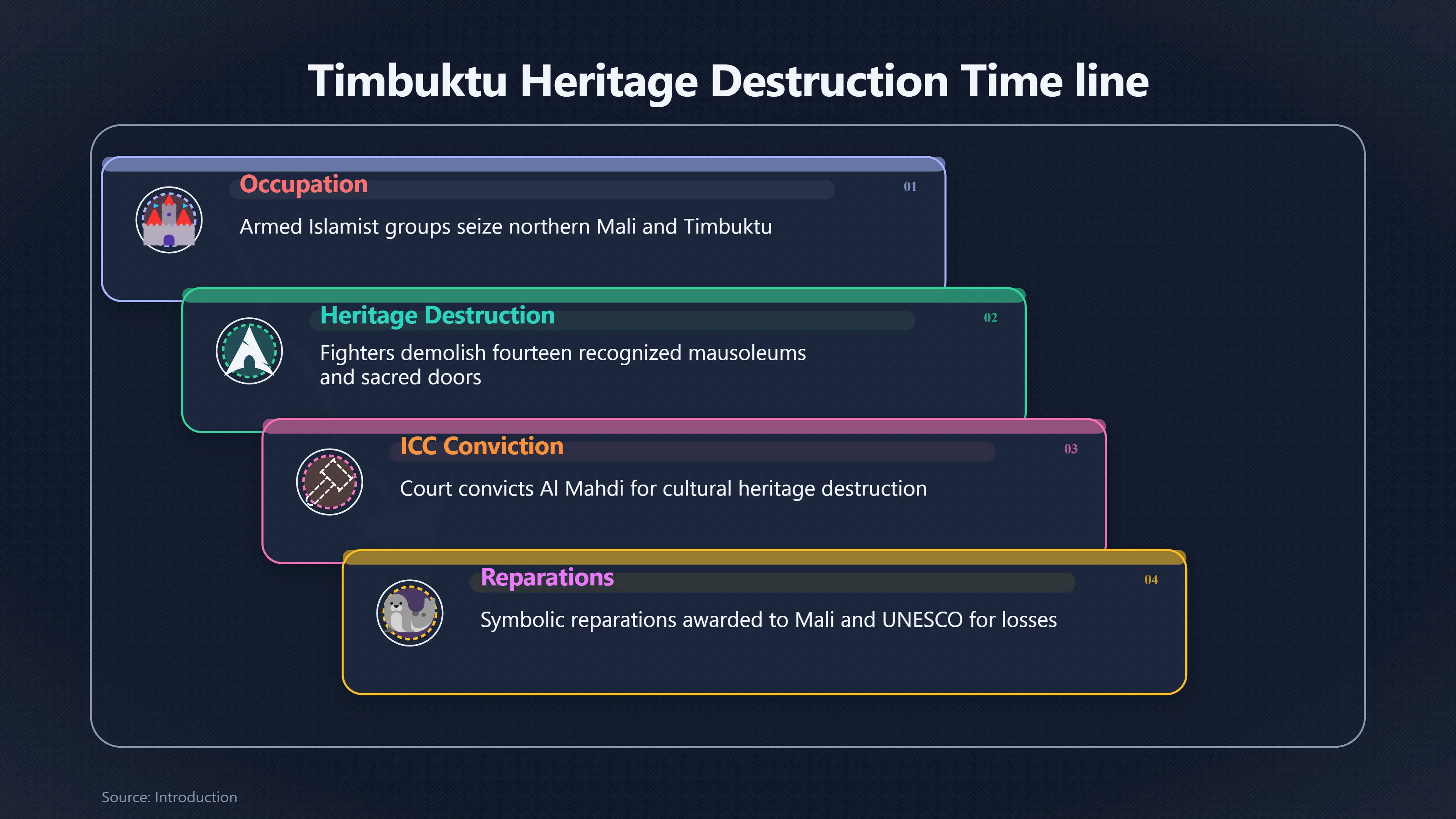
In 2012, during the occupation of northern Mali by armed Islamist groups, the destruction of Timbuktu’s historic mausoleums became one of the clearest examples of how violence against religious heritage can also be an attempt to reshape society. The attackers did not simply demolish old buildings. They sought to overturn centuries of local Islamic practice by declaring long-established traditions surrounding revered Muslim saints to be unacceptable. The campaign formed part of a wider effort to impose a strict religious order through coercion, fear and the rejection of local religious authority. For many residents, the assault was therefore not only an attack on monuments but also on the city’s identity, memory and religious life.[UNESCO World Heritage Centre]whc.unesco.orgUNESCO World Heritage CentreWorld Heritage Centre - Reconstruction of the destroyed mausoleums of Timbuktu (Mali)March 30, 2021…
Who had the right to define Timbuktu’s Islam?
For centuries, Timbuktu has been one of West Africa’s most important centres of Islamic scholarship. Alongside its famous mosques and manuscript collections, the city developed a tradition of honouring respected scholars and holy men through mausoleums built over their graves. These sites were places of remembrance, prayer and communal identity rather than objects of worship in themselves. They reflected a form of Islam deeply rooted in the city’s history and widely accepted by local communities.[UNESCO World Heritage Centre]whc.unesco.orgUNESCO World Heritage CentreWorld Heritage Centre - Reconstruction of the destroyed mausoleums of Timbuktu (Mali)March 30, 2021…
The armed groups that occupied northern Mali in 2012 rejected this tradition. Fighters associated with Ansar Dine, supported by other jihadist organisations operating in the region, argued that visiting saints’ tombs encouraged practices they considered incompatible with their interpretation of Islam. Their campaign therefore became a struggle over religious legitimacy. Rather than accepting the authority of Timbuktu’s scholars and longstanding religious customs, they claimed the right to redefine what counted as authentic Islam.[casebook.icrc.org]casebook.icrc.orgMali, Destruction of World Cultural Heritage | How does law protect in war?Online casebook…
This dispute is often oversimplified as a conflict between “traditional” and “fundamentalist” Islam. In reality, both sides understood themselves as acting within Islamic belief. The disagreement concerned religious interpretation, authority and acceptable devotional practice, not whether Timbuktu’s inhabitants were Muslim.
Occupation, coercion and religious rule
The destruction of the mausoleums took place within a broader system of violent rule rather than as isolated acts of vandalism. Armed groups imposed strict behavioural rules, established religious police and punished perceived violations through public floggings, amputations and intimidation. Residents faced restrictions on music, dress, social life and religious practice, while dissent became dangerous.[Reuters]reuters.comICC convicts Mali Islamist for Timbuktu atrocitiesAl Hassan, affiliated with the Ansar Dine Islamist group, was found guilty of actions including torture, cruel treatment, and public flog…
Within this environment, attacking the mausoleums carried practical as well as symbolic importance. The shrines represented respected local religious authority outside the control of the occupying groups. Destroying them demonstrated that existing spiritual leaders, inherited traditions and communal practices no longer enjoyed protection. Violence against heritage therefore reinforced violence against people by signalling that only the occupiers’ interpretation of religion would be tolerated.
UNESCO recorded that fourteen of Timbuktu’s sixteen recognised mausoleums were destroyed, together with the sacred door of the Sidi Yahia Mosque and other historic monuments. Thousands of manuscripts held at the Ahmed Baba Institute were also burned or stolen, although many more were secretly rescued by local people and moved to safety.[unesco.org]unesco.orgDamage to Timbuktu’s cultural heritage worse than first estimatedDamage to Timbuktu’s cultural heritage worse than first estimatedJune 7, 2013…
Why were the mausoleums targeted?
The mausoleums were chosen because they embodied a religious landscape that the occupiers wished to erase.
Several factors explain their importance:
- They honoured revered Muslim scholars and saints. For generations these figures connected Timbuktu’s religious history with everyday community life.
- They represented local religious authority. The shrines symbolised scholarly traditions that pre-dated the armed groups by centuries.
- They stood at the centre of communal identity. Families, neighbourhoods and religious institutions treated them as landmarks linking present-day Timbuktu with its past.
- They visibly contradicted the occupiers’ religious programme. Eliminating the shrines demonstrated the determination to replace local custom with a narrower interpretation of Islamic practice.[UNESCO World Heritage Centre]whc.unesco.orgUNESCO World Heritage CentreWorld Heritage Centre - Community conservation: Timbuktu…
UNESCO described the attacks as deliberate attempts to erase symbols of the tolerant and historically rooted Islam practised across the region. The organisation repeatedly emphasised that the destruction affected not only world heritage but also the cultural and spiritual identity of Timbuktu’s inhabitants.[UNESCO World Heritage Centre]whc.unesco.orgUNESCO World Heritage CentreDirector-General condemns renewed destruction of mausoleums in Timbuktu - UNESCO World Heritage CentreOctober…
Local Islam, reform movements and false simplifications
It is tempting to describe the episode simply as extremists destroying “culture”. That explanation captures part of the story but misses the deeper religious conflict.
Many Muslims throughout the world disagree over the religious status of shrines, saint veneration and pilgrimage to tombs. Such debates long pre-date the conflict in Mali and are conducted peacefully in many countries. What made Timbuktu distinctive was that one side possessed armed power and used coercion to settle theological disagreement through destruction rather than persuasion.
Equally misleading is the suggestion that the mausoleums represented a religion separate from Islam. Timbuktu’s shrines had existed within an internationally respected Islamic centre of learning for centuries. Local believers generally understood the mausoleums as commemorating exemplary Muslims whose lives deserved remembrance, while the occupying groups condemned these practices as forbidden innovations. The conflict therefore concerned competing interpretations within Islam rather than a clash between Islam and something outside it.[UNESCO World Heritage Centre]whc.unesco.orgUNESCO World Heritage CentreWorld Heritage Centre - Reconstruction of the destroyed mausoleums of Timbuktu (Mali)March 30, 2021…
Understanding this distinction helps explain why the destruction caused such profound local shock. Residents were not simply losing historic buildings; they were witnessing an attempt to delegitimise their own inherited religious identity.
A landmark case for cultural destruction as a war crime
The attacks transformed international thinking about cultural heritage during armed conflict. In 2016, the International Criminal Court convicted Ahmad Al Faqi Al Mahdi for intentionally directing attacks against Timbuktu’s protected religious and historic monuments. It was the first ICC conviction focused exclusively on the deliberate destruction of cultural heritage as a war crime.[UNESCO World Heritage Centre]whc.unesco.orgUNESCO World Heritage CentreWorld Heritage Centre - Reconstruction of the destroyed mausoleums of Timbuktu (Mali)March 30, 2021…
The legal case recognised that attacks on religious monuments can inflict lasting harm even when they are not directed at civilians themselves. The court accepted that destroying places carrying deep spiritual and communal meaning damages the identity and continuity of entire communities.
Following the liberation of Timbuktu, reconstruction of the mausoleums relied heavily on local masons, religious leaders and traditional building knowledge. UNESCO presented the rebuilding not merely as architectural restoration but as part of recovering social trust, religious continuity and community resilience after occupation. In 2021, symbolic reparations were awarded to Mali and UNESCO, recognising that the losses extended beyond physical structures to the cultural inheritance of both Mali and humanity more broadly.[UNESCO World Heritage Centre]whc.unesco.orgUNESCO World Heritage CentreWorld Heritage Centre - Reconstruction of the destroyed mausoleums of Timbuktu (Mali)March 30, 2021…

Why this episode matters in Mali’s history of collective belief
Unlike episodes driven by rumour, witchcraft accusations or mass panic, the destruction of Timbuktu’s mausoleums was rooted in an organised attempt to impose religious authority through force. Collective belief remained central to the story, but the decisive issue was who possessed the power to define legitimate belief.
The episode demonstrates how sacred places can become targets because they embody shared memory, communal legitimacy and competing interpretations of religion. In Mali’s wider history of collective fears and religious conflict, Timbuktu stands as a reminder that struggles over belief are often also struggles over authority, identity and the right to shape the moral landscape of society.
Amazon book picks
Further Reading
Books and field guides related to Who Had the Right to Define Timbuktu's Islam?. Use these as the next step if you want deeper reading beyond the article.
The ornament of the world
First published 2002. Subjects: Spain, Toleration, Jews, Religions, Nonfiction.
The Bad-Ass Librarians of Timbuktu
Covers the occupation of Timbuktu and threats to its heritage.
Endnotes
1.
Source: whc.unesco.org
Link:https://whc.unesco.org/en/canopy/timbuktu/
Source snippet
UNESCO World Heritage CentreWorld Heritage Centre - Reconstruction of the destroyed mausoleums of Timbuktu (Mali)March 30, 2021...
Published: March 30, 2021
2.
Source: casebook.icrc.org
Title: Mali, Destruction of World Cultural Heritage | How does law protect in war?
Link:https://casebook.icrc.org/case-study/mali-destruction-world-cultural-heritage
Source snippet
Online casebook...
3.
Source: whc.unesco.org
Link:https://whc.unesco.org/en/story-timbuktu
Source snippet
UNESCO World Heritage CentreWorld Heritage Centre - Community conservation: Timbuktu...
4.
Source: reuters.com
Title: ICC convicts Mali Islamist for Timbuktu atrocities
Link:https://www.reuters.com/world/africa/icc-convicts-mali-islamist-timbuktu-atrocities-2024-06-26/
Source snippet
Al Hassan, affiliated with the Ansar Dine Islamist group, was found guilty of actions including torture, cruel treatment, and public flog...
5.
Source: unesco.org
Title: Damage to Timbuktu’s cultural heritage worse than first estimated
Link:https://www.unesco.org/en/articles/damage-timbuktus-cultural-heritage-worse-first-estimated-reports-unesco-mission
Source snippet
Damage to Timbuktu’s cultural heritage worse than first estimatedJune 7, 2013...
Published: June 7, 2013
6.
Source: whc.unesco.org
Link:https://whc.unesco.org/en/news/947/
Source snippet
UNESCO World Heritage CentreDirector-General condemns renewed destruction of mausoleums in Timbuktu - UNESCO World Heritage CentreOctober...
7.
Source: unesco.org
Title: Director-General deplores new destruction of Timbuktu
Link:https://www.unesco.org/en/articles/unesco-director-general-deplores-new-destruction-timbuktu-mausoleums
Source snippet
UNESCO Director-General deplores new destruction of Timbuktu...
8.
Source: whc.unesco.org
Link:https://whc.unesco.org/en/news/2268/
9.
Source: unesco.org
Title: ahmad al faqi al mahdi i plead guilty 0
Link:https://www.unesco.org/en/articles/ahmad-al-faqi-al-mahdi-i-plead-guilty-0
10.
Source: courier.unesco.org
Title: ahmad al faqi al mahdi i plead guilty
Link:https://courier.unesco.org/en/articles/ahmad-al-faqi-al-mahdi-i-plead-guilty
11.
Source: unesco.org
Title: impunity war crimes against cultural heritage must stop
Link:https://www.unesco.org/en/articles/impunity-war-crimes-against-cultural-heritage-must-stop
12.
Source: casebook.icrc.org
Title: mali accountability destruction cultural heritage
Link:https://casebook.icrc.org/case-study/mali-accountability-destruction-cultural-heritage
Additional References
13.
Source: apnews.com
Link:https://apnews.com/article/5d67428058eeaadd9445a4d460fa78d2
Source snippet
These priceless documents, showcasing the region’s rich intellectual and cultural history, were secretly transported via donkey carts and...
14.
Source: youtube.com
Link:https://www.youtube.com/watch?v=RcbWCsYKlzk
Source snippet
Ansar Dine fighters destroy Timbuktu shrines...
15.
Source: getty.edu
Link:https://www.getty.edu/publications/cultural-heritage-mass-atrocities/part-2/14-assomo/
16.
Source: researchportal.northumbria.ac.uk
Link:https://researchportal.northumbria.ac.uk/en/publications/the-destruction-of-cultural-property-in-timbuktu-challenging-the-/
17.
Source: youtube.com
Title: Ansar Dine fighters destroy Timbuktu shrines
Link:https://www.youtube.com/watch?v=rhaR3M09Yes
Source snippet
Continued destruction of Mali shrines called 'war crime'...
18.
Source: youtube.com
Title: Restored mosque unveiled in Timbuktu
Link:https://www.youtube.com/watch?v=nnc4T_Htco4
Source snippet
Islamic radicals destroy several architectural gems in Timbuktu...
19.
Source: theguardian.com
Link:https://www.theguardian.com/world/2012/jul/02/mali-islamists-attack-world-heritage-mosques-timbuktu
20.
Source: tombouctoumanuscripts.uct.ac.za
Title: uct.ac.za Life in Timbuktu under Islamist rule | Tombouctou Manuscripts Project
Link:https://tombouctoumanuscripts.uct.ac.za/articles/2012-05-23-life-timbuktu-under-islamist-rule
21.
Source: thenationalnews.com
Title: The doctrine behind why Mali’s Islamists destroy Timbuktu tombs | The National
Link:https://www.thenationalnews.com/world/africa/the-doctrine-behind-why-mali-s-islamists-destroy-timbuktu-tombs-1.362449
22.
Source: aljazeera.com
Title: Al Jazeera Mali fighters destroy more Timbuktu tombs | News | Al Jazeera
Link:https://www.aljazeera.com/news/2012/12/23/mali-fighters-destroy-more-timbuktu-tombs
Topic Tree