Within Marshall Islands
How Nuclear Medicine Lost Marshallese Trust
Long-term medical studies, weak consent and failed resettlement promises made official reassurance difficult for many Marshallese families to trust.
On this page
- Project 4.1 and the patient subject divide
- Consent, communication and rumours of experimentation
- Failed resettlement and the cost of reversed assurances
Page outline Jump by section
Introduction
The lasting distrust between many Marshallese communities and US medical and scientific authorities did not arise from rumour alone. It grew from decades of health monitoring after nuclear fallout, disputed consent procedures, changing official reassurances, and repeated disagreements over whether exposed islanders were being treated primarily as patients or as valuable research subjects. The result was not a classic moral panic or episode of mass hysteria, but a profound crisis of confidence in government medicine that continues to shape debates about nuclear testing, compensation, environmental cleanup and resettlement.
For many Marshallese families, the central question became simple: if officials had underestimated danger once, why should later assurances be believed? That question has influenced attitudes towards medical programmes, environmental surveys and radiation monitoring ever since.[biotech.law.lsu.edu]biotech.law.lsu.eduChapter 12: The MarshalleseChapter 12: The Marshallese
Project 4.1 and the patient-subject divide
Soon after the Castle Bravo fallout of 1954, US medical teams began long-term health studies of the exposed populations of Rongelap, Ailinginae and Utrik. These programmes, often referred to collectively through Project 4.1 and subsequent follow-up studies, had two overlapping aims. Doctors sought to diagnose and treat radiation injuries, but they also collected information that advanced scientific understanding of human radiation exposure.
That dual purpose later became one of the most controversial aspects of the programme. Critics argued that the exposed Marshallese were simultaneously patients in need of care and research subjects whose experiences produced scientifically valuable data. Many survivors and later activists questioned whether those two roles had ever been clearly separated, particularly in the programme’s earliest years.[biotech.law.lsu.edu]biotech.law.lsu.eduChapter 12: The MarshalleseChapter 12: The Marshallese
Historians generally agree that many physicians involved genuinely attempted to provide medical treatment and that thyroid disease, cancers and other radiation-related conditions received sustained clinical attention over decades. At the same time, official records reviewed by the US Advisory Committee on Human Radiation Experiments found examples where research value was explicitly acknowledged, while communication with the affected communities remained poor. The committee concluded that informed consent, as understood today, was not consistently sought for research associated with medical care, reflecting broader medical practice of the period but leaving a legacy of mistrust.[biotech.law.lsu.edu]biotech.law.lsu.eduChapter 12: The MarshalleseChapter 12: The Marshallese
This distinction matters because the Marshallese experience is often remembered less as a dispute over individual doctors than as a broader failure to recognise that communities recovering from a disaster needed transparent partnership rather than paternalistic management.
Why communication failures mattered so much
Distrust deepened because scientific uncertainty was often communicated inconsistently.
Many Marshallese recalled being assured that conditions were safe enough for them to return home, only to see later studies identify continuing contamination or recommend additional precautions. Scientists themselves frequently stressed uncertainty, but those qualifications were not always conveyed clearly to affected communities.
Several problems repeatedly appeared:
- Technical information was translated imperfectly or reached communities only after long delays.
- Radiation measurements and health risks were difficult to explain across linguistic and cultural differences.
- Communities often received simplified reassurances while scientists continued debating unresolved questions internally.
- Newly released government reports sometimes appeared to contradict earlier public statements, even when they reflected improved scientific knowledge rather than deliberate deception.[biotech.law.lsu.edu]biotech.law.lsu.eduChapter 12: The MarshalleseChapter 12: The Marshallese
The result was that later official explanations were judged not only on their scientific merits but against a history in which many islanders already believed important information had been withheld.
Consent, communication and rumours of experimentation
Within the Marshall Islands, one of the most persistent beliefs has been that exposed islanders were deliberately used as human experiments after the fallout.
The historical evidence does not support the claim that US authorities intentionally exposed Marshallese communities in order to study radiation effects after Castle Bravo. The fallout itself resulted from unexpectedly high explosive yield and incorrect predictions of fallout patterns rather than a documented plan to irradiate civilians deliberately. However, that finding has not eliminated suspicion because subsequent medical research undeniably collected extensive long-term data from exposed populations.[biotech.law.lsu.edu]biotech.law.lsu.eduChapter 12: The MarshalleseChapter 12: The Marshallese
The Advisory Committee on Human Radiation Experiments found no evidence that medical teams intentionally withheld treatment in order to preserve research opportunities. Nevertheless, it criticised serious shortcomings in communication and acknowledged that many participants did not fully understand the research aspects of the programme. It also identified internal correspondence showing that the scientific value of the studies was recognised within government agencies, while public communication about those research goals remained limited.[biotech.law.lsu.edu]biotech.law.lsu.eduChapter 12: The MarshalleseChapter 12: The Marshallese
These findings help explain why rumours of experimentation spread so easily. The rumours were fuelled not simply by fear of radiation but by observable features of the programme:
- repeated blood tests and examinations over many years;
- limited explanation of research objectives;
- cultural and language barriers;
- restricted access to government records during the Cold War;
- growing awareness of secrecy surrounding nuclear weapons programmes more generally.
Rather than arising from collective delusion, these suspicions developed within an environment where genuine secrecy already existed around many aspects of US nuclear testing.
Failed resettlement and the cost of reversed assurances
Perhaps nothing damaged confidence more than the experience of Rongelap.
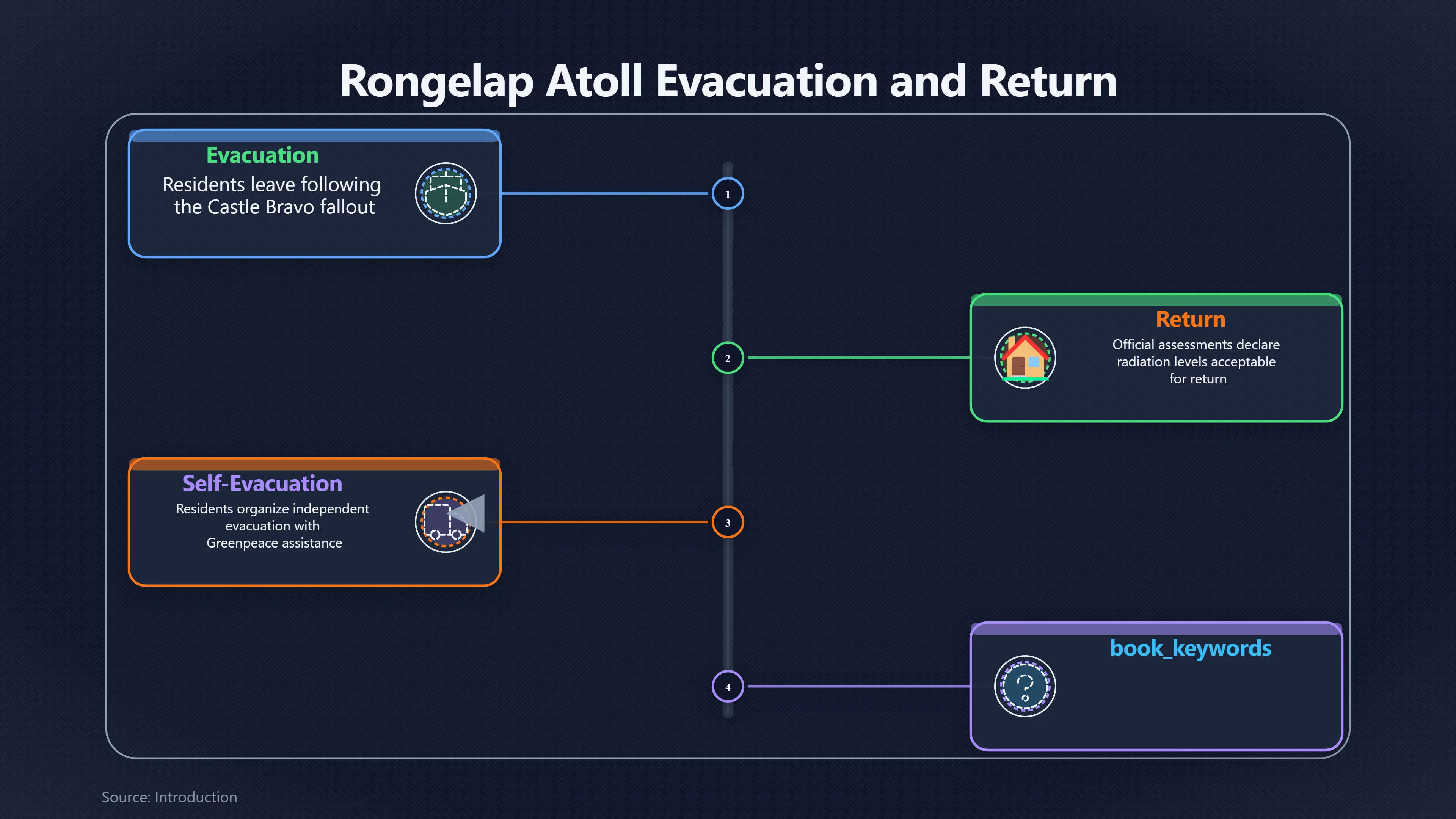
After evacuation in 1954, residents were allowed to return in 1957 following official assessments that radiation levels were acceptable under continuing surveillance. Over time, however, concerns increased about long-lived radioactive contamination, internal exposure through local foods and rising thyroid disease. By 1985 many Rongelap residents no longer trusted official advice and organised their own evacuation with assistance from Greenpeace rather than waiting for another US decision.[National Academies]nationalacademies.orgOpen source on nationalacademies.org.
The reversal carried enormous symbolic weight. Even if scientific understanding had evolved, many residents interpreted the sequence differently:
- first, they were told their islands were safe;
- later, new measurements suggested continuing contamination;
- then further monitoring became necessary.
For many families, the lesson was not that science had improved but that official reassurances could not be relied upon.
Subsequent National Research Council reviews acknowledged both the genuine trauma experienced by Rongelap residents and the continuing uncertainty involved in estimating future radiation doses. Rather than recommending absolute guarantees, the committee argued that categorical assurances should be avoided because uncertainties remained. Ironically, this greater scientific honesty also illustrated why earlier confident statements had proven so damaging.[NCBI]ncbi.nlm.nih.govSummary - Radiological Assessments for Resettlement of Rongelap in the Republic of the Marshall Islands - NCBI Bookshelf…
Why medical distrust still matters
Medical distrust in the Marshall Islands extends beyond historical memory.[energy.gov]energy.govSource details in endnotes.
Modern radiation surveys, whole-body counting programmes, environmental cleanup and resettlement planning continue to depend on community cooperation. Scientific institutions now place much greater emphasis on consultation, individual dose reporting and transparent publication of monitoring data. Nevertheless, many Marshallese continue to evaluate these programmes through the lens of previous broken trust rather than technical measurements alone.[marshallislands.llnl.gov]marshallislands.llnl.govRongelap Atoll | The Marshall Islands ProgramRongelap Atoll | The Marshall Islands Program
This history also shapes wider debates about nuclear justice. Questions over compensation, environmental restoration, access to healthcare and acknowledgement of historical wrongdoing are inseparable from confidence in scientific expertise. Communities that believe they were previously excluded from important decisions naturally demand greater participation before accepting new assurances.
A legacy of justified scepticism rather than collective panic
The Marshall Islands illustrates an important distinction in the history of collective belief. Distrust of nuclear medicine did not spread because people irrationally rejected science. Instead, it emerged after communities experienced evacuation, exposure, incomplete information, disputed consent and changing official assessments over many decades.
Historians therefore tend to interpret Marshallese medical distrust as a rational response to repeated institutional failures rather than an episode of mass hysteria. Rumours and suspicions certainly circulated, and some exceeded what documentary evidence can support. Yet they flourished within a setting where secrecy, inconsistent communication and reversed assurances had already made official credibility exceptionally fragile. That enduring loss of trust remains one of the most significant social consequences of the Marshall Islands nuclear testing programme.[lsu.edu]biotech.law.lsu.eduChapter 12: The MarshalleseChapter 12: The Marshallese
Amazon book picks
Further Reading
Books and field guides related to How Nuclear Medicine Lost Marshallese Trust. Use these as the next step if you want deeper reading beyond the article.
The Immortal Life of Henrietta Lacks
Provides powerful context for debates about patients and research subjects.

Before the fallout
Provides background to the era that produced the Marshall Islands studies.
Endnotes
1.
Source: biotech.law.lsu.edu
Title: Chapter 12: The Marshallese
Link:https://biotech.law.lsu.edu/research/reports/ACHRE/chap12_3.html
2.
Source: marshallislands.llnl.gov
Title: Rongelap Atoll | The Marshall Islands Program
Link:https://marshallislands.llnl.gov/affected-areas/rongelap-atoll
3.
Source: ncbi.nlm.nih.gov
Link:https://www.ncbi.nlm.nih.gov/books/NBK236604/
Source snippet
Summary - Radiological Assessments for Resettlement of Rongelap in the Republic of the Marshall Islands - NCBI Bookshelf...
4.
Source: ncbi.nlm.nih.gov
Link:https://www.ncbi.nlm.nih.gov/books/NBK236608/
Source snippet
Radiological Assessments for Resettlement of Rongelap in the Republic of the Marshall Islands - NCBI Bookshelf...
5.
Source: marshallislands.llnl.gov
Title: whole body counting
Link:https://marshallislands.llnl.gov/monitoring-programs/whole-body-counting
6.
Source: marshallislands.llnl.gov
Title: enewetak atoll
Link:https://marshallislands.llnl.gov/affected-areas/enewetak-atoll
7.
Source: marshallislands.llnl.gov
Link:https://marshallislands.llnl.gov/
8.
Source: nationalacademies.org
Link:https://www.nationalacademies.org/read/2352/chapter/3
9.
Source: pubmed.ncbi.nlm.nih.gov
Link:https://pubmed.ncbi.nlm.nih.gov/9199224/
10.
Source: ncbi.nlm.nih.gov
Link:https://www.ncbi.nlm.nih.gov/books/NBK236609/
11.
Source: ncbi.nlm.nih.gov
Link:https://www.ncbi.nlm.nih.gov/books/NBK236611/
12.
Source: pmc.ncbi.nlm.nih.gov
Link:https://pmc.ncbi.nlm.nih.gov/articles/PMC4358182/
13.
Source: ncbi.nlm.nih.gov
Link:https://www.ncbi.nlm.nih.gov/books/NBK236601/
14.
Source: nationalacademies.org
Link:https://www.nationalacademies.org/read/2352/chapter/11
15.
Source: nationalacademies.org
Link:https://www.nationalacademies.org/read/2352/chapter/2
16.
Source: ehss.energy.gov
Title: chap12 3
Link:https://ehss.energy.gov/ohre/roadmap/achre/chap12_3.html
Additional References
17.
Source: legalclarity.org
Title: Marshall Islands Radiation Effects: Health, Displacement, and Legacy
Link:https://legalclarity.org/marshall-islands-radiation-effects-health-displacement-and-legacy/
Source snippet
July 2, 2026 — HEALTH EFFECTS The health consequences of nuclear testing in the Marshall Islands have been studied for decade...
Published: July 2, 2026
18.
Source: rnz.co.nz
Title: But it also showed the US government’s lack of unders
Link:https://www.rnz.co.nz/international/pacific-news/544789/marshall-islands-rongelap-evacuation-changed-course-of-history
Source snippet
Marshall Islands: Rongelap evacuation changed course of history | RNZ NewsMarch 14, 2025 — This condescending American government respons...
Published: March 14, 2025
19.
Source: legalclarity.org
Title: Marshall Islands Nuclear Testing: Legacy and Compensation
Link:https://legalclarity.org/marshall-islands-nuclear-testing-legacy-and-compensation/
Source snippet
government established what became known as Project 4.1, formally titled “Study of Response of Human Beings Exposed to Sig...
20.
Source: latimes.com
Title: “The project was initiated w
Link:https://www.latimes.com/projects/marshall-islands-radiation-effects-cancer/
Source snippet
In Marshall Islands, radiation threatens tradition of handing down stories by song - Los Angeles TimesNovember 10, 2019 — In recent decad...
Published: November 10, 2019
21.
Source: energy.gov
Link:https://www.energy.gov/ehss/marshall-islands-program
22.
Source: congress.gov
Link:https://www.congress.gov/event/106th-congress/house-event/LC18652/text
23.
Source: cmi.edu
Link:https://www.cmi.edu/institutional-research/institutional-review-board/
24.
Source: rminucleardocs.icaad.ngo
Link:https://rminucleardocs.icaad.ngo/entity/0n1j38w0ozw?file=1610647297546r02fff4z3k.pdf&page=2
25.
Source: dceg.cancer.gov
Title: nci dose estimation predicted cancer risk residents marshall islands
Link:https://dceg.cancer.gov/research/how-we-study/exposure-assessment/nci-dose-estimation-predicted-cancer-risk-residents-marshall-islands
26.
Source: youtube.com
Title: Atomic Testing in the Marshall Islands
Link:https://www.youtube.com/watch?v=MMDuASm6sDs
Source snippet
The Marshall Islands and Nuclear Testing...
Topic Tree