When Belief, Fear and Politics Gripped Morocco
Morocco’s history of collective belief and social fear is not dominated by one famous witch trial or a single textbook outbreak of “mass hysteria”.
Page outline Jump by section
Introduction
These cases are not interchangeable. Some involved sincerely held religious ideas; some were political legends; some were moral panics in which ordinary cultural symbols were treated as evidence of hidden evil; and some exposed the harm caused when supernatural explanations displaced medical care. Together, they show how uncertainty in Morocco has often been interpreted through familiar languages of sacred authority, spiritual danger, social respectability and national identity.
Why Morocco does not fit the usual “mass hysteria” story
The phrase “mass hysteria” is often applied too loosely. In medicine, the more careful term is mass psychogenic illness: the rapid spread of real physical symptoms through a connected group when investigation finds no sufficient toxic, infectious or environmental cause. Morocco does not appear to have a well-documented national equivalent of the best-known school fainting epidemics or factory outbreaks reported elsewhere.
That absence matters. It would be misleading to convert every Moroccan story about spirits, miracles or collective excitement into a psychiatric event. A rumour can spread without producing illness. A political myth can strengthen solidarity without being a hallucination. Religious healing can be culturally meaningful even when particular institutions become abusive. A moral panic, meanwhile, is chiefly about the public exaggeration of a supposed social threat and the demand that authorities suppress it.
The strongest Moroccan cases therefore belong to several overlapping categories:
- millenarian or sacred politics, in which a leader claims divine favour or exceptional religious legitimacy;
- nationalist legend, where an extraordinary sign expresses political loyalty;
- moral panic, where a minority or youth culture is presented as a threat to religion and public order;
- possession belief and therapeutic pluralism, where families move between doctors, religious specialists and traditional healers;
- rumour and stigma, especially around sorcery, sexuality, mental illness and unconventional behaviour.
Keeping these distinctions prevents the subject from becoming a catalogue of exotic stories. It also makes the resulting harms easier to identify.

Bou Hmara: miracles, impersonation and a crisis of authority
One of Morocco’s clearest examples of charismatic belief entering political conflict was the rebellion of Bou Hmara, a throne claimant active in north-eastern Morocco from 1902 until his capture in 1909. His rise occurred during a period of weakening central authority, growing European pressure and dissatisfaction with Sultan Abdelaziz.
Bou Hmara was not merely a wandering prophet followed by a credulous crowd. He was educated, had experience in government circles and understood the political system he challenged. He claimed to be Moulay Mohammed, a largely secluded brother of the sultan whose reputation for piety made the impersonation plausible to some audiences. Historical accounts describe Bou Hmara cultivating an atmosphere of dreams, prophecies, magical feats and miraculous signs around his identity. His supporters also had practical grievances: taxation, insecurity, resentment of the court and opposition to foreign encroachment all helped create an audience for a supposedly rightful ruler.[Wikipedia]WikipediaBou HmaraBou Hmara
His movement therefore cannot be dismissed as a collective delusion. It was an armed struggle built on contested legitimacy. The supernatural stories mattered because Moroccan monarchy was not understood as a purely administrative office. Genealogy, religious standing and the ruler’s capacity to defend the community formed part of political legitimacy. A claimant who seemed saintly or divinely favoured could translate political resentment into a convincing alternative order.
Morocco already possessed a long tradition in which religious renewal and resistance could acquire millenarian language. In the fifteenth century, the influential preacher Muhammad al-Jazuli connected spiritual reform, resistance to Portuguese expansion and the expectation of leadership by a divinely guided figure. Historian C. R. Pennell describes how this message attracted thousands and helped reshape the relationship between religious networks, warfare and dynastic power.[South African History Online]sahistory.org.zaSouth African History Online
Bou Hmara belongs to this wider history, but he should not simply be called a “cult leader”. He commanded territory, negotiated commercial concessions and fought government armies. The language of miracles helped authorise his claim; it did not by itself explain why the rebellion lasted for years. His story is most useful as an example of how sacred reputation, political impersonation and genuine social crisis can reinforce one another.
The king in the moon: belief as nationalist solidarity
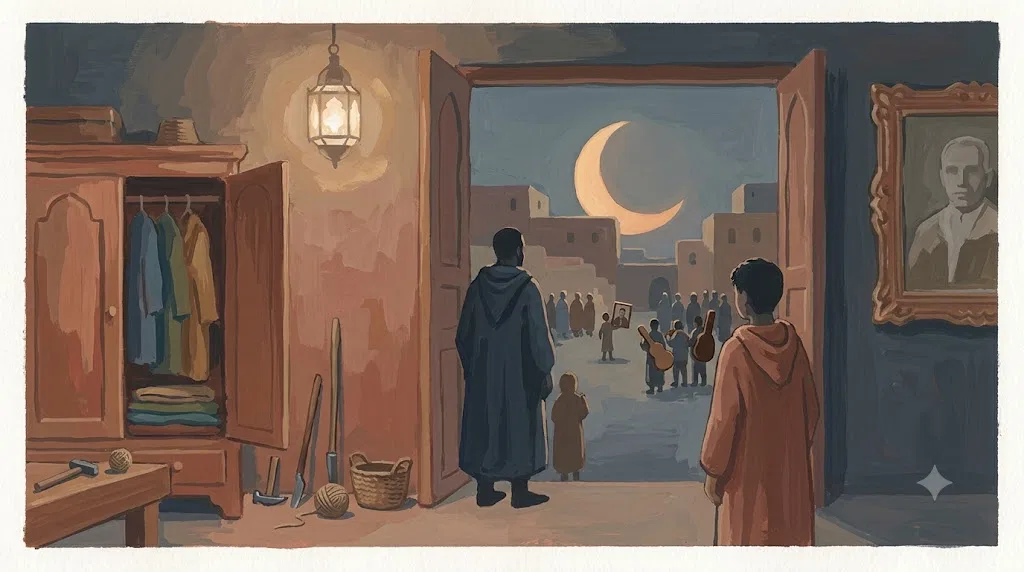
After French authorities deposed and exiled Sultan Mohammed V in August 1953, stories spread that Moroccans could see his face in the moon. The image later became one of the best-known popular memories of the independence struggle. It expressed the conviction that the absent ruler remained Morocco’s legitimate sovereign and that his removal had violated the country’s moral and political order.
The episode is sometimes described as a “collective hallucination”, but that label claims more than the evidence can establish. Surviving accounts do not prove that a large population experienced an identical visual perception at one moment. The story may have spread through suggestion, deliberate nationalist mobilisation, devotional storytelling, ordinary pattern-recognition in the lunar surface, or later family memory. Contemporary artist Mounir Fatmi has treated the event as a case in which viewers were encouraged to look at Mohammed V’s portrait and then at the moon, producing an after-image that gave political myth the appearance of direct vision.[Mounir Fatmi]mounirfatmi.comworkMounir Fatmiand then at the moon, creating the optical illusion that his…In 1955 Moroccans underwent a “collective hallucination,” as…
What is secure is the legend’s social function. Mohammed V’s exile intensified his symbolic importance, while the French-backed installation of Mohammed Ben Arafa failed to command comparable legitimacy. The moon story carried the sultan’s presence into homes and villages beyond the reach of speeches, newspapers or organised demonstrations. It made loyalty visible and repeatable: people could look upwards, point to the same object and participate in a shared national narrative.
This was not a panic because the central emotion was hope and allegiance rather than fear. Nor does it prove that Moroccans were unusually vulnerable to magical thinking. Political movements across the world have interpreted comets, apparitions, dreams and unusual coincidences as signs that history favours their cause. In Morocco, the story endured because Mohammed V returned in November 1955 and independence followed in 1956, allowing the supposed sign to be remembered as a prophecy fulfilled rather than a rumour disproved.
The episode remains culturally important because it blurs the boundary between propaganda and popular belief. Nationalists may have encouraged the story, but its survival depended on ordinary people finding it emotionally credible. The moon became a screen onto which grief at exile, reverence for the monarchy and expectation of liberation could all be projected.
The 2003 heavy-metal “Satanism” trial
Morocco’s most recognisable modern moral panic erupted in Casablanca in 2003, when fourteen musicians and music fans were prosecuted after being associated with heavy metal. Nine belonged to the bands Nekros, Infected Brain and Reborn; the others were fans. They received prison sentences ranging from three months to one year after prosecutors and the court treated dark clothing, album artwork, skull imagery and heavy-metal merchandise as signs of Satanism and conduct offensive to Islam.[The Guardian]theguardian.comThe Guardian Moroccan judge jails metalheads | World news | The GuardianThe Guardian Moroccan judge jails metalheads | World news | The Guardian
The case followed a classic moral-panic pattern. An unfamiliar youth culture was interpreted literally by institutions that did not understand its visual conventions. Symbols intended to signal musical identity, provocation or theatrical darkness became supposed evidence of an organised anti-religious movement. One judge reportedly regarded writing lyrics in English as suspicious and remarked that normal concertgoers should wear suits and ties. Conservative commentary connected the defendants not only with Satanism but with alcohol, delinquency and sexual licence, expanding a small music scene into a general threat to social order.[The Guardian]theguardian.comThe Guardian Moroccan judge jails metalheads | World news | The GuardianThe Guardian Moroccan judge jails metalheads | World news | The Guardian
The evidence publicly reported did not establish the existence of a Satanic organisation, ritual network or programme to undermine Islam. The panic depended instead on association: black shirts suggested death, death imagery suggested the devil, and the devil implied a hidden conspiracy. This chain of inference closely resembles earlier international panics around rock music, role-playing games and supposedly occult entertainment.
The reaction was not uniformly punitive. Lawyers, journalists, artists and civil-society activists protested that the defendants were being criminalised for their appearance and musical taste. Appeals reduced sentences and most were released. The controversy later inspired Ahmed Boulane’s Moroccan film The Satanic Angels, turning the trial itself into a warning about prejudice and institutional misunderstanding.
The music scene also survived. Reuters reported in 2008 that hundreds of fans attended a heavy-metal festival in Sidi Kacem, while police were present primarily to oversee security rather than to suppress the event.[Reuters]reuters.comMoroccan heavy metal lives on after Satanism trial | ReutersMoroccan heavy metal lives on after Satanism trial | Reuters… Recent research describes Moroccan metal as an enduring, if still marginalised, subculture whose musicians use lyrics to discuss alienation, injustice, corruption, identity and social change. The study found that metal’s confrontational style was frequently mistaken for meaningless aggression or devil worship, despite artists presenting their work as cultural and political expression.[European Scientific Journal]eujournal.orgEuropean Scientific Journal
The 2003 affair is best understood as a Satanic scare, not evidence of a Satanic cult. Its lasting importance lies in what it revealed about generational tension, freedom of expression and the danger of allowing aesthetic symbols to substitute for proof.

Bouya Omar: when possession belief caused material harm
The former healing complex around the Bouya Omar shrine, east of Marrakesh, represents a different and more painful intersection of belief, fear and institutional failure. Families brought people experiencing psychosis, severe emotional distress, intellectual disabilities, addiction or behavioural crises to the shrine in the belief that they were possessed or afflicted by supernatural forces.
Belief in spirit possession forms part of a broader Moroccan landscape of religious and traditional healing. Studies of mental health in Morocco have found that patients and families may combine psychiatric explanations with religious, social and supernatural ones rather than choosing only a single model. A person can seek clinical treatment while also visiting a healer, shrine or religious specialist. Such practices should not automatically be described as fraudulent or irrational; they can provide culturally familiar explanations, emotional support and a sense of community.[PMC]pmc.ncbi.nlm.nih.govViews of mental illness in Morocco: Western medicine meets…by D Stein · 2000 · Cited by 46 — Strongly rooted in Western medicine, M…
Bouya Omar became notorious because the alleged treatment involved confinement and coercion. Journalistic and human-rights accounts described residents being chained, beaten, neglected or kept in degrading conditions while intermediaries claimed that the shrine’s saintly power could defeat the spirits believed to control them. The harm came not simply from belief in possession but from the combination of family desperation, stigma, inadequate mental-health services, financial interests and the absence of effective oversight.[Gulf News]gulfnews.comGulf News'Possessed' Moroccans in marabouts seek a way outGulf News'Possessed' Moroccans in marabouts seek a way out
In June 2015, Morocco’s Ministry of Health closed the site through a state operation framed around dignity and psychiatric care. The ministry said that hundreds of people were evacuated, medically assessed and directed towards treatment or reintegration. Human Rights Watch later cited Morocco’s action as a significant example of a government releasing people with psychosocial disabilities who had been held in chains at a religious site.[Ministère de la Santé]sante.gov.maMinistère de la SantéAccueilMinistère de la SantéAccueil
Closure did not solve the underlying problem. Families had used Bouya Omar partly because formal alternatives were scarce, expensive or socially stigmatised. The World Health Organization’s country material on Morocco continues to place mental-health services within a system facing limitations in staff, facilities and community provision.[World Health Organization]who.intmental health atlas mar 2020 country profilemental health atlas mar 2020 country profile When institutions are difficult to reach, supernatural explanations can become practical pathways: they tell families where to go, whom to consult and what action to take.
Bouya Omar should therefore not be reduced to a story of “mass superstition”. It was a system in which a shared explanatory belief organised the treatment of many vulnerable people. The lesson is not that spiritual care must disappear, but that no religious or therapeutic claim can justify imprisonment, violence, forced restraint or the denial of medical assessment.
Sorcery fears without a Moroccan witch-trial tradition
Sorcery remains a familiar theme in Moroccan popular culture, personal disputes, healing practices and media reporting. People may attribute illness, marital conflict, infertility, misfortune or unusual behaviour to deliberate supernatural harm. Yet Morocco did not reproduce the large, centrally organised witch persecutions associated with parts of early modern Europe.
That difference is important. A society may possess strong beliefs in harmful magic without creating mass trials. Accusations can instead remain within households and neighbourhoods, reach healers rather than courts, or be prosecuted indirectly when money, poisoning, assault or deception is involved. Modern Moroccan law generally addresses harmful conduct through offences such as fraud or violence rather than requiring a court to prove that magic itself worked.
This does not make accusations harmless. Suspicion may fall particularly heavily on socially vulnerable people, unconventional women, healers, migrants or those already affected by mental illness. A supernatural accusation can damage a person’s reputation even where no formal prosecution follows. It may also delay treatment when symptoms are attributed entirely to curses or possession.
At the same time, sensational foreign accounts often flatten Moroccan religious life into “black magic”. They treat every amulet, shrine visit, healing ceremony or belief in spirits as evidence of sinister occultism. Anthropology and mental-health research point to a more complex reality in which religious practice, family care, medicine and local tradition overlap.[PMC]pmc.ncbi.nlm.nih.govViews of mental illness in Morocco: Western medicine meets…by D Stein · 2000 · Cited by 46 — Strongly rooted in Western medicine, M… The useful question is not whether a practice appears strange to an outsider, but whether it is voluntary, whether claims are being exploited for profit, and whether anyone is being harmed or prevented from receiving necessary care.
What makes collective fears spread in Morocco
The Moroccan cases differ in period and outcome, but several recurring pressures help explain their reach.
Uncertainty creates demand for legible explanations. A weak sultanate, colonial intervention, sudden exile, unfamiliar youth culture or frightening psychiatric symptoms all leave people searching for a story that makes events comprehensible.
Religious legitimacy carries political weight. Sacred genealogy, saintly reputation and defence of religion have historically been connected to authority. That makes claims of miraculous favour powerful, but also makes accusations of religious betrayal unusually damaging.
Visible symbols travel faster than complicated evidence. A face in the moon, a black T-shirt or a chained patient supposedly battling a spirit can communicate an entire explanation in a single image. Nuance arrives later, if at all.
Institutions can intensify a scare. Courts gave the metal panic real consequences. Colonial intervention strengthened Mohammed V’s symbolic status. Inadequate health provision allowed coercive shrine treatment to persist. Collective belief becomes most dangerous when authorities convert suspicion into punishment or neglect.
Counter-publics can reverse the process. Journalists, musicians, filmmakers, lawyers, doctors and human-rights organisations challenged the Satanism allegations and the abuses at Bouya Omar. Public mobilisation did not merely correct false information; it changed what behaviour institutions considered acceptable.
How these episodes should be remembered
Morocco’s cult, panic and collective-belief history is best understood through contrasts rather than a single label. Bou Hmara’s rebellion mixed sacred claims with material politics. The vision of Mohammed V in the moon was a nationalist legend, not a proven epidemic hallucination. The Casablanca metal trial was a documented moral panic built on misread cultural symbols. Bouya Omar involved widespread possession beliefs, but its central scandal was the coercive treatment of vulnerable people.
The common thread is not that Moroccans repeatedly lost contact with reality. It is that communities facing uncertainty used culturally available stories to decide whom to trust, what to fear and how to act. Sometimes those stories sustained resistance and solidarity. Sometimes they justified stigma, prosecution or abuse.
The most responsible way to study them is therefore to ask four separate questions: what people believed, what pressures made the belief persuasive, who gained the power to define the situation, and what happened to those who were labelled dangerous, deviant or possessed. In Morocco, as elsewhere, the decisive issue is rarely belief alone. It is what institutions and crowds do once a belief becomes socially authoritative.
Amazon book picks
Further Reading
Books and field guides related to When Belief, Fear and Politics Gripped Morocco. Use these as the next step if you want deeper reading beyond the article.
A history of modern Morocco
Provides political and cultural background for multiple episodes on the page.

Morocco: From Empire to Independence
Covers Morocco's political and social development.
Endnotes
1.
Source: Wikipedia
Title: Bou Hmara
Link:https://en.wikipedia.org/wiki/Bou_Hmara
2.
Source: sahistory.org.za
Title: South African History Online
Link:https://sahistory.org.za/sites/default/files/archive-files/c.r._pennell_morocco_from_empire_to_independenbook4me.org.pdf
3.
Source: reuters.com
Title: Moroccan heavy metal lives on after Satanism trial | Reuters
Link:https://www.reuters.com/article/lifestyle/moroccan-heavy-metal-lives-on-after-satanism-trial-idUSL23333336/
Source snippet
Moroccan heavy metal lives on after Satanism trial | Reuters...
4.
Source: eujournal.org
Title: European Scientific Journal
Link:https://eujournal.org/index.php/esj/article/download/17733/17605
5.
Source: pmc.ncbi.nlm.nih.gov
Link:https://pmc.ncbi.nlm.nih.gov/articles/PMC80417/
Source snippet
Views of mental illness in Morocco: Western medicine meets...by D Stein · 2000 · Cited by 46 — Strongly rooted in Western medicine, M...
6.
Source: who.int
Title: mental health atlas mar 2020 country profile
Link:https://www.who.int/publications/m/item/mental-health-atlas-mar-2020-country-profile
7.
Source: Wikipedia
Title: List of mass panic cases
Link:https://en.wikipedia.org/wiki/List_of_mass_panic_cases
8.
Source: Wikipedia
Title: Witch trials in the early modern period
Link:https://en.wikipedia.org/wiki/Witch_trials_in_the_early_modern_period
9.
Source: Wikipedia
Title: Satanic panic
Link:https://en.wikipedia.org/wiki/Satanic_panic
10.
Source: Wikipedia
Link:https://en.wikipedia.org/wiki/Millenarianism
11.
Source: Wikipedia
Title: The Satanic Angels
Link:https://en.wikipedia.org/wiki/The_Satanic_Angels
12.
Source: Wikipedia
Title: History of Morocco
Link:https://en.wikipedia.org/wiki/History_of_Morocco
13.
Source: Wikipedia
Title: Mohammed V of Morocco
Link:https://en.wikipedia.org/wiki/Mohammed_V_of_Morocco
14.
Source: Wikipedia
Title: Mass psychogenic illness
Link:https://en.wikipedia.org/wiki/Mass_psychogenic_illness
15.
Source: state.gov
Link:https://www.state.gov/reports/2019-report-on-international-religious-freedom/malaysia
16.
Source: state.gov
Link:https://www.state.gov/report/custom/6da600b6e0
17.
Source: state.gov
Link:https://www.state.gov/report/custom/559a621f38
18.
Source: time.com
Link:https://time.com/archive/6887611/morocco-man-of-balances/
19.
Source: cdn.who.int
Title: int Microsoft Word
Link:https://cdn.who.int/media/docs/default-source/mental-health/who-aims-country-reports/morocco_who_aims_report.pdf?download=true&sfvrsn=2473c5b_3
20.
Source: history.com
Title: what was satanic panic 1980s
Link:https://www.history.com/articles/what-was-satanic-panic-1980s
21.
Source: mounirfatmi.com
Title: work 445 55
Link:https://www.mounirfatmi.com/work-445-55.html
Source snippet
Mounir Fatmiand then at the moon, creating the optical illusion that his...In 1955 Moroccans underwent a “collective hallucination,” as...
22.
Source: theguardian.com
Title: The Guardian Moroccan judge jails metalheads | World news | The Guardian
Link:https://www.theguardian.com/world/2003/mar/11/arts.artsnews
23.
Source: gulfnews.com
Title: Gulf News’Possessed’ Moroccans in marabouts seek a way out
Link:https://gulfnews.com/world/mena/possessed-moroccans-in-marabouts-seek-a-way-out-1.1318028
24.
Source: sante.gov.ma
Title: Ministère de la SantéAccueil
Link:https://www.sante.gov.ma/Pages/Communiques.aspx?IDCom=120
25.
Source: eujournal.org
Title: Paper: Youth Heavy Metal Bands in Morocco: Resistance and the Struggle
Link:https://eujournal.org/index.php/esj/article/view/17733/17624
26.
Source: academia.edu
Link:https://www.academia.edu/91832481/Introduction_to_the_volume_Apocalypse_now_
27.
Source: theguardian.com
Link:https://www.theguardian.com/world/2003/jun/02/worlddispatch.brianwhitaker
28.
Source: theguardian.com
Link:https://www.theguardian.com/world/2004/apr/04/magazine.features7
29.
Source: theguardian.com
Title: carol morley the falling mass hysteria is a powerful group activity
Link:https://www.theguardian.com/film/2015/mar/29/carol-morley-the-falling-mass-hysteria-is-a-powerful-group-activity
30.
Source: theguardian.com
Title: was ripon school gripped by mass psychogenic illness
Link:https://www.theguardian.com/science/2015/nov/14/was-ripon-school-gripped-by-mass-psychogenic-illness
31.
Source: eujournal.org
Link:https://eujournal.org/index.php/esj/article/view/17733
32.
Source: eujournal.org
Link:https://eujournal.org/index.php/esj/article/view/17733/17605
33.
Source: eujournal.org
Link:https://eujournal.org/index.php/esj/article/view/6674/6407
34.
Source: pmc.ncbi.nlm.nih.gov
Link:https://pmc.ncbi.nlm.nih.gov/articles/PMC7396040/
35.
Source: pmc.ncbi.nlm.nih.gov
Link:https://pmc.ncbi.nlm.nih.gov/articles/PMC3536509/
36.
Source: ebsco.com
Link:https://www.ebsco.com/research-starters/social-sciences-and-humanities/mass-hysteria
37.
Source: healthline.com
Title: mass hysteria
Link:https://www.healthline.com/health/mental-health/mass-hysteria
38.
Source: dash.harvard.edu
Link:https://dash.harvard.edu/bitstreams/64b7157b-8bbe-4f9d-8875-71a4eb8e92cf/download
39.
Source: youtube.com
Link:https://www.youtube.com/watch?v=JxRYCX2BYOw
40.
Source: ouci.dntb.gov.ua
Link:https://ouci.dntb.gov.ua/en/works/45GR8Ek9/
Additional References
41.
Source: link.springer.com
Link:https://link.springer.com/content/pdf/10.1007/978-981-16-2546-6_11.pdf?pdf=inline+link
Source snippet
In 2015, the shrine was famously shut down by local authorities when violations to human rights were publicly denounced (Khammali, 2015)...
42.
Source: youtube.com
Title: Abdallah, the Cobra Charmer, Chases Away Evil Spirits in Morocco | SLICE
Link:https://www.youtube.com/watch?v=fsmGVJCzH3c
Source snippet
5 Health Minister El Houssaine Louardi: It's Either Me or Bouya Omar...
43.
Source: youtube.com
Title: The Secrets of Sufism in Morocco: Between Polytheism and Worship
Link:https://www.youtube.com/watch?v=qw-01q9NlH4
Source snippet
4 Abdallah, the Cobra Charmer, Chases Away Evil Spirits in Morocco | SLICE...
44.
Source: jstor.org
Link:https://www.jstor.org/stable/4282815
Source snippet
movement based in Marrakech. Morocco was indeed ripe for a rash of pretenders under the shaky reign of. Abd al-Aziz. But it is far less o...
45.
Source: academia.edu
Link:https://www.academia.edu/81450781/Mental_Health_Policy_Making_in_Morocco_The_Challenge_of_Folk_Medicine
46.
Source: researchgate.net
Link:https://www.researchgate.net/publication/236695018_Witch_Craze_Beyond_the_Legends_of_Panic
47.
Source: academia.edu
Link:https://www.academia.edu/115877224/Youth_Heavy_Metal_Bands_in_Morocco_Resistance_and_the_Struggle_for_Change
48.
Source: degruyterbrill.com
Link:https://www.degruyterbrill.com/document/doi/10.1525/9780520389403-003/html
49.
Source: researchgate.net
Link:https://www.researchgate.net/publication/271759288_Mass_hysteria_among_South_African_primary_school_learners_in_Kwa-Dukuza_KwaZulu-Natal
50.
Source: livrepository.liverpool.ac.uk
Link:https://livrepository.liverpool.ac.uk/3193961/1/A%20Fragmented%20Mind%20Altered%20States%20of%20Consciousness%20and%20Spirit%20Possession%20Between%20Rituals%20and%20Therapy.pdf
Topic Tree
Follow this branch
Related pages 192
- Antigua and Barbuda
- Argentina Belief Scares
- Azerbaijan Belief
- Bahrain Beliefs
- North Korea
- +187 more in sidebar