When Fear, Faith and Power Collided in Grenada
Grenada’s history does not contain a well-documented “mass hysteria” episode on the scale of a witch-trial frenzy or a school-wide outbreak of unexplained illness.
Page outline Jump by section
Introduction
These stories should not be collapsed into a single tale of national irrationality. Obeah was a broad and often hostile colonial label, not a clearly bounded “cult”. Gairy’s UFO campaign was documented government policy, however eccentric critics found it. Claims about his magical activities were mixed with rumour, satire and revolutionary propaganda. Grenada therefore offers a revealing case of how spiritual belief, political charisma, fear and ridicule can become entangled—and how later retellings can make the supernatural appear more certain than the surviving evidence allows.
When colonial government turned obeah into a threat
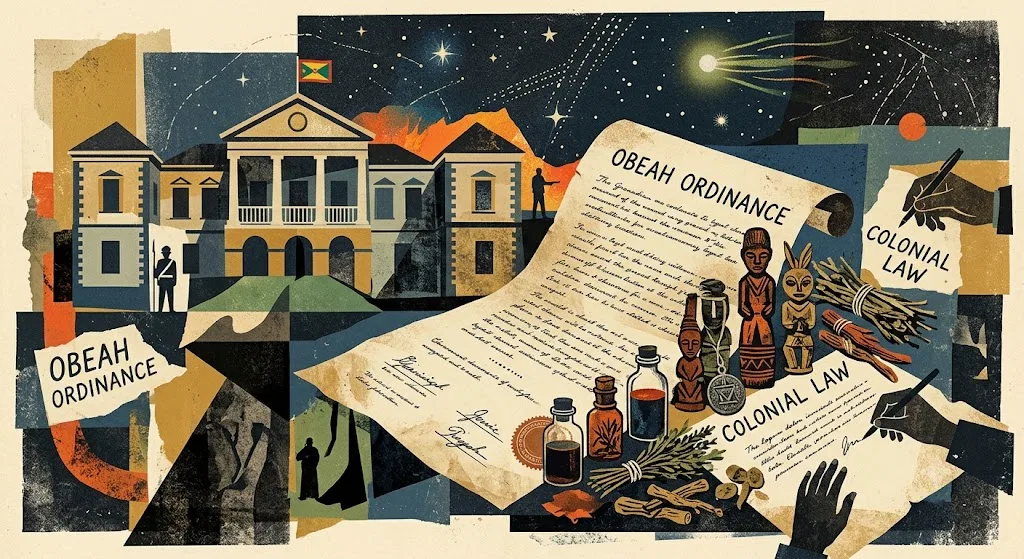
The roots of Grenada’s supernatural scares lie in slavery and colonial rule. “Obeah” was used across the English-speaking Caribbean for a varied field of healing, protective work, divination, charms, spiritual consultation and alleged harmful magic. It was not one organised religion with a central creed or membership. Colonial officials nevertheless treated it as a coherent danger because practitioners could command respect outside churches, plantations and courts.
Grenada’s Consolidated Slave Act of 1825 included a provision against obeah. Like comparable Caribbean slave laws, it belonged to a system designed to supervise enslaved people’s movement, gatherings, religious activity and access to independent authority. Historians of Caribbean law emphasise two recurring colonial fears: that spiritual specialists could support rebellion and that remedies or ritual substances might cause illness or death. The legal category was therefore both political and medical, while remaining vague enough to cover many different African-derived practices.[Obeah Histories]obeahhistories.orgObeah Histories1825 Grenada Consolidated Slave ActNovember 12, 2012 — The 1825 Consolidated Slave Act of Grenada is an example of one of…
This matters because official records did not neutrally describe a pre-existing religion called obeah. The law helped produce the category it claimed merely to regulate. Diverse practices could be gathered under a frightening name and associated with secrecy, fraud, poisoning or insurrection. Anti-obeah legislation elsewhere in the region later expanded this logic by presenting practitioners as confidence tricksters, vagrants or threats to public order. Scholars have consequently interpreted such laws not simply as responses to harmful conduct, but as attempts to police the boundaries of acceptable religion and subordinate Afro-Caribbean knowledge to colonial Christianity.[northeastern.edu]ecda.northeastern.eduObeah and the Law – ECDAEarly Caribbean Digital ArchiveThe anti-Obeah laws coincided with the legal end of slavery in the early 1800s, which lead to a rapid decr…
The resulting fear worked in more than one direction. Plantation authorities feared the supposed political influence of spiritual practitioners. Enslaved and later free communities might fear curses, poisoning or retaliation. Christian preaching could intensify the belief that non-church spiritual work was demonic. At the same time, people continued to seek protection, healing and a sense of control through practices that official culture condemned.
It would therefore be misleading to call Grenada’s anti-obeah history a straightforward witch panic. There is no clear Grenadian equivalent of the Salem trials, with a concentrated sequence of accusations and executions. The more important pattern was prolonged institutional suspicion: the transformation of African-derived spiritual authority into a legal and cultural menace.
Eric Gairy took UFOs to the United Nations
Grenada’s most extraordinary documented collective-belief story concerns Eric Gairy, the trade-union leader who became the country’s first prime minister at independence in 1974. During the later years of his government, Gairy promoted the investigation of unidentified flying objects as a serious international issue.
This was not merely a private enthusiasm. Grenada formally placed the subject before the United Nations. Gairy had already spoken about unexplained aerial phenomena at General Assembly sessions before his government submitted proposals in 1977. The original plan called for a United Nations body to coordinate UFO research, the declaration of 1978 as an international year devoted to UFOs and a second international UFO congress to be held in Grenada.[United Nations Digital Library System]digitallibrary.un.orgited Nations Digital Library Systemited Nations Digital Library System…
The proposal was ambitious. It treated UFO reports as a worldwide problem requiring shared records, scientific study and international cooperation. A revised version asked the UN Secretary-General to survey existing knowledge, including possible scientific, legal, economic and political consequences of contact with extraterrestrial life. The Special Political Committee discussed the issue in November and December 1977, but Grenada did not press its draft resolution to a vote. Instead, the committee adopted a much weaker consensus recommending that Gairy’s statements and Grenada’s proposal be circulated to member states.[United Nations Digital Library System]digitallibrary.un.orgited Nations Digital Library Systemited Nations Digital Library System…
Gairy continued his campaign. On 27 November 1978, he appeared at a UN event with supporters of UFO research. Contemporary UN records preserve the occasion, while a United States diplomatic memorandum records him asking President Jimmy Carter to support an international UFO study and referring to sightings reported in Grenada.[United Nations Media]media.un.orgOpen source on un.org.
The episode is sometimes described as though Gairy persuaded the United Nations to establish a UFO agency. He did not. The UN allowed discussion, circulated material and acknowledged the Grenadian initiative, but no permanent investigative body emerged. Claims that the proposal was formally defeated by a dramatic superpower veto should also be treated cautiously: the clearest official record shows that Grenada withdrew or declined to press successive draft resolutions while a limited consensus statement was adopted.
Belief, diplomacy or political theatre?
Several explanations can coexist. Gairy plainly expressed personal conviction that unexplained phenomena deserved investigation. In a speech forwarded to UN members, he connected questions about the universe with belief in a universal supreme being and a hoped-for world order based on peace. His UFO interest therefore had a spiritual as well as scientific or diplomatic dimension.[United Nations Digital Library System]digitallibrary.un.orgited Nations Digital Library Systemited Nations Digital Library System
The campaign also offered a small newly independent country a way to command an international audience. Grenada lacked the military and economic weight of larger states, but an unusual global cause could make its leader visible. Holding an international congress on the island would have attracted visitors, publicity and symbolic prestige.
For Gairy’s opponents, however, the initiative showed that the government was distracted by fantasies while Grenada faced unemployment, political violence and accusations of repression. What supporters might present as visionary independence could be portrayed as extravagance, superstition or personal vanity. Scholarship on revolutionary Grenada notes that Gairy’s reputed interest in both obeah and extraterrestrials became shorthand for backwardness in the political language of his critics.[JSTOR]jstor.orgOpen source on jstor.org.
The UFO campaign did not become a mass religion. There is no good evidence that Grenadians as a whole adopted an organised extraterrestrial belief system or treated Gairy as an alien prophet. It is better understood as a highly personalised state campaign that drew on the era’s international enthusiasm for UFOs, space exploration and paranormal research.
The “warlock” image and the politics of fear
By the late 1970s, Grenada was deeply divided. Gairy’s government was accused of authoritarianism, electoral intimidation and violence by security forces and allied groups, most notoriously the Mongoose Gang. The opposition New Jewel Movement presented the government as corrupt, brutal and irrational. When the movement seized power on 13 March 1979 while Gairy was abroad, reports about strange objects allegedly found among his belongings became part of the victorious revolution’s story.
International coverage readily combined the UFO campaign with claims about black magic. A particularly sensational Time article called Gairy a “warlock” and treated alleged ritual objects as evidence of his dependence on supernatural protection. Such reporting reflected genuine rumours circulating around his government, but its language also relied on longstanding Western stereotypes that reduced Afro-Caribbean spiritual practices to “voodoo”, sorcery and primitive fear.[Time]time.comgrenada the fall of a warlockgrenada the fall of a warlock
The distinction between documented fact and political narrative is crucial:
- Documented: Gairy publicly championed UFO research and used Grenada’s diplomatic machinery to raise it at the United Nations.
- Widely alleged: He consulted spiritual practitioners, collected ritual objects or believed himself protected by supernatural forces.
- Politically useful: Opposition figures used these allegations to portray his rule as irrational and morally corrupt.
- Not established: That magic played a demonstrable role in government decisions, that Gairy commanded an organised occult movement or that supernatural fear alone explains his political power.
The allegations were effective partly because they joined older fears to modern political grievances. Obeah had long been represented as secret, manipulative and dangerous. Gairy’s theatrical style and UFO advocacy made accusations of occultism appear plausible to hostile audiences. Attributing his authority to magic could also provide an emotionally satisfying explanation for why an unpopular or feared leader remained in power.
Yet the “warlock” story can obscure the material sources of that power: Gairy’s history as a labour organiser, his support among agricultural workers, control of state institutions and the coercive capacity of loyal security groups. It could likewise minimise the real causes of opposition—political violence and contested governance—by presenting the conflict as a struggle between rational revolutionaries and a superstitious ruler.
More recent scholarship has challenged this simplistic contrast. Mocking Gairy’s supposed obeah practice could reproduce colonial contempt for African cultural forms, even when the criticism came from anti-colonial revolutionaries. The charge did not merely attack one politician; it risked marking entire areas of Grenadian popular culture as ignorant or shameful.[Sage Journals]journals.sagepub.comOpen source on sagepub.com.
Revolution, rumours and genuine danger
Grenada’s political crises generated intense rumour, but they should not be mislabelled as collective delusion. Before the 1979 takeover, opposition supporters feared that Gairy’s forces would arrest or kill New Jewel Movement leaders. Some claims may have grown in the telling, but the wider fear existed in a setting of documented intimidation and political violence. Rumour helped accelerate action, yet it did not arise in a social vacuum.
The collapse of the revolutionary government in October 1983 presents an even clearer warning against loose use of “mass hysteria”. Prime Minister Maurice Bishop and several colleagues were killed after a power struggle, and the military authorities imposed a shoot-on-sight curfew. Regional governments and the United States then treated Grenada as a security emergency, leading to the US-led invasion on 25 October. Accounts of the intervention remain politically disputed, but the public fear surrounding it followed actual killings, armed conflict and governmental collapse.[The British Academy]thebritishacademy.ac.ukThe British Academy The Grenada intervention: 30 years laterThe British Academy The Grenada intervention: 30 years later
Political leaders naturally attempted to shape how people understood the danger. The military regime described harsh measures as necessary for order. The United States emphasised threats to its citizens and regional security. Critics argued that Washington exaggerated some risks to justify an intervention. These competing narratives belong to the history of propaganda, threat perception and moral justification, not to a medical diagnosis of mass psychogenic illness.
The same caution applies to everyday supernatural rumours. A community’s discussion of curses, prophetic dreams or ominous signs may reveal shared cultural assumptions without proving that everyone accepted the claim. People can repeat a story because it is frightening, entertaining, politically useful or socially expected while privately remaining doubtful.

What the evidence does—and does not—support
The surviving record supports three broad conclusions about cults, scares and contagious belief in Grenada.
First, colonial authorities constructed African-derived spiritual practices as a public danger. Anti-obeah law reflected fear of rebellion, poisoning and independent Black authority, but it also created an exceptionally broad category into which many practices could be placed. Modern historians therefore treat “obeah” carefully rather than assuming it denotes a single sinister religion.
Second, Gairy’s UFO diplomacy was real. Official UN and US records leave no doubt that he wanted international investigation of unexplained aerial phenomena. The initiative was unusual but not secret, and it did not create a Grenadian UFO cult or a UN extraterrestrial agency.
Third, the image of Gairy as a magician or warlock is less secure. It rests on a combination of local rumour, opposition rhetoric, alleged discoveries after the revolution and sensational foreign reporting. Some private belief or ritual involvement is possible, but the strongest claims cannot be verified to the same standard as his public UFO campaign.
There is also no securely documented Grenadian outbreak of mass psychogenic illness that should anchor the country’s history. That absence is worth stating because dramatic regional stories are easily reassigned to the wrong island. Eastern Caribbean witchcraft scares—such as school rumours in Dominica between 1999 and 2001—offer useful comparisons, but they are not Grenadian events.[anthrosource.onlinelibrary.wiley.com]anthrosource.onlinelibrary.wiley.comOpen source on wiley.com.
Why Grenada’s strange-belief history still matters
Grenada shows that collective belief cannot be separated neatly from power. Colonial officials used fear of obeah to regulate enslaved people and marginalise African-derived culture. A post-colonial prime minister used belief in UFOs to seek international prominence. His opponents then used supernatural accusations to weaken his legitimacy, while overseas journalists amplified those accusations through stereotypes.
The case also demonstrates why the word “cult” can mislead. Neither obeah nor Grenada’s UFO diplomacy describes a closed, centrally controlled organisation demanding total obedience from followers. The more revealing questions concern who had the authority to define respectable belief, whose spirituality was called fraudulent or dangerous, and when an unusual conviction became a political weapon.
Grenada’s experience is therefore not a catalogue of bizarre national delusions. It is a history of contested knowledge. Spiritual practices could be sources of healing or fear; UFOs could be framed as a scientific mystery or evidence of governmental absurdity; rumours could communicate genuine danger while also exaggerating it. The lasting lesson is that beliefs acquire social force not simply because people accept them, but because laws, leaders, opponents and media give them consequences.
Amazon book picks
Further Reading
Books and field guides related to When Fear, Faith and Power Collided in Grenada. Use these as the next step if you want deeper reading beyond the article.
The Serpent and the Rainbow
First published 1985. Subjects: Social life and customs, Description and travel, Zombiism, Bizango (Cult), Religious life and customs.
Occult America
First published 2009. Subjects: New Age, Nonfiction, Occultism, Parapsychology, History.

Caribbean history
First published 2011. Subjects: Race relations, History, Caribbean area, history, West indies, race relations, HISTORY.
The Caribbean: A History of the Region and Its Peoples
Places Grenada's political and religious history in regional context.
Endnotes
1.
Source: ecda.northeastern.edu
Title: Obeah and the Law – ECDA
Link:https://ecda.northeastern.edu/home/about-exhibits/obeah-narratives-exhibit/obeah-and-the-law/
Source snippet
Early Caribbean Digital ArchiveThe anti-[Obeah laws]({{ 'obeah-laws-43b50f/' | relative_url }}) coincided with the legal end of slavery in the early 1800s, which lead to a rapid decr...
2.
Source: jstor.org
Link:https://www.jstor.org/stable/26855622
Source snippet
“Misappropriations and Frauds: Stealing.” Criminal Code, ch. 72A, § 98(b) (1958)...Read more...
3.
Source: digitallibrary.un.org
Title: ited Nations Digital Library System
Link:https://digitallibrary.un.org/record/655326/files/A_32_430-EN.pdf?ln=zh_CN
Source snippet
ited Nations Digital Library System...
4.
Source: digitallibrary.un.org
Title: ited Nations Digital Library System
Link:https://digitallibrary.un.org/record/660850/files/A_32_142_Add.1-EN.pdf
5.
Source: history.state.gov
Title: Office of the Historian Historical Documents
Link:https://history.state.gov/historicaldocuments/frus1977-80v23/d304
6.
Source: jstor.org
Link:https://www.jstor.org/stable/25605753
7.
Source: time.com
Title: grenada the fall of a warlock
Link:https://time.com/archive/6850486/grenada-the-fall-of-a-warlock/
8.
Source: anthrosource.onlinelibrary.wiley.com
Link:https://anthrosource.onlinelibrary.wiley.com/doi/10.1525/ahu.2007.32.1.18
9.
Source: 2021-2025.state.gov
Link:https://2021-2025.state.gov/reports/2022-report-on-international-religious-freedom/grenada/
10.
Source: 2009-2017.state.gov
Link:https://2009-2017.state.gov/documents/organization/171780.pdf
11.
Source: content.time.com
Link:https://content.time.com/time/subscriber/article/0%2C33009%2C916730%2C00.html
12.
Source: obeahhistories.org
Link:https://obeahhistories.org/grenada1825/
Source snippet
Obeah Histories1825 Grenada Consolidated Slave ActNovember 12, 2012 — The 1825 Consolidated Slave Act of Grenada is an example of one of...
Published: November 12, 2012
13.
Source: obeahhistories.org
Link:https://obeahhistories.org/law/
Source snippet
Obeah HistoriesLegislationGrenada's 1825 Consolidated Slave Law, an example of a 'slave code' from the late period of slavery that includ...
14.
Source: media.un.org
Link:https://media.un.org/photo/en/asset/oun7/oun7603835
15.
Source: journals.sagepub.com
Link:https://journals.sagepub.com/doi/10.1177/0094582X251337712
16.
Source: thebritishacademy.ac.uk
Title: The British Academy The Grenada intervention: 30 years later
Link:https://www.thebritishacademy.ac.uk/documents/664/BAR22-08-Williams.pdf
17.
Source: Wikipedia
Title: Mass psychogenic illness
Link:https://en.wikipedia.org/wiki/Mass_psychogenic_illness
18.
Source: Wikipedia
Link:https://en.wikipedia.org/wiki/Obeah
19.
Source: Wikipedia
Title: Eric Gairy
Link:https://en.wikipedia.org/wiki/Eric_Gairy
20.
Source: facebook.com
Link:https://www.facebook.com/groups/269202760462518/posts/1485762908806491/
21.
Source: facebook.com
Link:https://www.facebook.com/groups/668061303250857/posts/26210749765221993/
22.
Source: end-blasphemy-laws.org
Link:https://end-blasphemy-laws.org/countries/americas/grenada/
23.
Source: ebsco.com
Link:https://www.ebsco.com/research-starters/social-sciences-and-humanities/mass-hysteria
24.
Source: sk.sagepub.com
Link:https://sk.sagepub.com/ency/edvol/globalreligion/chpt/barbados
Additional References
25.
Source: resolve.cambridge.org
Link:https://resolve.cambridge.org/core/services/aop-cambridge-core/content/view/614D64A80BF1F8CCF008F662FC7AD8D3/9781139198417c3_p76-118_CBO.pdf/creole_slave_society_obeah_and_the_law.pdf
Source snippet
Cambridge University Press & Assessment3 Creole slave society, obeah, and the lawIn defining obeah as a problem, the colonial legislation...
26.
Source: youtube.com
Link:https://www.youtube.com/watch?v=82EklxGaCwE
Source snippet
Marronage, Medicine, and Mythology: Narrating Obeah in the 19th Century...
27.
Source: uscirf.gov
Link:https://www.uscirf.gov/sites/default/files/Blasphemy%20Laws%20Report.pdf
28.
Source: warwick.ac.uk
Title: paton trevor
Link:https://warwick.ac.uk/fac/arts/english/events/warvan-copy/prog/paton_trevor.pdf
Source snippet
University of WarwickObeah Acts: Producing and Policing the Boundaries of...by D Paton · 2009 · Cited by 136 — Obeah has been a crime in...
29.
Source: researchgate.net
Link:https://www.researchgate.net/publication/250942559_Enchanting_Panics_and_Obeah_Anxieties_Concealing_and_Disclosing_Eastern_Caribbean_Witchcraft
30.
Source: instagram.com
Link:https://www.instagram.com/p/DUdgHKfElO6/
31.
Source: apic.or.jp
Link:https://www.apic.or.jp/english/projects/barbados013-eng.html
32.
Source: grenadaparliament.gd
Link:https://grenadaparliament.gd/wp-content/uploads/2021/08/Cap128A-GRENADA-CONSTITUTION-ACT.pdf
33.
Source: parliament.am
Link:https://www.parliament.am/library/sahmanadrutyunner/grenada.pdf
34.
Source: hangar1publishing.com
Link:https://hangar1publishing.com/blogs/ufos-uaps-and-aliens/ufo-religions?srsltid=AfmBOorLbImwc5bM2sgYsVIVYRLUTA-ucDRNmqaqWO1LURiyY1vuR1kg
Topic Tree
Follow this branch
Related pages 192
- Antigua and Barbuda
- Argentina Belief Scares
- Azerbaijan Belief
- Bahrain Beliefs
- North Korea
- +187 more in sidebar