Within Russia
Why Russia Never Had a Great Witch Hunt
Russian witchcraft cases were brutal but usually local disputes over harmful magic rather than a nationwide Satanic conspiracy.
On this page
- What Russian Witchcraft Accusations Looked Like
- Torture, Household Power and Forced Testimony
- Why Trials Did Not Become Regional Chain Reactions
Page outline Jump by section
Introduction
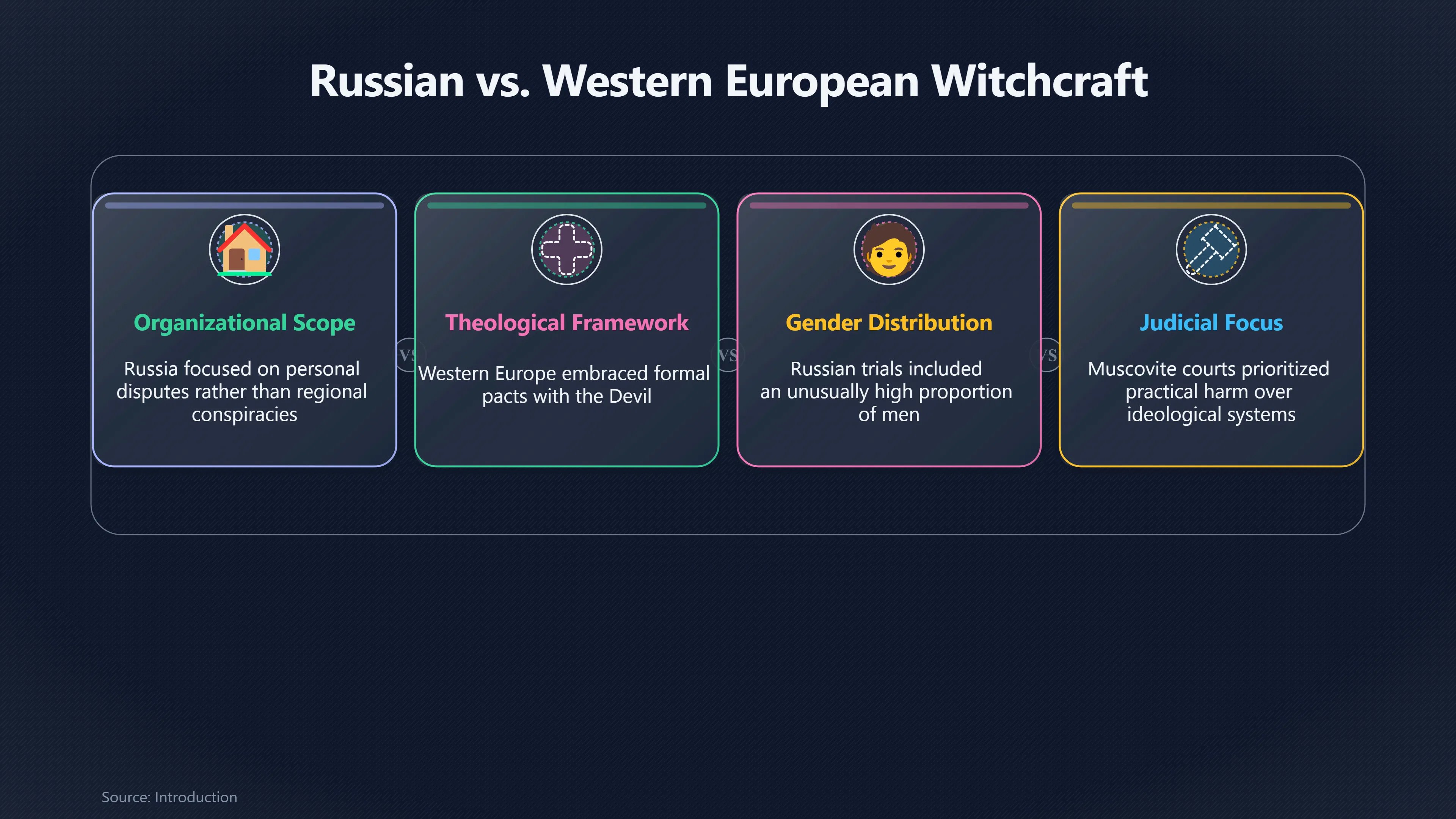
Russia did prosecute people for witchcraft, sometimes with extreme cruelty, but it never experienced a continent-wide “great witch hunt” comparable to those that devastated parts of Germany, Scotland or Switzerland. That difference is one of the most distinctive features of early modern Russian legal and religious history. Muscovite courts accepted that harmful magic existed and could threaten individuals, households and rulers, yet they generally did not embrace the elaborate belief that witches belonged to an organised satanic conspiracy spreading across entire regions. As a result, Russian witchcraft prosecutions were usually local, personal disputes rather than self-reinforcing waves of accusation. Historians now argue that understanding this difference is essential to understanding both Russian legal culture and the wider history of European witch persecutions.[cambridge.org]cambridge.orgCambridge University Press & AssessmentProsaic Witchcraft and Semiotic Totalitarianism: Muscovite Magic Reconsidered | Slavic Review | Ca…

What Russian witchcraft accusations looked like
Most Russian witchcraft cases centred on the practical consequences of alleged magic rather than theological ideas about the Devil. Accusers claimed that a neighbour, servant, healer or rival had caused illness, infertility, impotence, failed crops, bad luck, or the loss of favour within a household. Magic was viewed as something that could damage everyday life through curses, charms, powders, herbs or spoken spells rather than through participation in a hidden satanic religion.[Cambridge University Press & Assessment]cambridge.orgCambridge University Press & AssessmentProsaic Witchcraft and Semiotic Totalitarianism: Muscovite Magic Reconsidered | Slavic Review | Ca…
This made Russian accusations look very different from many western European trials. In much of western Europe, judges increasingly accepted the demonological idea that witches had entered into formal pacts with the Devil, attended secret gatherings and belonged to organised conspiracies. Those assumptions encouraged investigators to search for networks of accomplices. Muscovite courts generally focused instead on whether a particular act of harmful magic had occurred against a specific victim. The alleged crime was personal, not collective.[Cambridge University Press & Assessment]cambridge.orgCambridge University Press & AssessmentProsaic Witchcraft and Semiotic Totalitarianism: Muscovite Magic Reconsidered | Slavic Review | Ca…
Another important difference was gender. While women certainly appeared among the accused, seventeenth-century Russian prosecutions included an unusually high proportion of men compared with western Europe. Male healers, fortune-tellers, servants, clerks and military men could all face accusations. Historians argue that Russian ideas about magical power were less closely tied to femininity than those found in many western European demonological traditions.[Cambridge University Press & Assessment]cambridge.orgCambridge University Press & AssessmentProsaic Witchcraft and Semiotic Totalitarianism: Muscovite Magic Reconsidered | Slavic Review | Ca…
Torture, household power and forced testimony
The absence of mass witch hunts did not make Russian trials humane. Witchcraft ranked among the gravest offences in Muscovite law, and investigators frequently relied on torture to obtain confessions.
Suspects could be beaten, suspended by their arms, burned with heated implements or subjected to other coercive methods intended to force admissions or expose supposed magical practices. Confessions extracted under torture naturally distorted many cases, making it difficult to know what defendants actually believed or practised. Modern historians therefore treat many trial records as evidence of judicial coercion as much as evidence of popular belief.[OUP Academic]academic.oup.comOUP AcademicTrials, Justice, and the Logic of Torture | Desperate Magic: The Moral Economy of Witchcraft in Seventeenth-Century Russia |…
Many accusations also grew out of unequal relationships inside households. Masters accused servants, servants accused fellow servants, wives accused rivals, and members of elite households blamed retainers for unexplained illnesses or changes in favour. Since powerful household heads exercised enormous authority over dependants, witchcraft prosecutions often reveal tensions over discipline, loyalty, inheritance and reputation rather than simply fear of supernatural forces. Magic accusations became one way of explaining conflicts that otherwise lacked satisfactory answers.[doi.org]doi.orgWitchcraft, Heresy, Treason, Rebellion: Defining Muscovy’s Most Heinous Crimes | Desperate Magic: The Moral Economy of Witchcraft in S…
The result was a legal culture in which witchcraft could produce severe punishments while simultaneously reflecting ordinary social disputes. The records reveal anxieties about health, family, status and dependence far more often than fears of an organised kingdom of Satan.[Cambridge University Press & Assessment]cambridge.orgCambridge University Press & AssessmentProsaic Witchcraft and Semiotic Totalitarianism: Muscovite Magic Reconsidered | Slavic Review | Ca…

Why trials did not become regional chain reactions
The crucial question is not why Russia had witchcraft trials, but why those trials rarely escalated into regional panics.
One explanation lies in religious ideas. Western European demonology increasingly portrayed witches as members of a vast anti-Christian conspiracy directed by the Devil. Once investigators accepted that model, every confession created pressure to identify accomplices, producing expanding circles of accusation. Muscovite religious and legal thinking never developed that same comprehensive framework to the same extent. Harmful magic was believed to exist, but it was usually understood as an individual offence rather than participation in an organised satanic movement.[Cambridge University Press & Assessment]cambridge.orgCambridge University Press & AssessmentProsaic Witchcraft and Semiotic Totalitarianism: Muscovite Magic Reconsidered | Slavic Review | Ca…
Legal practice also mattered. Although torture remained widespread, Russian courts generally pursued individual incidents rather than constructing ever-larger conspiracies. Confessions therefore did not routinely trigger the cascading denunciations that fuelled many western European hunts. Historians describe Muscovite witchcraft as “prosaic”: a collection of practical beliefs about everyday magical harm rather than a single ideological system explaining all misfortune through the Devil’s servants.[Cambridge University Press & Assessment]cambridge.orgCambridge University Press & AssessmentProsaic Witchcraft and Semiotic Totalitarianism: Muscovite Magic Reconsidered | Slavic Review | Ca…
The social geography of accusations reinforced this pattern. Cases usually remained rooted in particular villages, estates or court circles. They addressed specific grievances—an unexplained illness, a failed relationship, a suspicious servant or a political rivalry—without automatically spreading into neighbouring communities. Even where several accusations occurred together, they rarely developed into the runaway judicial processes familiar from some German territories or the Scottish witch hunts.[Cambridge University Press & Assessment]cambridge.orgCambridge University Press & AssessmentProsaic Witchcraft and Semiotic Totalitarianism: Muscovite Magic Reconsidered | Slavic Review | Ca…
What these trials reveal about Muscovite society
Russian witchcraft prosecutions illuminate a society in which supernatural explanations coexisted with highly practical concerns.
People genuinely feared magic because illness, crop failure and sudden death often lacked convincing natural explanations. At the same time, accusations frequently served as tools for negotiating authority within households and communities. A failed cure, damaged reputation or unexpected political setback could all be interpreted through the language of sorcery.[Cambridge University Press & Assessment]cambridge.orgCambridge University Press & AssessmentProsaic Witchcraft and Semiotic Totalitarianism: Muscovite Magic Reconsidered | Slavic Review | Ca…
The cases also reveal the limits of simple comparisons between Russia and western Europe. Russia was not unusually sceptical about magic, nor was it free from judicial brutality. Rather, its legal and religious traditions channelled fears in different directions. Harmful magic was treated as dangerous, but investigators generally did not transform isolated accusations into continent-style campaigns against an imagined satanic conspiracy.[cambridge.org]cambridge.orgCambridge University Press & AssessmentProsaic Witchcraft and Semiotic Totalitarianism: Muscovite Magic Reconsidered | Slavic Review | Ca…
Why historians reject the idea of a Russian “great witch hunt”
Older histories sometimes assumed that every European society passed through essentially the same witch-hunting experience. Research over the past several decades has challenged that assumption.
Specialists such as Valerie Kivelson and Jonathan Shaheen argue that imposing western European models onto Muscovite Russia obscures the evidence. Russian witchcraft beliefs formed a varied collection of local practices and fears rather than a unified demonological system. The country’s trials were undeniably violent, but they lacked the judicial feedback loop—confession, denunciation, expanding conspiracies and mass executions—that characterised Europe’s largest witch hunts.[Cambridge University Press & Assessment]cambridge.orgCambridge University Press & AssessmentProsaic Witchcraft and Semiotic Totalitarianism: Muscovite Magic Reconsidered | Slavic Review | Ca…
For that reason, “Russian witch trials without a great witch hunt” is not a contradiction. It captures the central historical reality: Russia experienced harsh prosecutions for alleged magic, yet avoided the sustained regional chain reactions that made the western European witch hunts one of the largest episodes of judicial persecution in early modern history.[cambridge.org]cambridge.orgCambridge University Press & AssessmentProsaic Witchcraft and Semiotic Totalitarianism: Muscovite Magic Reconsidered | Slavic Review | Ca…



Endnotes
1.
Source: cambridge.org
Link:https://www.cambridge.org/core/journals/slavic-review/article/abs/prosaic-witchcraft-and-semiotic-totalitarianism-muscovite-magic-reconsidered/79F43EF98D3524A76A35D77CCDDB57B2
Source snippet
Cambridge University Press & AssessmentProsaic Witchcraft and Semiotic Totalitarianism: Muscovite Magic Reconsidered | Slavic Review | Ca...
2.
Source: doi.org
Link:https://doi.org/10.7591/cornell/9780801451461.003.0008
Source snippet
Witchcraft, Heresy, Treason, Rebellion: Defining Muscovy’s Most Heinous Crimes | Desperate Magic: The Moral Economy of Witchcraft in S...
3.
Source: academic.oup.com
Link:https://academic.oup.com/cornell-scholarship-online/book/20201/chapter-abstract/179240033
Source snippet
OUP AcademicTrials, Justice, and the Logic of Torture | Desperate Magic: The Moral Economy of Witchcraft in Seventeenth-Century Russia |...
4.
Source: academic.oup.com
Link:https://academic.oup.com/cornell-scholarship-online/book/38301/chapter-abstract/333273356
Source snippet
"Kivelson (ed.), Christine D. Worobec (ed.) [https://doi.org/10.7591/cornell/9781501750649.001.0001..."](https://doi.org/10.7591/cornell/9781501750649.001.0001...")...
5.
Source: cambridge.org
Link:https://www.cambridge.org/core/journals/slavic-review/article/prosaic-witchcraft-and-semiotic-totalitarianism-muscovite-magic-reconsidered/79F43EF98D3524A76A35D77CCDDB57B2
Source snippet
1520-c. 1630),” in Ankarloo and Henningsen, eds., Early Modern European Witchcraft,45–82. 19 19 Gasparov, Boris, “Intr...
6.
Source: academic.oup.com
Link:https://academic.oup.com/cornell-scholarship-online/book/20201/chapter/179238908
7.
Source: academic.oup.com
Link:https://academic.oup.com/cornell-scholarship-online/book/20201
8.
Source: academic.oup.com
Link:https://academic.oup.com/cornell-scholarship-online/book/20201/chapter/179241620
9.
Source: cambridge.org
Link:https://www.cambridge.org/core/journals/comparative-studies-in-society-and-history/article/abs/male-witches-and-gendered-categories-in-seventeenthcentury-russia/F9FA9F79E0576D4F0AC5EA29E3EFF59A
10.
Source: parliament.uk
Link:https://www.parliament.uk/about/living-heritage/transformingsociety/private-lives/religion/overview/witchcraft/
Additional References
11.
Source: smithsonianmag.com
Title: In Early Modern Russia, the Majority of Accused ‘Witches’ Were Men
Link:https://www.smithsonianmag.com/history/in-early-modern-russia-most-accused-witches-were-men-180980256/
Source snippet
June 15, 2022 — IN EARLY MODERN RUSSIA, THE MAJORITY OF ACCUSED ‘WITCHES’ WERE MEN ORTHODOX RUSSIANS DEPLOYED MAGIC FOR PRACTICAL PURPOSE...
Published: June 15, 2022
12.
Source: youtube.com
Link:https://www.youtube.com/watch?v=aaQc6x2vrsQ
Source snippet
Swimming of witches in Podillia (1711) - Read by Christine Worobec...
13.
Source: youtube.com
Title: History Hack: Witchcraft and Magic in 18th Century Russia
Link:https://www.youtube.com/watch?v=2Y8EZhFX2ZY
Source snippet
Valerie A. Kivelson and Christine D. Worobec, "Witchcraft in Russia and Ukraine, 1000-1900"...
14.
Source: youtube.com
Title: HOW WITCHES WERE DEALT WITH IN ANCIENT RUSSIA
Link:https://www.youtube.com/watch?v=qukXSuHONw4
Source snippet
A History of Witchcraft and Magic in Europe Part 7: The Early Modern Witch Trials...
15.
Source: degruyterbrill.com
Title: Desperate Magic
Link:https://www.degruyterbrill.com/document/doi/10.1515/9781644699409/html?lang=en
Source snippet
December 1, 2020 — DESPERATE MAGIC The Moral Economy of Witchcraft in Seventeenth-Century Russia * Valerie Kivelson * Translated by: Vlad...
Published: December 1, 2020
16.
Source: youtube.com
Link:https://www.youtube.com/watch?v=TQI2MLD96t0
Source snippet
HOW WITCHES WERE DEALT WITH IN ANCIENT RUSSIA...
17.
Source: onlinelibrary.wiley.com
Link:https://onlinelibrary.wiley.com/doi/full/10.1111/hisn.12138
Source snippet
By Valerie Kivelson. (Ithaca, NY: Cornell University Press, 2013. Pp. xx, 349. $79.95.) - Thurston - 2016 - Historian - Wiley Online Libr...
18.
Source: goodreads.com
Link:https://www.goodreads.com/en/book/show/17918112-desperate-magic
19.
Source: biblio.ugent.be
Link:https://biblio.ugent.be/publication/7189217
20.
Source: researchgate.net
Link:https://www.researchgate.net/publication/259748026_Prosaic_Witchcraft_and_Semiotic_Totalitarianism_Muscovite_Magic_Reconsidered
Topic Tree