Within Ethiopia
How Did the Derashe Illness Last for Years?
The long Derashe outbreak reveals how grief, social memory and weak early responses can turn collective illness into a lasting community crisis.
On this page
- The death that preceded the first reported cases
- How symptoms became embedded in community life
- What a more humane public health response required
Page outline Jump by section
Introduction
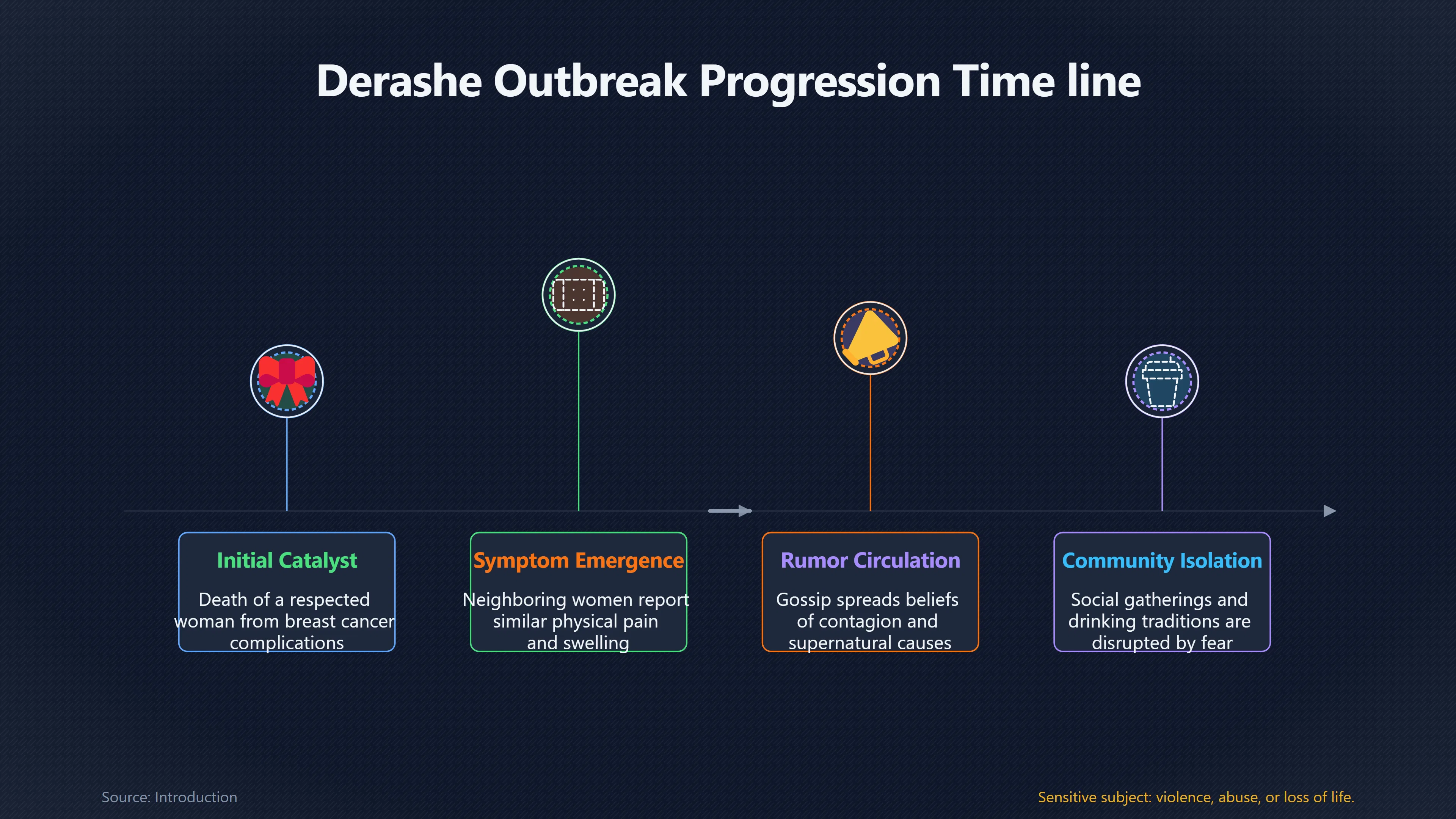
The Derashe outbreak is one of Ethiopia’s best-documented examples of a prolonged community illness that researchers describe as mass psychogenic illness rather than an infectious epidemic. Beginning in 2012 in southern Ethiopia, the episode reportedly affected around 120 women over several years after the death of a well-known local woman from complications of breast cancer. What made the event unusual was not simply the number of people involved, but the way grief, fear, rumours and uncertainty became woven into everyday community life. Rather than disappearing within days or weeks, the illness persisted because many people believed it was contagious or caused by supernatural or environmental forces, while early official communication failed to provide convincing explanations.[PMC]pmc.ncbi.nlm.nih.govtional study - PMCJune 7, 2018…
The Derashe case is important because it illustrates how genuine suffering can become socially reinforced even when medical investigations find no evidence of a shared physical disease. It also demonstrates why respectful communication and community engagement are as important as clinical investigation during unexplained illness outbreaks.
The death that preceded the first reported cases
Researchers traced the beginning of the outbreak to the death of a 43-year-old socially respected and active woman who had suffered complications from breast cancer. Soon afterwards, other women began reporting symptoms that resembled what they believed she had experienced. The illness spread gradually through two neighbouring communities in Derashe Woreda rather than appearing suddenly as a conventional epidemic.[PMC]pmc.ncbi.nlm.nih.govtional study - PMCJune 7, 2018…
By the time investigators carried out a detailed community study in 2015, approximately 120 women had reportedly been affected. Ninety-seven women participated in the main quantitative investigation, while focus groups and interviews with community members, local health workers and officials explored how people understood the illness.[PMC]pmc.ncbi.nlm.nih.govtional study - PMCJune 7, 2018…
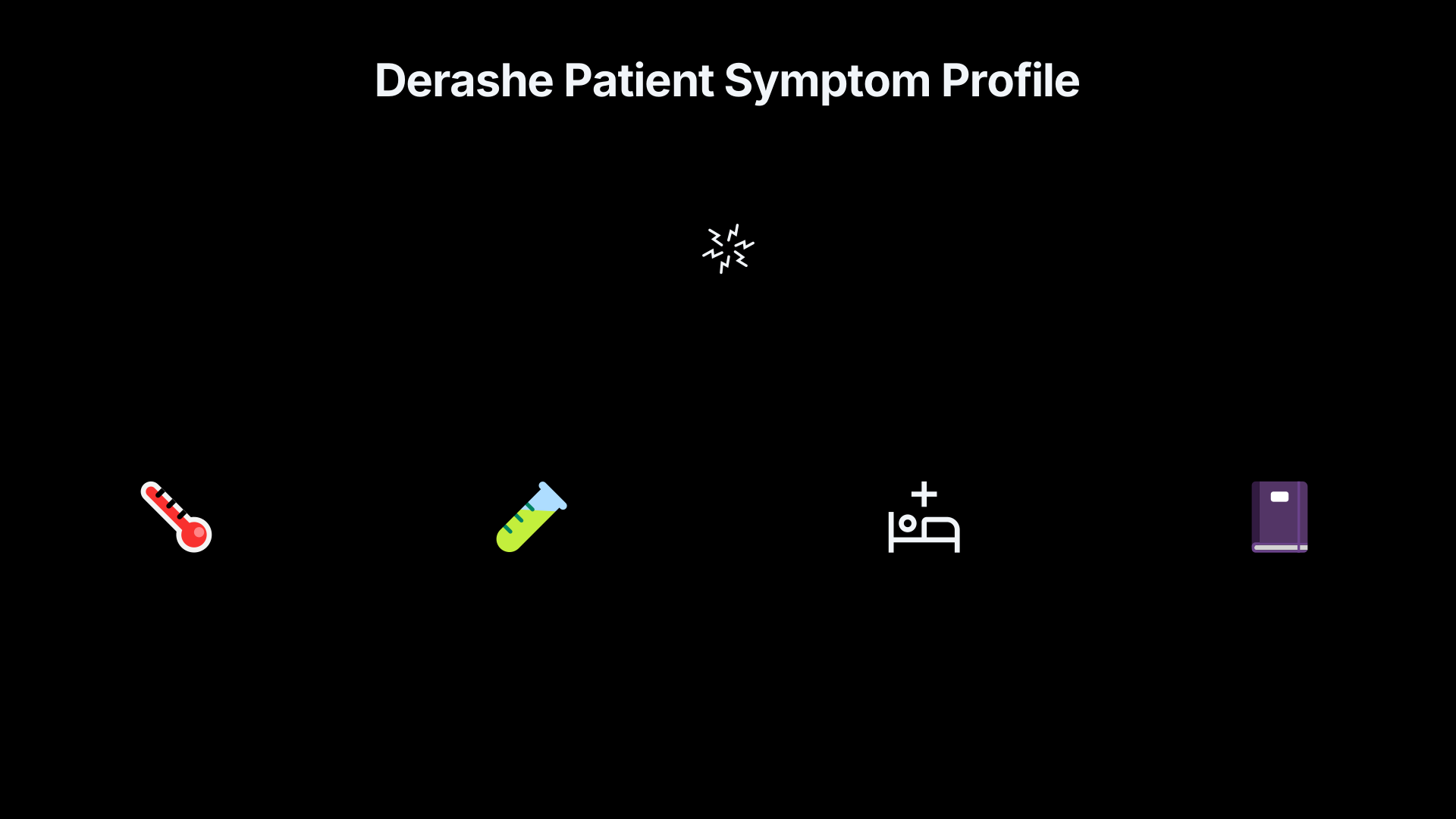
The women consistently described physical symptoms rather than vague feelings of anxiety. Common complaints included:
- breast pain and swelling;
- back pain and chest tightness;
- dizziness and headaches;
- tingling or numbness in the arms;
- weakness and fatigue;
- episodes of anxiety and difficulty concentrating.
Medical examinations, however, did not identify breast cancer or another shared physical condition that could explain the pattern across the affected women.[Springer Link]link.springer.comSpringer LinkChronic mass psychogenic illness among women in Derashe Woreda, Segen Area People Zone, southern Ethiopia: a community based…
How symptoms became embedded in community life
Unlike many school-based episodes of mass psychogenic illness, the Derashe outbreak continued for years. Researchers argue that several interacting factors helped sustain it rather than allowing it to fade quickly.[PMC]pmc.ncbi.nlm.nih.govtional study - PMCJune 7, 2018…
Rumours spread largely through conversation rather than official information. Nearly 90% of participants reported first hearing about the illness through gossip or indirect discussion, while very few initially received information from health professionals. As stories circulated, many women became increasingly alert to ordinary bodily sensations that could be interpreted as signs of the feared disease.[Springer Link]link.springer.comSpringer LinkChronic mass psychogenic illness among women in Derashe Woreda, Segen Area People Zone, southern Ethiopia: a community based…
The study also found that many participants had experienced significant personal stress before developing symptoms. Bereavement, illness within the family, financial hardship, family conflict and other psychosocial pressures were commonly reported. Researchers did not suggest that stress alone “caused” the illness, but concluded that these pressures likely made the community more vulnerable to developing and sustaining shared illness beliefs.[PMC]pmc.ncbi.nlm.nih.govtional study - PMCJune 7, 2018…
Importantly, the symptoms were experienced as real. Mass psychogenic illness does not imply deliberate deception or fabrication. Physical pain, dizziness, weakness and other symptoms can arise through complex interactions between stress, expectation, attention and social influence without conscious intent.[PMC]pmc.ncbi.nlm.nih.govtional study - PMCJune 7, 2018…
Why fear spread beyond the affected women
One of the most damaging consequences was not the symptoms themselves but the belief that the illness could spread through ordinary social contact.
Researchers recorded a range of explanations circulating within the community. Some women believed the illness represented divine punishment. Others suspected environmental pollution, toxic chemicals, witchcraft, ancestral curses or other causes. More than half said they simply did not know what was causing the condition.[PMC]pmc.ncbi.nlm.nih.govtional study - PMCJune 7, 2018…
Because many people regarded the illness as contagious:
- affected women experienced stigma from neighbours and relatives;
- some feared divorce or rejection by their husbands;
- communal drinking traditions were disrupted because people no longer wished to share drinking vessels with affected women;
- attendance at schools and social gatherings declined as anxiety spread through the wider community.[PMC]pmc.ncbi.nlm.nih.govtional study - PMCJune 7, 2018…
These responses reinforced fear. As more people avoided affected women, the apparent seriousness of the illness seemed confirmed, making rumours more persuasive and recovery more difficult.
Community responses and treatment seeking
The response of affected women reflected uncertainty rather than blind acceptance of a single explanation.
Around three-quarters sought care from modern health services. Nearly two-thirds also consulted traditional healers, and many used both systems. Smaller numbers sought religious healing, while a few pursued modern medicine, traditional healing and religious treatment simultaneously.[PMC]pmc.ncbi.nlm.nih.govtional study - PMCJune 7, 2018…
Traditional treatments reportedly included herbal preparations and cauterisation with heated metal. These approaches reflected attempts to relieve genuine suffering rather than rejection of modern medicine. In practice, many women moved between different forms of care because no single explanation appeared convincing or consistently effective.[PMC]pmc.ncbi.nlm.nih.govtional study - PMCJune 7, 2018…
Interviews also revealed widespread frustration. Participants repeatedly asked authorities to explain what was happening, illustrating that uncertainty itself became part of the crisis.[PMC]pmc.ncbi.nlm.nih.govtional study - PMCJune 7, 2018…

What a more humane public-health response required
The Derashe study is notable because it criticised not the community but the initial response.
Researchers concluded that the outbreak lasted far longer than necessary because health workers themselves were uncertain how to respond. Local services often referred cases onwards without providing clear explanations, leaving rumours to fill the information gap. Extensive investigation without effective communication sometimes strengthened the belief that an undiscovered disease must exist.[PMC]pmc.ncbi.nlm.nih.govtional study - PMCJune 7, 2018…
The authors argued that a more effective response required several elements working together:
- acknowledge that the women’s symptoms were genuine and deserved respectful care;
- investigate appropriately while avoiding repeated unnecessary medical testing once serious disease had been excluded;
- provide consistent public explanations about the lack of evidence for contagious breast cancer;
- reduce rumours through trusted local leaders and health educators;
- offer psychological support without dismissing sufferers as imagining their symptoms.[PMC]pmc.ncbi.nlm.nih.govtional study - PMCJune 7, 2018…
The researchers emphasised that simply telling people “nothing is wrong” would have been ineffective. Successful management depended on recognising real distress while explaining how genuine physical symptoms can occur without a contagious disease.
Why the Derashe outbreak remains significant
The Derashe outbreak occupies an important place in Ethiopia’s history of collective illness because it shows that prolonged community health scares do not require a malicious rumour campaign, a charismatic movement or sensational media coverage. Instead, they can emerge from ordinary social processes when grief, uncertainty and incomplete information reinforce one another.
For historians, psychologists and public-health specialists, the episode demonstrates how social memory can shape bodily experience. The death of one respected woman became the reference point through which many others interpreted their own symptoms. For public-health practitioners, it illustrates that early, compassionate communication is not an optional addition to outbreak management but a central intervention in its own right.[PMC]pmc.ncbi.nlm.nih.govtional study - PMCJune 7, 2018…
Amazon book picks
Further Reading
Books and field guides related to How Did the Derashe Illness Last for Years?. Use these as the next step if you want deeper reading beyond the article.

The Spirit Catches You and You Fall Down
Illustrates respectful public-health communication across cultures.



Endnotes
1.
Source: pmc.ncbi.nlm.nih.gov
Link:https://pmc.ncbi.nlm.nih.gov/articles/PMC5992694/
Source snippet
tional study - PMCJune 7, 2018...
Published: June 7, 2018
2.
Source: link.springer.com
Link:https://link.springer.com/article/10.1186/s13033
Source snippet
Springer LinkChronic mass psychogenic illness among women in Derashe Woreda, Segen Area People Zone, southern Ethiopia: a community based...
3.
Source: pubmed.ncbi.nlm.nih.gov
Link:https://pubmed.ncbi.nlm.nih.gov/38478508/
Source snippet
The collected data were analyzed using the InterVA model using R analytic software. The study reported both group-based and...
4.
Source: pmc.ncbi.nlm.nih.gov
Link:https://pmc.ncbi.nlm.nih.gov/articles/PMC9302037/
Source snippet
2022 Jul 22;12:04051. doi: 10.7189/jogh.12.04051 WHY MOTHERS DIE: ANALYSIS OF VERBAL AUTOPSY DATA FROM KERSA HEALTH AND DEMOGRAPHIC SURVE...
5.
Source: pmc.ncbi.nlm.nih.gov
Link:https://pmc.ncbi.nlm.nih.gov/articles/PMC9210177/
Source snippet
Predictors of mass psychogenic illness in a junior secondary school in rural Botswana: A case control study. S Afr J Ps...
6.
Source: pubmed.ncbi.nlm.nih.gov
Link:https://pubmed.ncbi.nlm.nih.gov/34970651/
Source snippet
We assessed trends in women's reproductive age mortality and the associated determinants using crude and adjusted Cox regressio...
7.
Source: pmc.ncbi.nlm.nih.gov
Link:https://pmc.ncbi.nlm.nih.gov/articles/PMC8712503/
Source snippet
2021 Dec 14;2:762984. doi: 10.3389/fgwh.2021.762984 TREND AND DETERMINANTS OF MORTALITY AMONG WOMEN OF REPRODUCTIVE AGE: A TWELVE-YEAR OP...
8.
Source: pmc.ncbi.nlm.nih.gov
Link:https://pmc.ncbi.nlm.nih.gov/articles/PMC7396040/
9.
Source: pubmed.ncbi.nlm.nih.gov
Link:https://pubmed.ncbi.nlm.nih.gov/32775400/
10.
Source: pubmed.ncbi.nlm.nih.gov
Link:https://pubmed.ncbi.nlm.nih.gov/28496370/
11.
Source: ouci.dntb.gov.ua
Link:https://ouci.dntb.gov.ua/en/works/4Kpj5p3l/
Additional References
12.
Source: drpress.org
Link:https://drpress.org/ojs/index.php/EHSS/article/view/6439
Source snippet
Mass hysteria: two syndromes? Psychological Medicine, 1987, 17(1): 109–120. Benaim, S., Horder, J., & Anderson, J. Hysterical epidemic in...
13.
Source: youtube.com
Title: Understanding Contagious Belief and Unexplained Illness
Link:https://www.youtube.com/watch?v=yRwFilSEGQ0
Source snippet
The Tanganyika Laughter Epidemic: How Social Illness Spreads...
14.
Source: youtube.com
Title: Collective Trauma and Community Health Response
Link:https://www.youtube.com/watch?v=VC-wx6-R0h8
Source snippet
Communicating during Medical Mysteries: Lessons in Community Engagement...
15.
Source: youtube.com
Title: The Tanganyika Laughter Epidemic: How Social Illness Spreads
Link:https://www.youtube.com/watch?v=sbBuqrW6BHw
Source snippet
Collective Trauma and Community Health Response...
16.
Source: youtube.com
Title: Grief, Stress and Mass Psychogenic Illness in Ethiopia
Link:https://www.youtube.com/watch?v=Fw910y8u4Dk
Source snippet
Understanding Contagious Belief and Unexplained Illness...
17.
Source: researchgate.net
Link:https://www.researchgate.net/publication/325637909_Chronic_mass_psychogenic_illness_among_women_in_Derashe_Woreda_Segen_Area_People_Zone_southern_Ethiopia_A_community_based_cross-sectional_study
18.
Source: mendeley.com
Link:https://www.mendeley.com/catalogue/460e4a83-823b-304e-83f1-b279f595e52a/
19.
Source: doaj.org
Link:https://doaj.org/article/89c31f37d8254cddafa7ed9e24d8b3f7
20.
Source: frontiersin.org
Link:https://www.frontiersin.org/journals/global-womens-health/articles/10.3389/fgwh.2021.762984/full
21.
Source: youtube.com
Title: Communicating during Medical Mysteries: Lessons in Community Engagement
Link:https://www.youtube.com/watch?v=u0fFIJapsRY
Topic Tree