Within Armenian Panics
Why Did Armenia Fear Foreign Sects?
After independence, missionaries and minority churches were often portrayed as foreign sects threatening families, military duty and national identity.
On this page
- Why Jehovah's Witnesses became highly visible
- How the word sect amplified public fear
- Conscientious objection, courts and legal reform
Page outline Jump by section
Introduction
After Armenia regained independence in 1991, religious life changed rapidly. New missionaries arrived, minority churches expanded their activities, and people encountered unfamiliar forms of Christianity after decades of Soviet restrictions. Among the most visible groups were Jehovah’s Witnesses, whose door-to-door preaching, refusal of military service on grounds of conscience, and separation from national religious traditions made them a frequent target of public suspicion. Rather than representing a single episode of mass hysteria, this period is better understood as a moral panic or sect scare: widespread fears that foreign religious movements threatened Armenian families, national identity and state security, often amplified by media coverage and political rhetoric.
The resulting conflicts had real consequences. Jehovah’s Witnesses faced social hostility, assaults, imprisonment for conscientious objection and repeated legal disputes. At the same time, Armenia’s gradual integration into European human rights institutions forced difficult debates about religious freedom, ultimately leading to significant legal reforms.
Why Jehovah’s Witnesses became highly visible
Jehovah’s Witnesses entered the post-Soviet religious landscape at a moment when Armenia was experiencing profound insecurity. The country had recently emerged from Soviet rule, was dealing with the aftermath of the Nagorno-Karabakh conflict, economic hardship and large-scale emigration, and was rebuilding institutions closely linked to national identity.
In that environment, the Armenian Apostolic Church occupied a role that extended well beyond religion. For many Armenians it symbolised historical survival after centuries of foreign rule and the Armenian genocide. Surveys consistently show that many citizens regard being Armenian and belonging to the Apostolic Church as closely connected ideas, even among people who are not highly observant. This made missionary activity by minority churches especially sensitive.[ecoi.net]ecoi.netUSDOS – US Department of State (Author): “2022 Report on International Religious Freedom: Armenia”, Document #2091908 - ecoi.netMay 15, 2023…
Jehovah’s Witnesses stood out because they:
- actively sought converts through public preaching and home visits;
- declined military service for reasons of conscience;
- maintained organisational independence from the Armenian Apostolic Church;
- were widely perceived as an international movement headquartered abroad rather than a local religious community.
Each of these characteristics fed existing anxieties about foreign influence during a period when Armenia was trying to strengthen both its state institutions and its national identity.
How the word “sect” amplified public fear
One of the defining features of the Armenian debate was language. Critics frequently described Jehovah’s Witnesses and other minority churches as “sects” rather than simply religious minorities.
The label carried several implications that went beyond theological disagreement. It suggested that these groups:
- manipulated vulnerable people;
- destroyed family relationships;
- served foreign political interests;
- weakened patriotism;
- encouraged members to reject Armenian culture.
Because these claims were often presented together, public discussion blurred important distinctions between peaceful missionary activity, controversial religious beliefs and genuinely abusive organisations.
International religious freedom reports repeatedly noted that minority religious communities experienced discrimination not only through official policies but also through hostile media coverage and social prejudice. Reports described bias in television, newspapers and public debate that portrayed non-traditional religious communities as inherently suspicious or socially dangerous.[ecoi.net]ecoi.netUSDOS – US Department of State (Author): “2012 International Religious Freedom Report - Armenia”, Document #1180654 - ecoi.net…
This pattern closely resembles moral panics seen elsewhere in post-Soviet Europe. Rather than emerging from evidence of widespread criminal behaviour, fears often grew from broader concerns about cultural change, national cohesion and external influence.

Why military service became the central controversy
The issue that most sharply separated Jehovah’s Witnesses from wider Armenian society was conscientious objection.
Military service carries exceptional symbolic importance in Armenia because of decades of regional conflict and unresolved security concerns. Refusing military service therefore attracted far more public criticism than missionary work alone.
Jehovah’s Witnesses teach political neutrality and reject participation in military service while accepting civilian alternatives that are genuinely separate from military authority. Armenia, however, initially failed to provide such an alternative.
As a result, hundreds of Jehovah’s Witnesses were imprisoned during the 1990s and 2000s after refusing compulsory military service. Amnesty International repeatedly identified many of these prisoners as prisoners of conscience, arguing that they were jailed solely because of their religious convictions rather than any act of violence.[Amnesty International]amnesty.orgAmnesty InternationalArmenia: "Respect my human dignity": Imprisonment of conscientious objectors - Amnesty InternationalAugust 31, 1999…
The imprisonment itself reinforced public suspicion. To critics, imprisonment appeared to confirm that Jehovah’s Witnesses were refusing civic duties. To human rights organisations, it demonstrated the state’s failure to protect freedom of conscience.
This disagreement reflected competing understandings of citizenship rather than evidence that Jehovah’s Witnesses posed a public safety threat.
European courts reshaped the debate
Armenia’s accession to the Council of Europe created new legal obligations concerning freedom of religion.
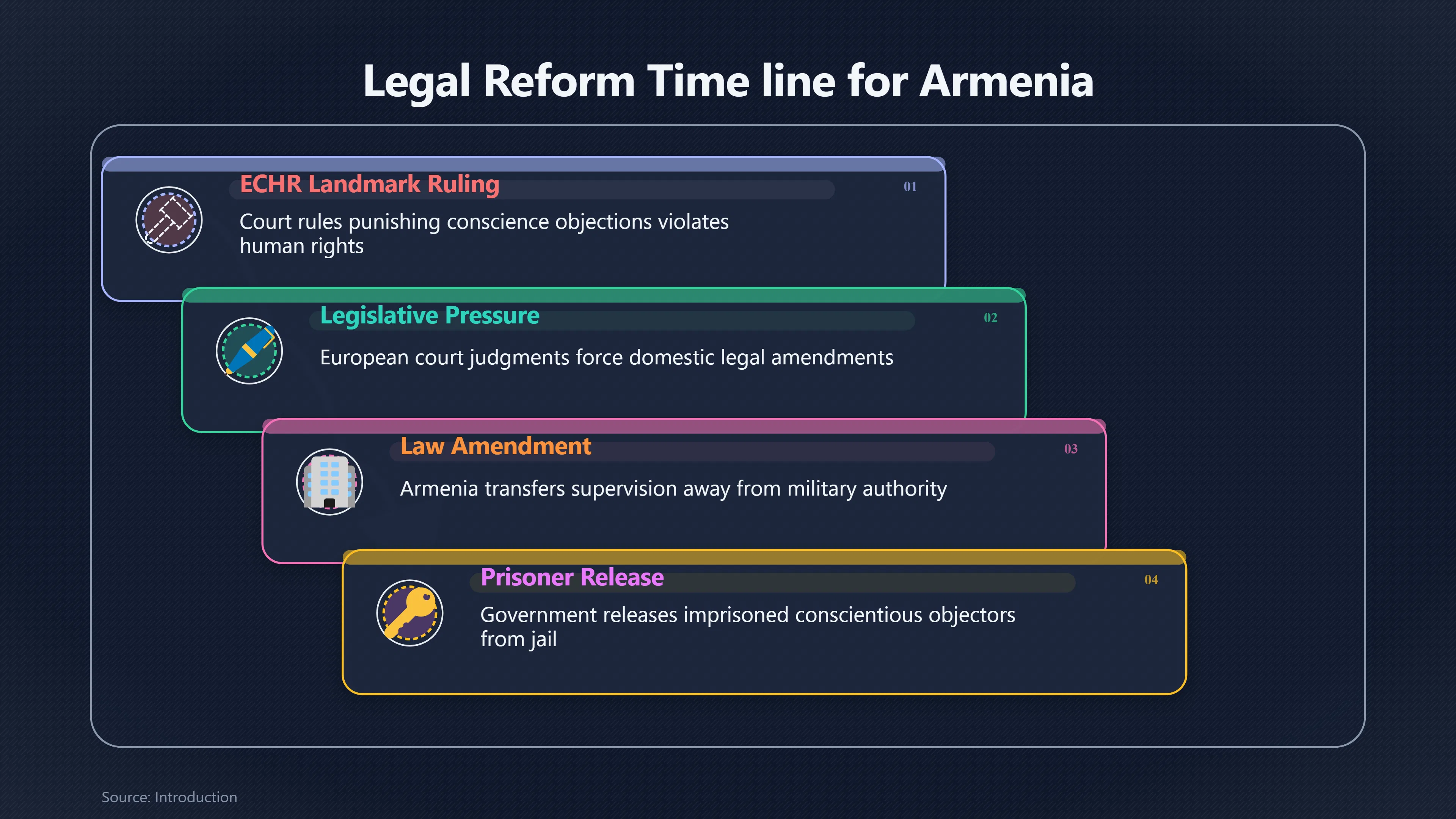
The turning point came through a series of judgments by the European Court of Human Rights, particularly the landmark Bayatyan v. Armenia case. The Court ruled that punishing conscientious objection violated the European Convention on Human Rights because freedom of thought, conscience and religion protected sincere objections to military service.
Subsequent cases examined Armenia’s attempt to create an alternative civilian service. Although legislation existed, early versions remained under military supervision, which many Jehovah’s Witnesses regarded as incompatible with their beliefs. Further European Court judgments concluded that the alternative service was not genuinely civilian.[JW.ORG]jw.orgHow Armenia Came to Recognize the Right to Conscientious ObjectionFebruary 15, 2018…
These rulings placed sustained pressure on Armenia to reform its laws.
In 2013, Armenia amended its alternative service legislation, transferring supervision away from the military. The government subsequently released imprisoned conscientious objectors, and Jehovah’s Witnesses were able to perform civilian alternative service instead of serving prison sentences. International religious freedom reports identified these reforms as a significant improvement in Armenia’s protection of freedom of religion.[ecoi.net]ecoi.netUSDOS – US Department of State (Author): “2013 International Religious Freedom Report - Armenia”, Document #1017357 - ecoi.net…
Did the fears match the evidence?
The sect scare surrounding Jehovah’s Witnesses illustrates the difference between public anxiety and documented evidence.
The movement undoubtedly challenged widely held assumptions about religion and citizenship. Its rejection of military service and active evangelism created genuine social and political disagreements in a country where national defence and the Armenian Apostolic Church occupy unusually prominent places.
However, independent investigations by Amnesty International, the US Department of State and other international observers did not find evidence that Jehovah’s Witnesses constituted a violent or subversive organisation. Instead, their reports focused on discrimination, imprisonment of conscientious objectors, media hostility and occasional physical attacks against members.[amnesty.org]amnesty.orgAmnesty InternationalArmenia: Fear of the freedom of conscience and religion: violations of the rights of Jehovah's Witnesses - Amnesty I…
This does not mean every criticism of Jehovah’s Witnesses was unfounded. Like the organisation in many countries, it has been criticised over internal disciplinary practices, treatment of former members and other religious policies. Those debates exist independently of Armenia’s post-Soviet sect scare and should not be confused with claims that the movement threatened national security.
The evidence suggests that many of the strongest public fears in Armenia reflected broader anxieties about foreign influence and national identity rather than demonstrable criminal activity by the religious community itself.

Why the episode remains significant
Armenia’s experience shows how quickly unfamiliar religious movements can become symbols of wider social fears.
Jehovah’s Witnesses became a focal point because they stood at the intersection of several sensitive questions:
- What defines Armenian national identity?
- Can religious minorities reject military service while remaining loyal citizens?
- Should a historic national church enjoy special protection?
- How should international human rights standards interact with domestic traditions?
The eventual legal reforms did not eliminate social suspicion towards minority religions, but they marked an important shift from treating conscientious objection primarily as a security problem towards recognising it as a protected human right.
For historians of moral panics, the Armenian sect scare demonstrates that collective fear often grows less from spectacular incidents than from ordinary practices—door-to-door preaching, religious conversion and refusal of military service—that become invested with much larger symbolic meaning during periods of national uncertainty.
Amazon book picks
Further Reading
Books and field guides related to Why Did Armenia Fear Foreign Sects?. Use these as the next step if you want deeper reading beyond the article.


Cults in Our Midst
First published 1995. Subjects: Brainwashing, Controversial literature, Cults, Persuasion (Psychology), Psychology.
Endnotes
1.
Source: ecoi.net
Link:https://www.ecoi.net/en/document/2091908.html
Source snippet
USDOS – US Department of State (Author): “2022 Report on International Religious Freedom: Armenia”, Document #2091908 - ecoi.netMay 15, 2023...
Published: May 15, 2023
2.
Source: ecoi.net
Link:https://www.ecoi.net/en/document/1180654.html
Source snippet
USDOS – US Department of State (Author): “2012 International Religious Freedom Report - Armenia”, Document #1180654 - ecoi.net...
3.
Source: ecoi.net
Link:https://www.ecoi.net/en/document/1017357.html
Source snippet
USDOS – US Department of State (Author): “2013 International Religious Freedom Report - Armenia”, Document #1017357 - ecoi.net...
4.
Source: 2001-2009.state.gov
Link:https://2001-2009.state.gov/g/drl/rls/irf/2007/90162.htm
Source snippet
State.govArmenia...
5.
Source: amnesty.org
Link:https://www.amnesty.org/en/documents/eur54/006/1999/en/
Source snippet
Amnesty InternationalArmenia: "Respect my human dignity": Imprisonment of conscientious objectors - Amnesty InternationalAugust 31, 1999...
Published: August 31, 1999
6.
Source: amnesty.org
Link:https://www.amnesty.org/en/documents/eur54/001/2008/en/
Source snippet
Amnesty InternationalArmenia: Fear of the freedom of conscience and religion: violations of the rights of Jehovah's Witnesses - Amnesty I...
7.
Source: jw.org
Title: How Armenia Came to Recognize the Right to Conscientious Objection
Link:https://www.jw.org/en/news/region/armenia/recognize-right-to-conscientious-objection/
Source snippet
February 15, 2018...
Published: February 15, 2018
8.
Source: jw.org
Title: Legal & Human Rights Facts: Jehovah’s Witnesses in Armenia | JW.OR G
Link:https://www.jw.org/en/news/region/armenia/jehovah-witness-facts/
9.
Source: ecoi.net
Link:https://www.ecoi.net/en/document/2031192.html
10.
Source: ecoi.net
Link:https://www.ecoi.net/en/document/1436783.html
11.
Source: jw.org
Title: ECH R Orders Armenia to Pay Damages to 17 Jehovah’s Witnesses
Link:https://www.jw.org/en/news/region/armenia/ordered-to-pay-damages/
12.
Source: ecoi.net
Link:https://www.ecoi.net/de/dokument/1142122.html
13.
Source: amnesty.org
Title: Landmark ECHR ruling recognizes right to conscientious objection
Link:https://www.amnesty.org/en/latest/news/2011/07/landmark-echr-ruling-recognizes-right-conscientious-objection/
14.
Source: amnesty.org
Link:https://www.amnesty.org/fr/documents/eur54/001/2008/en/
15.
Source: amnesty.org
Link:https://www.amnesty.org/zh-hant/documents/eur54/001/2008/en/
Additional References
16.
Source: uscirf.gov
Title: releases report persecution jehovahs witnesses
Link:https://www.uscirf.gov/news-room/releases-statements/uscirf-releases-report-persecution-jehovahs-witnesses
Source snippet
USCIRF Releases Report on Persecution of Jehovah’s Witnesses | USCIRFNovember 22, 2024 — USCIRF RELEASES REPORT ON PERSECUTION OF JEHOVAH...
Published: November 22, 2024
17.
Source: youtube.com
Link:http://www.youtube.com/watch?v=jWfpp5WD6Ys
Source snippet
Religious sects on the territory of the former Soviet Union...
18.
Source: youtube.com
Title: Court upholds ban on religious sect
Link:http://www.youtube.com/watch?v=8OWTKgIjiuY
Source snippet
Jehovah's Witnesses Armenia human rights conscientious objection Armenia's conscientious objector- Jehovah's Witnesses who are in prison...
19.
Source: youtube.com
Title: Global News: Armenia Releases Conscientious Objectors
Link:http://www.youtube.com/watch?v=q4gN4b6pI8k
Source snippet
Public uncertainty remains over Jehovah's Witnesses' conscientious objection of military service...
20.
Source: youtube.com
Title: Armenia’s conscientious objector- Jehovah’s Witnesses who are in prison
Link:http://www.youtube.com/watch?v=_2zOacocVJE
Source snippet
Global News: Armenia Releases Conscientious Objectors...
21.
Source: uscirf.gov
Link:https://www.uscirf.gov/publications/religious-freedom-challenges-jehovahs-witnesses
22.
Source: usa.gov
Link:https://www.usa.gov/agencies/u-s-commission-on-international-religious-freedom
23.
Source: refworld.org
Link:https://www.refworld.org/reference/countryrep/amnesty/2008/50870
24.
Source: amnesty.org.uk
Title: armenia jehovahs witnesses abused and discriminated against their beliefs
Link:https://www.amnesty.org.uk/knowledge-hub/all-resources/armenia-jehovahs-witnesses-abused-and-discriminated-against-their-beliefs/
25.
Source: youtube.com
Title: Religious sects on the territory of the former Soviet Union
Link:http://www.youtube.com/watch?v=FmOXG_eS6v4
Source snippet
Court upholds ban on religious sect...
Topic Tree