Within Sweden's Scares
Did Dark Games and Music Really Threaten Sweden?
Dark music, occult imagery and fantasy games were often treated as signs of hidden criminal networks rather than youth culture or fiction.
On this page
- Why Satan became a symbol of youth anxiety
- Heavy metal, vandalism and imagined secret networks
- Role playing games and the moral panic media cycle
Page outline Jump by section
Introduction
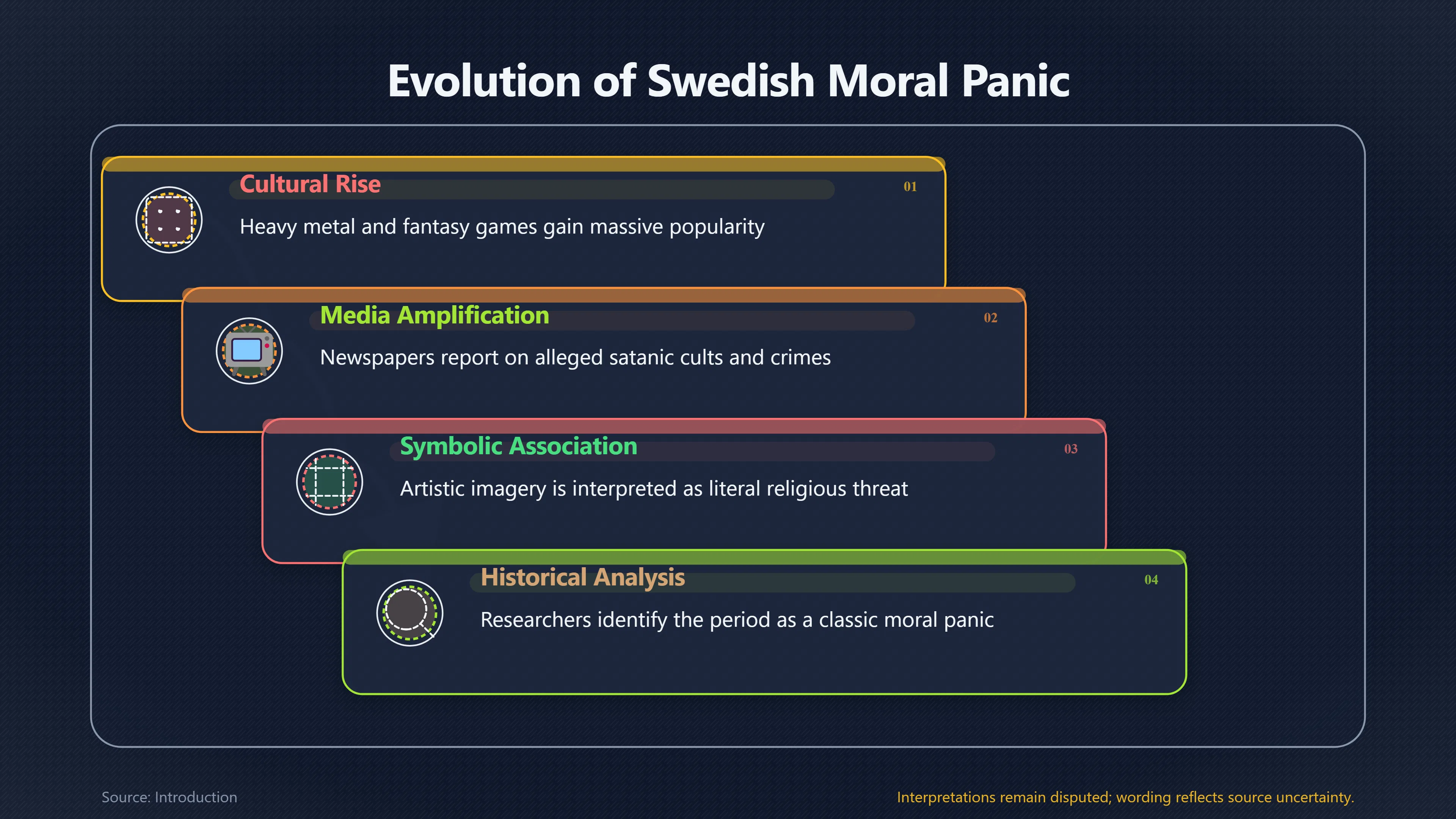
During the late twentieth century, Sweden experienced a series of anxieties about youth culture that echoed the wider Western “satanic panic” without reaching the same scale as in the United States. Heavy metal music, occult imagery and fantasy role-playing games were repeatedly presented by some campaigners, religious groups and sections of the media as gateways to Satanism, violence or secret criminal networks. A handful of genuine crimes involving young people, together with sensational reporting, encouraged the impression that hidden satanic organisations were recruiting through music or games. Later research has found little evidence for such organised networks. Instead, historians and sociologists generally interpret these episodes as moral panics in which real concerns about adolescent wellbeing became entangled with exaggerated claims about popular culture and the occult.[history.com]history.comwhat was satanic panic 1980sWhat Sparked the Satanic Panic of the 1980s? | HISTORYNovember 13, 2025…
Why Satan became a symbol of youth anxiety
By the 1980s, Sweden had become one of Europe’s strongest heavy metal countries, while fantasy literature, horror films and tabletop role-playing games were attracting large numbers of young people. To many teenagers these interests represented imagination, rebellion and identity. To some parents, teachers and religious activists, however, the same symbols appeared mysterious and threatening.
This anxiety did not emerge in isolation. International media carried stories about alleged satanic cults, ritual abuse and hidden messages in heavy metal music. Swedish newspapers and television reported many of these claims, often alongside domestic concerns about youth violence, drug use and changing family life. Although Sweden developed its own debates, many of the fears were imported from the broader English-speaking satanic panic rather than arising from evidence of organised satanic crime within Sweden itself.[HISTORY]history.comwhat was satanic panic 1980sWhat Sparked the Satanic Panic of the 1980s? | HISTORYNovember 13, 2025…
The figure of Satan functioned less as a description of an actual movement than as a symbol of wider fears. Dark clothing, inverted crosses, fantasy artwork and horror themes became visual shorthand for perceived moral decline, even when participants understood them primarily as artistic or fictional expressions.
Heavy metal, vandalism and imagined secret networks
Swedish heavy metal developed a reputation for theatrical darkness, particularly within death metal and later black metal. Album covers, lyrics and stage imagery frequently used religious or occult symbolism intended to shock, entertain or establish a distinctive artistic identity. Critics sometimes interpreted these images literally.
The emergence of Norwegian black metal in the early 1990s complicated the picture. Church burnings and several notorious violent crimes committed by individuals within parts of the Norwegian scene received enormous international attention. Because Scandinavian music scenes were closely connected, Swedish metal musicians and fans sometimes found themselves viewed through the same lens, despite Sweden not experiencing a comparable wave of organised church attacks. The crimes were real, but assumptions that heavy metal culture as a whole concealed extensive satanic conspiracies went far beyond the available evidence.[Reddit]reddit.comDid this antagonism originate within the metal subculture, or did it have roots in other movements of the time?June 25, 2022…
Media reporting occasionally blurred several distinct issues:
- artistic use of satanic imagery;
- individual fascination with occult ideas;
- isolated acts of vandalism or violence;
- claims of organised satanic networks.
These categories often became merged in public discussion. Someone listening to extreme metal or wearing occult symbols could be portrayed as evidence of wider conspiracies, despite investigators producing little support for claims of coordinated underground organisations.
Researchers studying moral panics note that such episodes often create a “folk devil”—a visible group onto which broader social anxieties are projected. In Sweden, metal fans periodically occupied that role, particularly when shocking crimes demanded simple explanations.[Cambridge University Press & Assessment]cambridge.orgBy Joseph P. Laycock. Oakland: University of California Press, 2015. xiv + 349 pp. $29.95 paper. | Church History | Cambridge Core…
Role-playing games and the moral-panic media cycle
The most distinctive Swedish controversy centred on tabletop role-playing games rather than music alone.
Beginning in the 1980s, games such as Drakar och Demoner introduced hundreds of thousands of Swedish teenagers to collaborative fantasy storytelling. Players created fictional characters, rolled dice and invented adventures together. For participants, the attraction lay in creativity, friendship and shared imagination rather than belief in magic or occult practices.[Polygon]polygon.comhelldivers 2 inspired by dnd dragonbane free leagueInitially launched in 1982 by Target Games, Drakar och Demoner utilized the Basic Role-Playing system from Chaosium, the publisher of Cal…
Public concern intensified during the early 1990s, particularly after the publication of darker horror-themed games such as Kult. Unlike traditional fantasy games, Kult deliberately used disturbing religious and occult imagery, making it an obvious target for critics.
Religious publications and some newspapers warned that these games promoted Satanism or psychological harm. Following a widely reported murder in Bjuv involving a young person who had participated in role-playing games, some reporting implied a connection between fantasy gaming and real violence. Although the crime itself was genuine, broader claims that role-playing games caused murder or recruited players into satanic movements rested largely on association rather than demonstrated causation.[SVT Nyheter]svt.seNyheter Rollspelsvågen – bland magi och moralpanik | SVT NyheterSVT NyheterRollspelsvågen – bland magi och moralpanik | SVT Nyheter…
Swedish television retrospectives and later historical research describe this period as a classic media-driven moral panic. Coverage frequently relied on dramatic imagery—pentagrams, demons and horror artwork—that encouraged audiences to confuse fictional game settings with players’ beliefs or behaviour.[SVT Nyheter]svt.seNyheter Rollspelsvågen – bland magi och moralpanik | SVT NyheterSVT NyheterRollspelsvågen – bland magi och moralpanik | SVT Nyheter…
Why the fears spread so easily
Several factors made these stories persuasive despite limited supporting evidence.
First, fantasy role-playing remained unfamiliar to much of the adult population. Outsiders often misunderstood collaborative storytelling as psychological immersion or occult practice rather than a structured game.
Second, the visual language of heavy metal and games such as Kult intentionally borrowed from religious imagery. Pentagrams, demons and apocalyptic themes generated publicity but also reinforced fears among those already worried about Satanism.
Third, highly publicised crimes encouraged retrospective pattern-seeking. Once a suspect was found to enjoy heavy metal or role-playing games, those hobbies received disproportionate attention even though similar interests were widespread among peaceful young people.
Finally, Swedish reporting formed part of a wider international cycle. Claims first circulated abroad were adapted to domestic circumstances, creating the impression that Sweden faced the same hidden threat described elsewhere.[history.com]history.comwhat was satanic panic 1980sWhat Sparked the Satanic Panic of the 1980s? | HISTORYNovember 13, 2025…
What later evidence showed
Subsequent scholarship has found strong evidence that Sweden experienced a genuine moral panic surrounding role-playing games during the 1980s and 1990s. Newspaper analysis shows recurring themes familiar from other moral panics: exaggeration of isolated incidents, warnings from self-appointed experts, symbolic “folk devils” and repeated assumptions that fantasy blurred into reality.[sh.diva-portal.org]sh.diva-portal.orgOpen source on diva-portal.org.
What researchers have not found is convincing evidence that heavy metal culture or tabletop role-playing served as recruiting mechanisms for extensive satanic criminal organisations. Individuals interested in occult beliefs certainly existed, as they have in many societies, but claims of widespread secret networks influencing Swedish youth were not substantiated.
Modern studies of game-related moral panics argue that periods of social uncertainty often encourage adults to attribute complex problems to unfamiliar forms of entertainment. The games or music become symbols through which broader anxieties about childhood, authority and cultural change are expressed.[ssrn.com]papers.ssrn.comSSRN Moral Panic over Games is about Trauma, Not Games by David Widerberg, Muhammed Zia:: SSRNOctober 27, 2025…
Why these scares still matter
The Swedish debates over Satanism, heavy metal and role-playing games now serve as useful case studies in how moral panics develop without requiring widespread irrational belief or complete fabrication. Real crimes occurred, controversial artistic works existed, and some individuals deliberately cultivated satanic imagery. The panic arose when these separate facts were assembled into a larger narrative about hidden conspiracies that evidence could not sustain.
The episode also illustrates how youth culture repeatedly becomes a testing ground for wider social fears. Earlier generations worried about comic books or rock music; later debates focused on video games and the internet. Sweden’s experience with heavy metal and tabletop role-playing demonstrates how unfamiliar entertainment can become a convenient explanation for troubling events, even when closer investigation points instead to more complex social and individual causes.[diva-portal.org]sh.diva-portal.orgOpen source on diva-portal.org.

Amazon book picks
Further Reading
Books and field guides related to Did Dark Games and Music Really Threaten Sweden?. Use these as the next step if you want deeper reading beyond the article.
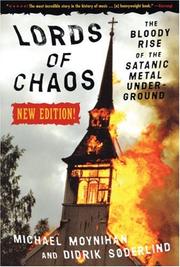
Lords of chaos
Covers the real crimes and myths surrounding Scandinavian metal culture.
Endnotes
1.
Source: history.com
Title: what was satanic panic 1980s
Link:https://www.history.com/articles/what-was-satanic-panic-1980s
Source snippet
What Sparked the Satanic Panic of the 1980s? | HISTORYNovember 13, 2025...
Published: November 13, 2025
2.
Source: sh.diva-portal.org
Link:https://sh.diva-portal.org/smash/get/diva2%3A2072377/FULLTEXT01.pdf
3.
Source: cambridge.org
Link:https://www.cambridge.org/core/journals/church-history/article/dangerous-games-what-the-moral-panic-over-roleplaying-games-says-about-play-religion-and-imagined-worlds-by-joseph-p-laycock-oakland-university-of-california-press-2015-xiv-349-pp-2995-paper/F0091BA73B60AABD4E0F08EC21207C68
Source snippet
By Joseph P. Laycock. Oakland: University of California Press, 2015. xiv + 349 pp. $29.95 paper. | Church History | Cambridge Core...
4.
Source: reddit.com
Link:https://www.reddit.com/r/AskHistorians/comments/vke6wh
Source snippet
Did this antagonism originate within the metal subculture, or did it have roots in other movements of the time?June 25, 2022...
Published: June 25, 2022
5.
Source: polygon.com
Title: helldivers 2 inspired by dnd dragonbane free league
Link:https://www.polygon.com/tabletop-games/497774/helldivers-2-inspired-by-dnd-dragonbane-free-league
Source snippet
Initially launched in 1982 by Target Games, Drakar och Demoner utilized the Basic Role-Playing system from Chaosium, the publisher of Cal...
6.
Source: svt.se
Title: Nyheter Rollspelsvågen – bland magi och moralpanik | SVT Nyheter
Link:https://www.svt.se/kultur/rollspelsvagen
Source snippet
SVT NyheterRollspelsvågen – bland magi och moralpanik | SVT Nyheter...
7.
Source: papers.ssrn.com
Link:https://papers.ssrn.com/sol3/papers.cfm?abstract_id=5685803
Source snippet
SSRN<p>Moral Panic over Games is about Trauma, Not Games</p> by David Widerberg, Muhammed Zia:: SSRNOctober 27, 2025...
Published: October 27, 2025
Additional References
8.
Source: youtube.com
Title: Storm Of Damnation
Link:https://www.youtube.com/watch?v=olLq6PorOuQ
Source snippet
The 3 Waves of the RPG Moral Panic - RPG History...
9.
Source: youtube.com
Title: The 3 Waves of the RPG Moral Panic
Link:https://www.youtube.com/watch?v=OpjV-melB-c
Source snippet
Satanic Panic and the PMRC War on Heavy Metal...
10.
Source: youtube.com
Title: We need to talk about Swedish TTRPGs
Link:https://www.youtube.com/watch?v=GVASRMumGjI
Source snippet
Storm Of Damnation - The Story Of Bathory Documentary...
11.
Source: youtube.com
Title: Satanic Panic and the PMRC War on Heavy Metal
Link:https://www.youtube.com/watch?v=6iPiDcBAAJA
Source snippet
Why The Satanic Panic Hit D&D... Books...
12.
Source: youtube.com
Link:https://www.youtube.com/watch?v=p7H1S8gRxE0
Topic Tree