When Belief Became a Threat to Armenia
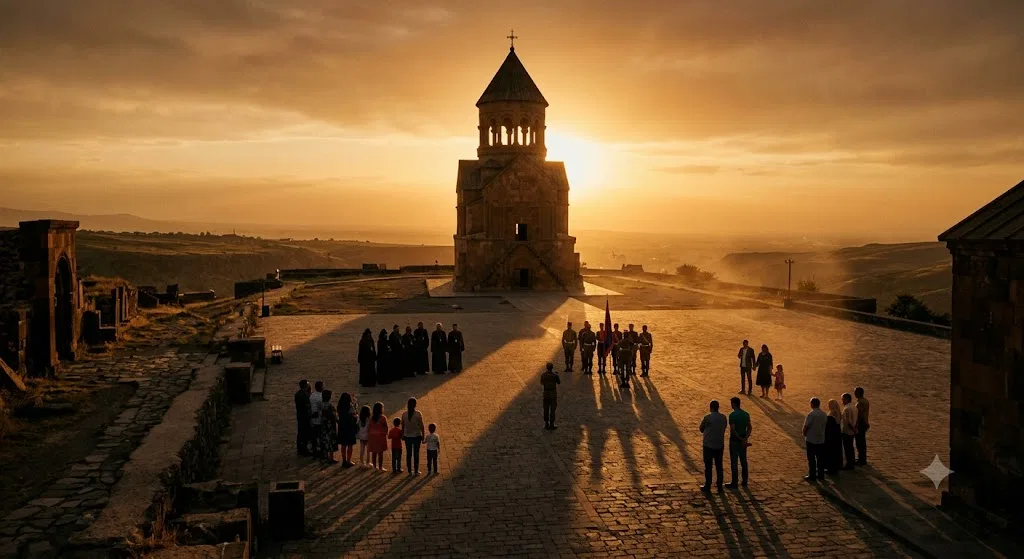
Armenia’s history of collective fear is not dominated by a single famous “mass hysteria” episode. Its strongest documented pattern is different: religious difference repeatedly became entangled with fears about national survival, foreign influence and political disloyalty.
Page outline Jump by section
Introduction
These episodes should not all be called hysteria. They include real political conflicts, state repression, moral panics, propaganda campaigns and the circulation of emotionally compelling stories. What connects them is the process by which a disputed belief or unfamiliar group becomes imagined as a threat to the whole community. Armenia is especially revealing because the Armenian Apostolic Church is not merely a religious institution: for many people it is also a symbol of historical continuity, cultural survival and nationhood.[Pew Research Center]pewresearch.orgOpen source on pewresearch.org.
When heresy became a national and political threat
The Paulicians and Tondrakians, religious movements that arose in or around medieval Armenia, are the earliest major examples of this pattern. They rejected at least some doctrines, rituals and institutional claims upheld by established Armenian and Byzantine churches. Yet almost everything known about them comes from clerics and chroniclers who opposed them. Their own writings, sacred places and material culture were frequently destroyed, leaving historians dependent on sources written to condemn them.[Ceræ Journal]ceraejournal.comCeræ JournalCeræ Journal
This makes the familiar picture of secretive, depraved or dangerously dualist heretics difficult to accept at face value. Scholars continue to debate whether the Paulicians formed one coherent movement, whether their theology was truly dualist and how much their beliefs changed across time and place. Some may have considered themselves reforming Christians who were recovering a purer faith rather than founding a separate religion. Modern research therefore places quotation marks around “heretic” because it was a judgement imposed by religious authorities, not a neutral description.[gnosis.study]gnosis.studyThe PauliciansThe Paulicians. Heresy, Persecution and Warfare on the. Byzantine Frontier, c.750– 880. By. Carl Dixon. Page 4. Typeface fo…
What began as doctrinal condemnation became political violence. Leaders were executed, followers were dispossessed or deported, and communities were subjected to military campaigns. Paulician resistance eventually acquired an armed and territorial dimension along the Byzantine frontier, which gave imperial authorities a genuine security problem. But the conflict also became circular: persecution encouraged rebellion and alliance with imperial enemies, while that rebellion was then used as proof that the movement had always been treacherous.[Ceræ Journal]ceraejournal.comCeræ Journal
The Tondrakians were similarly remembered through accusations of religious subversion and social disorder. Their reported rejection of church authority, sacraments and clerical privilege made them threatening not only as believers but as critics of an established hierarchy. Some interpretations have presented them as a movement of poorer or marginalised people, although the surviving evidence is too one-sided to reconstruct a simple class revolt. The central lesson is clearer: labels such as heretic, sectarian and traitor blurred together, turning theological disagreement into an imagined danger to public order.
This was not a witch panic in the early-modern European sense. Armenia did not develop the same large, judicially organised pattern of witch trials seen in parts of Germany, Scotland or New England. Its better-documented persecutions focused on heterodox religious communities rather than an epidemic of accusations that neighbours were secretly using magic. Claims about Armenian “cults” in the medieval period must therefore be separated from later folklore and from modern attempts to project the European witch-hunt model onto a different history.
Soviet atheism and the campaign against belief
After Armenia was incorporated into the Soviet Union, the main institutional threat was redefined. The Bolshevik state regarded organised religion as an ideological rival and moved against the Armenian Apostolic Church through confiscation of property, anti-religious propaganda, surveillance and repression of clergy. Academic studies describe the severe weakening of the Church during the 1920s and 1930s, when religious institutions were stripped of resources and public atheism became part of state-building.[georgefox.edu]digitalcommons.georgefox.eduSoviet Armenia and the Armenian Apostolic Churchby CS Calian · 1982 · Cited by 2 — took place under the leadership of Gregory the Parthia…
This was not a spontaneous public panic. It was an organised campaign from above, supported by political doctrine and the coercive power of the state. Nevertheless, it used mechanisms familiar from moral panics. Religion was presented not merely as mistaken but as socially contaminating: a survival of ignorance, an obstacle to modernity and a potential source of counter-revolutionary loyalty. Newspapers, books, education, radio and cinema helped establish the model citizen as rational, scientific and atheist, while believers could be portrayed as backward or politically suspect.[wisdomperiodical.com]wisdomperiodical.comArmenian Apostolic Church Under Bolshevik Ideological and…25 Jun 2021 — This article presents the ideological controversies that arose…
The campaign also shows why public conformity should not be mistaken for the disappearance of belief. Religious practice continued in homes, families, pilgrimages and local customs even when public institutions were restricted. The eventual revival of the Armenian Church during the late Soviet period and after 1991 revealed that religious belonging had survived decades of official atheism.[academia.edu]academia.eduOpen source on academia.edu.
The Soviet experience left a lasting contradiction. State repression helped strengthen the later idea that the Armenian Church had preserved the nation against an alien political system. When religious freedom returned, that memory encouraged broad support for the historic Church—but it could also make unfamiliar religious movements appear to be another foreign intrusion.
The post-Soviet fear of “sects”
The collapse of Soviet rule opened Armenia to missionaries, evangelical churches and other religious organisations that had previously been absent, underground or tightly controlled. Some Armenians welcomed this as freedom of conscience. Others interpreted it as a spiritual invasion arriving during a period of war, economic hardship, migration and institutional uncertainty.
Jehovah’s Witnesses became the most persistent target. Their public preaching, rejection of military service and distance from the Armenian Apostolic tradition made them highly visible. In a society where military defence and national survival carried enormous emotional weight, conscientious objection could be interpreted not simply as a religious practice but as disloyalty. Officials, clerics and sections of the media repeatedly used language suggesting that Witnesses were dangerous, anti-national or controlled from abroad. Research on post-Soviet Armenia describes a self-reinforcing cycle in which public hostility encouraged official pressure, and official pressure appeared to confirm that the group was genuinely threatening.[escholarship.org]escholarship.orge Scholarship Jehovah's Witnesses in Post-Soviet Armeniae Scholarship Jehovah's Witnesses in Post-Soviet Armenia
The word “sect” performed much of the work. In ordinary usage it did not merely mean a smaller religious organisation. It suggested manipulation, family breakdown, financial exploitation, brainwashing or national betrayal, often without evidence that a particular group had committed such abuses. Human-rights researchers noted public calls to “fight” sects in schools and neighbourhoods, even though “sect” had no precise legal meaning.[OSCE]cdn.osce.orgOpen source on osce.org.
The fear was not wholly invented. Rapid social change can produce exploitative organisations, aggressive proselytising and genuine disputes within families. Religious freedom does not exempt any institution from laws against fraud, abuse or coercion. The moral-panic problem begins when evidence about specific conduct is replaced by assumptions about an entire minority. A group’s foreign origins, unusual theology or refusal to follow majority customs are not themselves proof of psychological control.
The European Court of Human Rights became important in separating demonstrable conduct from hostile labelling. Armenia faced repeated legal challenges concerning conscientious objectors and the treatment or registration of Jehovah’s Witness organisations. Court decisions helped push the country towards a genuinely civilian alternative to military service and rejected official arguments that treated the denomination’s beliefs as inherently illegitimate.[HUDOC]hudoc.echr.coe.intOpen source on coe.int.
Other evangelical groups, including the Word of Life Church, were also called “sects” in political and media debate. A 2021 religious-freedom report recorded a politician applying that label to both Word of Life and Jehovah’s Witnesses, although neither organisation used it for itself. Studies of Armenian online speech found that negative claims about religious minorities were often repeated more readily than neutral information, allowing association and insinuation to substitute for verification.[U.S. Department of State]2021-2025.state.govOpen source on state.gov.
Why the scare was so persuasive
The post-Soviet “sect” panic gained force because several genuine pressures converged.
Religion and national belonging were closely linked. Across post-communist Eastern Europe, religious identity often returned more quickly than regular religious practice. Pew Research described a pattern of “believing and belonging, without behaving”: people may rarely attend worship yet still regard a historic church as central to who they are. In Armenia, where Christianity is woven into narratives of survival, minority conversion can therefore be experienced by relatives or neighbours as departure from the nation rather than merely a personal choice.[Pew Research Center]pewresearch.orgOpen source on pewresearch.org.
War intensified suspicion of pacifist groups. Armenia’s security environment made military service a powerful test of citizenship. Jehovah’s Witness conscientious objectors were consequently vulnerable to the claim that their beliefs weakened national defence, even though international human-rights law protects conscientious objection.
Economic insecurity encouraged rumours about conversion. Stories circulated that foreign churches paid poor Armenians to join. Such claims were difficult to verify but emotionally effective because they transformed conversion into evidence of exploitation: converts were imagined as victims who had sold their identity under pressure.
The Church had recently emerged from persecution. After Soviet repression, efforts to restore the Armenian Apostolic Church could easily be framed as a national recovery project. Competition from missionary churches then appeared not as normal religious pluralism but as an attempt to interrupt that recovery.
These pressures explain the appeal of the panic without proving its claims. Sociologically, a moral panic does not require that every fear be false. It occurs when a person or group becomes a simplified symbol of much wider anxieties and when the response becomes disproportionate, generalised or detached from verified harm.
Earthquake, miracle and a story too good to be true
Armenia’s 1988 earthquake produced another kind of contagious belief: the inspirational disaster story. The earthquake killed more than 25,000 people and left hundreds of thousands injured, displaced or without basic necessities. During the international rescue effort, Soviet and foreign media reported that six men had survived for more than a month beneath the ruins of Leninakan by eating preserved food and telling stories to keep up their spirits. The tale became known as the “Leninakan miracle”.[RadioFreeEurope/RadioLiberty]rferl.orgOpen source on rferl.org.
It was fabricated by a journalist who reportedly wanted to restore international attention to Armenia after other world events had displaced the disaster from the headlines. The story spread through the Soviet news agency TASS and was repeated internationally before its falsehood was established.[RadioFreeEurope/RadioLiberty]rferl.orgOpen source on rferl.org.
This was not a religious apparition or a case of mass psychogenic illness. Nor was the audience irrational for believing a report distributed by established news organisations during a chaotic rescue operation. Its importance lies in how easily a hopeful narrative can bypass scepticism when it supplies what a distressed public needs: survival, dignity and meaning amid incomprehensible loss.
The hoax also illustrates why “collective delusion” can be a misleading phrase. Most readers did not independently imagine the same event. They trusted an apparently authoritative report that was then validated by repetition. The mechanism was institutional amplification, not a shared mental disorder.
How to read Armenia’s panic history
Armenia’s record is best understood by distinguishing several phenomena that are too often collapsed into the word “hysteria”.
A persecution uses power against a defined population. The campaigns against medieval dissident Christians and the Soviet repression of the Armenian Church belong primarily in this category.
A moral panic turns a group into a symbol of broader social danger. Post-Soviet fears of “sects” often followed this pattern, especially when minority beliefs were treated as proof of foreign control or treason.
A rumour cascade occurs when an uncertain claim gains credibility through repetition. The Leninakan survival story is a particularly clear example because its route from fabrication to global news can be reconstructed.
Mass psychogenic illness is different again: it involves real bodily symptoms spreading through a group without an identified toxic or infectious cause, usually amid anxiety. No comparably famous, thoroughly documented Armenian episode currently anchors the country’s public history in the way school fainting outbreaks do elsewhere. It would therefore be misleading to force Armenia’s religious and political conflicts into a medical category.
The most durable Armenian pattern is the fear that hidden belief masks hidden allegiance. Medieval heretics were suspected of threatening church and empire; Soviet officials treated faith as concealed opposition; post-Soviet activists portrayed minority churches as agents of foreign influence. In each period, unfamiliar belief became easier to condemn once it was described as an organised assault on the community.
That history matters because Armenia has repeatedly faced genuine existential dangers. Precisely for that reason, claims about betrayal, contamination and secret control have unusual emotional power. The responsible response is not to dismiss every fear as fantasy, but to ask what evidence shows: who made the accusation, what conduct was actually documented, whether the accused could answer, and whether the reaction targeted harm or merely difference.
Amazon book picks
Further Reading
Books and field guides related to When Belief Became a Threat to Armenia. Use these as the next step if you want deeper reading beyond the article.
The Demon-Haunted World
Broad background on extraordinary claims and critical inquiry.
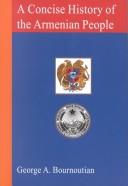
A Concise History of the Armenian People
Provides essential historical context for religion and identity in Armenia.
Endnotes
1.
Source: state.gov
Link:https://www.state.gov/reports/2023-report-on-international-religious-freedom/armenia
Source snippet
State Department2023 Report on International Religious Freedom: ArmeniaAccording to the 2022 census, approximately 97.5 percent of the po...
2.
Source: ceraejournal.com
Title: Ceræ Journal
Link:https://ceraejournal.com/wp-content/uploads/2023/01/8.-Vol.-9-Cartledge-Griffin-pp.-235-271-1.pdf
3.
Source: gnosis.study
Link:https://gnosis.study/library/%D0%94%D1%80%D1%83%D0%B3%D0%B8%D0%B5%20%D1%83%D1%87%D0%B5%D0%BD%D0%B8%D1%8F/%D0%9F%D0%B0%D0%B2%D0%BB%D0%B8%D0%BA%D0%B8%D0%B0%D0%BD%D0%B5/%D0%9A%D0%BD%D0%B8%D0%B3%D0%B8/ENG/Dixon%20C.%20-%20The%20Paulicians.%20Heresy%2C%20Persecution%20and%20Warfare%20on%20the%20Byzantine%20Frontier%2C%20c.750-880.pdf
Source snippet
The PauliciansThe Paulicians. Heresy, Persecution and Warfare on the. Byzantine Frontier, c.750– 880. By. Carl Dixon. Page 4. Typeface fo...
4.
Source: digitalcommons.georgefox.edu
Link:https://digitalcommons.georgefox.edu/cgi/viewcontent.cgi?article=1781&context=ree
Source snippet
Soviet Armenia and the Armenian Apostolic Churchby CS Calian · 1982 · Cited by 2 — took place under the leadership of Gregory the Parthia...
5.
Source: wisdomperiodical.com
Link:https://wisdomperiodical.com/index.php/wisdom/article/view/539
Source snippet
Armenian Apostolic Church Under Bolshevik Ideological and...25 Jun 2021 — This article presents the ideological controversies that arose...
6.
Source: academia.edu
Link:https://www.academia.edu/7943635/The_Armenian_Apostolic_Church_and_Vernacular_Christianity_in_Soviet_Armenia
7.
Source: books.openedition.org
Link:https://books.openedition.org/ifeagd/1563?lang=en
8.
Source: escholarship.org
Title: e Scholarship Jehovah’s Witnesses in Post-Soviet Armenia
Link:https://escholarship.org/content/qt1jn618pr/qt1jn618pr_noSplash_8a79ea5d6e216cea4fa2e66f01c0e8df.pdf?t=rvmgiu
9.
Source: oc-media.org
Title: armenias jehovahs witnesses enemies of the state
Link:https://oc-media.org/armenias-jehovahs-witnesses-enemies-of-the-state/
10.
Source: cdn.osce.org
Link:https://cdn.osce.org/sites/default/files/f/documents/4/7/67674.pdf
11.
Source: osce.org
Link:https://www.osce.org/files/f/documents/4/7/67674.pdf
12.
Source: 2021-2025.state.gov
Link:https://2021-2025.state.gov/reports/2021-report-on-international-religious-freedom/armenia/
13.
Source: 2021-2025.state.gov
Link:https://2021-2025.state.gov/report/custom/a8e545a326/
14.
Source: state.gov
Link:https://www.state.gov/report/custom/b5a7ca03ae
15.
Source: state.gov
Link:https://www.state.gov/report/custom/2a6d8d8238
16.
Source: state.gov
Link:https://www.state.gov/report/custom/3894b18c1b
17.
Source: state.gov
Link:https://www.state.gov/report/custom/c5a1b313a4
18.
Source: state.gov
Link:https://www.state.gov/report/custom/3d1c4a33f6/
19.
Source: state.gov
Link:https://www.state.gov/report/custom/e48557d8ce
20.
Source: state.gov
Link:https://www.state.gov/report/custom/3aaf1aaa13
21.
Source: state.gov
Link:https://www.state.gov/report/custom/2fd3c32a6e
22.
Source: 2017-2021.state.gov
Link:https://2017-2021.state.gov/report/custom/02ebc46819/
23.
Source: 2021-2025.state.gov
Link:https://2021-2025.state.gov/report/custom/595918cc4e/
24.
Source: state.gov
Link:https://www.state.gov/report/custom/1485a2df82
25.
Source: state.gov
Link:https://www.state.gov/report/custom/a329948607
26.
Source: academia.edu
Link:https://www.academia.edu/30559904/New_Religious_Movements_Countermovements_Moral_Panics_and_the_Media
27.
Source: academia.edu
Link:https://www.academia.edu/9879584/THE_HYPOSTASIS_OF_THE_WITCHDOCTOR_IN_POST_SOVIET_RUSSIA
28.
Source: academia.edu
Link:https://www.academia.edu/1699916/The_Production_of_Science_and_Religion_in_Ufology_and_UFO_Religious_Movements
29.
Source: academia.edu
Link:https://www.academia.edu/144741841/The_Relevance_of_the_History_of_the_Paulician_and_Tondrakian_Movements_A_Critical_Perspective_on_18th_20th_Century_Armenian_Historiography_In_Armenian_
30.
Source: cejsh.icm.edu.pl
Title: articles 59555432.pdf
Link:https://cejsh.icm.edu.pl/cejsh/element/bwmeta1.element.ojs-doi-10_12775_SDR_2023_EN7_05/c/articles-59555432.pdf.pdf
31.
Source: pewresearch.org
Link:https://www.pewresearch.org/religion/2017/05/10/religious-belief-and-national-belonging-in-central-and-eastern-europe/
32.
Source: ejournals.uni-muenster.de
Link:https://ejournals.uni-muenster.de/index.php/byzrev/article/download/8800/8854/21736
Source snippet
E-Journals MünsterByzRev 07.2025.045A third section of the introduction (pp. 28–53) attempts to define Paulician heresy. It features a br...
33.
Source: hudoc.echr.coe.int
Link:https://hudoc.echr.coe.int/eng?i=001-216366
34.
Source: hudoc.echr.coe.int
Title: HUDOCCASE OF HAMZAYAN v. ARMENIA
Link:https://hudoc.echr.coe.int/?i=001-230705
35.
Source: rferl.org
Link:https://www.rferl.org/a/fake-news-soviet-style-the-armenian-earthquake-rescue-that-was-too-good-to-be-true/29643951.html
36.
Source: facebook.com
Link:https://www.facebook.com/groups/139681107177742/posts/1094459788366531/
37.
Source: Wikipedia
Title: Mass psychogenic illness
Link:https://en.wikipedia.org/wiki/Mass_psychogenic_illness
38.
Source: Wikipedia
Title: Armenian Apostolic Church
Link:https://en.wikipedia.org/wiki/Armenian_Apostolic_Church
39.
Source: pewresearch.org
Link:https://www.pewresearch.org/short-reads/2017/11/03/many-central-and-eastern-europeans-see-link-between-religion-and-national-identity/
40.
Source: coe.int
Link:https://www.coe.int/en/web/minorities/armenia
41.
Source: coe.int
Link:https://www.coe.int/en/web/european-commission-against-racism-and-intolerance/armenia
42.
Source: nationalarchives.gov.uk
Link:https://www.nationalarchives.gov.uk/education/resources/early-modern-witch-trials/
Additional References
43.
Source: youtube.com
Link:https://www.youtube.com/watch?v=s_75QK3WEIM
Source snippet
Aslamazyan PHOENIX #5: Sects in Armenia, children of the new consciousness, the Indigo generation...
44.
Source: banber.matenadaran.am
Link:https://banber.matenadaran.am/ftp/data/Banber21/20.J.Osiecki.pdf
Source snippet
Բանբեր Մատենադարանիjakub osiecki contexts regarding antireligious propaganda...In general, real persecutions and real struggle with the...
45.
Source: youtube.com
Link:https://www.youtube.com/watch?v=3zpcVRwk3no
Source snippet
What is Paulicianism: The Untold Story of Medieval 'Good Christians' and Their Struggle...
46.
Source: youtube.com
Link:https://www.youtube.com/watch?v=9peYaMcHh2U
Source snippet
Why Armenians Rejected Chalcedon / Disruptive Modern Sects...
47.
Source: uscirf.gov
Link:https://www.uscirf.gov/sites/default/files/2025-08/2025%20Turkmenistan%20Country%20Update%20Final.pdf
48.
Source: uscirf.gov
Link:https://www.uscirf.gov/sites/default/files/2021-09/2021%20Factsheet%20-%20Destruction%20of%20Cemeteries_0.pdf
49.
Source: researchgate.net
Link:https://www.researchgate.net/publication/268694182_Outbreak_of_Mass_Psychogenic_Illness_at_a_High_School_Amhara_Region_Ethiopia_April_2010
50.
Source: researchgate.net
Link:https://www.researchgate.net/publication/264195362_The_Armenian_Apostolic_Church_and_Vernacular_Christianity_in_Soviet_Armenia
51.
Source: hzf.lu.lv
Link:https://www.hzf.lu.lv/fileadmin/user_upload/LU.LV/Apaksvietnes/Fakultates/www.hzf.lu.lv/zinas/zinas2026/03_marts/1._2026_March_11_Wednesday_Obligatory_reading_the_occult_underground_of_late_soviet_russia.pdf
52.
Source: researchgate.net
Link:https://www.researchgate.net/publication/273828017_The_Tondrakian_Movement_Religious_movements_in_the_Armenian_Church_from_the_fourth_to_the_tenth_centuries_By_Vrej_Nersessian_Pp_iv_145_London_Kahn_Averill_1987_895_0_900707
Topic Tree
Follow this branch
Related pages 192
- Antigua and Barbuda
- Argentina Belief Scares
- Azerbaijan Belief
- Bahrain Beliefs
- North Korea
- +187 more in sidebar