Within Eritrea
Why Did Eritrea Drive New Churches Underground?
Registration rules turned Pentecostal and evangelical worship into a security issue and pushed many congregations underground.
On this page
- How the 2002 registration order changed religious life
- Why Pentecostal worship was portrayed as foreign and disruptive
- Raids, detention and pressure to renounce belief
Page outline Jump by section
Introduction
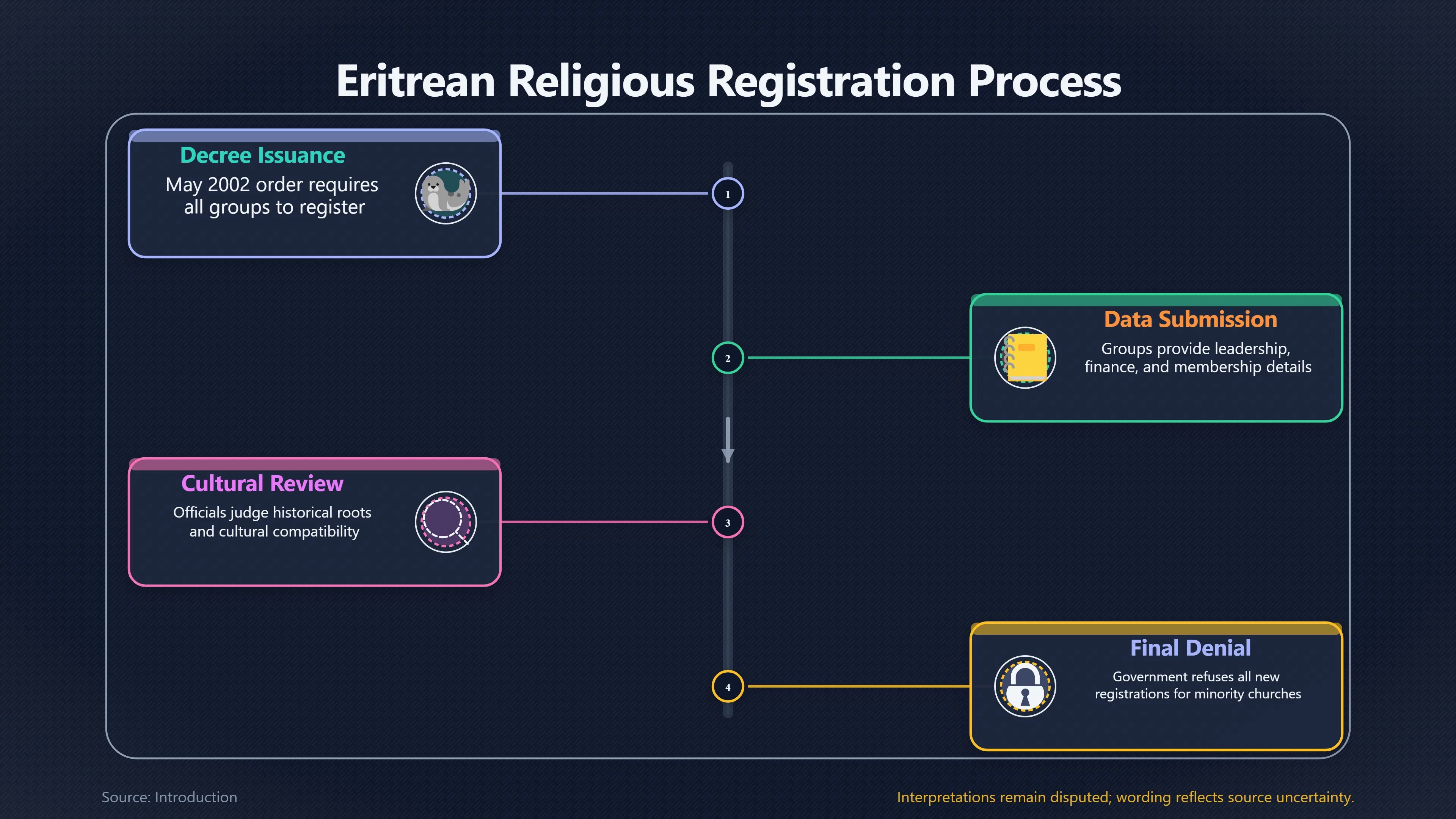
In May 2002, Eritrea transformed the legal status of many Christian communities almost overnight. A government decree required all religious groups other than four officially recognised traditions to register and to suspend religious activities until approval was granted. In practice, no additional Christian denomination was subsequently recognised, leaving Pentecostal, evangelical and many other Protestant congregations without legal status. What had previously been public worship increasingly moved into private homes, where prayer meetings became vulnerable to police raids, arrests and long periods of detention. Rather than reflecting a spontaneous public panic, the episode illustrates how the Eritrean state turned minority religious activity into a question of national security, portraying newer churches as foreign influences capable of undermining social cohesion and state authority.[Refworld]refworld.orgU.S. Department of State Annual Report on International Religious Freedom for 2002 - Eritrea | RefworldOctober 7, 2002…
How the 2002 registration order changed religious life
The May 2002 decree established a simple but far-reaching rule: any religious community outside the four recognised traditions had to submit detailed registration applications and cease religious activities until approval was granted. The recognised communities were:
- The Eritrean Orthodox Tewahedo Church[uscirf.gov]uscirf.govSource details in endnotes.
- Sunni Islam
- The Roman Catholic Church
- The Evangelical Lutheran Church of Eritrea[ecoi.net]ecoi.netSource details in endnotes.
Registration required extensive information about leadership, finances, membership and religious activities. Officials indicated that applications would be judged partly on whether groups had deep historical roots in Eritrea and were compatible with local culture. Although several communities applied, the government did not approve additional registrations, effectively making the suspension permanent.[Refworld]refworld.orgU.S. Department of State Annual Report on International Religious Freedom for 2002 - Eritrea | RefworldOctober 7, 2002…
For minority Christian churches, this represented much more than an administrative change. Congregations could no longer legally rent halls, construct churches or organise public worship. Many pastors lost the ability to minister openly, while ordinary believers faced the choice of abandoning communal worship or meeting in secret.
Why Pentecostal worship became a security issue
The government’s public justification centred on regulation rather than theology. Officials argued that registration was necessary to preserve national unity, maintain public order and prevent organisations with foreign influence from operating without oversight. Senior officials also suggested that groups lacking a long historical presence in Eritrea would be unlikely to receive recognition.[Refworld]refworld.orgU.S. Department of State Annual Report on International Religious Freedom for 2002 - Eritrea | RefworldOctober 7, 2002…
In practice, Pentecostal and evangelical churches became the principal targets. Government reports and later diplomatic assessments describe these communities collectively as “Pentes”, a broad label covering Pentecostals, Born Again Christians, Seventh-day Adventists, independent evangelical churches and several other Protestant groups.[Refworld]refworld.orgU.S. Department of State Annual Report on International Religious Freedom for 2002 - Eritrea | RefworldOctober 7, 2002…
Several factors appear to have shaped official suspicion:
- Foreign connections. Many churches maintained links with international missionary organisations or overseas denominations, making them vulnerable to accusations of promoting outside influence.
- Independent organisation. Small house churches operated outside state-approved religious hierarchies and were therefore harder for authorities to supervise.
- Rapid growth. Pentecostal congregations had expanded during the 1990s, attracting young people and converts from other Christian traditions, which increased official concern about social change.
- State control. The government generally sought tight oversight of civil society, and autonomous religious networks represented one of the few organised spaces outside direct state influence.
These concerns reflected state security thinking rather than evidence that ordinary worshippers posed a violent threat. Independent observers have found no indication that the churches targeted in 2002 were involved in organised political opposition or armed activity.[Refworld]refworld.orgU.S. Department of State Annual Report on International Religious Freedom for 2002 - Eritrea | RefworldOctober 7, 2002…
Raids, detention and pressure to renounce belief
Once legal protection disappeared, enforcement relied on police and security services.
House churches became frequent targets because many congregations continued meeting privately after public worship was prohibited. Reports from subsequent years describe security forces interrupting prayer meetings, arresting worshippers and detaining pastors without formal criminal proceedings.[Refworld]refworld.orgU.S. Department of State Annual Report on International Religious Freedom for 2003 - Eritrea | Refworld…
Human rights organisations and diplomatic reporting documented several recurring patterns:
- Worshippers detained during home prayer meetings.
- Long periods of detention without trial.
- Pressure on detainees to sign statements renouncing their faith before release.
- Continued surveillance of congregations that attempted to reorganise after arrests.
The severity varied over time and between locations, but the basic pattern remained consistent: religious activity outside the recognised framework became grounds for police intervention rather than simply an administrative violation. Later State Department reports continued to describe arrests, arbitrary detention and restrictions linked directly to the unresolved 2002 registration system.[Refworld]refworld.orgU.S. Department of State Annual Report on International Religious Freedom for 2003 - Eritrea | Refworld…
Why many churches moved underground
The crackdown fundamentally changed how minority Christian communities functioned.
Instead of visible congregations with recognised buildings and regular public services, many groups fragmented into small gatherings held in private homes. Leaders frequently changed meeting locations to reduce the risk of detection, while some believers limited attendance because arrests could affect employment, education or compulsory national service.
This underground existence also altered religious practice itself. Activities that are routine in many churches—such as baptisms, weddings, Bible study groups and youth meetings—became more difficult to organise openly. The legal uncertainty discouraged long-term planning and made it difficult to train clergy or maintain stable congregational structures.
For many Eritrean Christians, secrecy became a practical survival strategy rather than a theological preference.
Was this a moral panic?
The 2002 campaign is best understood as a state-driven security campaign rather than a classic moral panic generated by sensational media or widespread public hysteria.
Government rhetoric portrayed newer churches as organisations with questionable foreign loyalties that could threaten national unity and social stability. That framing encouraged officials to treat ordinary religious gatherings as potential security problems even without evidence of criminal conduct. The central dynamic therefore involved official suspicion and administrative control rather than spontaneous collective fear among the wider population.[Refworld]refworld.orgU.S. Department of State Annual Report on International Religious Freedom for 2002 - Eritrea | RefworldOctober 7, 2002…
This distinction matters because the crackdown illustrates a broader theme in Eritrea’s social history: collective fears were often produced and reinforced through state institutions instead of emerging organically from popular rumour or mass belief.
Why the 2002 crackdown remains important
The registration order marked a turning point in Eritrea’s religious landscape. More than two decades later, the same four religious traditions remain the only officially recognised communities, and no additional registration applications have been approved. The legal framework introduced in 2002 continues to shape the daily lives of many minority Christian believers, keeping numerous congregations in a precarious position between private worship and the risk of state intervention.[U.S. Department of State]2021-2025.state.govU.S. Department of StateInternational Religious Freedom Reports: Custom Report Excerpts - United States Department of State…
Within the wider history of collective fear in Eritrea, the crackdown stands out because it shows how a government’s perception of religious movements as foreign, disruptive or politically suspect can transform peaceful worship into an object of surveillance and punishment. Rather than reflecting a mass delusion, it demonstrates how official narratives about social danger can reshape public life, redefine lawful religious practice and push entire communities underground for years.


Endnotes
1.
Source: refworld.org
Link:https://www.refworld.org/reference/annualreport/usdos/2002/en/10454
Source snippet
U.S. Department of State Annual Report on International Religious Freedom for 2002 - Eritrea | RefworldOctober 7, 2002...
Published: October 7, 2002
2.
Source: 2021-2025.state.gov
Link:https://2021-2025.state.gov/report/custom/f394056d48/
Source snippet
U.S. Department of StateInternational Religious Freedom Reports: Custom Report Excerpts - United States Department of State...
3.
Source: refworld.org
Link:https://www.refworld.org/reference/annualreport/usdos/2003/en/17910
Source snippet
U.S. Department of State Annual Report on International Religious Freedom for 2003 - Eritrea | Refworld...
4.
Source: refworld.org
Link:https://www.refworld.org/reference/annualreport/usdos/2006/en/35519
Source snippet
U.S. Department of State Annual Report on International Religious Freedom for 2006 - Eritrea | Refworld...
5.
Source: refworld.org
Link:https://www.refworld.org/reference/annualreport/uscirf/2014/99084
6.
Source: refworld.org
Link:https://www.refworld.org/reference/annualreport/usdos/2007/en/48915
7.
Source: refworld.org
Link:https://www.refworld.org/reference/annualreport/uscirf/2007/en/59323
8.
Source: refworld.org
Link:https://www.refworld.org/reference/annualreport/usdos/2005/36198
9.
Source: refworld.org
Link:https://www.refworld.org/reference/annualreport/uscirf/2005/59230
10.
Source: refworld.org
Link:https://www.refworld.org/reference/annualreport/usdos/2004/18582
11.
Source: refworld.org
Link:https://www.refworld.org/reference/annualreport/uscirf/2004/59199
12.
Source: 2009-2017.state.gov
Link:https://2009-2017.state.gov/j/drl/rls/hrrpt/2003/27726.htm
13.
Source: hrw.org
Link:https://www.hrw.org/world-report/2005/country-chapters/eritrea
14.
Source: hrw.org
Link:https://www.hrw.org/world-report/2018/country-chapters/eritrea
Additional References
15.
Source: uscirf.gov
Link:https://www.uscirf.gov/publications/did-you-knoweritrea
16.
Source: ecoi.net
Link:https://www.ecoi.net/en/document/2051549.html
Source snippet
USDOS – US Department of State (Author): “2020 Report on International Religious Freedom: Eritrea”, Document #2051549 - ecoi.netMay 12, 2...
17.
Source: ecoi.net
Link:https://www.ecoi.net/en/document/2091856.html
Source snippet
USDOS – US Department of State (Author): “2022 Report on International Religious Freedom: Eritrea”, Document #2091856 - ecoi.netMay 15, 2...
18.
Source: ecoi.net
Link:https://www.ecoi.net/en/document/2011120.html
Source snippet
USDOS – US Department of State (Author): “2018 Report on International Religious Freedom: Eritrea”, Document #2011120 - ecoi.netJune 21...
19.
Source: ecoi.net
Link:https://www.ecoi.net/en/document/1338424.html
20.
Source: ecoi.net
Link:https://www.ecoi.net/en/document/1033155.html
Source snippet
USDOS – US Department of State (Author): “2015 Report on International Religious Freedom - Eritrea”, Document #1033155 - ecoi.net...
21.
Source: amnesty.org.uk
Title: eritrea 57 christian girls and boys held metal containers possessing bibles
Link:https://www.amnesty.org.uk/knowledge-hub/all-resources/eritrea-57-christian-girls-and-boys-held-metal-containers-possessing-bibles/
22.
Source: youtube.com
Title: Episode 3: Helen Berhane, Eritrea
Link:https://www.youtube.com/watch?v=FTK_6KCzMRA
Source snippet
Christians Imprisoned for their Faith in Eritrea...
23.
Source: oikoumene.org
Title: Religious freedom and liberty in Eritrea | World Council of Churches
Link:https://www.oikoumene.org/resources/documents/religious-freedom-and-liberty-in-eritrea
24.
Source: uscirf.gov
Title: month may marks eritreas religious freedom abuses
Link:https://www.uscirf.gov/news-room/releases-statements/month-may-marks-eritreas-religious-freedom-abuses
Topic Tree