Within Tunisia
Why Rumours Ruled Tunisia's Revolutionary Nights
After Ben Ali fled, real violence and collapsing trust made stories of snipers, escaped prisoners and hidden loyalists difficult to test.
On this page
- The genuine dangers after 14 January 2011
- How neighbourhood watches turned suspicion into action
- Why authoritarian secrecy made reassurance ineffective
Page outline Jump by section
Introduction
The nights immediately following President Zine El Abidine Ben Ali’s flight from Tunisia on 14 January 2011 became some of the most uncertain in the country’s modern history. Real violence, armed confrontations and the sudden collapse of the regime’s security apparatus created an environment in which ordinary people struggled to distinguish verified threats from rumours. Stories about hidden snipers, escaped prisoners, roaming militias and loyalists preparing a counter-revolution spread rapidly through neighbourhoods, mobile phones, television and social networks. Some reports reflected genuine dangers, while others proved impossible to verify or were later challenged. Understanding these “nights of rumour” is important because they show how collective fear develops when trust in official information disappears, rather than because they represent a classic case of mass hysteria.
The genuine dangers after 14 January 2011
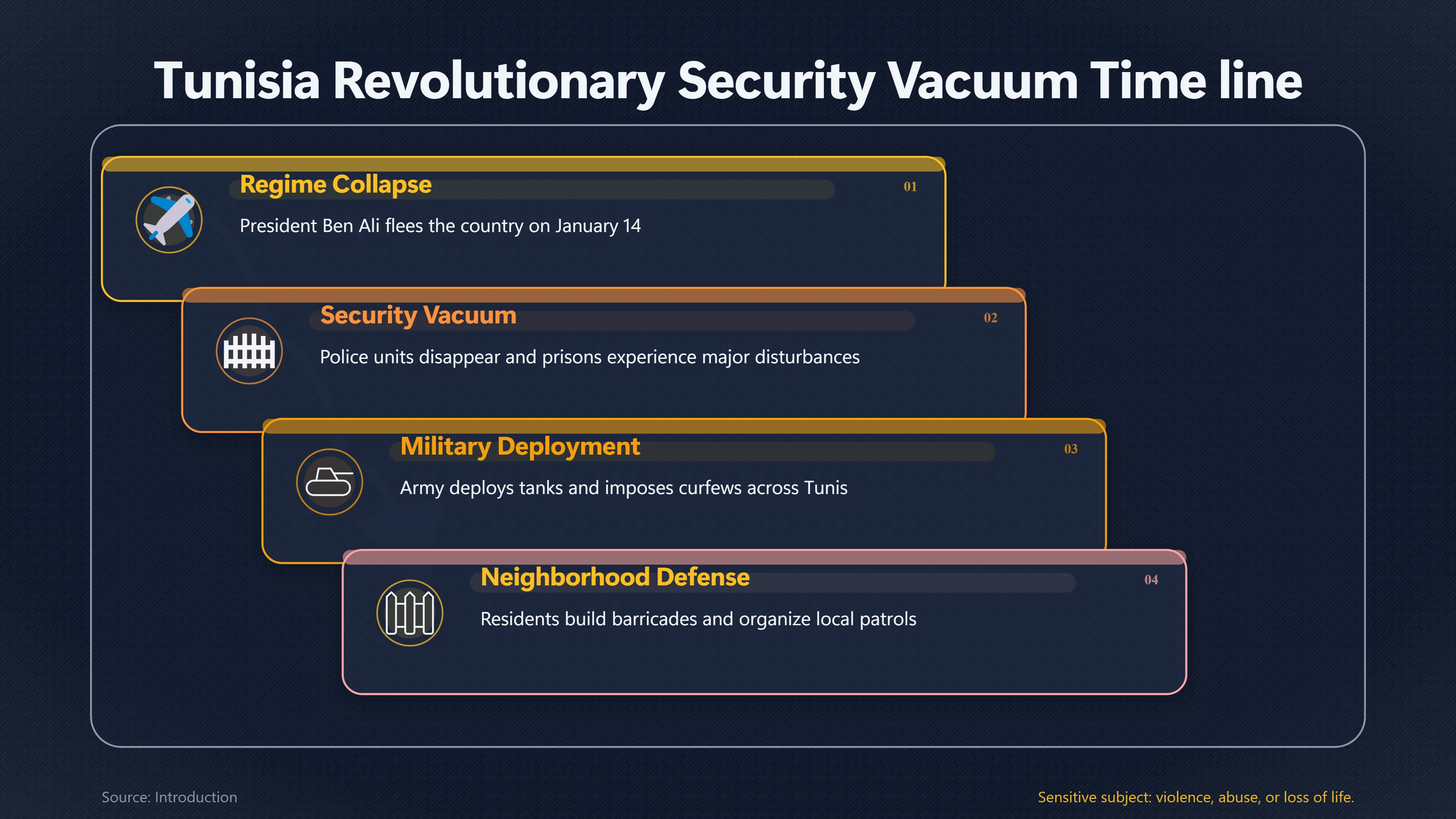
The rumours that swept Tunisia cannot be understood as simple fantasy. Ben Ali’s departure created a genuine security vacuum.
Police units largely disappeared from many streets, prisons experienced disturbances and escapes, government authority fragmented, and there were confirmed incidents of gunfire, looting and attacks on public buildings. The army deployed across Tunis, tanks guarded key sites, and curfews were imposed while the interim authorities attempted to restore order. Amnesty International documented extensive state violence during the uprising itself and called for investigations into unlawful killings committed before the regime collapsed.[Amnesty International]amnesty.orgInternational Tunisia in revolt: State violence during anti-government protestsAmnesty InternationalTunisia in revolt: State violence during anti-government protests - Amnesty InternationalMarch 1, 2011…
Journalists on the ground described confusion rather than clarity. Reports from Tunis referred to exchanges of gunfire, armed men in vehicles, fighting around the presidential palace and widespread uncertainty over who exactly was shooting. In such conditions, people often interpreted every burst of gunfire through the lens of rumours already circulating.[The Guardian]theguardian.comThe GuardianConfusion, fear and horror in Tunisia as old regime's militia carries on the fight | Tunisia | The GuardianJanuary 16, 2011…
The result was an unusual mixture of documented violence and unverified claims:
- Armed men were reported in several areas, but their identities were frequently disputed.
- Prison disturbances and escapes were real, although estimates and descriptions spread faster than verified information.
- Looting occurred in parts of the country, encouraging fears that organised attacks on neighbourhoods would follow.
- Claims of coordinated counter-revolutionary operations often combined confirmed incidents with speculation about hidden organisers.
For ordinary Tunisians, separating fact from rumour in real time was almost impossible.
How neighbourhood watches turned suspicion into action
One of the most striking responses was the spontaneous creation of neighbourhood defence committees.
Residents blocked roads with makeshift barricades, inspected vehicles, organised overnight patrols and communicated through local telephone networks. Many people armed themselves with sticks, metal bars or improvised weapons despite having little idea who they might face. Reuters reported neighbourhoods surrounding themselves with checkpoints while residents attempted to protect homes after nights of shootings and looting.[Daily FT]ft.lkDaily FTTunisia plans unity government, fragile peace holds | Daily FTJanuary 17, 2011…
These patrols served practical purposes. They discouraged opportunistic crime and reassured frightened residents that someone was watching the streets. At the same time, they also became powerful channels for rumour.
Warnings moved rapidly from one checkpoint to another:
- reports that suspicious vehicles had entered a district;
- claims that loyalists were poisoning water or electricity supplies;
- alerts that snipers had been seen on rooftops;
- stories that armed gangs were approaching nearby neighbourhoods.
Because each warning seemed to come from another trusted local group rather than from anonymous strangers, rumours often acquired credibility as they travelled.
This process illustrates a common mechanism in crises. Community self-organisation increases resilience but also creates dense networks through which unverified information can circulate with remarkable speed.
Why the sniper stories became so powerful
Among the most enduring revolutionary rumours were stories about snipers.
Many Tunisians believed concealed marksmen loyal to the old regime were firing on protesters or civilians from rooftops. During the chaotic days immediately after Ben Ali’s departure, journalists, witnesses and officials all referred to reports of snipers, making the idea seem plausible. Contemporary reporting from Tunis described widespread belief that security loyalists were shooting from elevated positions during continuing clashes.[The Guardian]theguardian.comThe GuardianConfusion, fear and horror in Tunisia as old regime's militia carries on the fight | Tunisia | The GuardianJanuary 16, 2011…
The historical picture, however, became more complicated.
As investigations progressed, Tunisia’s National Commission of Inquiry, chaired by Taoufik Bouderbala, stated in 2011 that it had found no evidence supporting the widespread belief in organised sniper teams as popularly imagined. According to the commission, testimony from detained security officials did not confirm the existence of dedicated sniper units operating during the revolution.[إدارتي]idaraty.tnإدارتيBouderbala affirme qu'il n'y a pas eu de snipersJuly 15, 2011…
This does not mean that nobody was shot, nor that all eyewitness accounts were fabricated. Protesters unquestionably died from gunfire during the uprising, and security forces were responsible for many deaths. Rather, later investigations questioned one specific narrative: the image of numerous mysterious rooftop snipers operating across Tunisia as a coordinated hidden force.
The persistence of the sniper story demonstrates how collective memory often preserves emotionally convincing explanations even after official investigations complicate them.
Why authoritarian secrecy made reassurance ineffective
The Ben Ali regime had governed through tight control of information, censorship and extensive internal security.
When that system suddenly collapsed, the new authorities inherited an enormous credibility problem. Citizens had spent years assuming that official statements concealed the truth. As a result, even accurate announcements struggled to gain public trust.
This helps explain why rumours flourished despite repeated public statements.
Several factors reinforced each other:
- Long-term distrust. Years of censorship meant official denials often sounded no more convincing than rumours.
- Information gaps. News organisations faced the same uncertainty as ordinary citizens, reporting events while facts remained incomplete.
- Visible violence. Since genuine shootings and attacks were occurring, even improbable stories appeared believable.
- Political suspicion. Many revolutionaries feared remnants of the old regime were deliberately trying to destabilise the transition.
Political scientists and journalists observing Tunisia’s transition noted that uncertainty about who still exercised power encouraged competing interpretations of every violent incident. Each new episode became evidence for different political narratives rather than simply another security event.[Al Jazeera]aljazeera.comAl Jazeera Political ambiguity breeds violence | Features | Al JazeeraAl JazeeraPolitical ambiguity breeds violence | Features | Al JazeeraMarch 7, 2011…
When rumours became political weapons
The nights of rumour did not end once immediate security improved.
Stories about hidden loyalists, secret conspiracies and deliberate attempts to sabotage the revolution increasingly became part of political conflict. Competing parties and activists sometimes interpreted unexplained violence as proof that opponents were collaborating with the former regime or seeking to derail democratic change.
This illustrates an important distinction.
A rumour panic is not merely false information spreading quickly. It is also a social process through which uncertain events become attached to larger political meanings. During Tunisia’s transition, individual shootings, unexplained fires or local disturbances were often interpreted as signs of a much broader struggle over the future of the revolution.
Because evidence was frequently incomplete, many accusations remained impossible to prove conclusively.
Why the rumour nights still matter
The revolutionary nights of January 2011 remain one of Tunisia’s clearest examples of how collective fear develops during institutional collapse.
They were not primarily driven by irrational panic. Instead, they emerged from an unusual combination of genuine danger, fragmented information and profound distrust created by decades of authoritarian rule. The rumours about snipers, escaped prisoners and hidden loyalists spread because they fitted a world in which people knew that violence was real but no longer knew whom to believe.
For historians and social scientists, these events show that rumours are often adaptive attempts to explain uncertainty rather than simple inventions. They help communities make rapid decisions when reliable information is unavailable, even though those decisions can also amplify suspicion and occasionally lead to mistaken accusations.
The Tunisian experience therefore occupies an important place in the country’s history of collective fear. It demonstrates how quickly political transitions can transform ordinary neighbourhoods into information networks where warnings, speculation and real threats become difficult to separate, and where rebuilding trust proves almost as challenging as restoring public order.
Amazon book picks
Further Reading
Books and field guides related to Why Rumours Ruled Tunisia's Revolutionary Nights. Use these as the next step if you want deeper reading beyond the article.
Extraordinary Popular Delusions and the Madness of Crowds
Rating: 4.0/5 from 5 Google Books ratings
Illustrates historical rumour panics.

The Wisdom of Crowds:Why the Many Are Smarter Than the Few an...
Provides insight into collective behaviour.


Endnotes
1.
Source: amnesty.org
Title: International Tunisia in revolt: State violence during anti-government protests
Link:https://www.amnesty.org/en/documents/MDE30/011/2011/en/
Source snippet
Amnesty InternationalTunisia in revolt: State violence during anti-government protests - Amnesty InternationalMarch 1, 2011...
Published: March 1, 2011
2.
Source: ft.lk
Link:https://www.ft.lk/Sectors/tunisia-plans-unity-government-fragile-peace-holds/20-15169
Source snippet
Daily FTTunisia plans unity government, fragile peace holds | Daily FTJanuary 17, 2011...
Published: January 17, 2011
3.
Source: youtube.com
Title: Tunisia’s Ben Ali: The Dictator’s Last Calls
Link:https://www.youtube.com/watch?v=YaST3lc0CXw
Source snippet
Tunisia - Anti-government protests and the fall of President Ben Ali...
4.
Source: youtube.com
Link:https://www.youtube.com/watch?v=e-OB2MA4vs4
Source snippet
The Birth of A Revolution...
5.
Source: amnesty.org.uk
Link:https://www.amnesty.org.uk/knowledge-hub/all-resources/tunisia-disturbing-new-evidence-security-force-brutality-revealed/
6.
Source: theguardian.com
Link:https://www.theguardian.com/world/2011/jan/16/tunisia-gun-battle-army-tunis
Source snippet
The GuardianConfusion, fear and horror in Tunisia as old regime's militia carries on the fight | Tunisia | The GuardianJanuary 16, 2011...
Published: January 16, 2011
7.
Source: idaraty.tn
Title: إدارتيBouderbala affirme qu’il n’y a pas eu de snipers
Link:https://idaraty.tn/fr/news/2011/07/bouderbala-affirme-qu-il-n-y-a-pas-eu-de-snipers-fshvdv
Source snippet
July 15, 2011...
Published: July 15, 2011
8.
Source: aljazeera.com
Title: Al Jazeera Political ambiguity breeds violence | Features | Al Jazeera
Link:https://www.aljazeera.com/features/2011/3/7/political-ambiguity-breeds-violence
Source snippet
Al JazeeraPolitical ambiguity breeds violence | Features | Al JazeeraMarch 7, 2011...
Published: March 7, 2011
9.
Source: theguardian.com
Link:https://www.theguardian.com/world/2011/mar/07/tunisia-abolishes-secret-police-force
10.
Source: aljazeera.com
Title: The massacre behind the revolution | Features | Al Jazeera
Link:https://www.aljazeera.com/features/2011/2/16/the-massacre-behind-the-revolution
11.
Source: aljazeera.com
Title: The massacre behind the revolution | Features | Al Jazeera
Link:https://www.aljazeera.com/amp/features/2011/2/16/the-massacre-behind-the-revolution
12.
Source: theguardian.com
Link:https://www.theguardian.com/world/2011/jan/15/tunisia-protests-zine-al-abidine-ben-ali
Additional References
13.
Source: stabroeknews.com
Title: Stabroek News Tunisia tries to form coalition, shooting on streets
Link:https://www.stabroeknews.com/2011/01/16/news/guyana/tunisia-tries-to-form-coalition-shooting-on-streets/
Source snippet
Stabroek NewsTunisia tries to form coalition, shooting on streets - Stabroek News...
14.
Source: youtube.com
Title: Tunisia and the Arab spring 10 years on: “We tried to rise”
Link:https://www.youtube.com/watch?v=YMGqxHB6BLE
Source snippet
The rise and fall of Ben Ali: Remembering ousted Tunisian strongman...
15.
Source: journals.sagepub.com
Link:https://journals.sagepub.com/doi/10.1177/00104140241252101
Source snippet
Erroneous Beliefs Trigger Authoritarian Collapse: The Case of Tunisia, January 14, 2011 - Anne Wolf, 2025June 7, 2024 — HOW ERRONEOUS BEL...
Published: January 14, 2011
16.
Source: journals.sagepub.com
Link:https://journals.sagepub.com/doi/full/10.1177/00104140241252101
Source snippet
Erroneous Beliefs Trigger Authoritarian Collapse: The Case of Tunisia, January 14, 2011 - Anne Wolf, 2025June 7, 2024 — First published o...
Published: January 14, 2011
17.
Source: ecoi.net
Link:https://www.ecoi.net/en/document/1096875.html
18.
Source: reutersconnect.com
Link:https://www.reutersconnect.com/item/a-protester-from-tunisias-poor-rural-heartlands-chants-slogans-during-a-demonstration-by-the-prime-ministers-office-in-tunis/dGFnOnJldXRlcnMuY29tLDIwMTE6bmV3c21sX0dNMUU3MU4xVEVYMDI
19.
Source: reutersconnect.com
Link:https://www.reutersconnect.com/item/protesters-camp-out-overnight-outside-the-prime-ministers-office-in-tunis/dGFnOnJldXRlcnMuY29tLDIwMTE6bmV3c21sX0dNMUU3MVAxNkFRMDE?lastViewed=dGFnOnJldXRlcnMuY29tLDIwMjA6bmV3c21sX1JDMkJYSjlSR09IUA&position=2
20.
Source: reutersconnect.com
Link:https://www.reutersconnect.com/item/protesters-help-an-injured-man-during-a-clashes-near-government-offices-in-the-casbah/dGFnOnJldXRlcnMuY29tLDIwMTE6bmV3c21sX0dNMUU3MVExUDJEMDE
21.
Source: reutersconnect.com
Link:https://www.reutersconnect.com/item/protesters-help-an-injured-man-during-clashes-near-government-offices-in-the-casbah-the-old-city-of-tunis/dGFnOnJldXRlcnMuY29tLDIwMTE6bmV3c21sX0dNMUU3MVExVUVMMDE
22.
Source: reutersconnect.com
Link:https://www.reutersconnect.com/item/protesters-from-tunisias-poor-rural-heartlands-chant-slogans-during-a-demonstration-by-the-prime-ministers-office-in-tunis/dGFnOnJldXRlcnMuY29tLDIwMTE6bmV3c21sX0dNMUU3MU4xVDgyMDE?lastViewed=dGFnOnJldXRlcnMuY29tLDIwMTE6bmV3c21sX0dNMUU3MU8wRzFRMDE&position=1
Topic Tree