Within Brazilian Belief Panics
Why Prophecy Took Hold in Contestado
The Contestado movement joined sacred prophecy to anger over dispossession, railway expansion and the failure of state protection.
On this page
- Railways, logging and rural dispossession
- Jose Maria and the sacred communities
- War, repression and disputed death tolls
Page outline Jump by section
Introduction
The Contestado War (1912–1916) was far more than a rural uprising in southern Brazil. It emerged where religious prophecy, mass displacement and rapid economic change collided. Thousands of poor rural families who had lost access to land because of railway construction, commercial logging and colonisation schemes gathered around charismatic religious leaders who promised divine justice and the restoration of a moral order. To government officials and regional elites, however, these growing sacred communities appeared to be a dangerous challenge to state authority. The result was one of the bloodiest internal conflicts in modern Brazilian history, ending only after prolonged military campaigns that employed modern weapons against largely impoverished rural populations. The movement remains an important example of how millenarian belief can become inseparable from material grievances rather than replacing them.[repositorio.pucrs.br]repositorio.pucrs.br6 – 1916…
Why prophecy took hold in Contestado
Unlike movements driven primarily by theological innovation, the Contestado communities developed in response to profound social upheaval. The disputed frontier between the states of Paraná and Santa Catarina had long been occupied by small farmers, cattle raisers and people who depended upon forests and yerba mate harvesting. Many lacked formal legal title but had lived on the land for generations.
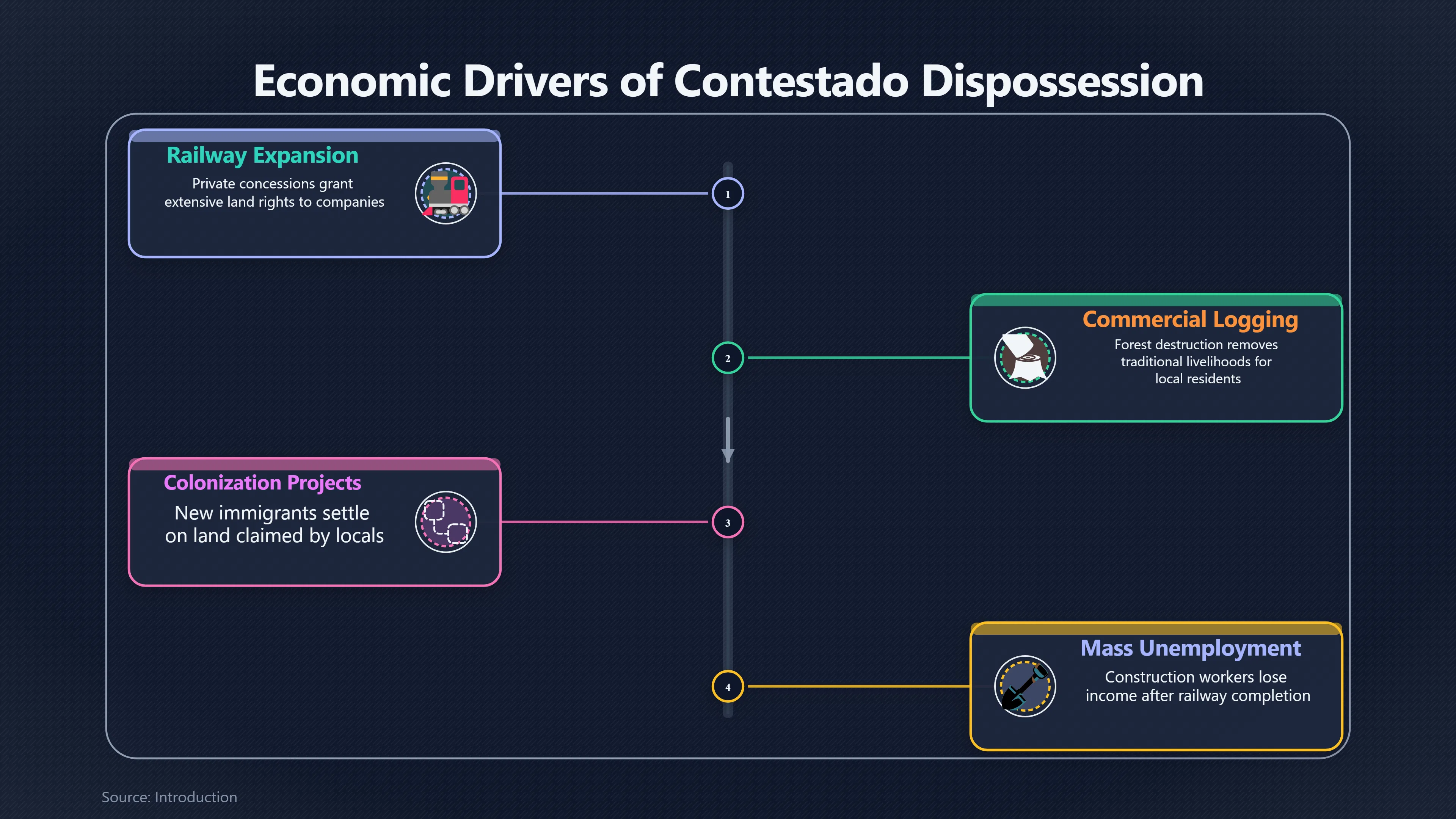
The arrival of the São Paulo–Rio Grande railway transformed this world. The railway concession granted extensive land rights to the private Brazil Railway Company, while its subsidiary, the Southern Brazil Lumber & Colonization Company, exploited forests and promoted settlement by new colonists. Thousands of labourers hired to build the railway were dismissed when construction ended. At the same time, many existing residents were expelled from land now claimed for railway or timber operations. These overlapping changes produced a large population of unemployed and landless rural families who increasingly believed that the existing political order no longer protected them.[repositorio.pucrs.br]repositorio.pucrs.br6 – 1916…
In these circumstances, prophecy did not simply offer hope for the next world. It explained immediate suffering and promised that injustice would soon be reversed through divine intervention. Religious expectation therefore became a way of interpreting dispossession, rather than an escape from it.
Railways, logging and rural dispossession
The conflict cannot be understood without recognising the economic transformation that preceded it.
Several developments reinforced one another:
- Railway expansion brought outside capital and new transport links but also transferred enormous areas of land into private concessions.
- Commercial logging accelerated the destruction of forests that had supported local livelihoods.
- Colonisation projects settled immigrants on land that local residents believed had been taken from them.
- Mass unemployment followed completion of the railway, leaving thousands of former construction workers without income or land.
For many rural families, these were not isolated events but parts of a single process in which powerful companies, politicians and landowners benefited while long-established communities lost both economic security and legal recognition. Historians therefore describe the Contestado movement as both a religious revival and a social protest rooted in unequal development.[repositorio.pucrs.br]repositorio.pucrs.br6 – 1916…
José Maria and the sacred communities
The movement’s most influential religious figure was José Maria, a wandering healer and preacher whose followers regarded him as a holy man. He preached repentance, healing and divine justice while attracting people already searching for protection amid social disruption. His influence expanded rapidly because he appeared to offer both spiritual authority and practical leadership.[Brasil Escola]brasilescola.uol.com.brBrasil Escola Guerra do Contestado: causas, líder, consequênciasBrasil EscolaGuerra do Contestado: causas, líder, consequências - Brasil Escola…
José Maria was killed during an early confrontation with state forces in 1912. His death did not end the movement. Instead, many followers believed he had not truly disappeared and would return at the head of a heavenly army to establish a just kingdom on earth. This expectation gave the rebellion an unmistakably millenarian character: believers anticipated a dramatic transformation of society rather than gradual political reform.[Brasil Escola]brasilescola.uol.com.brBrasil Escola Guerra do Contestado: causas, líder, consequênciasBrasil EscolaGuerra do Contestado: causas, líder, consequências - Brasil Escola…
The settlements that developed after his death functioned as more than military camps. They were sacred communities organised around collective worship, shared labour and expectations of divine deliverance. Women as well as men played important roles, and later leaders, including the young visionary Maria Rosa, assumed positions of religious and military authority after José Maria’s death.[Wikipedia]WikipediaContestado WarContestado War
Why authorities saw a threat
Regional officials and military commanders interpreted the expanding settlements very differently.
From their perspective, the communities:
- rejected established political authority;
- gathered large armed populations beyond state control;
- interfered with railway, timber and colonisation interests; and
- appeared capable of inspiring wider rural resistance.
Official reports often described the movement as irrational fanaticism. That language helped justify increasingly severe military intervention. Modern historians, however, argue that reducing the rebels to religious extremists obscures the movement’s social foundations. Millenarian belief certainly shaped the conflict, but it did so alongside genuine disputes over land ownership, economic exclusion and political neglect.[periodicos.ufba.br]periodicos.ufba.brLIMITAÇÕES DE UMA GUERRA SERTANEJA: reflexão sobre aspectos militares do Contestado (1912-1916) | Caderno CRH…
This distinction matters because labels such as “fanatics” or “mad believers” reflected the assumptions of state authorities as much as the realities of rural life.
War, repression and disputed death tolls
The conflict escalated into a prolonged campaign between 1912 and 1916. Early government expeditions suffered unexpected defeats against rebels who knew the terrain well and relied on guerrilla tactics. The federal government then committed larger military forces equipped with artillery, machine guns and, unusually for Brazil at the time, military aircraft used for reconnaissance.[periodicos.ufba.br]periodicos.ufba.brLIMITAÇÕES DE UMA GUERRA SERTANEJA: reflexão sobre aspectos militares do Contestado (1912-1916) | Caderno CRH…
The repression was devastating. Sacred settlements were destroyed, suspected supporters were pursued across the countryside and large sections of the rural population were displaced. Because many deaths occurred in remote areas and record-keeping was incomplete, historians continue to debate the total number of casualties.
Most scholarly estimates place deaths in the many thousands. Some detailed historical studies suggest roughly 8,000 fatalities, while broader estimates extend considerably higher, particularly when civilian losses are included. The uncertainty itself reflects the fragmented documentation left by a conflict fought across isolated rural regions.[repositorio.pucrs.br]repositorio.pucrs.br6 – 1916…

How historians interpret the movement today
Earlier accounts frequently portrayed the Contestado rebels as victims of religious delusion or as dangerous extremists resisting modernisation. Contemporary scholarship presents a more complex picture.
Most historians emphasise that the movement combined several elements:
- Millenarian religion, centred on prophecy, sacred leadership and expectations of divine justice.
- Resistance to dispossession, especially the loss of customary land rights.
- Economic disruption, caused by railway construction, logging and unemployment.
- Weak state protection, leaving rural communities with few legal means to defend their livelihoods.
Rather than treating prophecy as the cause of the rebellion by itself, historians increasingly argue that religious belief gave meaning, cohesion and endurance to grievances that were already deeply rooted in material experience. The sacred communities became places where displaced people could imagine an alternative social order when existing institutions appeared to have failed them.[repositorio.pucrs.br]repositorio.pucrs.br6 – 1916…
Why Contestado remains culturally important
The Contestado War occupies a distinctive place in Brazil’s history of collective belief because it demonstrates how religious movements can be misunderstood when viewed only through the language of fanaticism. Like the earlier destruction of Canudos, it shows how governments sometimes interpreted marginal religious communities primarily as security threats while overlooking the economic and political conditions that had attracted followers in the first place.
For historians of collective belief, Contestado illustrates that prophecy spreads most powerfully when it speaks to lived injustice. Faith in divine intervention did not replace practical concerns over land, employment and dignity; it transformed those concerns into a shared vision capable of sustaining resistance despite overwhelming military force. The movement therefore remains one of Brazil’s clearest examples of how millenarian belief, social exclusion and state repression became tightly intertwined in the early twentieth century.
Amazon book picks
Further Reading
Books and field guides related to Why Prophecy Took Hold in Contestado. Use these as the next step if you want deeper reading beyond the article.

Endnotes
1.
Source: repositorio.pucrs.br
Link:https://repositorio.pucrs.br/dspace/handle/10923/3882?locale=en
Source snippet
6 – 1916...
2.
Source: periodicos.ufba.br
Link:https://periodicos.ufba.br/index.php/crh/article/view/18644
Source snippet
LIMITAÇÕES DE UMA GUERRA SERTANEJA: reflexão sobre aspectos militares do Contestado (1912-1916) | Caderno CRH...
3.
Source: Wikipedia
Title: Contestado War
Link:https://en.wikipedia.org/wiki/Contestado_War
4.
Source: history.com
Title: How Many People Died in World War I?
Link:https://www.history.com/articles/how-many-people-died-in-world-war-i
Source snippet
HISTORYApril 19, 2023 — By: Patrick J. Kiger World War I HOW MANY PEOPLE DIED IN WORLD WAR I? The carnage of the war was so extreme tha...
Published: April 19, 2023
5.
Source: tede2.pucrs.br
Link:https://tede2.pucrs.br/tede2/handle/tede/2277
6.
Source: brasilescola.uol.com.br
Title: Brasil Escola Guerra do Contestado: causas, líder, consequências
Link:https://brasilescola.uol.com.br/historiab/guerra-contestado.htm
Source snippet
Brasil EscolaGuerra do Contestado: causas, líder, consequências - Brasil Escola...
Additional References
7.
Source: encyclopedia.1914-1918-online.net
Title: war losses austria hungary
Link:https://encyclopedia.1914-1918-online.net/article/war-losses-austria-hungary/
Source snippet
Losses (Austria-Hungary)September 16, 2016 — WAR LOSSES (AUSTRIA-HUNGARY) By Anatol Schmied-Kowarzik Estimates of the total losses of the...
Published: September 16, 2016
8.
Source: tandfonline.com
Link:https://www.tandfonline.com/doi/abs/10.1080/02684527.2016.1270994
Source snippet
‘A matter of opinion’: British attempts to assess the attrition of German manpower, 1915–1917: Intelligence and National Security: Vol 32...
9.
Source: youtube.com
Title: Forgotten History: The Contestado War
Link:https://www.youtube.com/watch?v=3JKHbi91rPo
Source snippet
"Documentary: Contestado War - The Electorate Without Borders[https://www.youtube.com/watch?v=ONzNKN4L5RI..."](https://www.youtube.com/watch?v=ONzNKN4L5RI...")...
10.
Source: youtube.com
Title: Historical Inconveniences: Brazil’s War | Full Documentary | Curta Docs
Link:https://www.youtube.com/watch?v=ISYecACekLs
Source snippet
The Contestado War: The Price of Land and Hope...
11.
Source: onlinelibrary.wiley.com
Title: 1468 229X.12733
Link:https://onlinelibrary.wiley.com/doi/10.1111/1468-229X.12733
Source snippet
245-274 Article TRUTH AND FAKE NEWS ABOUT CAPORETTO: EXPLAINING THE DISASTER IN ITALY AND IN BRITAIN MARK THOMPSON, MARK THOMPSON Univers...
12.
Source: encyclopedia.1914-1918-online.net
Title: But th
Link:https://encyclopedia.1914-1918-online.net/article/war-losses-russian-empire/
Source snippet
Losses (Russian Empire)July 5, 2018 — WAR LOSSES (RUSSIAN EMPIRE) By Alexandre Sumpf With about 5.5 million out of 16 million soldiers ki...
Published: July 5, 2018
13.
Source: doaj.org
Link:https://doaj.org/article/33acd6ba25994655a91f0bda0af1ab4e
14.
Source: dspace.library.uvic.ca
Link:https://dspace.library.uvic.ca/items/3f6a89ed-6141-424b-8c95-4b560a459f19
15.
Source: researchgate.net
Title: 295105966 War without Frontiers The Archaeology of the Arab Revolt 1916 18
Link:https://www.researchgate.net/publication/295105966_War_without_Frontiers_The_Archaeology_of_the_Arab_Revolt
16.
Source: youtube.com
Title: CONTESTADO WAR: PR-SC, railroad and messianic movement | HISTORY
Link:https://www.youtube.com/watch?v=QbdIIY3iIi8
Topic Tree