When Fear Became Fact in Iceland
Iceland’s history contains no well-documented dance plague, nationwide satanic conspiracy scare or large home-grown apocalyptic cult comparable with famous cases elsewhere.
Page outline Jump by section
Introduction
These episodes should not all be called “mass hysteria”. The witch trials were a judicial persecution, the Reykjavík confessions were a miscarriage of justice, the ecstasy episode fits the sociological model of a moral panic, and elf-road stories sit between folklore, environmental protest and media mythmaking. Taken together, however, they reveal a recurring pattern: ambiguous events acquired powerful explanations, trusted authorities reinforced those explanations, and a small, closely connected society could circulate fear and certainty with unusual speed.[galdrasyning.is]galdrasyning.isthe witch hunts in icelandThe Witch-hunts in IcelandBetween 1625 and 1683 twenty one Icelanders were burnt alive for practicing magic. The Icelandic wi…
Iceland’s seventeenth-century witch-hunt
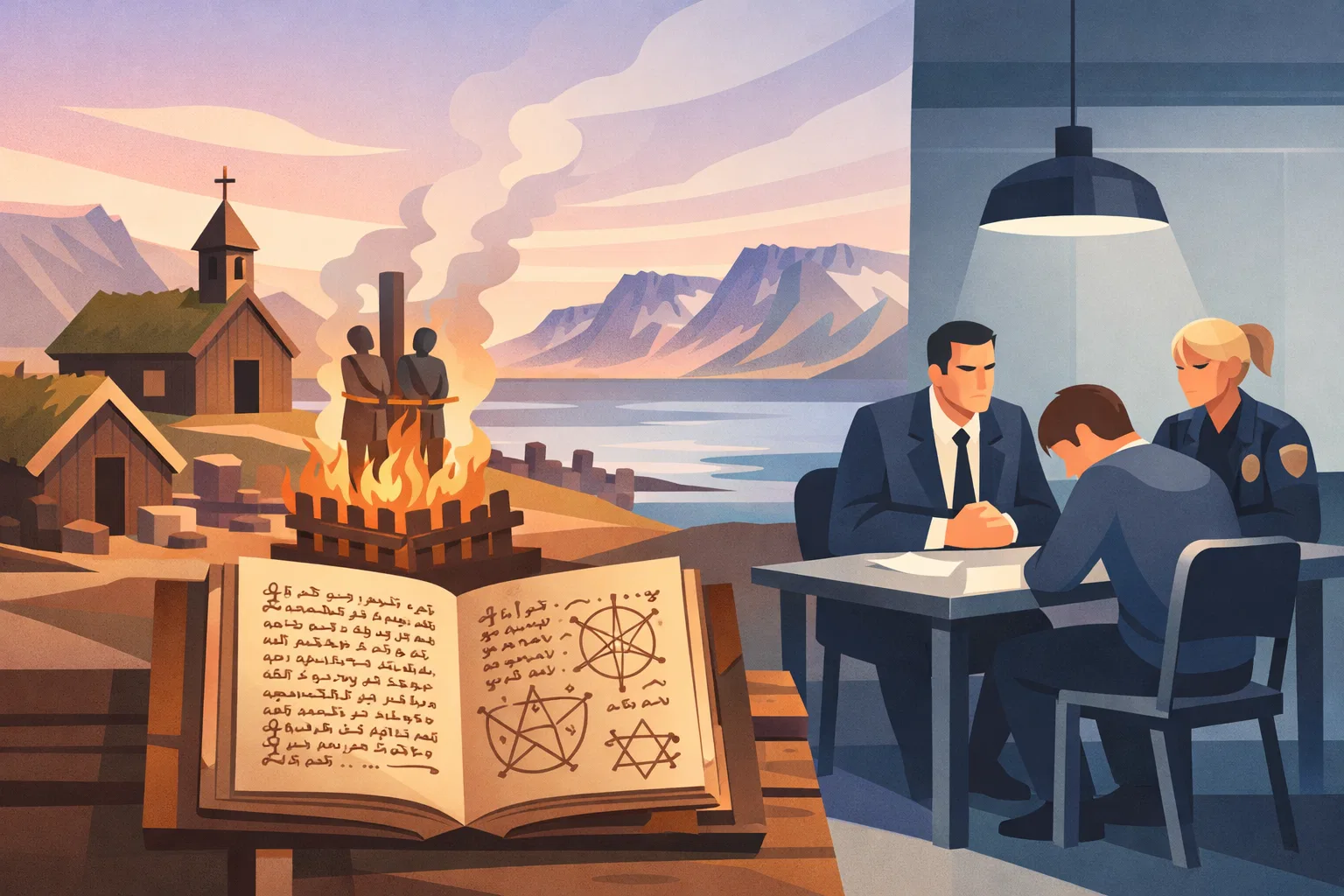
Between 1625 and 1683, 21 people were burned in Iceland for offences associated with magic. The episode was small beside the mass prosecutions of parts of Germany or Scotland, but it was extraordinary by Icelandic standards. Older magical practices and stories had existed for centuries; what changed was the arrival of a harsher legal and religious framework that connected harmful magic with demonic crime and made execution possible. Icelandic officials educated in Denmark and northern Germany helped carry these continental ideas into the island’s courts.[Galdrasyning]galdrasyning.isthe witch hunts in icelandThe Witch-hunts in IcelandBetween 1625 and 1683 twenty one Icelanders were burnt alive for practicing magic. The Icelandic wi…
Calling this simply an explosion of popular superstition is misleading. The surviving pattern points to an interaction between belief from below and pressure from above. Icelanders might accuse neighbours of causing illness, livestock losses or other misfortune, but officials decided which allegations became capital cases. Court procedure, Lutheran religious discipline and the influence of Danish law transformed local suspicions into punishable offences.
The geography also mattered. Many serious cases arose in the Westfjords, where scattered communities faced severe weather, poverty, illness and difficult personal relations. In such settings an unexplained sickness was not merely private. It could threaten a household’s labour, livelihood and reputation. Sorcery offered an explanation that identified both a cause and a culprit.
Why most of the condemned were men
Iceland sharply complicates the familiar image of the European witch-hunt as an attack almost exclusively on women. Nearly all those executed in Iceland were men; only one woman was burned. Men were also prominent among those associated with magical books, written signs, healing practices and spells.[NAT]nat.isWitchcraft and Sorcery, IcelandWitchcraft and Sorcery, Iceland - NATMarch 24, 2017 — A father and a son from farm Kirkjubol, both by the name Jon, were accused of sc…
This does not make Iceland’s trials less connected to gender. It means that magical suspicion followed local ideas about who possessed dangerous knowledge. In much of western Europe, demonological writing portrayed women as especially vulnerable to the Devil. In Iceland, learned or semi-learned magic was more readily imagined as a male activity. Literacy, clerical culture and the circulation of handwritten magical material all helped shape that stereotype.
Nor should every accused person be imagined as a member of an organised secret religion. The evidence points instead to individuals accused of using spells, signs, books or curses for practical purposes. “Witch cult” language, popular in some older retellings, imposes a coherent underground movement where the records more often show quarrels, healing, folk practice, crime and personal enmity.
The Kirkjuból affair: illness becomes proof of sorcery
The best-known Icelandic witch case began when a clergyman, Jón Magnússon, became convinced that his physical and spiritual sufferings were caused by magic. He accused a father and son, both named Jón Jónsson, members of his congregation at Kirkjuból in the Westfjords. They were imprisoned, confessed to magical acts and were burned in 1656.[wikipedia.org]WikipediaKirkjuból witch trialKirkjuból witch trial
The pastor later described his ordeal as a sustained supernatural assault. His symptoms and household disturbances became meaningful within a shared religious world in which invisible attack was considered possible. Once that explanation took hold, continuing illness did not count against it. Instead, each new episode could be interpreted as evidence that further sorcery remained undiscovered.
That self-sealing quality is central to many panics. A failed prediction or unsuccessful punishment need not weaken the underlying belief; it can generate a search for additional enemies. After the two men died, the pastor accused their female relative of continuing the attack. This time the case failed. She was acquitted and later won compensation, an important reminder that early modern courts were not automatic engines of conviction and that accusations could be challenged.[Wikipedia]WikipediaKirkjuból witch trialKirkjuból witch trial
Confessions also require caution. Imprisonment, repeated questioning and fear of punishment can make an admission look more reliable than it is. The Kirkjuból records tell historians what defendants said under extreme pressure, but not necessarily what they had actually done or privately believed.
The affair became culturally durable because Jón Magnússon left a vivid written account. That narrative gives unusual access to his terror, but it also means that the accuser’s interpretation has survived more fully than the voices of those he condemned. Modern scholarship therefore reads the text not as neutral testimony to demonic events, but as evidence of how illness, religious expectation and personal conflict could combine into prosecutable certainty.[ResearchGate]researchgate.net370083182 A Witch Finders Archive in 17th Century IcelandResearchGate(PDF) A Witch Finderʼs Archive in 17th-Century Iceland29 Apr 2026 — PDF | On Apr 12, 2023, Már Jónsson published A Witch Find…
How the witch panic ended
The Icelandic persecutions did not stop because magical belief vanished. They declined as legal controls tightened and officials became less willing to treat every allegation as a capital matter. After the last burning in 1683, a royal order required capital cases to be referred to Copenhagen. By 1719, Iceland’s national assembly could reprimand a sheriff for wasting the court’s time with a magical accusation.[Galdrasyning]galdrasyning.isgaldramal og galdrabrennurgaldramal og galdrabrennur
This distinction matters. Folklore, charms and stories of supernatural harm continued, but the machinery that converted belief into execution weakened. A society can retain supernatural traditions while abandoning judicial killing.
Modern museums and popular histories sometimes place magical folklore beside the witch trials, which can blur their chronology. Some famous magical objects and stories were recorded long after the burnings, and later copies of magical books do not prove the existence of a seventeenth-century organised cult. Iceland’s Museum of Sorcery and Witchcraft itself distinguishes the documented prosecutions from magical traditions preserved in later sources.[Galdrasyning]galdrasyning.isOpen source on galdrasyning.is.
The Reykjavík confessions: collective certainty without bodies
A modern Icelandic case shows how powerful beliefs can form without any supernatural element. In 1974, two unrelated young men, Guðmundur Einarsson and Geirfinnur Einarsson, disappeared. No bodies were recovered, no clear crime scenes were established and there was no forensic evidence that either man had been murdered. Yet investigators gradually developed an elaborate theory implicating a group of young people. Six were convicted of offences connected with the supposed killings.[PMC]pmc.ncbi.nlm.nih.govPMCThe Science-Based Pathways to Understanding Falseby GH Gudjonsson · 2021 · Cited by 98 — There was no tangible evidence base for the Reykjavík investigation in either the Gudmundur or…
The convictions depended heavily on confessions produced during prolonged interrogations and severe isolation. Suspects struggled to distinguish genuine memories from scenarios repeatedly discussed by investigators. Some came to doubt their own recollections and attempted to reconstruct crimes they could not independently remember.
Psychologist Gísli Guðjónsson, who studied the case, used it to examine “memory distrust”: a condition in which people lose confidence in their own memory and become increasingly dependent on external suggestions. His scientific review concluded that the investigation had no tangible evidential foundation and that interrogators relied on self-incriminating accounts that were inconsistent, contaminated and unsupported.[PMC]pmc.ncbi.nlm.nih.govPMCThe Science-Based Pathways to Understanding Falseby GH Gudjonsson · 2021 · Cited by 98 — There was no tangible evidence base for the Reykjavík investigation in either the Gudmundur or…
This was not mass psychogenic illness, because the central phenomenon was not a cluster of contagious physical symptoms. Nor was it a conventional moral panic driven chiefly by newspapers. It was closer to an institutional belief cascade. Investigators assumed murders had occurred, interpreted uncertainty as concealment and treated contradictory statements as problems to be overcome rather than warnings that the theory itself might be wrong.
Iceland’s small population may have intensified the pressure. The disappearances became a national mystery; suspects, police, officials, journalists and members of the public operated within closely connected social networks. The desire for a coherent solution could easily outweigh the discomfort of admitting that two disappearances remained unexplained.
In September 2018, Iceland’s Supreme Court acquitted five of the convicted men. The state subsequently apologised and compensation was paid to those affected or their families. The disappearances themselves remain unresolved.[Wikipedia]WikipediaGuðmundur and Geirfinnur caseGuðmundur and Geirfinnur case
The case is now internationally important in the psychology of false confession. Its central lesson is not that everyone involved was irrational. It is that normal efforts to solve an alarming mystery can become dangerous when authorities repeatedly reinforce one another’s assumptions and fail to seek independent confirmation.
Ecstasy and the making of a drug panic
When ecstasy appeared in Icelandic public discussion during the 1990s, it became more than a new illegal substance. Police statements, news reporting and campaign groups presented it as a rapidly expanding threat to young people and to the country’s social order. Researchers Jónas Orri Jónasson and Helgi Gunnlaugsson examined newspaper coverage from 1985 to 1997 and concluded that the reaction displayed the main features of a moral panic.[Ejournals]ejournals.isMoral panic in Icelandic society: Arrival of ecstasy to Icelandby JO Jónasson · 2014 · Cited by 3 — Discourse analysis is employ…
A moral panic does not mean that the underlying behaviour is harmless or imaginary. Ecstasy can cause medical emergencies, and unregulated tablets may contain unpredictable substances. The sociological question is whether the scale, novelty or symbolism of the threat becomes disproportionate to the available evidence.
In Iceland, ecstasy acquired several classic elements of the pattern:
- A newly visible danger: the drug was portrayed as an unfamiliar threat arriving from abroad.
- Recognisable villains: dealers became “folk devils”, shorthand figures blamed for corrupting young people.
- Amplification: alarming stories and official warnings increased the drug’s visibility, generating demands for stronger action.
- A broader symbolic conflict: debate about one substance became a debate about youth culture, nightlife, foreign influence and declining social control.
Later analysis of Icelandic drug policy argues that the episode strengthened an already punitive approach. Police, media and interest groups focused attention on the new tablet, while public pressure encouraged prompt government action.[Stockholm University Press]stockholmuniversitypress.seStockholm University Press4. Drug Controls in Iceland: Any Retreat in Sight?Stockholm University Press4. Drug Controls in Iceland: Any Retreat in Sight?
The episode is useful because it demonstrates how a real risk and an exaggerated social reaction can coexist. Dismissing everything as hysteria understates genuine drug harms. Accepting every contemporary claim at face value, however, hides the political work done by fear: it identifies villains, narrows acceptable policy and makes cautious discussion appear irresponsible.
Elves, roads and a panic created for outsiders
One of the most repeated claims about modern Iceland is that road projects routinely stop because the public or government fears angering elves. There are genuine traditions about hidden beings associated with rocks, hills and lava fields, and particular construction disputes have included people who treated those traditions seriously. But the popular foreign version often exaggerates occasional controversies into a national system of supernatural planning.[Wikipedia]WikipediaOpen source on wikipedia.org.
The distinction between belief and cultural caution is crucial. Surveys can produce very different results depending on whether respondents are asked if elves certainly exist, might exist or cannot be ruled out. Folklorists have noted that many Icelanders are less willing to give a blunt denial than to make a firm declaration of belief. Ambiguity may express humour, respect for inherited stories or reluctance to dismiss experiences attributed to others.
Road disputes also involve ordinary material concerns. A rock associated with folklore may be locally distinctive, historically valued or part of a landscape threatened by development. Environmental protesters can use traditional stories as a language of protection without requiring every participant to hold the same literal belief.
The 2013 dispute over a road on the Álftanes peninsula illustrates this mixture. Protesters raised both environmental and folkloric objections. An Icelandic road official explained that the authorities considered the rock significant as cultural heritage, not because the agency had officially established the presence of elves.[wikipedia.org]WikipediaOpen source on wikipedia.org.
Earlier incidents helped form the stereotype. When machinery broke down during construction in Kópavogur in 1971, an elf explanation received press attention even though local people had not previously identified the rock as an elf dwelling. Repetition turned an amusing report into supposed proof that Icelandic infrastructure routinely yields to supernatural forces.[Wikipedia]WikipediaOpen source on wikipedia.org.
This is not a moral panic in the usual sense because it has seldom produced widespread fear or persecution. It is better understood as a media-folklore loop: traditional narratives influence public storytelling, journalists select the most colourful interpretation, tourism repeats it, and the resulting stereotype shapes how later events are reported.

What Iceland’s cases have in common
The Icelandic record warns against treating every collective error as the same psychological phenomenon. There is little securely documented evidence for a classic Icelandic outbreak of mass psychogenic illness involving rapidly spreading fainting, paralysis or unexplained physical symptoms. The country’s more important cases concern social interpretation: how communities and institutions decide what frightening events mean.
Four recurring mechanisms stand out.
Uncertainty invites a complete story. Unexplained illness became sorcery; unexplained disappearances became murder; a new drug became a threat to an entire generation. The explanation reduced uncertainty even when the evidence remained weak.
Authority changes the cost of disbelief. Once clergy, courts, police or prominent campaigners supported a claim, challenging it could appear morally dangerous. Doubt might be interpreted as sympathy with witches, murderers or drug dealers.
Confession can be mistaken for confirmation. Iceland’s witch trials and the Reykjavík investigation both demonstrate that admissions produced under confinement or intense questioning cannot safely be treated as independent proof.
Later storytelling simplifies mixed motives. Witchcraft folklore becomes an organised cult, a flawed investigation becomes a bizarre national mystery, and a planning dispute becomes evidence that an entire country believes roads must obey elves.
The greatest harm came not from strange belief by itself but from the institutions empowered to act on it. Folklore about magic or hidden beings could remain flexible, humorous and non-violent. It became dangerous when courts executed alleged sorcerers, or when investigators converted an unsupported theory into years of imprisonment.
Why these episodes still matter
Iceland’s witch burnings remain a reminder that persecution does not have to reach continental scale to devastate individuals and communities. The striking predominance of male victims also challenges easy generalisations about who was accused and why.
The Guðmundur and Geirfinnur case has a different legacy. It changed international understanding of interrogative pressure, suggestibility and memory distrust. Its eventual reversal showed the value of reopening cases in which confession evidence lacks forensic support.[PMC]pmc.ncbi.nlm.nih.govPMCThe Science-Based Pathways to Understanding Falseby GH Gudjonsson · 2021 · Cited by 98 — There was no tangible evidence base for the Reykjavík investigation in either the Gudmundur or…
The ecstasy panic remains relevant whenever a new drug, youth practice or imported cultural trend is presented as an unprecedented national emergency. Iceland’s experience shows why public-health warnings should be accurate and proportionate: inflated claims can produce punitive policy while weakening trust in legitimate advice.
Finally, the elf-road story demonstrates that outsiders can create collective myths about a country just as readily as people within it create myths about danger. Iceland is not a museum of irrational belief. Its history instead offers a compact study of something far more universal: how fear, authority, storytelling and the need for certainty can turn uncertain events into accepted social realities.
Amazon book picks
Further Reading
Books and field guides related to When Fear Became Fact in Iceland. Use these as the next step if you want deeper reading beyond the article.
Extraordinary Popular Delusions and the Madness of Crowds
Rating: 4.0/5 from 5 Google Books ratings
Broad introduction to collective belief, panics and social contagion.

The Geography of Thought
Provides context for how different societies interpret evidence and belief.

Mistakes Were Made (But Not by Me)
Explains why authorities and individuals cling to false certainty.
Endnotes
1.
Source: galdrasyning.is
Title: the [witch hunts]({{ ‘witch-hunts-e12170/’ | relative_url }}) in iceland
Link:https://galdrasyning.is/en/the-witch-hunts-in-iceland/
Source snippet
The Witch-hunts in IcelandBetween 1625 and 1683 twenty one Icelanders were burnt alive for practicing magic. The Icelandic wi...
2.
Source: ejournals.is
Link:https://ejournals.is/index.php/irpa/article/view/a.2014.10.2.9
Source snippet
Moral panic in Icelandic society: Arrival of ecstasy to Icelandby JO Jónasson · 2014 · Cited by 3 — Discourse analysis is employ...
3.
Source: pmc.ncbi.nlm.nih.gov
Title: PMCThe Science-Based Pathways to Understanding False
Link:https://pmc.ncbi.nlm.nih.gov/articles/PMC7937609/
Source snippet
by GH Gudjonsson · 2021 · Cited by 98 — There was no tangible evidence base for the Reykjavík investigation in either the Gudmundur or...
4.
Source: galdrasyning.is
Title: the witch hunts in iceland
Link:https://galdrasyning.is/the-witch-hunts-in-iceland/
Source snippet
The Witch-hunts in IcelandBetween 1625 and 1683 twenty one Icelanders were burnt alive for practicing magic. The Icelandic wi...
5.
Source: researchgate.net
Title: 370083182 A Witch Finders Archive in 17th Century Iceland
Link:https://www.researchgate.net/publication/370083182_A_Witch_Finders_Archive_in_17th-Century_Iceland
Source snippet
ResearchGate(PDF) A Witch Finderʼs Archive in 17th-Century Iceland29 Apr 2026 — PDF | On Apr 12, 2023, Már Jónsson published A Witch Find...
6.
Source: nat.is
Title: Witchcraft and Sorcery, Iceland
Link:https://nat.is/witchcraft-and-sorchery/
Source snippet
Witchcraft and Sorcery, Iceland - NATMarch 24, 2017 — A father and a son from farm Kirkjubol, both by the name Jon, were accused of sc...
Published: March 24, 2017
7.
Source: Wikipedia
Title: Kirkjuból witch trial
Link:https://en.wikipedia.org/wiki/Kirkjub%C3%B3l_witch_trial
8.
Source: academia.edu
Link:https://www.academia.edu/36665790/The_Icelandic_Witch_Craze_of_the_Seventeenth_Century
9.
Source: academia.edu
Link:https://www.academia.edu/85558174/A_Story_of_Sufferings_A_Re_Examination_of_Male_Witchcraft_in_Iceland
10.
Source: galdrasyning.is
Title: galdramal og galdrabrennur
Link:https://galdrasyning.is/en/galdramal-og-galdrabrennur/
11.
Source: galdrasyning.is
Link:https://galdrasyning.is/en/museum-of-sorcery-and-witchcraft-holmavik/
12.
Source: Wikipedia
Title: Guðmundur and Geirfinnur case
Link:https://en.wikipedia.org/wiki/Gu%C3%B0mundur_and_Geirfinnur_case
13.
Source: Wikipedia
Link:https://en.wikipedia.org/wiki/Hulduf%C3%B3lk
14.
Source: Wikipedia
Title: Witch trials in Iceland
Link:https://en.wikipedia.org/wiki/Witch_trials_in_Iceland
15.
Source: Wikipedia
Link:https://en.wikipedia.org/wiki/Apocalypticism
16.
Source: Wikipedia
Title: List of mass panic cases
Link:https://en.wikipedia.org/wiki/List_of_mass_panic_cases
17.
Source: Wikipedia
Title: List of new religious movements
Link:https://en.wikipedia.org/wiki/List_of_new_religious_movements
18.
Source: Wikipedia
Title: Mass psychogenic illness
Link:https://en.wikipedia.org/wiki/Mass_psychogenic_illness
19.
Source: Wikipedia
Title: Witch trials in the early modern period
Link:https://en.wikipedia.org/wiki/Witch_trials_in_the_early_modern_period
20.
Source: Wikipedia
Title: Early Norwegian black metal scene
Link:https://en.wikipedia.org/wiki/Early_Norwegian_black_metal_scene
21.
Source: Wikipedia
Title: Satanic panic
Link:https://en.wikipedia.org/wiki/Satanic_panic
22.
Source: academia.edu
Link:https://www.academia.edu/2395018/Apocalypse_in_Early_UFO_and_Alien_Based_Religions_Christian_and_Theosophical_Themes
23.
Source: academia.edu
Title: Table 1
Link:https://www.academia.edu/figures/12966666/table-1-the-icelandic-witch-craze-of-the-seventeenth-century
24.
Source: galdrasyning.is
Link:https://galdrasyning.is/en/soguslodir-a-strondum/
25.
Source: galdrasyning.is
Link:https://galdrasyning.is/en/annalar/
26.
Source: galdrasyning.is
Link:https://galdrasyning.is/en/galdrasyning-a-holmavik/
27.
Source: galdrasyning.is
Link:https://galdrasyning.is/en/sogupersonur-17-aldar/
28.
Source: galdrasyning.is
Link:https://galdrasyning.is/en/galdrasteinar/
29.
Source: galdrasyning.is
Link:https://galdrasyning.is/en/sorcery-in-trekyllisvik/
30.
Source: galdrasyning.is
Link:https://galdrasyning.is/en/viskubrunnur/
31.
Source: researchgate.net
Link:https://www.researchgate.net/publication/313714001_Apocalypse_in_Early_UFO_and_Alien-Based_Religions_Christian_and_Theosophical_Themes
32.
Source: researchgate.net
Link:https://www.researchgate.net/publication/392838044_Factors_related_to_the_occurrence_of_mass_psychogenic_illness_in_schools_a_systematic_review
33.
Source: researchgate.net
Title: 236695018 Witch Craze Beyond the Legends of Panic
Link:https://www.researchgate.net/publication/236695018_Witch_Craze_Beyond_the_Legends_of_Panic
34.
Source: researchgate.net
Title: 356640351 Drug Controls in Iceland Any Retreat in Sight
Link:https://www.researchgate.net/publication/356640351_Drug_Controls_in_Iceland_Any_Retreat_in_Sight
35.
Source: history.com
Title: mysterious illnesses mass hysteria
Link:https://www.history.com/articles/mysterious-illnesses-mass-hysteria
36.
Source: history.com
Title: what was satanic panic 1980s
Link:https://www.history.com/articles/what-was-satanic-panic-1980s
37.
Source: nat.is
Link:https://nat.is/witchcraft-and-scorcery-in-thingvellir/
38.
Source: tandfonline.com
Link:https://www.tandfonline.com/doi/full/10.1080/0015587X.2024.2359778
Source snippet
Taylor & Francis OnlineFull article: Patterns in Icelandic Elf Hillsby M Egeler · 2024 · Cited by 4 — This article presents a study of el...
39.
Source: ojs.hi.is
Link:https://ojs.hi.is/index.php/irpa/article/view/a.2014.10.2.9?articlesBySimilarityPage=2
40.
Source: stockholmuniversitypress.se
Title: Stockholm University Press4. Drug Controls in Iceland: Any Retreat in Sight?
Link:https://www.stockholmuniversitypress.se/books/73/files/8afbde81-9fe9-42e9-a474-e26910bc3616.pdf
41.
Source: theguardian.com
Title: elf lobby iceland road project
Link:https://www.theguardian.com/world/2013/dec/22/elf-lobby-iceland-road-project
42.
Source: theguardian.com
Title: carol morley the falling mass hysteria is a powerful group activity
Link:https://www.theguardian.com/film/2015/mar/29/carol-morley-the-falling-mass-hysteria-is-a-powerful-group-activity
43.
Source: theguardian.com
Title: zuism the growing religion of iceland that offers rebates in this life
Link:https://www.theguardian.com/world/shortcuts/2015/dec/09/zuism-the-growing-religion-of-iceland-that-offers-rebates-in-this-life
44.
Source: pmc.ncbi.nlm.nih.gov
Link:https://pmc.ncbi.nlm.nih.gov/articles/PMC3536509/
45.
Source: pmc.ncbi.nlm.nih.gov
Link:https://pmc.ncbi.nlm.nih.gov/articles/PMC12710187/
46.
Source: ebsco.com
Link:https://www.ebsco.com/research-starters/social-sciences-and-humanities/mass-hysteria
47.
Source: sajp.org.za
Link:https://sajp.org.za/index.php/sajp/article/view/1671/2648
Additional References
48.
Source: facebook.com
Link:https://www.facebook.com/HistoryHit/posts/17th-century-iceland-was-a-remote-place-but-its-isolation-didnt-stop-it-getting-/1105892241710467/
49.
Source: facebook.com
Link:https://www.facebook.com/HistoryHit/posts/17th-century-iceland-was-a-remote-place-but-its-isolation-didnt-stop-it-getting-/1105892405043784/
50.
Source: instagram.com
Link:https://www.instagram.com/p/DVTcIB1FMuT/
51.
Source: apothecaries.org
Link:https://www.apothecaries.org/wp-content/uploads/2019/06/Mass-psychogenic-illness-and-how-to-respond.pdf
52.
Source: reddit.com
Link:https://www.reddit.com/r/MetalForTheMasses/comments/1juevzy/metalheads_who_lived_through_the_satanic_panic_of/
53.
Source: nsfk.org
Link:https://nsfk.org/wp-content/uploads/2025/04/a9177-drugs-what-is-the-problem-and-how-do-we-perceive-it-policies-on-drugs-in-nordic-countries.pdf
54.
Source: scribd.com
Link:https://www.scribd.com/document/517852419/Witch-Hunts
55.
Source: uni.hi.is
Link:https://uni.hi.is/marj/files/2018/01/marjonsson_CV_2018_english.pdf
56.
Source: midaldastofa.hi.is
Link:https://midaldastofa.hi.is/
57.
Source: rollingstone.de
Link:https://www.rollingstone.de/satanic-panic-der-fruehen-1980er-jahre-kultur-phaenomen-mit-musikalischen-schauplaetzen-2882959/
Topic Tree
Follow this branch
Related pages 192
- Antigua and Barbuda
- Argentina Belief Scares
- Azerbaijan Belief
- Bahrain Beliefs
- North Korea
- +187 more in sidebar