Within Cambodia Belief Panics
When Sacred Power Became Political Resistance
Cambodia's holy man rebellions joined political resistance to beliefs in sacred authority, moral renewal and supernatural protection.
On this page
- The monk Kai and the rebellion of 1820
- Why supernatural protection inspired followers
- How historians distinguish revolt from cult
Page outline Jump by section
Introduction
Nineteenth-century Cambodia saw several rebellions led by charismatic religious figures who claimed sacred authority and were believed to possess supernatural protection. These were not simply outbreaks of religious enthusiasm or examples of what would now be called a “cult”. They emerged during a period of political crisis, foreign intervention and heavy demands on the rural population. Sacred leaders offered followers both a spiritual explanation for suffering and a practical programme of resistance. The best-documented example is the rebellion led by the former monk Kai in 1820, whose movement combined Buddhist authority, millenarian expectations and confidence that righteous believers could become invulnerable to enemy weapons. Historians today treat these movements as political revolts expressed through religious language rather than as irrational episodes of collective delusion.[Cambridge University Press & Assessment]cambridge.orgCambridge University Press & AssessmentAn Anti-Vietnamese Rebellion in Early Nineteenth Century Cambodia: Pre-colonial Imperialism and a…
When the monk Kai turned sacred authority into rebellion
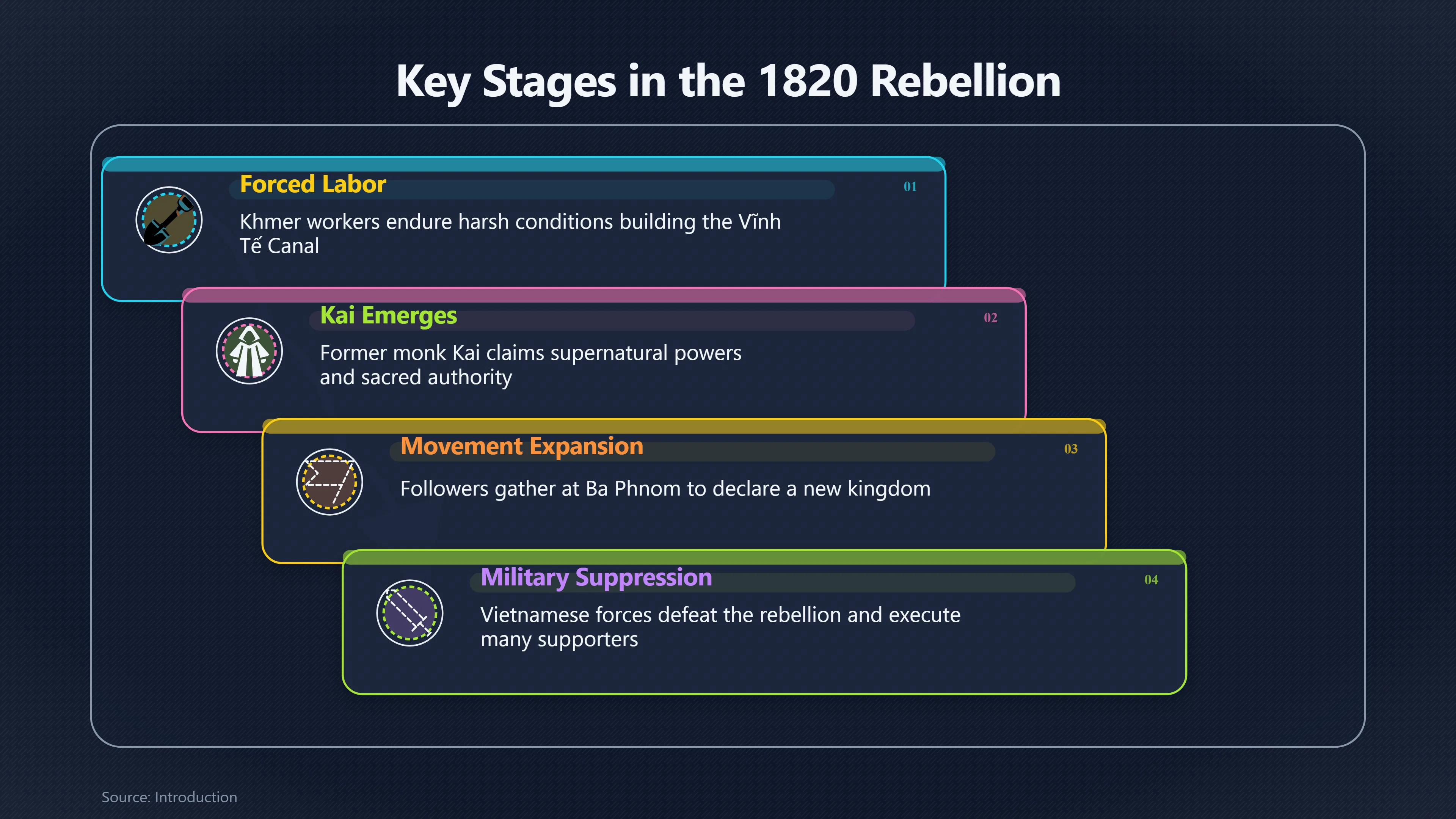
The most important Cambodian “holy man” uprising took place in 1820, during a period when Cambodia was caught between the competing influence of Vietnam and Siam. Vietnamese officials exercised increasing control over Cambodian affairs, while large public works, especially the construction of the Vĩnh Tế Canal, relied on forced labour from thousands of Khmer workers under extremely harsh conditions. Contemporary and later accounts link widespread suffering during these projects with growing resentment against Vietnamese rule.[Wikipedia]WikipediaCambodian rebellion (1820Cambodian rebellion (1820
Kai, a former Buddhist monk associated with Wat Sambaur, emerged as a charismatic religious leader claiming supernatural powers. Rather than presenting himself merely as a political commander, he established his authority through sacred reputation. He gathered followers at the ancient religious centre of Ba Phnom, declared himself king, and attracted monks, local officials and ordinary villagers to his cause. David P. Chandler’s classic study describes the revolt as the best-documented Cambodian “holy man’s rebellion” before French colonial rule and places it within a wider Southeast Asian tradition of Buddhist-inspired resistance movements.[Cambridge University Press & Assessment]cambridge.orgCambridge University Press & AssessmentAn Anti-Vietnamese Rebellion in Early Nineteenth Century Cambodia: Pre-colonial Imperialism and a…
The movement expanded rapidly across parts of south-eastern Cambodia. Some Cambodian military leaders defected to Kai, while King Ang Chan appealed to Vietnam for military assistance. Vietnamese forces eventually defeated the rebellion, Kai was killed, and many of his supporters, including monks, were executed or dispersed. The suppression strengthened Vietnamese military involvement in Cambodia rather than weakening it.[Wikipedia]WikipediaCambodian rebellion (1820Cambodian rebellion (1820
Why supernatural protection inspired followers
Modern readers can easily misunderstand claims that Kai’s followers believed themselves protected from bullets or blades. Such beliefs were not random fantasies but formed part of a long-established regional tradition linking moral purity, sacred authority and physical protection.
Across Cambodia, monks and ritual specialists prepared protective prayers, sacred diagrams and amulets that many people believed could shield the righteous from harm. Similar traditions existed in neighbouring Thailand and Laos. The promise of supernatural protection therefore rested upon familiar religious practices rather than entirely new doctrines.[ResearchGate]researchgate.netResearch Gate(PDF) Cambodian Buddhists' Response to the French ProtectorateResearchGate(PDF) Cambodian Buddhists' Response to the French ProtectorateJanuary 22, 2020…
In times of political collapse, these beliefs acquired additional meaning:
- Religious legitimacy: A holy man appeared more trustworthy than ordinary political leaders whose authority had failed.
- Moral renewal: Followers believed social disorder reflected moral corruption, and that righteous leadership could restore justice.
- Collective courage: Confidence in sacred protection reduced fear when confronting much stronger armies.
- Shared identity: Rituals, blessings and sacred symbols strengthened solidarity among people drawn from different villages and social backgrounds.
Millenarian expectations—the belief that history was approaching a dramatic transformation leading to a more just order—also encouraged participation. Rather than expecting personal salvation alone, many followers anticipated the renewal of the kingdom itself through a divinely favoured ruler.[Cambridge University Press & Assessment]cambridge.orgCambridge University Press & AssessmentEmbodied national history: leaders, regime change, and regional historiographical trends of indepe…

Why belief spread so quickly
The appeal of Kai’s movement cannot be separated from the conditions facing rural Cambodians.
Forced labour, taxation, displacement and foreign military intervention created widespread insecurity. Vietnamese administrative reforms also weakened older patterns of local authority and patronage. Under such circumstances, rumours of a holy leader able to restore justice travelled rapidly through existing religious networks centred on monasteries and village communities.[Angkor Database]angkordatabase.asiaAngkor Database A History of CambodiaAngkor Database A History of Cambodia
Buddhist monks occupied a unique social position. They were educators, ritual specialists and respected local figures. Although the Cambodian sangha as a whole did not endorse rebellion, the participation of some monks gave Kai’s movement religious credibility. This helps explain why historians describe the revolt as both political and religious without reducing it to either category alone.[Cambridge University Press & Assessment]cambridge.orgCambridge University Press & AssessmentAn Anti-Vietnamese Rebellion in Early Nineteenth Century Cambodia: Pre-colonial Imperialism and a…
More than one holy man
Kai’s rebellion established a pattern that reappeared later in the nineteenth century.
Former monk Po Kambo (also known as Achar Leak) led another major uprising during the 1860s against King Norodom and the emerging French protectorate. Like Kai, he drew upon millenarian ideas, accused rulers of failing their moral duties, and attracted thousands of followers, including monks and recognised holy men. His movement again combined political grievances with expectations that sacred leadership would transform society rather than merely replace one government with another.[Wikipedia]WikipediaAchar KhmerAchar Khmer
These recurring movements demonstrate that holy man rebellions were not isolated accidents but one recurring form of resistance during periods of profound political instability.
How historians distinguish revolt from cult
Modern scholarship avoids treating these movements simply as irrational outbreaks or “cults”. Several distinctions are important.
First, the movements addressed concrete political problems: foreign domination, forced labour, taxation and collapsing royal authority. Religious belief did not replace political aims; it provided the language through which those aims became meaningful.[Cambridge University Press & Assessment]cambridge.orgCambridge University Press & AssessmentAn Anti-Vietnamese Rebellion in Early Nineteenth Century Cambodia: Pre-colonial Imperialism and a…
Second, belief in supernatural protection was neither unique nor marginal within Cambodian society. Protective rituals, sacred inscriptions and blessed objects had long formed part of mainstream religious practice. The rebellions intensified existing traditions rather than inventing entirely new ones.[ResearchGate]researchgate.netResearch Gate(PDF) Cambodian Buddhists' Response to the French ProtectorateResearchGate(PDF) Cambodian Buddhists' Response to the French ProtectorateJanuary 22, 2020…
Third, historians compare Cambodia’s holy man rebellions with similar Buddhist millenarian movements elsewhere in mainland Southeast Asia, particularly in Thailand and Laos. These comparisons show recurring patterns: charismatic leaders claiming sacred authority, promises of moral renewal, confidence in supernatural protection and resistance to expanding states or colonial rule. The Cambodian experience therefore belongs to a broader regional history rather than representing an isolated national peculiarity.[Wikipedia]WikipediaHoly Man's RebellionHoly Man's Rebellion
Why these rebellions still matter
Holy man rebellions remain significant because they reveal how religion and politics became inseparable during one of Cambodia’s most difficult historical periods. Sacred authority gave ordinary villagers a framework for understanding foreign domination and social upheaval, while promises of supernatural protection made resistance appear both morally justified and practically possible.
Rather than dismissing these beliefs as simple superstition, historians see them as expressions of collective hope under extreme pressure. The movements illustrate how spiritual ideas could mobilise political action, showing that religious belief often became a language through which Cambodians articulated demands for justice, independence and legitimate rule.[Cambridge University Press & Assessment]cambridge.orgCambridge University Press & AssessmentAn Anti-Vietnamese Rebellion in Early Nineteenth Century Cambodia: Pre-colonial Imperialism and a…
Endnotes
1.
Source: cambridge.org
Link:https://www.cambridge.org/core/journals/journal-of-southeast-asian-studies/article/abs/an-antivietnamese-rebellion-in-early-nineteenth-century-cambodia-precolonial-imperialism-and-a-prenationalist-response/13EF3837803AAB0565B338D8A06E46DF
Source snippet
Cambridge University Press & AssessmentAn Anti-Vietnamese Rebellion in Early Nineteenth Century Cambodia: Pre-colonial Imperialism and a...
2.
Source: cambridge.org
Title: University Press & Assessment Journal of Southeast Asian Studies: Volume 6
Link:https://www.cambridge.org/core/journals/journal-of-southeast-asian-studies/volume/BCD2FEA14A033AE2EA06424E32FC4919
Source snippet
Cambridge University Press & AssessmentJournal of Southeast Asian Studies: Volume 6 - | Cambridge Core...
3.
Source: Wikipedia
Title: Cambodian rebellion (1820)
Link:https://en.wikipedia.org/wiki/Cambodian_rebellion_%281820%29
4.
Source: researchgate.net
Title: Research Gate(PDF) Cambodian Buddhists’ Response to the French Protectorate
Link:https://www.researchgate.net/publication/338753962_Cambodian_Buddhists%27_Response_to_the_French_Protectorate
Source snippet
ResearchGate(PDF) Cambodian Buddhists' Response to the French ProtectorateJanuary 22, 2020...
Published: January 22, 2020
5.
Source: cambridge.org
Link:https://www.cambridge.org/core/journals/international-journal-of-asian-studies/article/embodied-national-history-leaders-regime-change-and-regional-historiographical-trends-of-independent-cambodia/EAF4A6AF9A4703968E103AF591A25E8E
Source snippet
Cambridge University Press & AssessmentEmbodied national history: leaders, regime change, and regional historiographical trends of indepe...
6.
Source: cambridge.org
Link:https://www.cambridge.org/core/journals/journal-of-southeast-asian-studies/article/an-antivietnamese-rebellion-in-early-nineteenth-century-cambodia-precolonial-imperialism-and-a-prenationalist-response/13EF3837803AAB0565B338D8A06E46DF
Source snippet
Cambridge University Press & AssessmentAn Anti-Vietnamese Rebellion in Early Nineteenth Century Cambodia: Pre-colonial Imperialism and a...
7.
Source: Wikipedia
Title: History of Buddhism in Cambodia
Link:https://en.wikipedia.org/wiki/History_of_Buddhism_in_Cambodia
8.
Source: Wikipedia
Title: Achar Khmer
Link:https://en.wikipedia.org/wiki/Achar_Khmer
9.
Source: Wikipedia
Title: Holy Man’s Rebellion
Link:https://en.wikipedia.org/wiki/Holy_Man%27s_Rebellion
10.
Source: cambridge.org
Link:https://www.cambridge.org/core/journals/journal-of-the-royal-asiatic-society/article/abs/treason-and-loyalty-to-the-royal-court-the-kan-narrative-in-nineteenth-and-earlytwentiethcentury-khmer-chronicle-manuscripts/9C2BE96A1D836B1E45BCBC87D7386F4A
11.
Source: researchgate.net
Title: (PDF) Violence and Elias’s Historical Sociology: The Case of Cambodia
Link:https://www.researchgate.net/publication/321374050_Violence_and_Elias%27s_Historical_Sociology_The_Case_of_Cambodia
12.
Source: cambridge.org
Link:https://www.cambridge.org/core/journals/modern-asian-studies/article/abs/peasant-politics-in-cambodia-the-1916-affair/48301BC60B7F2FD80E8AAF0E3A617CBE
13.
Source: researchgate.net
Link:https://www.researchgate.net/publication/304925609_Buddhist_Perspective_on_Addressing_War-Displacement
14.
Source: angkordatabase.asia
Title: Angkor Database A History of Cambodia
Link:https://angkordatabase.asia/libs/docs/d.chandler-a-history-of-cambodia.pdf
Additional References
15.
Source: fliphtml5.com
Title: The Vinh Te Canal, in turn, later
Link:https://fliphtml5.com/heumk/zrba/A_History_of_Cambodia_4th_Edition_by_Devid_Chardler/
Source snippet
A History of Cambodia 4th Edition by Devid Chardler - Flipbook by Pisey Chun | FlipHTML5October 18, 2021 — P:162 THE CRISIS OF THE NINETE...
Published: October 18, 2021
16.
Source: youtube.com
Link:https://www.youtube.com/watch?v=Gy6DDzBy30U
Source snippet
Major Siamese–Vietnamese War in Cambodia (1831–1834)...
17.
Source: youtube.com
Link:https://www.youtube.com/watch?v=mHm-rjdveUE
Source snippet
Siam and Vietnam Fought Over Cambodia: 100 Years of Invasions and Puppets 18th–19th Century...
18.
Source: youtube.com
Title: Remembering Prince Sapphasitthiprasong: the modernizer of Ubon or its pacifier?
Link:https://www.youtube.com/watch?v=e_GZ0SC-U-U
Source snippet
The Broken Mandala: Siam's Failed Coup in Cambodia (1811–1813)...
19.
Source: youtube.com
Link:https://www.youtube.com/watch?v=HnpXXu_O7Jk
Source snippet
1794 – The Day Cambodia Lost Battambang and Siem Reap to Siam...
20.
Source: scribd.com
Link:https://www.scribd.com/presentation/635960010/Untitled
21.
Source: sciencedirect.com
Link:https://www.sciencedirect.com/science/article/pii/S2212420919312543
22.
Source: cambodgemag.com
Title: cambodia in the mid nineteenth century a heroic quest for survival 1840 1863
Link:https://www.cambodgemag.com/en/post/cambodia-in-the-mid-nineteenth-century-a-heroic-quest-for-survival
23.
Source: persee.fr
Title: VII I. La cérémonie de l’appel des esprits vitaux chez les Cambodgiens
Link:https://www.persee.fr/doc/befeo_0336-1519_1951_num
24.
Source: youtube.com
Link:https://www.youtube.com/watch?v=fMLiMB-wkTU
Topic Tree