Within India Panics
What Really Happened During Delhi's Monkey Man Panic?
Conflicting sightings of a mysterious attacker became one shared story that caused patrols, injuries and fatal falls across Delhi.
On this page
- How the sightings changed from witness to witness
- What injuries and medical reports established
- How newspapers and neighbourhood warnings sustained the scare
Page outline Jump by section
Introduction
In May 2001, Delhi experienced one of India’s best-known modern rumour panics. Reports of a mysterious “Monkey Man” attacking people at night spread rapidly across the capital and nearby suburbs, producing hundreds of claimed sightings, neighbourhood patrols, vigilante activity and several panic-related deaths. Yet despite the scale of the alarm, no verified attacker matching the popular descriptions was ever identified. Instead, the episode became a classic example of how uncertain observations, genuine minor injuries, sensational reporting and widespread anxiety can merge into a single shared narrative.

The Monkey Man panic remains important because it demonstrates how rumours can become self-reinforcing. Real injuries occurred, but the evidence rarely pointed to one identifiable creature. Instead, witness accounts became increasingly contradictory while fear itself generated further incidents, making it difficult for residents, police and journalists to distinguish between genuine assaults, accidents, hoaxes and imagination.[theguardian.com]theguardian.comThe Guardian'Monkey man' causes panic across Delhi | World news | The GuardianMay 17, 2001…
How the sightings changed from witness to witness
The first reports emerged from poorer districts of East Delhi before spreading across the wider city. Most alleged attacks occurred late at night, often between midnight and dawn, when many residents were sleeping outdoors or on rooftops because of the intense summer heat and frequent power cuts. Darkness, fatigue and heightened vigilance created ideal conditions for ambiguous experiences to be interpreted as evidence of the same mysterious attacker.[theguardian.com]theguardian.comThe Guardian'Monkey man' causes panic across Delhi | World news | The GuardianMay 17, 2001…
Descriptions quickly diverged instead of converging. Witnesses variously claimed the Monkey Man was:
- about four or five feet tall, although some estimated very different heights;
- covered in black hair;
- equipped with metal claws or steel fingernails;
- wearing a crash helmet or metal mask;
- possessing glowing red eyes;
- capable of extraordinary leaps between rooftops;
- in some accounts even wearing roller skates or having mechanical features.
Rather than weakening belief, these contradictions often strengthened the legend. Each new report added another detail, allowing almost any frightening experience at night to fit the evolving story. Police eventually considered the possibility that several pranksters or attackers were exploiting the panic rather than a single mysterious figure being responsible.[theguardian.com]theguardian.comThe Guardian'Monkey man' causes panic across Delhi | World news | The GuardianMay 17, 2001…
What injuries and medical reports actually established
One reason the rumour persisted was that many people did arrive at hospitals with visible injuries. However, the medical evidence proved far less dramatic than popular accounts suggested.
Doctors documented scratches, abrasions, bite marks and minor wounds. These injuries demonstrated that people had genuinely been hurt, but they did not establish the existence of an unknown creature. Police stated that examinations had produced no conclusive evidence identifying a unique attacker. Some doctors believed certain bites resembled animal bites, while many scratches were equally compatible with falls, contact with rough surfaces or attacks using ordinary objects.[The Guardian]theguardian.comThe Guardian'Monkey man' causes panic across Delhi | World news | The GuardianMay 17, 2001…
More serious harm resulted from panic itself than from any verified assault. Among the documented consequences were:
- people falling from rooftops after hearing cries that the Monkey Man had arrived;
- fatal falls down staircases while fleeing;
- injuries sustained during stampedes and frantic escapes;
- assaults on innocent people mistakenly believed to be the attacker.
These events illustrate an important distinction. The injuries and deaths were real, but they do not by themselves prove that a single mysterious assailant existed. Instead, many resulted directly from fear and confusion.[washingtonpost.com]washingtonpost.comThe Washington Post…
How newspapers and neighbourhood warnings sustained the scare
The Monkey Man story spread through a feedback loop between local communities, newspapers, television and police activity.
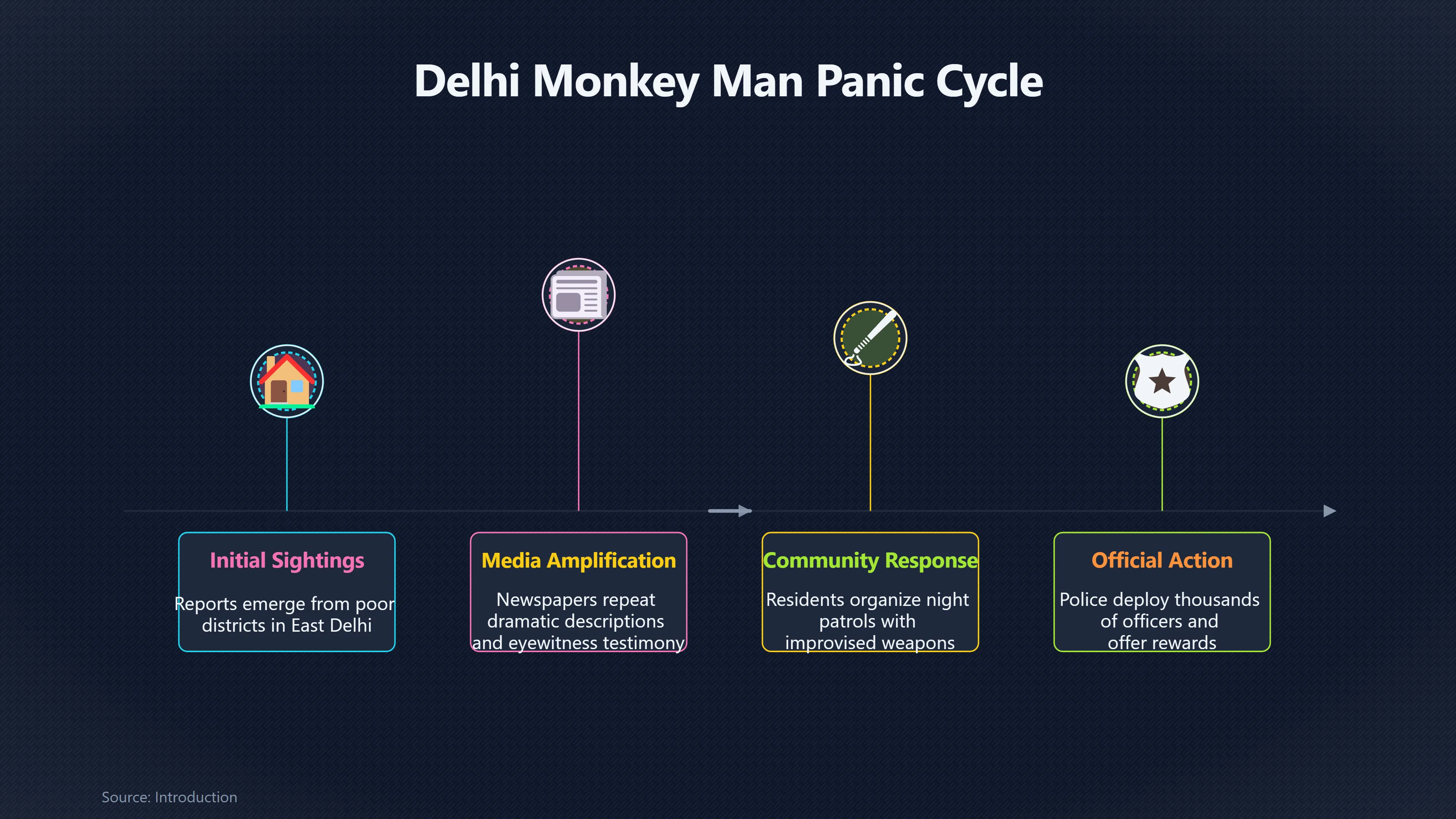
Every reported sighting became news. Coverage frequently highlighted eyewitness testimony while repeating dramatic descriptions of claws, glowing eyes and rooftop attacks. Residents then became more alert to unusual sounds or movements during the night. Fresh reports generated further headlines, encouraging still more witnesses to interpret uncertain experiences through the same narrative. Ravi Sundaram has described this as an example of urban media creating new “technologies of fear”, where continuous reporting and public discussion amplified the sense of danger even without definitive evidence.[OUP Academic]academic.oup.comOUP AcademicDanger, Media, and the Urban Experience in Delhi | Facing Fear: The History of an Emotion in Global Perspective | Princeton S…
Neighbourhood responses reinforced the cycle:
- residents organised night patrols armed with sticks and improvised weapons;
- families warned neighbours whenever suspicious noises were heard;
- strangers moving through residential areas after dark became objects of suspicion;
- police received hundreds of emergency calls that were difficult to verify.
The authorities responded by deploying thousands of additional officers and offering a reward for information leading to the capture of the supposed attacker. While intended to reassure the public, such measures also signalled that officials considered the reports serious enough to merit extraordinary action, unintentionally lending further credibility to the rumour.[The Washington Post]washingtonpost.comThe Washington Post…

Why investigators found no convincing evidence of a single attacker
Despite the large number of reports, investigators never recovered evidence expected from a single extraordinary assailant.
There were:
- no authenticated photographs;
- no consistent footprints or physical traces;
- no reliable pattern connecting all reported attacks;
- no agreement among eyewitnesses about appearance or behaviour.
Police increasingly suggested that several unrelated events had been merged into one story. Some incidents may have involved ordinary monkeys, which are common around Delhi. Others may have involved human attackers, opportunistic pranksters or fabricated reports. Still others probably reflected frightened interpretations of harmless encounters during dark, stressful nights.[theguardian.com]theguardian.comThe Guardian'Monkey man' causes panic across Delhi | World news | The GuardianMay 17, 2001…
The Washington Post reported that investigators judged most emergency calls to be hoaxes or mistaken observations, although officials did not completely rule out isolated criminal assaults taking advantage of the panic.[The Washington Post]washingtonpost.comThe Washington Post…

Why the rumour spread so effectively
Several social conditions made Delhi especially vulnerable to this particular panic.
First, the hottest weeks of May forced many residents, especially in poorer neighbourhoods, to sleep on rooftops or outdoors. This increased exposure to darkness, unfamiliar noises and sudden awakenings.
Second, frequent electricity cuts left large areas poorly lit, making it difficult to identify people, animals or ordinary movements.
Third, Delhi was undergoing rapid urban growth. Many communities had weak trust in official information, while rumours travelled quickly through neighbourhood networks long before they could be checked.
Finally, continuous media attention transformed scattered incidents into what appeared to be a single city-wide threat. Rather than calming fears, every new report suggested the attacker had struck again somewhere else.[washingtonpost.com]washingtonpost.comThe Washington Post…
What the Monkey Man panic tells us about rumour evidence
The Delhi Monkey Man episode remains one of India’s clearest examples of a rumour panic because it combines genuine evidence with profound uncertainty.
Several conclusions are well supported:
- people genuinely suffered injuries and several died in panic-related accidents;
- police devoted substantial resources to investigating reports;
- witness descriptions became increasingly inconsistent as the story spread;
- no convincing physical evidence ever established the existence of the creature described in popular accounts.
For historians, psychologists and media scholars, the lasting lesson is not whether a mysterious attacker existed, but how communities construct certainty under conditions of fear. Ambiguous injuries, repeated storytelling and widespread expectation gradually transformed isolated incidents into a shared city-wide belief. The Monkey Man panic therefore stands as an important case study in the relationship between rumour, media amplification and collective fear in modern urban India.[oup.com]academic.oup.comOUP AcademicDanger, Media, and the Urban Experience in Delhi | Facing Fear: The History of an Emotion in Global Perspective | Princeton S…
Amazon book picks
Further Reading
Books and field guides related to What Really Happened During Delhi's Monkey Man Panic?. Use these as the next step if you want deeper reading beyond the article.
Extraordinary Popular Delusions and the Madness of Crowds
Rating: 4.0/5 from 5 Google Books ratings
Excellent match for rumor-driven urban panic.

Endnotes
1.
Source: academic.oup.com
Link:https://academic.oup.com/princeton-scholarship-online/book/15980/chapter/170925623
Source snippet
OUP AcademicDanger, Media, and the Urban Experience in Delhi | Facing Fear: The History of an Emotion in Global Perspective | Princeton S...
2.
Source: deseret.com
Title: News’Monkey man’ hoax is blamed on gang – Deseret News
Link:https://www.deseret.com/2001/5/18/19586831/monkey-man-hoax-is-blamed-on-gang/
Source snippet
Deseret News'Monkey man' hoax is blamed on gang – Deseret News...
3.
Source: academic.oup.com
Link:https://academic.oup.com/chicago-scholarship-online/book/17840/chapter/175614132
4.
Source: academic.oup.com
Link:https://academic.oup.com/princeton-scholarship-online/book/15980/chapter-abstract/170925623
5.
Source: theguardian.com
Title: The Guardian’Monkey man’ causes panic across Delhi | World news | The Guardian
Link:https://www.theguardian.com/world/2001/may/18/lukeharding
Source snippet
May 17, 2001...
Published: May 17, 2001
6.
Source: washingtonpost.com
Link:https://www.washingtonpost.com/archive/politics/2001/05/21/monkey-man-lurks-among-new-delhis-poor-or-at-least-in-their-minds/eace3021-0cc6-44ef-be2c-fee75cb35e77/
Source snippet
The Washington Post...
7.
Source: skepticalinquirer.org
Title: Skeptical Inquirer The Monkey Man Panic: 20 Years Later | Skeptical Inquirer
Link:https://skepticalinquirer.org/exclusive/the-monkey-man-panic-20-years-later/
8.
Source: telegraphindia.com
Title: Telegraph India MONKEY-MAN PHOBIA TURNS FATAL
Link:https://www.telegraphindia.com/india/monkey-man-phobia-turns-fatal/cid/931290
Source snippet
Telegraph IndiaMONKEY-MAN PHOBIA TURNS FATAL - Telegraph India...
9.
Source: telegraphindia.com
Title: MONKE Y-MAN TURNS DELHI INTO LYNCH MOB
Link:https://www.telegraphindia.com/india/monkey-man-turns-delhi-into-lynch-mob/cid/931381
10.
Source: abcnews.go.com
Link:https://abcnews.go.com/International/story?id=81072&page=1
11.
Source: telegraphindia.com
Title: CRAC K TEAM TO TRACK ‘MONKEY MAN’
Link:https://www.telegraphindia.com/india/crack-team-to-track-monkey-man/cid/930899
12.
Source: abcnews.go.com
Link:https://abcnews.go.com/International/story?id=81077&page=1
Additional References
13.
Source: amrita.edu
Title: A Study on Mass Hysteria (Monkey Men?) Victims in East Delhi
Link:https://www.amrita.edu/publication/a-study-on-mass-hysteria-monkey-men-victims-in-east-delhi/
Source snippet
Amrita Vishwa VidyapeethamJanuary 7, 2026 — A STUDY ON MASS HYSTERIA (MONKEY MEN?) VICTIMS IN EAST DELHI Publication Type: Journal Artic...
Published: January 7, 2026
14.
Source: knowledgeableresearch.com
Title: MAIN ARTICLE CONTENT
Link:https://knowledgeableresearch.com/index.php/1/article/view/385
Source snippet
MASS HYSTERIA: THE CASE OF MONKEY MAN IN DELHI | Knowledgeable Research A Multidisciplinary JournalAugust 30, 2024 — MASS HYSTERIA: THE C...
Published: August 30, 2024
15.
Source: youtube.com
Link:https://www.youtube.com/watch?v=feyj-bIlGTs
Source snippet
The Truth Behind Karachi's Chadda Group & Delhi's Monkey Man | Nukta True Crime...
16.
Source: youtube.com
Title: Hysteria amid reports of “monkey man” attacking sleepers
Link:https://www.youtube.com/watch?v=viSUe9zNU8o
Source snippet
Monkey Man Delhi 2001 Story | Monkey man delhi case | Kala Bandar Ka Sach...
17.
Source: youtube.com
Title: Fake News Causing Mass Hysteria: Case Study of Monkey Man
Link:https://www.youtube.com/watch?v=ukAt2KnAPJg
Source snippet
Unsolved mystery case: Delhi's Monkey Man | Amazing facts...
18.
Source: youtube.com
Title: Unsolved mystery case: Delhi’s Monkey Man | Amazing facts
Link:https://www.youtube.com/watch?v=G4KS25bYBv4
Source snippet
Hysteria amid reports of "monkey man" attacking sleepers...
19.
Source: en-academic.com
Link:https://en-academic.com/dic.nsf/enwiki/530680
21.
Source: independent.co.uk
Link:https://www.independent.co.uk/news/world/asia/two-die-as-dehli-monkey-man-stalks-the-slums-5365046.html
22.
Source: researchgate.net
Title: (PDF) A study on mass hysteria (monkey men?) victims in East Delhi
Link:https://www.researchgate.net/publication/10591905_A_study_on_mass_hysteria_monkey_men_victims_in_East_Delhi
Topic Tree