When Religious Controversy Became a National Crisis
Mauritania does not have a well-documented history of classic “mass hysteria” episodes such as dancing plagues, mass school fainting or large apocalyptic sects.
Page outline Jump by section
Introduction
Three cases are especially revealing. In 2012, anti-slavery activist Biram Dah Abeid burned legal texts that he said had been used to justify slavery, prompting accusations of apostasy and demands for punishment. From 2014, blogger Mohamed Cheikh Ould Mkhaitir’s criticism of religious arguments for racial hierarchy led to a death sentence and years of public mobilisation. In 2017–18, warnings about a supposed “Shia tide” helped frame a small minority movement as a national danger and preceded the closure of a Shia religious centre.[unpo.org]unpo.orgArrest of Mauritanian Anti-Slavery LeaderArrest of Mauritanian Anti-Slavery LeaderJune 2, 2012 — On 29 April 2012, Biram Ould Dah Ould Abeid was arrested at his home in conne…
These were not outbreaks of imaginary symptoms, nor should ordinary Mauritanian religious life be described as cultic. They are better understood as moral panics and struggles over authority: moments when genuine religious feeling became entangled with racial inequality, political rivalry, regional geopolitics and fears that accepted boundaries were being deliberately breached.
Why the evidence is unusually thin
Mauritania rarely appears in international catalogues of witch trials, mass psychogenic illness or millenarian movements. Searches of medical and historical literature reveal no securely documented Mauritanian equivalent of the school-based fainting outbreaks reported elsewhere in Africa. That absence matters. It means the country should not be given a dramatic folklore of “mass hysteria” merely because similar events occurred in neighbouring regions.
There are several reasons for the patchy record. Much Mauritanian history has been preserved through religious scholarship, family memory and oral transmission rather than through the kinds of police, medical and newspaper archives used to reconstruct European witch panics. Modern press freedom has also been constrained, while internet restrictions during periods of unrest have sometimes limited reporting and public verification. International coverage tends to concentrate on slavery, elections, security and human rights, leaving everyday rumours and local scares poorly recorded.[academia.edu]academia.eduPDF) The History of Islam in MauritaniaAcademia(PDF) The History of Islam in MauritaniaJanuary 1, 2019 — 23 Dec 2019 — The paper discusses the historical trajectory of Islam in…
The available evidence therefore supports a careful conclusion: Mauritania’s clearest collective-belief episodes concern contested religious identity, not epidemic illness or organised doomsday communities. Even within those cases, language such as “panic”, “sect” or “extremism” must be treated as part of the dispute rather than accepted as a neutral description.
When anti-slavery protest became a religious emergency
The 2012 book burning
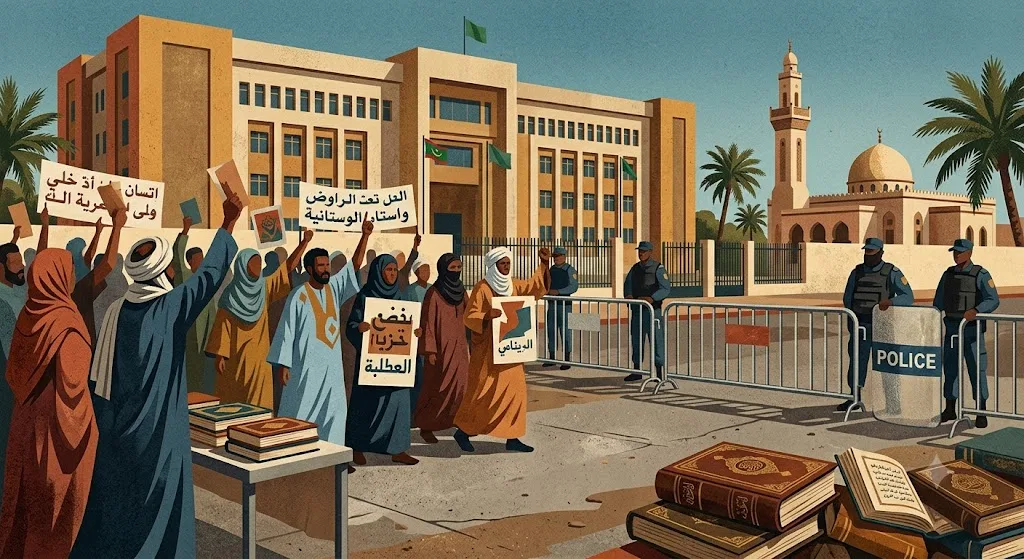
On 28 April 2012, Biram Dah Abeid and fellow members of the Initiative for the Resurgence of the Abolitionist Movement publicly burned works of Islamic jurisprudence in a Nouakchott suburb. Abeid argued that passages in the books had been used to legitimise enslavement, sexual exploitation and inherited social hierarchy. Accounts sympathetic to the activists say they removed pages containing Qur’anic passages and references to the name of God before setting the remaining material alight. He was arrested the following day.[UNPO]unpo.orgArrest of Mauritanian Anti-Slavery LeaderArrest of Mauritanian Anti-Slavery LeaderJune 2, 2012 — On 29 April 2012, Biram Ould Dah Ould Abeid was arrested at his home in conne…
The distinction between scripture and legal commentary was central to the action, but it was easily lost in the public reaction. Reports and sermons described the event as an attack on Islam itself. Newspapers and religious voices called Abeid a heretic, crowds demonstrated, and some participants demanded his death. Abeid later said that a rumour identifying him as an Israeli agent was also circulated, turning an internal argument about slavery and religious law into a story about foreign subversion.[The New Yorker]newyorker.comDespite the country's 1981 abolishment of slavery and a 2007 law allowing slaveholder prosecution under international pressure, slavery p…
This episode had the structure of a moral panic even though it grew from a real, deliberately provocative act. A symbolic boundary had been crossed; commentators warned that a sacred order was under attack; the alleged offender was recast as an enemy of the whole community; and demands for exemplary punishment spread faster than detailed discussion of what the books contained.
Yet the reaction was never unanimous. Abeid’s supporters, especially among Haratin communities historically associated with inherited servitude, saw the burning as a challenge to the misuse of religion by powerful families and scholars. His organisation mounted protests of its own, while the dispute forced the public to confront the uncomfortable relationship between religious authority, race and slavery. Mauritanian faith was therefore not simply the fuel of the scare. It was also the language through which abolitionists claimed dignity and moral legitimacy.[merip.org]merip.orgthe importance of mauritanian scholars in global islamThe Importance of Mauritanian Scholars in Global Islam13 Apr 2021 — The history of Mauritanian scholars and their significant influe…
The episode is sometimes retold as if Abeid burned the Qur’an. The surviving reports do not support that description. The targets were legal and interpretative works which the activists believed had been used to defend slavery. That difference does not make the act uncontroversial, but it changes what happened: it was an attack on particular traditions of interpretation, not evidence of an anti-religious cult or a campaign to destroy Islam.

The blogger case and the escalation of blasphemy fear
In January 2014, Mohamed Cheikh Ould Mkhaitir published an article examining how episodes from early Islamic history had been invoked selectively to reinforce discrimination in Mauritania. The essay was connected to the marginalisation of the country’s lower-status artisan community and to the wider problem of racial and inherited hierarchy. It was widely interpreted not as a social critique but as an insult to the Prophet. Mkhaitir was arrested, prosecuted for apostasy and sentenced to death in December 2014.[Human Rights Watch]hrw.orgmauritania quash blogger mkhaitirs death sentenceHuman Rights WatchMauritania: Quash Blogger Mkhaitir's Death Sentence7 Nov 2017 — He spent 12 months in pretrial detention, and a court s…
The case produced sustained mobilisation rather than a single spontaneous riot. Religious leaders publicly demanded that the sentence be carried out, and demonstrations accompanied important stages of the proceedings. Reuters reported in 2016 that clerics were still urging his execution two years after the original judgment. Mkhaitir apologised and said that he had not intended to insult Islam, but the controversy had acquired a life beyond the article itself.[Reuters]reuters.comMauritanian clerics urge for blogger's death penalty to beMauritanian clerics urge for blogger's death penalty to be
Several forces helped the alarm endure. First, accusations of blasphemy concerned a boundary regarded by many people as fundamental to Mauritanian identity. Second, the dispute was communicated through online publication, sermons, political statements and street protest, allowing each new legal hearing to reactivate it. Third, the article touched the same explosive question raised by Abeid: whether religious tradition was being used to protect racial privilege. The dispute could therefore be presented either as a defence of the faith or as an attempt to silence criticism of hierarchy.
In November 2017, an appeal court replaced the death sentence with a two-year term and a fine. Because Mkhaitir had already spent nearly four years in custody, the ruling should have led to his release. Instead, he remained detained in an undisclosed location until July 2019, apparently because the authorities feared renewed public disorder and threats to his safety.[amnesty.org]amnesty.orgInternational Mauritania: Death penalty for Facebook blogger quashedInternational Mauritania: Death penalty for Facebook blogger quashed
The legal outcome did not moderate the wider political response. In 2018, Mauritania amended article 306 of its penal code so that certain blasphemy and apostasy offences carried a mandatory death sentence and repentance would no longer necessarily prevent execution. United Nations experts later said that these provisions conflicted with international protections for life, belief and expression. The death penalty has not been carried out for such an offence in modern Mauritania, but its presence in law gives public accusations unusually high stakes.[ohchr.org]ohchr.orghuman rights committee considers civil and political rights mauritaniahuman rights committee considers civil and political rights mauritania
Calling this simply “religious hysteria” would obscure both the sincerity of public offence and the political conditions that magnified it. The more precise description is a blasphemy-centred moral panic: an episode in which one text came to symbolise an alleged attack on society, punishment became a public test of loyalty, and the state hardened the law partly under pressure to demonstrate religious commitment.
The fear of a “Shia tide”
A different type of scare emerged around the small Shia Muslim presence in Mauritania. From the mid-2010s, religious and political voices across Sunni North Africa warned that Iran was spreading Shia doctrine through cultural centres, schools, social media and charitable networks. In Mauritania, the country’s grand mufti was reported as calling on the authorities to resist a rising Shia “tide”. The metaphor implied not ordinary conversion by individuals, but an organised influx capable of overwhelming the established religious order.[Reuters]reuters.comCommentary: In Sunni North Africa, fears of Iran's Shi'iteCommentary: In Sunni North Africa, fears of Iran's Shi'ite
On 28 May 2018, Mauritanian authorities closed the Ali bin Abi Talib religious complex in Nouakchott’s Dar al-Na’im district. The state removed its imam and placed the mosque under the Ministry of Islamic Affairs. Contemporary reporting linked the action to accusations that the centre promoted Shia teaching, although official accounts also referred to regulatory control and the protection of national religious unity.[state.gov]state.govMAURITANIA 2018 INTERNATIONAL RELIGIOUS FREEDOM REPORTMAURITANIA 2018 INTERNATIONAL RELIGIOUS FREEDOM REPORT
Evidence that Mauritania faced a large, coordinated Shia takeover was weak. Reports described a small minority and a limited number of centres, not a mass movement with the capacity suggested by words such as “invasion” or “tide”. The alarm drew much of its force from regional politics: competition between Iran and Sunni Arab governments, the wars in Syria and Yemen, and wider North African anxiety that sectarian difference could become a channel for foreign influence.[carnegieendowment.org]carnegieendowment.orgCarnegie Endowment Sectarian Dilemmas in Iranian Foreign PolicyCarnegie Endowment Sectarian Dilemmas in Iranian Foreign Policy
This does not prove that Iranian institutions had no interest in religious outreach. It shows that a question about a minor religious network was framed in the language of national survival. The resulting response restricted worship and reinforced the idea that a Mauritanian citizen’s religious identity should remain within officially accepted Sunni boundaries.
The case also demonstrates why the label “cult” is misleading. Shia Islam is a major global branch of Islam, not a secretive new religious movement. Describing Mauritanian Shia believers as a cult would reproduce the hostile language of their opponents. The historically significant phenomenon is the panic about sectarian penetration, not the existence of the minority itself.
Sacred authority, race and the state
The book-burning and blogger controversies were not isolated arguments about doctrine. Both challenged ways in which religious interpretation had been connected to Mauritania’s social hierarchy. Haratin anti-slavery activists have argued that inherited servitude survived partly because selected legal traditions were treated as sacred and beyond criticism. Their opponents often responded that attacks on those traditions were attacks on Islam, converting disputes about power into tests of belief.[merip.org]merip.orgthe importance of mauritanian scholars in global islamThe Importance of Mauritanian Scholars in Global Islam13 Apr 2021 — The history of Mauritanian scholars and their significant influe…
Mauritania’s status as an Islamic republic gives such contests an institutional dimension. Islam is not merely the majority religion but part of the state’s constitutional identity. The government regulates religious institutions, restricts non-Muslim proselytising and requires authorisation for many forms of religious assembly. This makes the state both an arbiter of acceptable belief and a political actor with an incentive to prove that it is defending the faith.[State Department]2021-2025.state.govOpen source on state.gov.
That arrangement can turn public outrage into policy. When rulers face accusations of tolerating sacrilege or foreign sectarian influence, arrests, closures and stricter laws offer visible demonstrations of authority. At the same time, officials may fear that releasing an accused person will lead to violence. Mkhaitir’s continued confinement after his sentence had expired shows how a state can present detention as protection while still denying the prisoner liberty.[FIDH]fidh.orgmauritania blogger still detained one year after court decisionmauritania blogger still detained one year after court decision
Religious alarm can also be politically selective. Abeid and Mkhaitir were socially marginal figures challenging entrenched inequality. Their critics could defend established power while claiming only to defend religion. This does not mean every offended protester was consciously protecting slavery or discrimination. It means that moral panics often allow very different motives—faith, fear, class interest, racial loyalty and political calculation—to converge on the same target.

Rumour, outrage and contagious belief
Mauritania’s best-documented scares spread through a mixture of sermons, street protest, news websites and social media. The process resembles other moral panics even where the original incident is undisputed:
- A boundary-crossing act occurs. A book is burned, an article is published or a minority centre becomes visible.
- The act is simplified. Complex criticism of legal interpretation becomes “insulting Islam”; a small minority becomes an advancing “tide”.
- Motives are enlarged. The accused person is linked to foreign enemies, hidden agendas or a broad attack on national identity.
- Public loyalty is tested. Clerics, officials and citizens are pressed to demand punishment or risk appearing indifferent.
- Institutions respond symbolically. Arrests, prolonged detention, closures and harsher laws reassure the public that the boundary will be defended.
This model does not require the public to be irrational. People may begin with genuine moral concern. The panic develops when uncertainty is replaced by the most threatening interpretation, dissent is treated as proof of disloyalty, and punishment becomes more important than establishing intention or proportionality.
Rumours are especially potent in such settings because they solve an explanatory problem. If an activist who identifies as Muslim attacks religious books, opponents need a reason why. A story that he is secretly directed by Israel or another outside power makes the contradiction disappear. The rumour is persuasive not because it is well evidenced, but because it fits an existing picture of sacred community threatened by concealed enemies. Abeid’s account of being labelled an Israeli agent is a clear example of this mechanism.[The New Yorker]newyorker.comDespite the country's 1981 abolishment of slavery and a 2007 law allowing slaveholder prosecution under international pressure, slavery p…
What should not be called mass hysteria
“Mass hysteria” has often been used loosely for any crowd whose conduct appears emotional or extreme. That usage is unhelpful in Mauritania. In medicine, the more precise term mass psychogenic illness describes the spread of real physical symptoms through a group without an identified toxic or infectious cause. Typical cases involve fainting, dizziness, nausea, breathing difficulty or involuntary movement in schools, factories or other close communities.[nih.gov]pmc.ncbi.nlm.nih.govOpen source on nih.gov.
No comparably well-supported Mauritanian outbreak appears in the accessible medical literature. Public demonstrations over blasphemy were collective behaviour, but they were not collective illness. Nor were they delusions in the strict sense: books really were burned, an article really was published and a Shia centre really existed. The disputed elements concerned meaning, intention, scale and danger.
The cases are therefore better separated into three categories:
- Moral panic: a perceived threat to shared values is amplified and concentrated on a person or minority.
- Rumour panic: unverified claims about hidden agents or conspiracies increase hostility and fear.
- Political-religious mobilisation: leaders and organisations use religious language to organise support, demand policy or challenge opponents.
These categories can overlap, but they prevent the lazy conclusion that intense belief is itself a psychiatric condition.
What remains unproven
Claims about Mauritanian “cults”, secret sorcerers or mass possession should be treated sceptically unless they can be tied to contemporary records, named witnesses or reliable scholarship. Regional folklore about spirits, healing and occult harm is not evidence of a national witch panic. Nor does the presence of respected religious teachers, Sufi traditions or devotional communities make them cults.
The same caution applies to state descriptions of dangerous sectarian activity. Government action proves that officials perceived or presented a threat; it does not prove the threat existed at the scale alleged. In the Shia-centre case, the closure is documented, but claims of a coordinated religious takeover rest largely on rhetoric about Iranian influence rather than transparent evidence of mass conversion or subversion.[U.S. Department of State]2017-2021.state.govDepartment of State2018 Report on International Religious Freedom: MauritaniaOn May 28, government authorities closed a Shia religious ce…
Likewise, human-rights reporting on the Mkhaitir case establishes the sentence, detention and threats, but it cannot measure exactly how widely demands for execution were shared. Visible demonstrations and prominent clerical statements may dominate coverage while quieter disagreement remains under-recorded. Mauritanian society should not be portrayed as a single enraged crowd.
Why these episodes matter
Mauritania’s history of collective fear is important because it shows how accusations of sacrilege can police more than theology. They can determine who may question racial hierarchy, which interpretations of religion may be debated, and whether minority beliefs are permitted to appear in public.
The 2012 and 2014 controversies also reveal a struggle within religion rather than a simple conflict between belief and unbelief. Abeid and Mkhaitir challenged what they saw as the misuse of Islam to preserve inequality. Their opponents treated the challenges as offences against Islam itself. The central question was therefore who had the authority to define authentic faith—and whose social interests that definition protected.
The consequences were concrete. People were imprisoned, threatened with death or held beyond completed sentences. A minority religious centre was closed. Penal law was tightened so that speech judged blasphemous could carry a mandatory death sentence. International bodies repeatedly criticised these measures, but the legal framework remained a powerful warning to writers, activists and religious minorities.[ohchr.org]ohchr.orghuman rights committee considers civil and political rights mauritaniahuman rights committee considers civil and political rights mauritania
Mauritania offers no reliable catalogue of spectacular dancing plagues, UFO religions or mass school illnesses. Its more sobering story concerns the contagious power of accusation: how one article, one symbolic protest or one small religious community can be transformed into evidence that the entire moral order is under siege. Understanding that process requires neither dismissing faith nor accepting every claim made in its defence. It requires separating documented harm from rumour, religious conviction from coercive mobilisation, and genuine disagreement from the panic-driven demand that only punishment can restore society.
Amazon book picks
Further Reading
Books and field guides related to When Religious Controversy Became a National Crisis. Use these as the next step if you want deeper reading beyond the article.
The New Jim Crow
Useful background on how legal systems can reinforce social hierarchy.
Folk Devils and Moral Panics the Creation of the Mods and Roc...
First published 1972. Subjects: Youth, great britain, Deviant behavior, Case studies, Subculture, Young adults.
Endnotes
1.
Source: unpo.org
Title: Arrest of Mauritanian Anti-Slavery Leader
Link:https://www.unpo.org/downloads/473.pdf
Source snippet
Arrest of Mauritanian Anti-Slavery LeaderJune 2, 2012 — On 29 April 2012, Biram Ould Dah Ould Abeid was arrested at his home in conne...
Published: June 2, 2012
2.
Source: 2017-2021.state.gov
Link:https://2017-2021.state.gov/reports/2018-report-on-international-religious-freedom/mauritania/
Source snippet
Department of State2018 Report on International Religious Freedom: MauritaniaOn May 28, government authorities closed a Shia religious ce...
3.
Source: academia.edu
Title: (PDF) The History of Islam in Mauritania
Link:https://www.academia.edu/41412063/The_History_of_Islam_in_Mauritania
Source snippet
Academia(PDF) The History of Islam in MauritaniaJanuary 1, 2019 — 23 Dec 2019 — The paper discusses the historical trajectory of Islam in...
Published: January 1, 2019
4.
Source: merip.org
Title: the importance of mauritanian scholars in global islam
Link:https://www.merip.org/2021/04/the-importance-of-mauritanian-scholars-in-global-islam/
Source snippet
The Importance of Mauritanian Scholars in Global Islam13 Apr 2021 — The history of Mauritanian scholars and their significant influe...
5.
Source: reuters.com
Title: mauritania condemns man to death for insulting the prophet id USKBN0K30OP
Link:https://www.reuters.com/article/world/mauritania-condemns-man-to-death-for-insulting-the-prophet-idUSKBN0K30OP/
6.
Source: reuters.com
Title: Mauritanian clerics urge for blogger’s death penalty to be
Link:https://www.reuters.com/article/us-mauritania-trial/mauritanian-clerics-urge-for-bloggers-death-penalty-to-be-applied-idUSKBN1380P0/?il=0
7.
Source: amnesty.org
Title: International Mauritania: Death penalty for Facebook blogger quashed
Link:https://www.amnesty.org/en/latest/news/2017/11/mauritania-death-penalty-for-facebook-blogger-quashed/
8.
Source: fidh.org
Title: mauritania blogger still detained one year after court decision
Link:https://www.fidh.org/en/issues/human-rights-defenders/mauritania-blogger-still-detained-one-year-after-court-decision
9.
Source: ohchr.org
Title: human rights committee considers civil and political rights mauritania
Link:https://www.ohchr.org/en/press-releases/2019/07/human-rights-committee-considers-civil-and-political-rights-mauritania
10.
Source: docstore.ohchr.org
Link:https://docstore.ohchr.org/SelfServices/FilesHandler.ashx?enc=xnje1v1ByEScOhkSCtWU6ISKmQNjpUtX7XVvyDfJ6MB7co7Yfcx6pMr4Ccn26M0NygY3VU22%2B%2FqPzQ%2FoXLz9lA%3D%3D
11.
Source: 2021-2025.state.gov
Link:https://2021-2025.state.gov/reports/2023-report-on-international-religious-freedom/mauritania/
12.
Source: reuters.com
Title: Commentary: In Sunni North Africa, fears of Iran’s Shi’ite
Link:https://www.reuters.com/article/opinion/commentary-in-sunni-north-africa-fears-of-irans-shiite-shadow-idUSKBN1CV36U/
13.
Source: state.gov
Title: MAURITANIA 2018 INTERNATIONAL RELIGIOUS FREEDOM REPORT
Link:https://www.state.gov/wp-content/uploads/2019/05/MAURITANIA-2018-INTERNATIONAL-RELIGIOUS-FREEDOM-REPORT.pdf
14.
Source: pmc.ncbi.nlm.nih.gov
Link:https://pmc.ncbi.nlm.nih.gov/articles/PMC7396040/
15.
Source: humanists.uk
Link:https://humanists.uk/2026/07/07/humanists-uk-calls-on-mauritania-to-repeal-blasphemy-laws-at-un/
16.
Source: uprdoc.ohchr.org
Link:https://uprdoc.ohchr.org/uprweb/downloadfile.aspx?file=EnglishTranslation&filename=15079
17.
Source: tbinternet.ohchr.org
Title: Download Draft.aspx
Link:https://tbinternet.ohchr.org/_layouts/15/TreatyBodyExternal/DownloadDraft.aspx?key=Akwd%2FdqmJFfPWcktvLoaQHwvVVGFXtmabgk1HkCWR0ZHTqPNvngehFAOj4qYBcnv
18.
Source: uprdoc.ohchr.org
Link:https://uprdoc.ohchr.org/uprweb/downloadfile.aspx?file=EnglishTranslation&filename=8168
19.
Source: academia.edu
Link:https://www.academia.edu/4593752/Of_Women_and_Witches_A_Case_Study_in_Moral_Panics
20.
Source: reuters.com
Link:https://www.reuters.com/world/africa/three-die-mauritanian-detention-after-post-election-protests-ministry-says-2024-07-02/
21.
Source: reuters.com
Link:https://www.reuters.com/article/world/freed-anti-slavery-campaigner-says-he-will-run-for-mauritania-presidency-idUSKCN0YA0II/
22.
Source: reuters.com
Link:https://www.reuters.com/article/world/activists-warn-over-slavery-as-mauritania-joins-un-human-rights-council-idUSKCN20K2GR/
23.
Source: reuters.com
Link:https://www.reuters.com/video/watch/idRW108909042026RP1/
24.
Source: reuters.com
Link:https://www.reuters.com/article/world/as-slavery-evolves-in-mauritania-silent-victims-prove-harder-to-find-idUSKCN1NC02R/
25.
Source: reuters.com
Title: mauritanians march over koran desecration idUSJOEA2300Q
Link:https://www.reuters.com/article/world/mauritanians-march-over-koran-desecration-idUSJOEA2300Q/
26.
Source: history.com
Title: salem witch trials hysteria factors
Link:https://www.history.com/articles/salem-witch-trials-hysteria-factors
27.
Source: amnesty.org
Link:https://www.amnesty.org/en/documents/afr38/9716/2019/en/
28.
Source: humanists.international
Title: iheu condemns death sentence for apostasy handed to writer in mauritania
Link:https://humanists.international/2015/01/iheu-condemns-death-sentence-for-apostasy-handed-to-writer-in-mauritania/
29.
Source: humanists.international
Link:https://humanists.international/advocacy-statement/apostasy-and-blasphemy-laws-in-africa/
30.
Source: hrw.org
Title: mauritania quash blogger mkhaitirs death sentence
Link:https://www.hrw.org/news/2017/11/07/mauritania-quash-blogger-mkhaitirs-death-sentence
Source snippet
Human Rights WatchMauritania: Quash Blogger Mkhaitir's Death Sentence7 Nov 2017 — He spent 12 months in pretrial detention, and a court s...
31.
Source: newyorker.com
Link:https://www.newyorker.com/magazine/2014/09/08/freedom-fighter
Source snippet
Despite the country's 1981 abolishment of slavery and a 2007 law allowing slaveholder prosecution under international pressure, slavery p...
32.
Source: history.wisc.edu
Link:https://history.wisc.edu/people/esseissah-khaled/
33.
Source: carnegieendowment.org
Title: Carnegie Endowment Sectarian Dilemmas in Iranian Foreign Policy
Link:https://carnegieendowment.org/russia-eurasia/research/2016/11/sectarian-dilemmas-in-iranian-foreign-policy-when-strategy-and-identity-politics-collide
34.
Source: thecairoreview.com
Title: The Cairo Review of Global Affairs Sectarianism and the New Shiism
Link:https://www.thecairoreview.com/tahrir-forum/sectarianism-and-the-new-shiism/
35.
Source: sajp.org.za
Link:https://sajp.org.za/index.php/sajp/article/view/1671/2648
36.
Source: facebook.com
Title: the halloween witch is one of the most enduring images in western pop culture bu
Link:https://www.facebook.com/ucsantabarbara/posts/the-halloween-witch-is-one-of-the-most-enduring-images-in-western-pop-culture-bu/1230279545803925/
37.
Source: facebook.com
Link:https://www.facebook.com/humanists.uk/posts/at-a-un-review-of-its-human-rights-record-at-the-un-mauritania-pledged-to-reform/1450633110430872/
38.
Source: facebook.com
Link:https://www.facebook.com/PakistanTVGlobal/posts/irans-greatest-source-of-influence-is-its-historic-cultural-religious-and-ideolo/1451676816984125/
39.
Source: facebook.com
Link:https://www.facebook.com/groups/museodellereligioni/posts/7535791133182137/
40.
Source: facebook.com
Link:https://www.facebook.com/leralpointnet/posts/mauvaises-pratiques-des-beuk-neek-quand-des-victimes-se-confient-ils-sont-nombre/10158555643756569/
41.
Source: facebook.com
Link:https://www.facebook.com/LeMatinjournal/posts/les-all%C3%A9gations-sur-lenl%C3%A8vement-dune-mineure-%C3%A0-outabouabane-taounate-sont-d%C3%A9nu%C3%A9e/1332812135547595/
42.
Source: facebook.com
Title: aurora humanitarian biram dah abeid one of mauritanias leading anti slavery advo
Link:https://www.facebook.com/AuroraHumanitarian/posts/aurora-humanitarian-biram-dah-abeid-one-of-mauritanias-leading-anti-slavery-advo/1630275775129049/
43.
Source: sk.sagepub.com
Title: millenarian movements
Link:https://sk.sagepub.com/ency/edvol/globalreligion/chpt/millenarian-movements
44.
Source: end-blasphemy-laws.org
Link:https://end-blasphemy-laws.org/countries/middle-east-and-north-africa/mauritania/
45.
Source: Wikipedia
Title: New religious movement
Link:https://en.wikipedia.org/wiki/New_religious_movement
46.
Source: Wikipedia
Title: Biram Dah Abeid
Link:https://en.wikipedia.org/wiki/Biram_Dah_Abeid
47.
Source: nationalarchives.gov.uk
Title: an act against witchcraft
Link:https://www.nationalarchives.gov.uk/education/resources/early-modern-witch-trials/an-act-against-witchcraft/
48.
Source: mediareform.org.uk
Link:https://www.mediareform.org.uk/wp-content/uploads/2015/12/Reuters_Handbook_of_Journalism.pdf
49.
Source: hrw.org
Title: mauritania new apostasy draft law
Link:https://www.hrw.org/news/2017/12/05/mauritania-new-apostasy-draft-law
Additional References
50.
Source: youtube.com
Title: Muslim clerics urge for blogger’s death penalty to be applied
Link:https://www.youtube.com/watch?v=bVr53zdXaBY
Source snippet
2014 Geneva Summit: Biram Dah Abeid, Mauritanian Human Rights Activist...
51.
Source: policehumanrightsresources.org
Link:https://policehumanrightsresources.org/content/uploads/2016/07/The-Witchcraft-Act.pdf?x36399=
52.
Source: researchgate.net
Link:https://www.researchgate.net/publication/271759288_Mass_hysteria_among_South_African_primary_school_learners_in_Kwa-Dukuza_KwaZulu-Natal
53.
Source: researchgate.net
Link:https://www.researchgate.net/publication/355852349_Global_Shinqit_Mauritania%27s_Islamic_Knowledge_Tradition_and_the_Making_of_Transnational_Religious_Authority_Nineteenth_to_Twenty-First_Century
54.
Source: encyclopedia.com
Link:https://www.encyclopedia.com/environment/encyclopedias-almanacs-transcripts-and-maps/african-religions-new-religious-movements
55.
Source: soufflesmonde.com
Link:https://www.soufflesmonde.com/posts/political-islam-national-identity-and-the-afro-arab-divide-in-mauritania
56.
Source: instagram.com
Link:https://www.instagram.com/p/DVqrCFCFLpG/
57.
Source: reddit.com
Link:https://www.reddit.com/r/AskHistorians/comments/1kuwhal/in_your_research_have_you_ever_came_across_local/
58.
Source: arabcenterdc.org
Link:https://arabcenterdc.org/resource/middle-east-sectarianism-a-symptom-to-a-cause/
59.
Source: upr-info.org
Link:https://upr-info.org/sites/default/files/documents/2021-08/eclj_upr37_mrt_e_main_rev.pdf
Topic Tree
Follow this branch
Related pages 192
- Antigua and Barbuda
- Argentina Belief Scares
- Azerbaijan Belief
- Bahrain Beliefs
- North Korea
- +187 more in sidebar