How Witch Fear Overran Early Liechtenstein
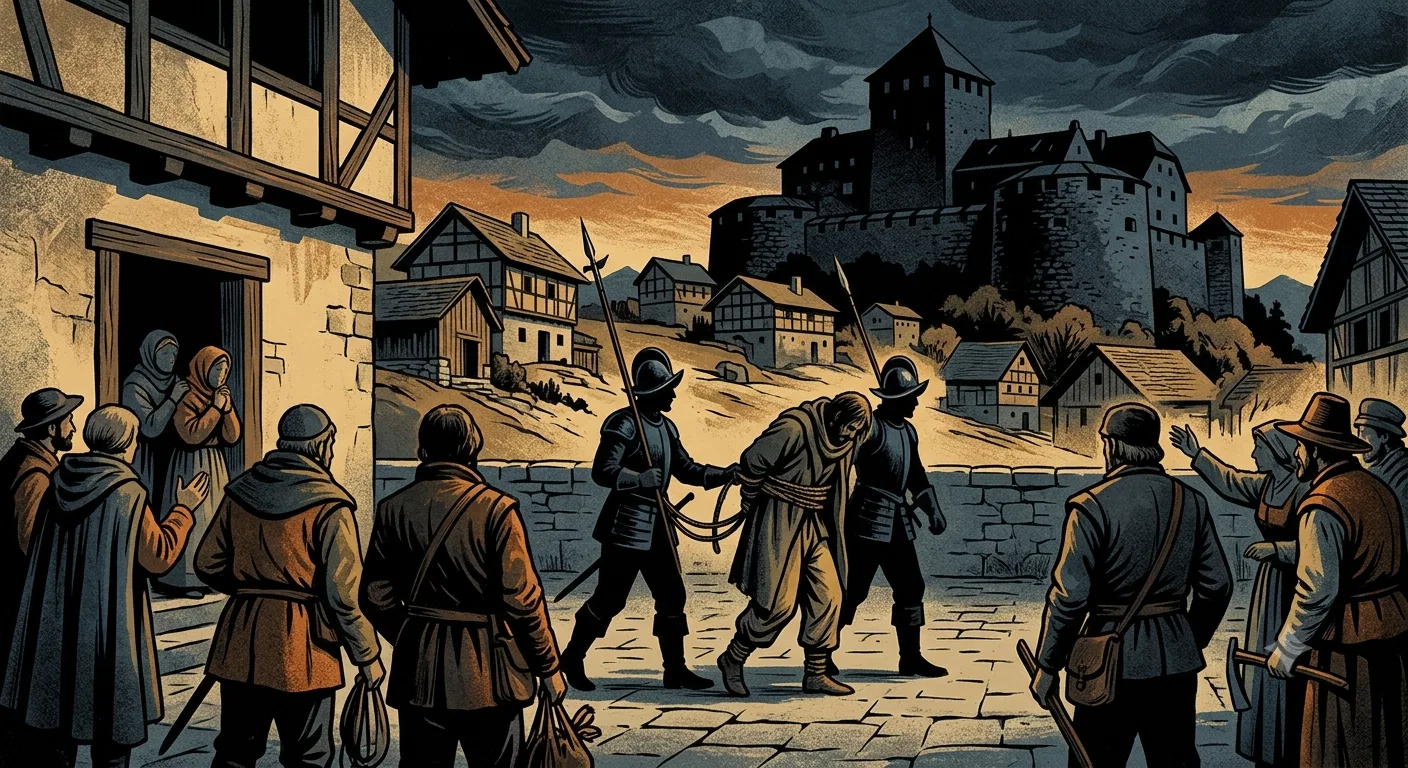
Liechtenstein’s clearest and best-documented episode of contagious fear is not a modern cult scare or outbreak of mass psychogenic illness, but an exceptionally severe series of witch prosecutions in the territories of Vaduz and Schellenberg during the sixteenth and seventeenth centuries.
Page outline Jump by section
Introduction
These events happened before the Principality of Liechtenstein formally existed. Vaduz and Schellenberg were united under that name only in 1719. Nevertheless, the trials belong centrally to the country’s social history because they occurred within its present borders, divided local families and helped bring down the ruling regime.[Your Site Title]liechtensteinusa.orgYour Site Title History — Your Site TitleYour Site TitleHistory — Your Site Title - Embassy of LiechtensteinThe Holy Roman Emperor Charles VI united Vaduz and Schellenberg in 171…
What people believed witches were doing
The accusations rested on a familiar early modern European picture of witchcraft. Suspected witches were imagined not merely as people practising folk magic, but as members of a hidden conspiracy allied with the Devil. They could supposedly cause illness, ruin harvests, kill livestock, create storms or bring misfortune upon neighbours.
This belief joined ordinary suspicions about harmful magic to a much larger religious story. A failed crop, unexplained death or bitter quarrel could be interpreted as evidence of supernatural attack. Once courts accepted that such crimes were real, private resentment and village gossip could acquire the force of law.
The authorities did not regard witchcraft as an eccentric personal belief. It was treated as a serious criminal offence. Across the Holy Roman Empire, legal doctrine increasingly allowed witchcraft to be handled as an exceptional crime, encouraging courts to relax normal safeguards and rely heavily on interrogation, torture and accusations against supposed accomplices.[Historisches Lexikon Bayerns]historisches-lexikon-bayerns.deEN:Persecution of witcheswitchcraft, complete with all its elements, was now fully established. This provided the legal basis for the large-scale witch trials to…
That distinction matters. The victims were not members of an organised satanic movement uncovered by investigators. They were ordinary people whom neighbours and officials placed inside an imagined conspiracy. Calling the episode a “cult” story would therefore be misleading: the secret cult existed in the accusations, not in reliable evidence of an actual group.
How the persecution became self-sustaining
The earliest securely dated witch trials in Vaduz took place in 1597, 1598 and 1600, producing at least 11 executions. Larger waves followed around the middle of the seventeenth century and again in the late 1670s.[Liechtenstein Historical Lexicon]historisches-lexikon.liLiechtenstein Historical LexiconHexenverfolgung… Salzburg, wo 1682 Dr. Johann Baptist Moser in einem Rechtsgutachten die Prozesse der J…
Several forces allowed suspicion to spread.
Accusations generated further accusations. A prisoner under torture could be pressed to confess and identify other supposed witches. Each new name created another investigation, another interrogation and another opportunity to expand the alleged network.
Reputation could become inherited. Families associated with earlier prosecutions remained vulnerable. Maria Eberle of Planken, for example, had both a grandfather and an aunt who had been executed for witchcraft. Sources describe her as already notorious within her village before she was arrested.[news.historisches-lexikon.li]news.historisches-lexikon.limaria eberle und das ende der hexenverfolgungen15 Apr 2024 — Bereits Maria Eberles Grossvater und ihre Tante waren der Hexerei angeklagt und verbrannt worden, weshalb sie den Quellen z…
Local conflict supplied plausible targets. Economic hardship, personal hostility, religious anxiety and disputes among neighbours made supernatural blame emotionally persuasive. Witchcraft accusations offered a simple human cause for events that otherwise seemed frightening or inexplicable.
The authorities had material interests. Convicted people’s property could be confiscated. The county’s ruler, Count Ferdinand Karl von Hohenems, was heavily indebted, and later imperial action addressed both unlawful prosecution and the seizure of victims’ assets. Financial gain does not explain every accusation, but it gave officials a reason not to restrain the process.[liechtenstein-institut.li]liechtenstein-institut.liOpen source on liechtenstein-institut.li.
The resulting system resembled a panic more than a normal investigation. The courts began with the assumption that an invisible enemy existed. Confessions extracted under coercion then appeared to confirm that assumption. The absence of physical evidence did little to weaken the cases because the alleged crime was, by definition, secret and supernatural.

The last wave and Maria Eberle’s escape
The final intense series began in 1679. Its most important surviving story is that of Maria Eberle, whose resistance helped turn a local persecution into an imperial legal scandal.
Eberle was arrested on 19 November 1680 and imprisoned at Vaduz Castle. Under torture, she confessed to witchcraft and was condemned to death. She then escaped through an opening near a stove, moved through the roof space, displaced tiles and climbed down from the castle using tied bedsheets. After reaching nearby Feldkirch, she arranged for a notarised protest challenging the legality of her prosecution.[news.historisches-lexikon.li]news.historisches-lexikon.limaria eberle und das ende der hexenverfolgungen15 Apr 2024 — Bereits Maria Eberles Grossvater und ihre Tante waren der Hexerei angeklagt und verbrannt worden, weshalb sie den Quellen z…
Her escape mattered because it broke the closed circle of accusation, torture and conviction. Eberle and four other fugitives appealed to Emperor Leopold I, supported by Valentin von Kriss, a parish priest from Triesen. Their petitions described legal abuses that local officials could no longer conceal.
In 1681, the emperor prohibited further proceedings and appointed an investigating commission. A legal opinion prepared in Salzburg examined the 1679–80 cases according to strict standards and found them unlawful. In 1684, imperial intervention removed criminal jurisdiction from the territorial ruler; by 1685, the sentences from the final wave had been invalidated.[historisches-lexikon.li]historisches-lexikon.liLiechtenstein Historical LexiconHexenverfolgung… Salzburg, wo 1682 Dr. Johann Baptist Moser in einem Rechtsgutachten die Prozesse der J…
Eberle’s own death sentence was overturned, and officials were ordered to return 234 guilders and 30 kreuzers that had been confiscated from her. Her later life remains obscure. Records suggest that she struggled to re-establish herself and was twice forced back towards Vaduz by armed men after seeking refuge with relatives in Schellenberg.[news.historisches-lexikon.li]news.historisches-lexikon.limaria eberle und das ende der hexenverfolgungen15 Apr 2024 — Bereits Maria Eberles Grossvater und ihre Tante waren der Hexerei angeklagt und verbrannt worden, weshalb sie den Quellen z…
Her story should not be romanticised as the triumph of one heroic individual over superstition. The persecution ended because fugitives, clergy, notaries, imperial officials and legal scholars created an effective chain of appeal. Even so, her decision to escape and challenge the court gave that process its first known impetus.
Why the authorities finally intervened
The trials did not end simply because belief in witchcraft disappeared. Imperial intervention focused on procedure, jurisdiction and abuse of power.
The Salzburg legal assessment tested individual cases rather than accepting the general claim that witches threatened society. This exposed how confessions, accusations and convictions had been produced. The emperor subsequently stripped Count Ferdinand Karl of criminal authority and placed Vaduz and Schellenberg under imperial administration.[Liechtenstein Historical Lexicon]historisches-lexikon.liLiechtenstein Historical LexiconHexenverfolgung… Salzburg, wo 1682 Dr. Johann Baptist Moser in einem Rechtsgutachten die Prozesse der J…
This is an important feature of witch-panic history. Higher courts and central authorities sometimes restrained persecutions when local courts had become trapped in escalating accusations. The decisive question was not necessarily whether magic existed, but whether the evidence and procedures could justify execution.
The scandal also contributed to the collapse of Hohenems rule. Ferdinand Karl was detained by imperial order and died in 1686. His family’s financial and political position continued to deteriorate, and Schellenberg and Vaduz were eventually sold to the House of Liechtenstein before being united as a principality in 1719.[Wikipedia]WikipediaHohenems familyHohenems family
The witch trials therefore sit unexpectedly close to Liechtenstein’s state formation. They were not the reason the principality was created, but the abuses, debts and administrative crisis surrounding them helped weaken the regime that preceded it.
Who suffered and why the numbers matter
Older retellings have sometimes suggested that as many as 300 people were burned, perhaps a tenth of the population. Modern research is more cautious. The Historical Lexicon of Liechtenstein places the total number of death sentences at roughly 200 between the end of the sixteenth century and 1680, while the best-documented final wave claimed 45 lives.[Liechtenstein National Library]eliechtensteinensia.liLiechtenstein National Library Hexenland LiechtensteinLiechtenstein National Library Hexenland Liechtenstein
The uncertainty reflects gaps in the surviving records. Some proceedings are well documented, while others are known through incomplete files, later summaries or indirect references. Historians must therefore distinguish confirmed executions from estimates and inherited local claims.
The gender pattern is also more complicated than the stereotype of witch-hunting as an exclusively female persecution. Women were the majority of victims across much of Europe, and misogynistic ideas strongly shaped the image of the witch. Yet approximately half those executed in Liechtenstein’s 1679–80 trials were men.[news.historisches-lexikon.li]news.historisches-lexikon.limaria eberle und das ende der hexenverfolgungen15 Apr 2024 — Bereits Maria Eberles Grossvater und ihre Tante waren der Hexerei angeklagt und verbrannt worden, weshalb sie den Quellen z…
This does not make gender irrelevant. Women such as Maria Eberle were vulnerable to assumptions connecting female reputation, family history and demonic witchcraft. But the local panic expanded far enough to consume men as well as women. Once denunciation networks grew, almost any socially credible accusation could become dangerous.
Panic, persecution or mass hysteria?
“Mass hysteria” is sometimes used loosely for any historical outbreak of irrational behaviour. It is not the most precise label here.
There is no well-supported account of Liechtenstein experiencing a classic episode of mass psychogenic illness, such as contagious fainting, trembling or unexplained physical symptoms spreading through a school or workplace. The witch trials were instead a judicial and social persecution sustained by shared beliefs, rumour, coercive institutions and official power.
“Moral panic” is closer, but still requires care. The fear was disproportionate and centred on an imagined secret enemy threatening Christian society. Accused people became convenient embodiments of danger, while authorities presented punishment as communal protection. Yet the episode lasted through several waves and operated through established criminal courts, making it more than a brief media-driven scare.
The most accurate description is a witch persecution with panic dynamics. Collective belief identified a hidden threat; rumours and forced denunciations made it appear ever larger; officials converted those fears into arrests and executions; and the resulting prosecutions supplied fresh “evidence” that the threat was real.
How persecution became folklore
The legal trials ended, but stories about witches did not. Liechtenstein developed a rich body of legends associated with supernatural figures, enchanted places and dangerous night-time encounters. Some recorded tales draw directly on the memory of the persecutions, while others combine older folklore with later storytelling.[Visit Liechtenstein]en.tourismus.liOpen source on tourismus.li.
This afterlife creates a problem for readers. A legend may preserve a community’s memory of fear without offering reliable evidence about a particular trial. Later stories can compress several people into one character, add supernatural details or turn victims into the frightening beings they were falsely accused of being.
Modern tourism material presents witch legends as part of Liechtenstein’s cultural heritage. That can keep local history visible, but it may also soften the distinction between folklore and persecution. The historical centre of the story is not whether witches haunted a mountain or cast spells. It is that courts accepted such claims, tortured accused people and killed them.
The most responsible way to read these legends is therefore on two levels. They are evidence of how supernatural ideas remained culturally memorable, but they are not proof that the alleged magic occurred. Their real historical value lies in showing how a community remembers, disguises or reshapes violence committed against its own members.
What the Liechtenstein case teaches
Liechtenstein’s witch trials show that collective fear does not require a large country, a mass newspaper industry or a central propaganda machine. In a small, closely connected society, reputation travelled quickly and family histories were difficult to escape. The same intimacy that bound communities together could make accusation unusually destructive.
The case also shows why “people were simply superstitious” is an inadequate explanation. Belief mattered, but belief alone did not burn anyone. Executions required courts, officials, coercive interrogation, rules permitting confiscation and a political system willing to treat rumour as evidence.
Finally, the end of the trials demonstrates the importance of outside review. Local institutions had become invested in validating their own accusations. The panic weakened only when fugitives reached authorities beyond the county and legal reviewers examined cases individually.
Liechtenstein’s most significant history of contagious belief is therefore not a tale of mysterious supernatural events. It is a documented example of how fear, neighbourhood suspicion and institutional self-interest can create an imaginary conspiracy—and how difficult it becomes to stop once punishment itself is treated as proof that the danger was real.
Amazon book picks
Further Reading
Books and field guides related to How Witch Fear Overran Early Liechtenstein. Use these as the next step if you want deeper reading beyond the article.
The witch-hunt in early modern Europe
Authoritative overview of causes, spread and decline of European witch trials.

The witch
Explains European witch beliefs and persecutions that frame Liechtenstein's trials.
Europe's inner demons
Explores the intellectual roots of witch-hunting and conspiracy beliefs.
Witch craze
Provides close regional context for events near present-day Liechtenstein.
Endnotes
1.
Source: historisches-lexikon.li
Link:https://historisches-lexikon.li/Hexenverfolgung
Source snippet
Liechtenstein Historical LexiconHexenverfolgung... Salzburg, wo 1682 Dr. Johann Baptist Moser in einem Rechtsgutachten die Prozesse der J...
2.
Source: news.historisches-lexikon.li
Title: maria eberle und das ende der hexenverfolgungen
Link:https://news.historisches-lexikon.li/maria-eberle-und-das-ende-der-hexenverfolgungen
Source snippet
15 Apr 2024 — Bereits Maria Eberles Grossvater und ihre Tante waren der Hexerei angeklagt und verbrannt worden, weshalb sie den Quellen z...
3.
Source: liechtenstein-institut.li
Title: 300 jahre furstentum liechtenstein
Link:https://liechtenstein-institut.li/news/300-jahre-furstentum-liechtenstein
Source snippet
300 Jahre Fürstentum Liechtenstein15 Jan 2019 — Am 23. Januar 1719 vereinigte Kaiser Karl VI. die Reichsgrafschaft Vaduz und die Reichshe...
4.
Source: historisches-lexikon-bayerns.de
Title: EN:Persecution of witches
Link:https://www.historisches-lexikon-bayerns.de/Lexikon/EN%3APersecution_of_witches
Source snippet
witchcraft, complete with all its elements, was now fully established. This provided the legal basis for the large-scale witch trials to...
5.
Source: historisches-lexikon.li
Link:https://historisches-lexikon.li/Eberle_%28Eberlin%29%2C_Maria
6.
Source: liechtenstein-institut.li
Link:https://liechtenstein-institut.li/en/research-projects/die-kaiserliche-administration-der-reichsgrafschaft-vaduz-und-der-reichsherrschaft-schellenberg-1684-16991712
7.
Source: Wikipedia
Title: Hohenems family
Link:https://en.wikipedia.org/wiki/Hohenems_family
8.
Source: Wikipedia
Title: Liechtenstein witch trials
Link:https://en.wikipedia.org/wiki/Liechtenstein_witch_trials
9.
Source: Wikipedia
Title: List of mass panic cases
Link:https://en.wikipedia.org/wiki/List_of_mass_panic_cases
10.
Source: Wikipedia
Title: Moral panic
Link:https://en.wikipedia.org/wiki/Moral_panic
11.
Source: Wikipedia
Title: Liechtenstein National Archives
Link:https://en.wikipedia.org/wiki/Liechtenstein_National_Archives
12.
Source: Wikipedia
Link:https://en.wikipedia.org/wiki/Liechtenstein
13.
Source: Wikipedia
Title: Witch trials in the early modern period
Link:https://en.wikipedia.org/wiki/Witch_trials_in_the_early_modern_period
14.
Source: Wikipedia
Title: Witch hunt
Link:https://en.wikipedia.org/wiki/Witch_hunt
15.
Source: Wikipedia
Title: Religion in Liechtenstein
Link:https://en.wikipedia.org/wiki/Religion_in_Liechtenstein
16.
Source: historisches-lexikon.li
Link:https://historisches-lexikon.li/Artikel_A-Z
17.
Source: 2021-2025.state.gov
Link:https://2021-2025.state.gov/reports/2023-report-on-international-religious-freedom/liechtenstein/
18.
Source: 2009-2017.state.gov
Link:https://2009-2017.state.gov/outofdate/bgn/liechtenstein/35889.htm
19.
Source: state.gov
Link:https://www.state.gov/reports/2022-report-on-international-religious-freedom/liechtenstein
20.
Source: liechtensteinusa.org
Title: Your Site Title History — Your Site Title
Link:https://www.liechtensteinusa.org/history
Source snippet
Your Site TitleHistory — Your Site Title - Embassy of LiechtensteinThe Holy Roman Emperor Charles VI united Vaduz and Schellenberg in 171...
21.
Source: eliechtensteinensia.li
Title: Liechtenstein National Libraryschen Hexenprozessen ist nicht mehr zu eruieren
Link:https://www.eliechtensteinensia.li/viewer/api/v1/records/000000453_96/files/images/00000108.tif/full.pdf?divID=LOG_0003
Source snippet
Hexenprozesse um die Mitte des 17. Jahr- hunderts sollen in der Grafschaft Vaduz und der. Herrschaft Schellenberg ungefähr 100...
22.
Source: eliechtensteinensia.li
Link:https://www.eliechtensteinensia.li/viewer/fulltext/000469227/48/
23.
Source: eliechtensteinensia.li
Title: Liechtenstein National Library Hexenland Liechtenstein
Link:https://www.eliechtensteinensia.li/viewer/api/v1/records/000439113_1997/files/images/000045554_1997_031.tif/full.pdf?divID=LOG_0011
24.
Source: en.tourismus.li
Link:https://en.tourismus.li/reiseland/unser-land/feiertage-brauchtum/top-sagen-liechtensteins.html
25.
Source: eliechtensteinensia.li
Link:https://www.eliechtensteinensia.li/viewer/api/v1/records/000000453_96/files/images/00000126.tif/full.pdf?divID=LOG_0003
26.
Source: eliechtensteinensia.li
Link:https://www.eliechtensteinensia.li/viewer/api/v1/records/000000453_108/files/images/00000228.tif/full.pdf?divID=LOG_0003
27.
Source: eliechtensteinensia.li
Link:https://www.eliechtensteinensia.li/viewer/api/v1/records/000000453_96/files/images/00000076.tif/full.pdf?divID=LOG_0003
28.
Source: eliechtensteinensia.li
Link:https://www.eliechtensteinensia.li/viewer/api/v1/records/000000453_96/files/images/00000186.tif/full.pdf?divID=LOG_0003
29.
Source: eliechtensteinensia.li
Link:https://www.eliechtensteinensia.li/viewer/api/v1/records/000000453_101/files/images/00000150.tif/full.pdf?divID=LOG_0007
30.
Source: eliechtensteinensia.li
Link:https://www.eliechtensteinensia.li/viewer/api/v1/records/000000453_96/files/images/00000182.tif/full.pdf?divID=LOG_0003
31.
Source: eliechtensteinensia.li
Link:https://www.eliechtensteinensia.li/viewer/api/v1/records/000000453_101/files/images/00000152.tif/full.pdf?divID=LOG_0003
32.
Source: eliechtensteinensia.li
Link:https://www.eliechtensteinensia.li/viewer/api/v1/records/000000453_96/files/images/00000074.tif/full.pdf?divID=LOG_0007
33.
Source: peterleeson.com
Title: witch trials
Link:https://www.peterleeson.com/witch_trials.pdf
34.
Source: worldstatesmen.org
Link:https://www.worldstatesmen.org/Liechtenstein.htm
Additional References
35.
Source: law.berkeley.edu
Link:https://www.law.berkeley.edu/research/the-robbins-collection/exhibitions/witch-trials-in-early-modern-europe-and-new-england/
Source snippet
UC Berkeley LawWitch Trials in Early Modern Europe and New EnglandHistorians have identified a number of crucial legal developments that...
36.
Source: historysnob.com
Link:https://www.historysnob.com/war-and-historical-events/20-chilling-cases-mass-hysteria-throughout-history
37.
Source: researchgate.net
Link:https://www.researchgate.net/publication/391946128_The_Satanic_Cult_Conspiracy_How_online_conspiracy_theory_discourses_construct_moral_panic
38.
Source: facebook.com
Link:https://www.facebook.com/groups/200654943447427/posts/3069321043247455/
39.
Source: facebook.com
Link:https://www.facebook.com/NatGeoHistory/posts/each-winter-in-switzerlands-valais-region-skiers-take-to-the-slopes-dressed-as-w/1476720213814429/
40.
Source: liechtensteincollections.at
Link:https://www.liechtensteincollections.at/en/collections-online/emperor-charles-vi-unites-the-county-of-vaduz-and-the-demesne-of-schellenberg-and-raises-them-to-the-rank-of-imperial-principality-under-the-name-o
41.
Source: flcz-historikerkommission.com
Link:https://www.flcz-historikerkommission.com/en/science-and-research/archive/liechtensteinisches-landesarchiv-vaduz
42.
Source: llv.li
Link:https://www.llv.li/serviceportal2/amtsstellen/amt-fuer-auswaertige-angelegenheiten/bekaempfung-rassismus-u.-minderheitsschutz/pdf-llv-aaa-nationale_minderheiten-rahmengl04-en.pdf
43.
Source: academia.edu
Link:https://www.academia.edu/28591174/Moral_Panics_and_Anti_Cult_Terrorism_in_Western_Europe
44.
Source: cat-int.org
Link:https://cat-int.org/wp-content/uploads/2022/04/Terrorism-and-Political-Violence-Moral-panics-and-anti%E2%80%90cult-terrorism-in-Western-Europe-Massimo-Introvigne-Vol.12-Issue-1-2000-03.pdf
Topic Tree
Follow this branch
Related pages 192
- Antigua and Barbuda
- Argentina Belief Scares
- Azerbaijan Belief
- Bahrain Beliefs
- North Korea
- +187 more in sidebar