Within Greece Panics
Why Did Mykonos Burn a Vampire?
In 1701, fear of a restless corpse spread across Mykonos until ritual precautions escalated into the destruction of the body.
On this page
- What Tournefort recorded on Mykonos
- How rumours and rituals reinforced the panic
- What the case reveals about Greek revenant belief
Page outline Jump by section
Introduction
In 1701, the Greek island of Mykonos experienced one of the best-documented vampire panics in European history. Unlike many later vampire legends, this episode was described by a named eyewitness: the French botanist and traveller Joseph Pitton de Tournefort, who happened to be on the island during his scientific expedition through the eastern Mediterranean. His account does not prove that a supernatural event occurred, but it does provide unusually detailed evidence of how fear spread through a community, how rumours reinforced one another, and how ritual attempts to solve the crisis gradually escalated until the corpse at the centre of the panic was completely burned. Tournefort’s narrative remains one of the clearest contemporary records of collective belief in a restless corpse in the early modern Greek world.[De Gruyter Brill]degruyterbrill.comDe Gruyter Brill IV. De Tournefort's VrykolakasDe Gruyter BrillIV. De Tournefort's VrykolakasJanuary 1, 2008…
What Tournefort recorded on Mykonos
Tournefort arrived on Mykonos during his travels in the Ottoman-controlled Aegean and later published his observations in Relation d’un voyage du Levant (1718). He described the case of a recently buried man who had reportedly been violent and quarrelsome during his lifetime. Shortly after his burial, rumours spread that he was returning from the grave at night.
According to the reports Tournefort collected and witnessed developing:
- Residents claimed the dead man entered houses after dark.
- He was blamed for knocking over furniture, extinguishing lamps and making loud noises.
- Some islanders believed he assaulted sleepers or damaged property.
- New stories appeared almost daily, with each fresh incident reinforcing belief that the corpse remained active.[daimonologia.org]daimonologia.orgThe Exhumation of a Vampire on the Island of Mykonos in 1700: An Eye-Witness Account…
Tournefort himself remained sceptical throughout. Rather than accepting the supernatural explanation, he portrayed the island as gripped by contagious fear. Yet his scepticism makes the account especially valuable to historians: instead of promoting belief in vampires, he inadvertently documented the social mechanics of a panic as it unfolded.
How rumours and rituals reinforced the panic
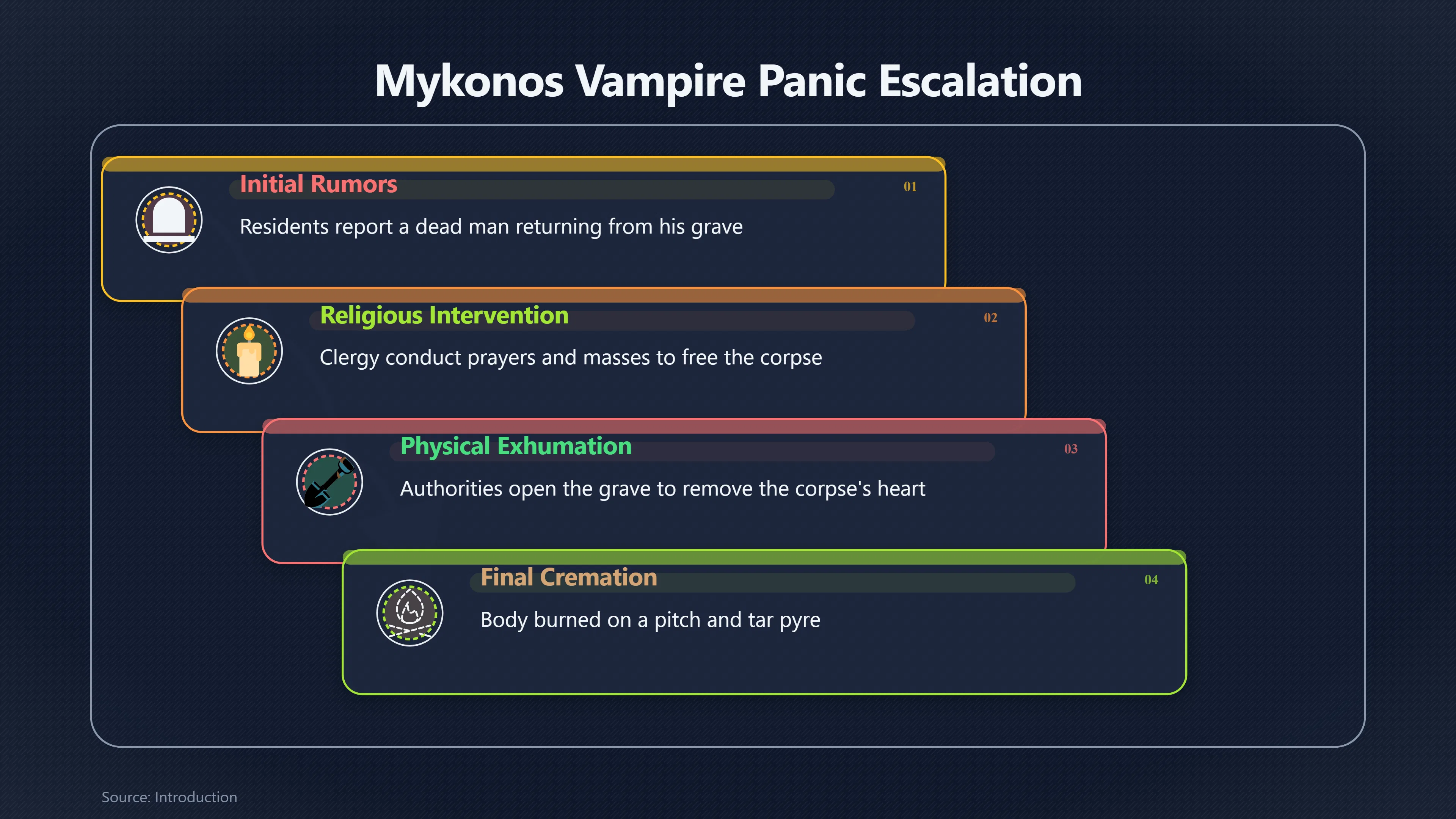
The Mykonos affair did not erupt fully formed. Instead, it developed through a sequence of increasingly dramatic responses that unintentionally strengthened belief.
At first, many islanders reportedly laughed off the rumours. As more respectable members of the community claimed to have experienced disturbances, however, disbelief became harder to maintain. Clergy conducted prayers and masses intended to free the corpse from whatever force was believed to animate it.
When these religious measures failed to end the reported disturbances, the community escalated its response.
The grave was opened repeatedly. Eventually an attempt was made to remove the corpse’s heart, following beliefs that destroying or disabling part of the body could stop a revenant. Tournefort vividly described the unsuccessful search for the heart and the overpowering smell released when the corpse was cut open. He observed that incense burned to mask the odour mixed with the smell of decomposition, while frightened spectators interpreted the rising smoke as further evidence that supernatural forces were present.[daimonologia.org]daimonologia.orgThe Exhumation of a Vampire on the Island of Mykonos in 1700: An Eye-Witness Account…
The failure of each ritual reinforced rather than weakened belief. Because the supposed vampire continued to receive blame for every unexplained event, each unsuccessful intervention simply justified a more extreme remedy.

Why the body was finally burned
As reports accumulated, the atmosphere on Mykonos became increasingly tense.
Tournefort wrote that some families abandoned their homes and slept together in public spaces or prepared to leave the island altogether. Fear became a practical social problem rather than merely a supernatural belief. Authorities therefore faced pressure to demonstrate decisive action.
After prayers, exhumation and removal of the heart apparently failed, local leaders ordered the remaining body to be taken to the headland of Saint George and burned on a large pyre prepared with pitch and tar to ensure complete destruction.
Tournefort records that after the cremation no further complaints were made about the supposed vampire. Songs were reportedly composed mocking the revenant, suggesting that the destruction of the corpse provided psychological closure for the community as much as a physical solution.[daimonologia.org]daimonologia.orgThe Exhumation of a Vampire on the Island of Mykonos in 1700: An Eye-Witness Account…
How strong is the evidence?
The Mykonos episode is unusually well documented compared with many vampire legends, but historians distinguish carefully between evidence for the panic and evidence for the supernatural.
Several aspects make the account historically valuable:
- A named eyewitness. Tournefort was present during the events rather than recording a story generations later.
- A contemporary publication. His description appeared only a few years after the incident in a widely circulated travel narrative.
- Independent purpose. He travelled as a botanist and scientific observer, not as a collector of ghost stories, giving historians confidence that the episode was not invented solely for entertainment.
- Detailed chronology. The account traces the progression from rumour to ritual escalation, allowing historians to reconstruct how communal belief developed.[De Gruyter Brill]degruyterbrill.comDe Gruyter Brill IV. De Tournefort's VrykolakasDe Gruyter BrillIV. De Tournefort's VrykolakasJanuary 1, 2008…
The evidence also has important limitations.
Everything concerning the vampire’s alleged activities ultimately depends on testimony from frightened residents rather than independently verifiable events. Tournefort did not personally witness the supposed nocturnal attacks. His observations concern the community’s reactions—the exhumations, rituals, conversations and public fear—rather than proof that the dead man actually returned from the grave.
What the case reveals about Greek revenant belief
The Mykonos affair illustrates beliefs about restless corpses that were widespread in parts of the Greek-speaking world long before nineteenth-century fictional vampires became famous.
The being feared on Mykonos was not the elegant aristocratic vampire of later Gothic literature. Instead, it was a corpse believed to leave its grave physically and harass the living. Reports focused on making noise, damaging property, striking people and disturbing households rather than systematically drinking blood. Modern scholars note that many early Balkan and Greek revenant traditions emphasised suffocation, harassment or unexplained illness more than blood consumption.[Google Books]books.google.co.ukGoogle Books Vampires, Burial, and Death: Folklore and RealityGoogle BooksVampires, Burial, and Death: Folklore and Reality - Paul Barber - Google BooksJanuary 1, 1988…
The methods used against the corpse likewise reflected local traditions. Religious services, repeated exhumation, removal of the heart and finally cremation were all attempts to neutralise a dangerous dead body rather than to destroy a fictional monster in the modern sense. These practices appear in other early modern accounts from the eastern Mediterranean and Balkans, although the Mykonos narrative is among the fullest surviving descriptions.[Heidelberg Historical Collections]digi.ub.uni-heidelberg.deHeidelberg Historical CollectionsPashley, Robert: Travels in Crete (Band 2) (Cambridge und London, 1837)…
Why historians still study the Mykonos panic
For historians, psychologists and scholars of religion, the importance of the Mykonos case lies less in vampire folklore than in the dynamics of collective belief.
Several features stand out:
- Expectation shaped perception. Ordinary noises, accidents or misfortunes increasingly came to be interpreted through a single supernatural explanation.
- Authority could reinforce belief. Priests and local officials did not simply suppress rumours; by participating in rituals they unintentionally confirmed that the threat deserved serious attention.
- Failed interventions intensified commitment. Each unsuccessful attempt to stop the revenant encouraged calls for stronger measures rather than scepticism.
- Collective action restored confidence. The final burning of the corpse ended reports of supernatural attacks, demonstrating how a public ritual can bring closure to a frightened community even without resolving the underlying factual claims.[daimonologia.org]daimonologia.orgThe Exhumation of a Vampire on the Island of Mykonos in 1700: An Eye-Witness Account…
The episode therefore occupies an important place in the social history of Greece. It offers one of the clearest surviving examples of an early modern communal panic centred on a supposed revenant, while also showing how rumour, religious assumptions, social pressure and ritual action combined to create a self-reinforcing cycle of fear. Rather than serving as evidence that vampires existed, Tournefort’s account stands as remarkably rich evidence for how communities can collectively construct, sustain and ultimately resolve a supernatural crisis.
Amazon book picks
Further Reading
Books and field guides related to Why Did Mykonos Burn a Vampire?. Use these as the next step if you want deeper reading beyond the article.


Magic, science, and religion, and other essays
Explains why supernatural beliefs spread within communities.

Bram Stoker's Dracula omnibus
First published 1897. Subjects: Fiction, horror, Children: Grades 3-4, Dracula, count (fictitious character), fiction, Frankenstein (fict...
Endnotes
1.
Source: daimonologia.org
Link:https://www.daimonologia.org/2019/10/the-exhumation-of-vampire-on-island-of.html
Source snippet
The Exhumation of a Vampire on the Island of Mykonos in 1700: An Eye-Witness Account...
2.
Source: books.google.com
Title: Vampires Burial and Death
Link:https://books.google.com/books/about/Vampires_Burial_and_Death.html?id=nXEDnwEACAAJ
3.
Source: books.google.com
Title: Vampires Burial and Death
Link:https://books.google.com/books/about/Vampires_Burial_and_Death.html?hl=fr&id=o55_G3ls-Q0C
4.
Source: daimonologia.org
Link:https://www.daimonologia.org/2019/10/
5.
Source: youtube.com
Title: Vampire Island
Link:https://www.youtube.com/watch?v=B1dfifyNwOU
Source snippet
Vampire Panics...
6.
Source: youtube.com
Title: Vampire Panics
Link:https://www.youtube.com/watch?v=G7gq-kmwzqw
Source snippet
The Monsters of Ancient Greece Explained | Hydra, Greek Vampires & More - The Mystery Files #91...
7.
Source: degruyterbrill.com
Title: De Gruyter Brill IV. De Tournefort’s Vrykolakas
Link:https://www.degruyterbrill.com/document/doi/10.12987/9780300153484-007/html
Source snippet
De Gruyter BrillIV. De Tournefort's VrykolakasJanuary 1, 2008...
Published: January 1, 2008
8.
Source: books.google.co.uk
Title: Google Books Vampires, Burial, and Death: Folklore and Reality
Link:https://books.google.co.uk/books/about/Vampires_Burial_and_Death.html?id=o55_G3ls-Q0C
Source snippet
Google BooksVampires, Burial, and Death: Folklore and Reality - Paul Barber - Google BooksJanuary 1, 1988...
Published: January 1, 1988
9.
Source: digi.ub.uni-heidelberg.de
Link:https://digi.ub.uni-heidelberg.de/diglit/pashley1837bd2/0222
Source snippet
Heidelberg Historical CollectionsPashley, Robert: Travels in Crete (Band 2) (Cambridge und London, 1837)...
10.
Source: books.google.co.uk
Title: google.co.uk Vampires, Burial, and Death: Folklore and Reality
Link:https://books.google.co.uk/books/about/Vampires_Burial_and_Death.html?hl=en&id=o55_G3ls-Q0C&output=html_text
11.
Source: play.anghami.com
Link:https://play.anghami.com/episode/1257290297
Additional References
12.
Source: en.rua.gr
Link:https://en.rua.gr/2022/06/27/vampire-of-mykonos-who-terrified-the-islanders-to-the-brutal-reprisal-against-him/
Source snippet
of Mykonos, who terrified the islanders to the brutal reprisal against him - Athens NewsJuly 4, 2026 — July 4, 2026 VAMPIRE OF MYKONOS, W...
Published: July 4, 2026
13.
Source: thewritingpost.com
Title: Folklore: The Botched Destruction of a Vampire on Mykonos
Link:https://thewritingpost.com/2025/01/13/folklore-the-botched-destruction-of-a-vampire-on-mykonos/
Source snippet
The Writing PostJanuary 13, 2025 — Image: Vampire Blog, Folklore FOLKLORE: THE BOTCHED DESTRUCTION OF A VAMPIRE ON MYKONOS January 13, 20...
Published: January 13, 2025
14.
Source: youtube.com
Title: Before Dracula: Europe’s Real Vampire Panic. Why Villages Opened the Graves
Link:https://www.youtube.com/watch?v=ANEhDdcBAcY
Source snippet
The Vampire of Mykonos - Eerie Greece (Greek Creepy Folklore)...
15.
Source: usubjects.com
Link:https://usubjects.com/article/a-vrykolakas-vampire-in-sunny-mykonos-2893
Source snippet
Greek folklore vampire was said to terrorize Mykonos | Unexplained SubjectsJune 30, 2026 — GREEK FOLKLORE VAMPIRE WAS SAID TO TERRORIZE M...
Published: June 30, 2026
16.
Source: music.amazon.it
Link:https://music.amazon.it/podcasts/3c0229fe-894a-4fcf-bfab-cef6f6c4c26f/episodes/9b9803eb-bf81-4220-9320-42b80b8d78ba/cursed-voices-dark-history-and-unsolved-mysteries-ep-12—vrykolakas-a-real-zombie-in-mykonos-history-or-greek-urban-legend-dark-history-podcast?tag=searcht-20
Source snippet
12 - Vrykolakas: A Real Zombie in Mykonos History or Greek Urban Legend? | Dark History Podcast-Cursed Voices: Dark History and Unsolved...
17.
Source: researchgate.net
Link:https://www.researchgate.net/publication/393903142_De_la_literatura_a_la_arqueologia_hallazgos_de_enterramientos_vampiricos_en_Europa
18.
Source: tandfonline.com
Link:https://www.tandfonline.com/doi/abs/10.1080/0015587X.2013.829666
19.
Source: atmostfear-entertainment.com
Title: Blood, Disease and the Early Modern Vampire Reports – Atmostfear Entertainment
Link:https://www.atmostfear-entertainment.com/culture/folklore/blood-disease-early-modern-vampire-reports/
20.
Source: youtube.com
Title: The Monsters of Ancient Greece Explained | Hydra, Greek Vampires & More
Link:https://www.youtube.com/watch?v=4isUZStYzP0
21.
Source: larevuedesressources.org
Title: broucolaques ou vroucolaques extrait du dictionnaire infernal 1818,1460
Link:https://larevuedesressources.org/broucolaques-ou-vroucolaques-extrait-du-dictionnaire-infernal-1818%2C1460.html
Topic Tree