Within Indonesia Panics
How Rumour Turned Banyuwangi Into a Killing Ground
Rumours of sorcerers and black-clad assassins turned political uncertainty into lethal vigilantism in East Java.
On this page
- From sorcery accusations to mob violence
- The rise of the black clad ninja rumour
- Death toll disputes and unresolved responsibility
Page outline Jump by section
Introduction
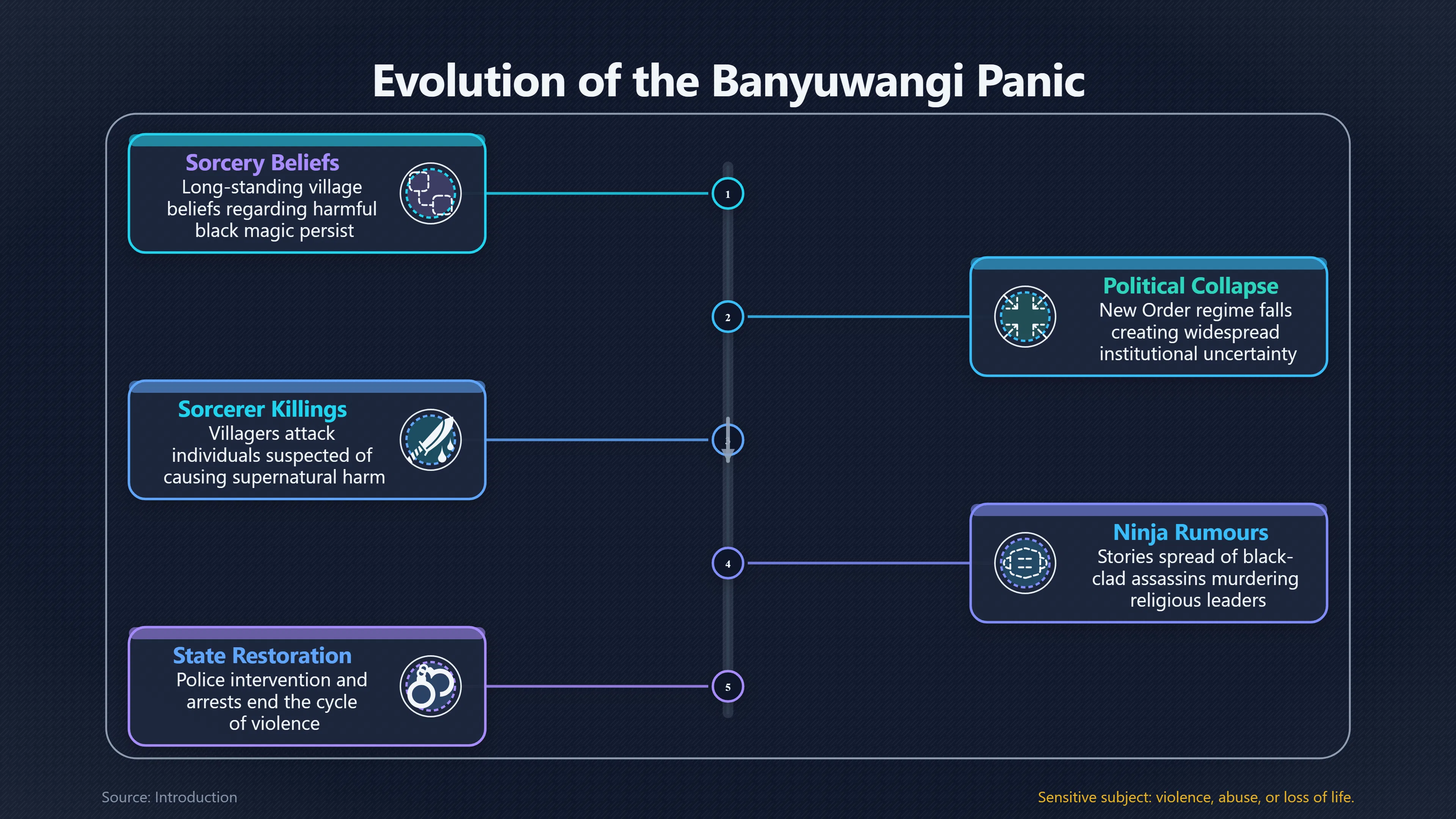
The Banyuwangi sorcerer killings and the subsequent “ninja” panic were among the deadliest episodes of rumour-driven violence in modern Indonesian history. During the political and economic turmoil surrounding the collapse of President Suharto’s New Order regime in 1998, hundreds of people in East Java were accused of practising black magic and killed by neighbours or organised vigilante groups. Soon afterwards, rumours spread that mysterious black-clad assassins—described as “ninjas”—were murdering Islamic religious leaders. Fear of these supposed attackers prompted communities to establish roadblocks, night patrols and vigilante groups, leading to further killings of people suspected of being ninjas. Historians now view the episode as a powerful example of how long-standing beliefs about sorcery combined with political uncertainty, collapsing trust in state institutions and rapidly spreading rumours to create a cycle of persecution and collective fear.[researchgate.net]researchgate.netResearchGate(PDF) “Sorcerer” Killings in Banyuwangi: A Re-Examination of State Responsibility for ViolenceMarch 1, 2007…

From sorcery accusations to mob violence
Belief in harmful magic had long been part of village life in Banyuwangi and neighbouring districts. Many residents believed that certain individuals could secretly cause illness, crop failure or death through supernatural means. Although accusations occasionally led to isolated killings before 1998, these incidents were usually localised and intermittent rather than part of a large campaign.[ResearchGate]researchgate.netResearchGate(PDF) “Sorcerer” Killings in Banyuwangi: A Re-Examination of State Responsibility for ViolenceMarch 1, 2007…
The situation changed dramatically during Indonesia’s Reformasi period. The Asian financial crisis, political protests and the weakening of central authority created widespread uncertainty. In Banyuwangi, rumours that sorcerers were responsible for unexplained deaths and misfortunes spread rapidly through villages. People identified as traditional healers, elderly villagers or individuals already viewed with suspicion became targets. Some were killed by neighbours, while others were attacked by organised groups moving between villages.[ResearchGate]researchgate.netResearchGate(PDF) “Sorcerer” Killings in Banyuwangi: A Re-Examination of State Responsibility for ViolenceMarch 1, 2007…
Researchers stress that the victims were not chosen simply because they belonged to one political party, ethnic community or religious group. Instead, accusations usually reflected local reputations, personal disputes and widespread belief that alleged sorcerers posed a genuine danger. Political instability did not create belief in sorcery, but it reduced confidence that the authorities would intervene, making vigilantism appear more acceptable to some communities.[ResearchGate]researchgate.netResearchGate(PDF) “Sorcerer” Killings in Banyuwangi: A Re-Examination of State Responsibility for ViolenceMarch 1, 2007…
The rise of the black-clad “ninja” rumour
As the killings spread, the story changed. Rumours emerged that professional assassins dressed entirely in black were travelling through East Java murdering respected Islamic scholars and community leaders. Because they supposedly operated at night and wore black clothing, they became widely known as “ninjas”, borrowing imagery from Japanese popular culture rather than reflecting any real connection with Japan.[Bridges]bridges.monash.eduBridges Witch-Hunt and Conspiracy: The 'Ninja Case' in East JavaBridges Witch-Hunt and Conspiracy: The 'Ninja Case' in East Java
The rumour spread quickly because it seemed to explain otherwise confusing violence. Some Muslim organisations argued that hidden political forces were attempting to destabilise society by disguising murders as anti-sorcery attacks. Reports circulated of mysterious strangers moving between villages, carrying communication equipment and escaping before they could be identified. Many of these stories could never be independently verified, but they travelled rapidly through local newspapers, word of mouth and community networks.[Bridges]bridges.monash.eduBridges Witch-Hunt and Conspiracy: The 'Ninja Case' in East JavaBridges Witch-Hunt and Conspiracy: The 'Ninja Case' in East Java
The fear had immediate consequences. Villagers organised night watches, blocked roads and stopped unfamiliar travellers. Men found walking after dark could be questioned, beaten or even killed if their explanations appeared suspicious. In several cases, people believed to be “ninjas” became victims of the same kind of mob violence that had earlier been directed against alleged sorcerers.[Bridges]bridges.monash.eduBridges Witch-Hunt and Conspiracy: The 'Ninja Case' in East JavaBridges Witch-Hunt and Conspiracy: The 'Ninja Case' in East Java
Why the rumours became so powerful
The panic cannot be understood simply as superstition. Several forces reinforced one another.
- Existing belief in sorcery: Many communities already accepted that black magic could cause genuine harm.
- Political transition: The fall of the New Order weakened confidence that police and local government could maintain order.
- Rumour networks: Stories travelled faster than official information, allowing each new report to reinforce earlier fears.
- Collective self-defence: Once villages believed organised killers were operating nearby, creating armed patrols appeared to be a rational response, even when based on false assumptions.
- Ambiguous violence: Because some murders were committed by unknown attackers, uncertainty itself encouraged further speculation and conspiracy theories.[researchgate.net]researchgate.netResearchGate(PDF) “Sorcerer” Killings in Banyuwangi: A Re-Examination of State Responsibility for ViolenceMarch 1, 2007…
Rather than describing the events as a simple case of “mass hysteria”, many scholars characterise them as a moral panic and a rumour-driven cycle of vigilantism. The fears were socially real and produced real behaviour, even though many of the specific claims—particularly about organised ninja squads—remain unsubstantiated.[Bridges]bridges.monash.eduBridges Witch-Hunt and Conspiracy: The 'Ninja Case' in East JavaBridges Witch-Hunt and Conspiracy: The 'Ninja Case' in East Java

Death toll disputes and unresolved responsibility
One of the most disputed aspects of the violence is the number of victims. Different organisations produced different counts, reflecting inconsistent reporting and disagreement over which deaths belonged to the same wave of violence. Local government figures, investigations by Nahdlatul Ulama and later studies all reached different totals. More recent research has estimated over 190 deaths in Banyuwangi alone, while Indonesia’s National Commission on Human Rights recorded approximately 307 deaths across the wider East Java scare, including Banyuwangi, Jember and Malang.[uinbukittinggi.ac.id]ejournal.uinbukittinggi.ac.idOpen source on uinbukittinggi.ac.id.
Responsibility also remains contested. Several explanations have been proposed:
- spontaneous village vigilantism encouraged by weakened policing;
- organised local groups exploiting anti-sorcery beliefs;
- political actors manipulating rumours during the turbulent transition from the New Order;
- combinations of genuine local fears and opportunistic violence.
No single explanation commands universal agreement. Academic studies increasingly argue against reducing the entire episode either to a centrally directed conspiracy or to irrational superstition alone. Instead, they emphasise the interaction between local belief, state weakness, rumour and political uncertainty.[researchgate.net]researchgate.netResearchGate(PDF) “Sorcerer” Killings in Banyuwangi: A Re-Examination of State Responsibility for ViolenceMarch 1, 2007…
How the violence ended
The killings declined sharply after security forces strengthened their response. Police, including units brought in from outside Banyuwangi, conducted large-scale arrests of suspected attackers and demonstrated a greater willingness to prosecute those involved. Researchers argue that this visible restoration of state authority removed the widespread perception that killers could act with impunity.[ResearchGate]researchgate.netResearchGate(PDF) “Sorcerer” Killings in Banyuwangi: A Re-Examination of State Responsibility for ViolenceMarch 1, 2007…
Although isolated violence continued elsewhere, the intense wave of killings that had characterised 1998 came to an end once communities believed that the authorities were again capable of enforcing the law.[ResearchGate]researchgate.netResearchGate(PDF) “Sorcerer” Killings in Banyuwangi: A Re-Examination of State Responsibility for ViolenceMarch 1, 2007…
Why the Banyuwangi panic still matters
The Banyuwangi killings occupy an unusual place in Indonesia’s social history because they combined several different forms of collective fear. They were simultaneously a witch hunt rooted in long-standing beliefs about harmful magic, a rumour panic centred on mysterious “ninjas”, and a product of an exceptional political transition.
For historians and social scientists, the episode demonstrates that collective violence rarely emerges from belief alone. Rumours become especially dangerous when institutions lose credibility, reliable information is scarce and communities feel responsible for their own protection. The Banyuwangi case therefore remains an important reference point for understanding how moral panics, conspiracy theories and supernatural beliefs can interact during periods of political crisis, transforming fear into lethal vigilantism.[researchgate.net]researchgate.netResearchGate(PDF) “Sorcerer” Killings in Banyuwangi: A Re-Examination of State Responsibility for ViolenceMarch 1, 2007…

Amazon book picks
Further Reading
Books and field guides related to How Rumour Turned Banyuwangi Into a Killing Ground. Use these as the next step if you want deeper reading beyond the article.
Extraordinary Popular Delusions and the Madness of Crowds
Rating: 4.0/5 from 5 Google Books ratings
Illustrates how rumours and collective fear can escalate.

The Lucifer Effect
Examines how ordinary people participate in violence under social pressure.


The Jakarta Method
Places the Banyuwangi violence within Indonesia's broader political transition.
Endnotes
1.
Source: researchgate.net
Link:https://www.researchgate.net/publication/232961257_Sorcerer_Killings_in_Banyuwangi_A_Re-Examination_of_State_Responsibility_for_Violence
Source snippet
ResearchGate(PDF) “Sorcerer” Killings in Banyuwangi: A Re-Examination of State Responsibility for ViolenceMarch 1, 2007...
Published: March 1, 2007
2.
Source: Wikipedia
Title: 1998 East Java ninja scare
Link:https://en.wikipedia.org/wiki/1998_East_Java_ninja_scare
3.
Source: researchgate.net
Title: (PDF) ‘Hard-Copy Rumours’: Print Media and Rumour in Indonesia
Link:https://www.researchgate.net/publication/274197574_%27Hard-Copy_Rumours%27_Print_Media_and_Rumour_in_Indonesia
4.
Source: researchgate.net
Link:https://www.researchgate.net/publication/233520089_Fear_and_Uncertainty_Local_Perceptions_of_the_Sorcerer_and_the_State_in_an_Indonesian_Witch-hunt
5.
Source: reference.org
Title: hjc Mn LVp
Link:https://reference.org/facts/1998_East_Java_ninja_scare/hjcMnLVp
6.
Source: bridges.monash.edu
Title: Bridges Witch-Hunt and Conspiracy: The ‘Ninja Case’ in East Java
Link:https://bridges.monash.edu/articles/monograph/Witch-Hunt_and_Conspiracy_The_Ninja_Case_in_East_Java/12821459
7.
Source: ejournal.uinbukittinggi.ac.id
Link:https://ejournal.uinbukittinggi.ac.id/Islam_realitas/article/view/10046?articlesBySimilarityPage=2
8.
Source: bircu-journal.com
Link:https://www.bircu-journal.com/index.php/birci/article/view/5695
Source snippet
Bircu JournalThe 1998 Banyuwangi Humanitarian Case (In Socio-Economic Studies) | Swastika | Budapest International Research and Critics I...
9.
Source: ejournal.unibabwi.ac.id
Link:https://ejournal.unibabwi.ac.id/index.php/santhet/article/view/7872
Source snippet
BANYUWANGI: THE STRUGGLE BETWEEN STIGMA AND CULTURE POST-REFORMATION 1998: Santet Banyuwangi: Pertarungan Antara Stigma dan Budaya Pasca...
10.
Source: richtmann.org
Link:https://www.richtmann.org/journal/index.php/ajis/article/view/10359
11.
Source: publishing.monash.edu
Title: witchhunt and conspiracy
Link:https://publishing.monash.edu/product/witchhunt-and-conspiracy/
12.
Source: nuspress.nus.edu.sg
Link:https://nuspress.nus.edu.sg/collections/sociology/products/witch-hunt-and-conspiracy-the-ninja-case-in-east-java
Additional References
13.
Source: urj.uin-malang.ac.id
Link:https://urj.uin-malang.ac.id/index.php/mij/article/view/18556
Source snippet
dukun santet di Banyuwangi: kasus pelanggaran ham berat yang belum tuntas | Maliki Interdisciplinary JournalOctober 28, 2025 — PEMBANTAIA...
Published: October 28, 2025
14.
Source: garuda.kemdiktisaintek.go.id
Title: kemdiktisaintek.go.id Garuda
Link:https://garuda.kemdiktisaintek.go.id/documents/detail/5963194
Source snippet
11 No. 2 (2025): December 2025 SHAMANS, VIOLENCE, AND THE RECONSTRUCTION OF MEMORY: VIOLENCE SURROUNDING WITCHCRAFT ACCUSATIONS IN...
Published: December 2025
15.
Source: tirto.id
Title: sejarah pembantaian dukun santet di banyuwangi tahun 1998 f95d
Link:https://tirto.id/sejarah-pembantaian-dukun-santet-di-banyuwangi-tahun-1998-f95d
Source snippet
Sejarah Pembantaian Dukun Santet di Banyuwangi Tahun 1998...
16.
Source: newmandala.org
Title: New Mandala Hunting and killing ninjas in Indonesia
Link:https://www.newmandala.org/hunting-killing-ninjas-indonesia/
Source snippet
New MandalaHunting and killing ninjas in Indonesia - New Mandala...
17.
Source: cambridge.org
Link:https://www.cambridge.org/core/journals/journal-of-asian-studies/article/abs/great-rumor-mill-gossip-mass-media-and-the-ninja-fear/E4A207660DE03F999D9E4F846885060F
18.
Source: ojs.unud.ac.id
Link:https://ojs.unud.ac.id/index.php/politika/article/view/24043/1000
19.
Source: hrw.org
Link:https://www.hrw.org/news/1998/12/28/indonesia-human-rights-and-pro-independence-actions-irian-jaya
20.
Source: ipsnews.net
Link:https://www.ipsnews.net/1998/11/religion-indonesia-killings-of-islamic-teachers-spread-fear/
21.
Source: hrw.org
Title: indonesia human rights and pro independence actions irian jaya
Link:https://www.hrw.org/report/1998/12/01/indonesia-human-rights-and-pro-independence-actions-irian-jaya
22.
Source: hrw.org
Title: Indonesia: Soeharto-Era Abuses Must Go | Human Rights Watch
Link:https://www.hrw.org/news/1998/09/04/indonesia-soeharto-era-abuses-must-go
Topic Tree