When Belief and Fear Reshaped Mali
Mali’s history of contagious belief is not dominated by a famous witch trial or a well-documented epidemic of mass fainting.
Page outline Jump by section
Introduction
None fits neatly under the old label “mass hysteria”. The first was a genuine religious movement, not simply a delusion. The second involved real coercion and violence, not an imagined danger. The third mixed legitimate political grievances with claims that were exaggerated, uncertain or unsupported. Understanding Mali therefore requires careful distinctions between belief, persecution, propaganda, organised religion and panic.
The anti-witchcraft movement that swept out of San
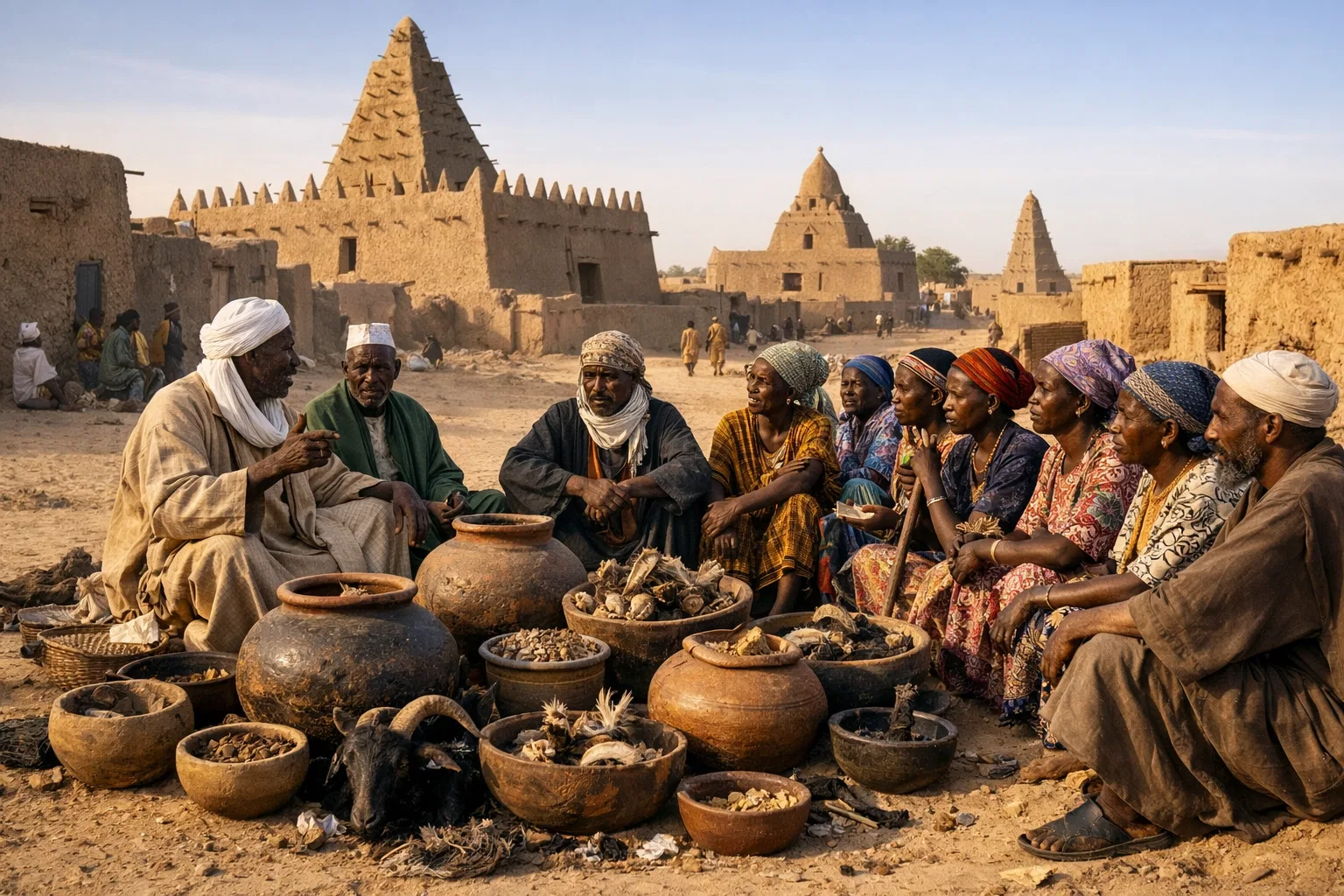
The most striking historical case is the movement commonly called Massa or Allah Koura. It began in the Cercle of San, in what was then French Sudan, and spread rapidly during the late 1940s and early 1950s through parts of present-day Mali, Burkina Faso, Côte d’Ivoire and Ghana. Its founder was a Minyanka farmer usually identified as M’Pèni or Peni Dembélé. The movement promised protection from witchcraft and other concealed sources of misfortune while offering rituals simpler than many established local religious systems.[persee.fr]persee.frPerséeLe Massa et l'eau de Moussa. Cultes régionaux, « traditions » locales et sorcellerie en Afrique de l'Ouest - Persée…
Massa combined innovation with familiar religious forms. Followers recognised a newly revealed spiritual power, maintained an altar and offered animal sacrifices, but the movement also imposed new prohibitions and challenged older ritual authorities. It could therefore appear traditional, reforming and revolutionary at the same time. Its rapid expansion was helped by travelling messengers, trade and kinship routes, and the widespread fear that illness, crop failure, infertility or sudden death might be caused by hostile occult action.[Persée]persee.frPerséeLe Massa et l'eau de Moussa. Cultes régionaux, « traditions » locales et sorcellerie en Afrique de l'Ouest - Persée…
Calling Massa a “cult” can be misleading. Colonial officials, missionaries and later art collectors often used that word for unfamiliar African religious organisations. A more neutral description is an anti-witchcraft or prophetic movement: a network that promised purification and protection while reorganising power inside villages. Scholarship on African anti-witchcraft movements emphasises that they were not merely irrational outbursts. They commonly arose where people felt that existing institutions could no longer control envy, illness, inequality or concealed aggression.[SHS Hal Science]shs.hal.scienceIn: Douglas, M. (ed.) Witchcraft Confessions and Accusations.Read moreAnti-Witchcraft Movements in Africaby J Bonhomme · 2013 · Cited by 7 — (1970) Instant millennium: the sociology of African witch-cleansin…
Fear of witches became a struggle over authority
The central promise of Massa was relief from witchcraft. Yet campaigns against hidden evil could create new targets. Gregory Mann’s study of colonial records notes that Dembélé advocated obedience to local authorities, but some young men claiming to act as his messengers attacked elders and alleged sorcerers. The movement therefore opened a generational struggle: younger adherents could challenge senior men who controlled initiation, sacrifice, knowledge and village office.[Cambridge University Press & Assessment]cambridge.orgCambridge University Press & AssessmentFETISHIZING RELIGION: ALLAH KOURA AND FRENCH…by G MANN · 2003 · Cited by 30 — This article argu…
This is one reason the episode should not be described as a simple wave of credulity. Fear of witchcraft supplied the language, but disputes over wealth, age, leadership and religious expertise helped determine who was accused and whose authority declined. The claim that harmful power was hidden inside established institutions made radical change appear morally necessary.
The French administration was uncertain how to classify the movement. Officials had long treated Islam as the principal organised religious and political threat in French Sudan, while dismissing many local practices as static “fetishism”. Massa confounded that division. It was indigenous, mobile and capable of attracting large numbers, yet its founder did not initially preach rebellion. The colonial response consequently mixed surveillance, attempts at control and a reluctant recognition that African religious life was innovative rather than frozen in tradition.[JSTOR]jstor.orgDembele had an important 'co 25 Recent work on aspects of the movement include Royer, 'Le Massa', a Massa, en Haute-Volta, 1950-1952'…
The destruction of ritual objects
Massa’s most visible consequence was iconoclasm: followers abandoned, surrendered or destroyed objects connected with older shrines and power associations. Accounts from Senufo areas describe piles of pottery, figures, masks, ornaments and other ritual property brought into public view. Some objects were destroyed; others entered the art market and eventually European or North American collections.[africa-art-archive.ch]africa-art-archive.chThe Rise and Fall of Senufo Art: A Decolonial PerspectiveOctober 24, 2024 — Eventually, the years of the Massa movement become a turning…
For followers, this was not necessarily “art destruction”. The objects were active religious things associated with powers that Massa promised to defeat. Destroying them demonstrated that old protections were unnecessary or dangerous. For elders and ritual specialists, however, the campaign could mean the loss of sacred knowledge, income and status. For collectors, the same upheaval created opportunities to acquire objects later presented as timeless examples of “traditional” African art.
The episode therefore survives in three incompatible memories: as liberation from witchcraft, as an assault on inherited religion, and as a turning point in the removal of West African sacred objects into foreign collections. That disagreement is part of its historical importance.
Miraculous water and mass pilgrimage
A related movement known as the Water of Moussa spread a few years later across part of the same borderland, especially in Burkina Faso and northern Côte d’Ivoire, with influence extending through communities connected to eastern Mali. Its prophet reported divine apparitions, and thousands travelled to obtain water believed to cleanse, protect and heal. The movement encouraged the destruction of local altars and was followed in some places by conversion to Islam or, less often, Catholicism.[Persée]persee.frPerséeLe Massa et l'eau de Moussa. Cultes régionaux, « traditions » locales et sorcellerie en Afrique de l'Ouest - Persée…
This was a classic miracle movement in the sense that reputation travelled faster than institutional organisation. People did not need to accept a detailed theology. They needed to believe that the water worked, or that visiting was worth the journey. Testimony about cures, purification and personal transformation supplied the movement’s publicity.
Such pilgrimages are easily caricatured as crowd delusion. A better interpretation asks what the miracle offered. Water was portable, comparatively simple and open to people who lacked control over older ritual institutions. It promised a direct remedy during an era of political transition, expanding markets and weakening colonial rule. The attraction lay not only in supernatural expectation but also in the possibility of escaping costly obligations and inherited hierarchies.[Persée]persee.frPerséeLe Massa et l'eau de Moussa. Cultes régionaux, « traditions » locales et sorcellerie en Afrique de l'Ouest - Persée…
The connection with Massa also shows how panics and miracle movements can feed each other. Fear that occult danger was everywhere increased demand for a universal protection. Reports of successful cleansing then encouraged more people to reject old shrines, which in turn made the new movement appear still more powerful.
Timbuktu: when religious fear became organised destruction
The occupation of northern Mali in 2012 produced a very different kind of collective crisis. Armed groups including Ansar Dine, the Movement for Unity and Jihad in West Africa and Al-Qaeda in the Islamic Maghreb took control of major towns. They imposed harsh rules, carried out floggings, amputations and executions, recruited children and attacked religious sites valued by local Muslims. This was not a moral panic about an imaginary threat: residents faced real armed coercion.[Human Rights Watch]hrw.orgHuman Rights Watch Mali: Islamist Armed Groups Spread Fear in NorthHuman Rights Watch Mali: Islamist Armed Groups Spread Fear in North
In Timbuktu, militants destroyed mausoleums associated with Muslim saints because they regarded the veneration of tombs as idolatrous. UNESCO protested as sacred structures within the World Heritage site were attacked. The campaign was both theological and political. It announced that the occupiers, rather than local scholars, families or religious leaders, would decide what counted as legitimate Islam.[UNESCO World Heritage Centre]whc.unesco.orgOpen source on unesco.org.
The destruction has sometimes been presented as a clash between “foreign fundamentalism” and a uniformly tolerant Malian tradition. That contrast contains some truth but is too simple. Mali has long contained several Islamic currents, including reformist movements critical of saint veneration. Scholars warn against treating all people labelled “Wahhabi” or “Salafi” as supporters of armed groups, just as they warn against imagining all Sufi leaders as politically liberal. The armed occupiers represented a coercive project, not an entire school of Muslim belief.[culanth.org]culanth.orgOpen source on culanth.org.
This distinction matters because war encourages hostile labelling. After 2012, religious vocabulary could turn ordinary disagreements about prayer, dress or authority into suspicions of sympathy with terrorism. Public discussion sometimes collapsed reformist Muslims, political Islamists and jihadist organisations into a single frightening category. That was a genuine moral-panic mechanism operating alongside a genuine security threat.
Fear, rescue and exaggerated loss
Reports that Timbuktu’s manuscripts were being annihilated produced worldwide alarm. The danger was real, but early accounts sometimes overstated the extent of the losses. Local librarians, families and custodians had hidden or transported large collections before militants could seize them. The rescue became a powerful counter-story: collective action preserved the city’s intellectual heritage even while armed groups destroyed shrines and burned or damaged some manuscripts.[Getty]getty.eduOpen source on getty.edu.
The mausoleum attacks later became a landmark in international law. Ahmad Al Faqi Al Mahdi admitted responsibility before the International Criminal Court and was convicted in 2016 of the war crime of intentionally directing attacks against historic and religious buildings. It was the first ICC case in which destruction of cultural heritage formed the central charge.[International Criminal Court]icc-cpi.intal mahdial mahdi
The case established that attacks on sacred places are not merely damage to property. They can be deliberate attempts to terrify communities, erase religious memory and demonstrate domination. Reconstruction by Malian craftspeople and local custodians was therefore more than architectural repair: it restored public practices that the occupiers had tried to outlaw.
Rumours of betrayal after foreign intervention
France’s 2013 military intervention was initially welcomed by many Malians because it helped remove armed Islamist groups from major northern towns. As insecurity continued, however, gratitude gave way to suspicion. Rumours increasingly claimed that France secretly supported separatists or jihadists, prevented the Malian army from retaking Kidal, coveted mineral wealth or deliberately prolonged the war.[Sciences Po]sciencespo.frSciences PoSciences Po
Some of these narratives grew from observable contradictions. France fought jihadist organisations while maintaining complicated relations with Tuareg-led armed groups. Kidal remained beyond effective control from Bamako, and official explanations of French policy often appeared ambiguous. Denis Tull argues that rumours became persuasive not simply because people lacked information, but because they fitted a longer history of colonial domination, foreign intervention and frustrated sovereignty.[Sciences Po]sciencespo.frSciences Po
This is the crucial difference between a rumour and nonsense. A claim may be unverified or false while still expressing a real political experience. Stories of French betrayal translated difficult questions—why had years of military intervention failed, why was Kidal treated differently, and who truly controlled Mali—into a simple account involving a hidden hand.
The narratives also had concrete effects. Rumours that French forces had sided with rebels after fighting around Kidal helped bring protesters into the streets in 2014. Anti-French explanations later became central to movements supporting Mali’s military rulers and closer relations with Russia. Public distrust contributed to an environment in which contrary reporting could be dismissed as foreign manipulation.[Institute of Current World Affairs]icwa.orgInstitute of Current World Affairs Anatomy of a conspiracy theoryInstitute of Current World Affairs Anatomy of a conspiracy theory
How smartphones changed the scale of a scare
Mali’s media system has been transformed by smartphones, social platforms and semi-professional online broadcasters sometimes known as “videomen”. These creators film speeches, livestream demonstrations and distribute political commentary through Facebook, TikTok, YouTube and messaging services. Researchers describe them as influential participants in a digital conflict over legitimacy rather than passive conduits for foreign propaganda.[OUP Academic]academic.oup.comOpen source on oup.com.
This new environment rewards urgency, certainty and emotional impact. A dramatic allegation can travel before journalists or investigators can verify it. Old footage, manipulated images and unsupported claims can be folded into current events, while platform payments and political patronage encourage creators to maximise attention. At the same time, conventional reporters face insecurity, restricted access to conflict zones and political pressure.[oup.com]academic.oup.comOpen source on oup.com.
Yet it would be wrong to explain Mali’s information crisis entirely as foreign interference. Russian-linked campaigns and state media have amplified anti-Western narratives, but local activists, politicians and online entrepreneurs possess their own motives and audiences. Research on Mali’s “videomen” argues that domestic frustration with corruption, failed governance and foreign intervention created the demand into which pro-Russian and anti-French messages entered.[OUP Academic]academic.oup.comOpen source on oup.com.
This mixture makes correction difficult. A fact-check that addresses only the literal truth of a viral claim may leave untouched the underlying grievance that made it believable. Effective responses require credible local journalism, access to public information and space for disagreement—not merely censorship or the replacement of one official narrative by another.
What Mali’s cases reveal about collective fear
Mali’s record does not support a single theory of mass hysteria. The major episodes operated through different mechanisms:
- Massa turned fear of hidden witchcraft into a popular religious reform movement. It promised protection but also enabled challenges to elders, ritual specialists and alleged sorcerers.
- Miraculous-water movements spread through testimony, pilgrimage and the hope of accessible healing. Their growth reflected social change as much as belief in supernatural power.
- The 2012 occupation made theological condemnation into coercive rule. Militants attacked shrines and people in order to impose authority; the fear they caused was based on real violence.
- Post-2013 conspiracy narratives converted political ambiguity into stories of secret betrayal. They gained strength from colonial memory, failed intervention and weak trust in institutions.
- Digital media accelerated every stage of modern rumour. Smartphones widened participation but also rewarded emotionally charged claims and blurred the boundary between reporting, activism and propaganda.
The most useful lesson is that beliefs spread when they solve a social problem, even imperfectly. Massa named an invisible enemy and offered protection. The militants in Timbuktu declared religious complexity corrupt and imposed a single answer by force. Conspiracy theories made prolonged military failure intelligible by locating a concealed author behind it.
Mali also demonstrates why the language of “cult” and “hysteria” must be used sparingly. Those labels can hide the political content of a movement, dismiss sincerely held religion or imply that frightened people had no rational reasons for mistrust. The better questions are who defined the danger, who gained authority from that definition, how the claim travelled, and who suffered once belief became action.

Why these histories still matter
The Massa movement remains important because it challenges the idea that African religious traditions existed unchanged until disrupted by Islam, Christianity or colonial rule. Malians and neighbouring peoples created new movements of their own, reworked older practices and sometimes destroyed inherited sacred objects in pursuit of reform. The episode also complicates museum stories that present exported ritual objects without explaining the local religious upheavals that brought them onto the market.
Timbuktu’s damaged and rebuilt mausoleums have become symbols of both vulnerability and resistance. They recall the attempt to erase a living Muslim heritage, the courage of people who protected manuscripts, and the recognition in international law that cultural destruction can be an attack on a community itself.[International Criminal Court]icc-cpi.intal mahdial mahdi
Contemporary rumours matter because they continue to shape alliances, protests and attitudes towards journalism. They cannot be reduced to ignorance, yet neither should they be romanticised as popular truth. Some expose contradictions that officials prefer not to discuss; others falsely accuse, polarise communities or help powerful actors escape scrutiny.
Across these cases, Mali’s history of collective belief is ultimately a history of trust: trust in healers, elders, prophets, religious scholars, armies, foreign powers, governments and media. When old authorities lose credibility, new explanations can spread with remarkable speed. Whether those explanations become reform, persecution, resistance or panic depends on who controls them—and on whether frightened communities still have institutions capable of testing claims without silencing the people who make them.
Amazon book picks
Further Reading
Books and field guides related to When Belief and Fear Reshaped Mali. Use these as the next step if you want deeper reading beyond the article.
The Bad-Ass Librarians of Timbuktu
Explains conflict, religion and heritage in modern Mali.
Endnotes
1.
Source: cambridge.org
Link:https://www.cambridge.org/core/journals/journal-of-african-history/article/fetishizing-religion-allah-koura-and-french-islamic-policy-in-late-colonial-french-soudan-mali/2C90A0F13E05B8E7046EDE957BACE16C
Source snippet
Cambridge University Press & AssessmentFETISHIZING RELIGION: ALLAH KOURA AND FRENCH...by G MANN · 2003 · Cited by 30 — This article argu...
2.
Source: jstor.org
Title: Susan Elizabeth Gagliardi
Link:https://www.jstor.org/stable/26410186
Source snippet
Senufo Unbound: Dynamics of Art...movement called Massa or Allah Koura. Founded by a Minianka farmer. M'pe Dembele, from the Cercle of...
3.
Source: shs.hal.science
Title: In: Douglas, M. (ed.) Witchcraft Confessions and Accusations.Read more
Link:https://shs.hal.science/halshs-00801509/file/AntiWitchcraftMovements.pdf
Source snippet
Anti-Witchcraft Movements in Africaby J Bonhomme · 2013 · Cited by 7 — (1970) Instant millennium: the sociology of African witch-cleansin...
4.
Source: jstor.org
Link:https://www.jstor.org/stable/4100866
Source snippet
Dembele had an important 'co 25 Recent work on aspects of the movement include Royer, 'Le Massa', a Massa, en Haute-Volta, 1950-1952'...
5.
Source: africa-art-archive.ch
Link:https://africa-art-archive.ch/files/Reworking-the-Archives-4-Foerster.pdf
Source snippet
The Rise and Fall of Senufo Art: A Decolonial PerspectiveOctober 24, 2024 — Eventually, the years of the Massa movement become a turning...
Published: October 24, 2024
6.
Source: academia.edu
Link:https://www.academia.edu/62072238/Iconoclasms_in_Africa_Implications_for_the_Debate_on_Restitution_of_Cultural_Heritage
7.
Source: whc.unesco.org
Link:https://whc.unesco.org/en/news/901
8.
Source: getty.edu
Link:https://www.getty.edu/publications/cultural-heritage-mass-atrocities/part-2/14-assomo/
9.
Source: africasacountry.com
Title: soft salafization in the sahel
Link:https://africasacountry.com/2022/10/soft-salafization-in-the-sahel
10.
Source: sciencespo.fr
Title: Sciences Po
Link:https://www.sciencespo.fr/ceri/sites/sciencespo.fr.ceri/files/ci90_mali_eng.pdf
11.
Source: academic.oup.com
Link:https://academic.oup.com/ia/article/100/4/1405/7710483
12.
Source: jhr.ca
Link:https://jhr.ca/jhr-trains-journalists-in-conflict-sensitive-reporting-to-fight-misinformation-in-mali/
13.
Source: 2021-2025.state.gov
Link:https://2021-2025.state.gov/reports/2023-report-on-international-religious-freedom/mali/
14.
Source: 2009-2017.state.gov
Link:https://2009-2017.state.gov/documents/organization/208382.pdf
15.
Source: 2009-2017.state.gov
Link:https://2009-2017.state.gov/r/pa/prs/ps/2012/07/194873.htm
16.
Source: jstor.org
Link:https://www.jstor.org/stable/4100752
17.
Source: jstor.org
Link:https://www.jstor.org/stable/4392944
18.
Source: jstor.org
Link:https://www.jstor.org/stable/jj.6142257.22
19.
Source: cambridge.org
Link:https://www.cambridge.org/core/journals/the-british-journal-of-psychiatry/article/protean-nature-of-mass-sociogenic-illness/2BDC2262E104B8A33F3DD49773DA0D8B
20.
Source: cambridge.org
Link:https://www.cambridge.org/core/journals/history-in-africa/article/mapping-senufo-reframing-questions-reevaluating-sources-and-reimagining-a-digital-monograph/71D83ADA97ECC5D3E3ED4F0BC16D04F8
21.
Source: cambridge.org
Link:https://www.cambridge.org/core/journals/journal-of-african-history/article/between-the-devil-and-the-cross-religion-slavery-and-the-making-of-the-anloewe/27C6363CE0CBA70DC7E3E355308C0B30
22.
Source: academia.edu
Link:https://www.academia.edu/4593752/Of_Women_and_Witches_A_Case_Study_in_Moral_Panics
23.
Source: academia.edu
Title: Anti Witchcraft Movements in Africa 2013
Link:https://www.academia.edu/2495380/Anti_Witchcraft_Movements_in_Africa_2013_
24.
Source: academia.edu
Link:https://www.academia.edu/34357776/_Mali_in_The_Oxford_Encyclopedia_of_the_Islamic_World
25.
Source: time.com
Title: timbuktus destruction why islamists are wrecking malis cultural heritage
Link:https://time.com/archive/7153434/timbuktus-destruction-why-islamists-are-wrecking-malis-cultural-heritage/
26.
Source: facebook.com
Link:https://www.facebook.com/natgeo/posts/the-mass-hysteria-and-superstition-that-enabled-witch-hunts-through-history-resu/541210507376384/
27.
Source: facebook.com
Link:https://www.facebook.com/opendoorsuk/posts/in-the-wake-of-a-wave-of-violence-in-mali-please-join-the-malian-church-in-prayi/1429865825835194/
28.
Source: facebook.com
Link:https://www.facebook.com/DrFredMmembe/posts/press-statement-of-the-socialist-party-on-the-termination-of-appointment-of-dr-c/3730479087031062/
29.
Source: facebook.com
Link:https://www.facebook.com/zambianfox/posts/why-kabwe-mayor-is-called-mr-nguzuafter-a-surveillance-of-13-months-our-task-for/2484883381788152/
30.
Source: facebook.com
Link:https://www.facebook.com/100063830244207/posts/by-cic-editorscic-editorial-analysistheyre-a-den-of-thieves-working-on-finding-a/167239101456774/
31.
Source: facebook.com
Link:https://www.facebook.com/groups/sidiquegeloo/posts/784066435131814/
32.
Source: facebook.com
Link:https://www.facebook.com/groups/1627186124031180/posts/24446618844994584/
33.
Source: academic.oup.com
Link:https://academic.oup.com/jicj/article/19/4/831/6428099
34.
Source: whc.unesco.org
Link:https://whc.unesco.org/en/news/1112
35.
Source: history.com
Title: salem witch trials hysteria factors
Link:https://www.history.com/articles/salem-witch-trials-hysteria-factors
36.
Source: youtube.com
Title: Mali: footage of cultural destruction in Timbuktu
Link:https://www.youtube.com/watch?v=PeL8gVAFPhA
Source snippet
Timbuktu heritage 'under threat'...
37.
Source: youtube.com
Title: Timbuktu heritage ‘under threat’
Link:https://www.youtube.com/watch?v=rZCmzB6AgxA
Source snippet
Mali: Timbuktu's historic mausoleums recovered from ruin, after their destruction by Islam...
38.
Source: youtube.com
Link:https://www.youtube.com/watch?v=ozFUZABGbFI
Source snippet
Fake news floods Sahel as disinformation wars escalate...
39.
Source: youtube.com
Title: Fake news floods Sahel as disinformation wars escalate
Link:https://www.youtube.com/watch?v=NL8I14Ap2n0
Source snippet
Deepfake news videos circulate in Mali amid tensions with France...
40.
Source: youtube.com
Title: Deepfake news videos circulate in Mali amid tensions with France
Link:https://www.youtube.com/watch?v=SnMecPyGuhM
41.
Source: persee.fr
Link:https://www.persee.fr/doc/cea_0008-0055_1999_num
Source snippet
PerséeLe Massa et l'eau de Moussa. Cultes régionaux, « traditions » locales et sorcellerie en Afrique de l'Ouest - Persée...
42.
Source: hrw.org
Title: Human Rights Watch Mali: Islamist Armed Groups Spread Fear in North
Link:https://www.hrw.org/news/2012/09/25/mali-islamist-armed-groups-spread-fear-north
43.
Source: culanth.org
Link:https://www.culanth.org/fieldsights/understanding-currents-of-islam-in-mali
44.
Source: icc-cpi.int
Title: al mahdi
Link:https://www.icc-cpi.int/mali/al-mahdi
45.
Source: icc-cpi.int
Title: International Criminal Court Case Information Sheet
Link:https://www.icc-cpi.int/sites/default/files/CaseInformationSheets/Al-MahdiEng.pdf
46.
Source: icwa.org
Title: Institute of Current World Affairs Anatomy of a conspiracy theory
Link:https://www.icwa.org/west-africa-conspiracy-theory/
47.
Source: ornito.com
Link:https://www.ornito.com/senufo/senufo-blog-part-2/
48.
Source: Wikipedia
Title: Moral panic
Link:https://en.wikipedia.org/wiki/Moral_panic
49.
Source: tribalartreference.com
Link:https://www.tribalartreference.com/africa.php
50.
Source: icc-cpi.int
Link:https://www.icc-cpi.int/news/icc-trial-chamber-viii-declares-mr-al-mahdi-guilty-war-crime-attacking-historic-and-religious
51.
Source: borisgershman.com
Link:https://www.borisgershman.com/research/witchcraft/witchcraft.pdf
52.
Source: legal-tools.org
Link:https://www.legal-tools.org/doc/bc8144/pdf/
53.
Source: sajp.org.za
Link:https://sajp.org.za/index.php/sajp/article/view/1671/2648
54.
Source: cfr.org
Title: international criminal court and africas cultural heritage
Link:https://www.cfr.org/articles/international-criminal-court-and-africas-cultural-heritage
55.
Source: x.com
Link:https://x.com/archeohistories/status/2037119801110434158
56.
Source: ndl.ethernet.edu.et
Link:https://ndl.ethernet.edu.et/bitstream/123456789/9023/1/45.pdf.pdf
57.
Source: hrw.org
Link:https://www.hrw.org/world-report/2024/country-chapters/mali
58.
Source: ebsco.com
Link:https://www.ebsco.com/research-starters/social-sciences-and-humanities/mass-hysteria
Additional References
59.
Source: journals.uchicago.edu
Link:https://www.journals.uchicago.edu/doi/pdfplus/10.1086/712219
Source snippet
Chicago JournalsIconoclasms in Africaare called “iconoclastic movements” in Europe are char- acterized in Africa as “anti-witchcraft move...
60.
Source: apnews.com
Link:https://apnews.com/article/785663f5854718cca7abdcc95ddeba66
Source snippet
On August 11, 2025, the Malian military government transported the first batch—over 200 crates weighing 5.5 tons—back to Timbuktu, a city...
Published: August 11, 2025
61.
Source: brill.com
Link:https://brill.com/display/book/9789004397101/B9789004397101_s007.pdf?srsltid=AfmBOoo4e7VT_12bdYHFpG9tk8BeLEyNo9XeATIswOfQwYPGriqjEGwb
62.
Source: researchgate.net
Link:https://www.researchgate.net/publication/319648607_Bamana_Texts_in_Arabic_Characters_Some_Leaves_from_Mali_Islamic_Manuscript_Cultures_in_Sub-Saharan_Africa
63.
Source: researchgate.net
Link:https://www.researchgate.net/publication/347058065_Ousmane_Doumbia_un_Cheikh_en_pays_Senoufo_en_Cote_d%27Ivoire_contemporaineOusmane_Doumbia_a_shaykh_among_the_Senufo_in_modern-day_Cote_d%27Ivoire
64.
Source: tribalartmagazine.com
Link:https://www.tribalartmagazine.com/en/info/ressources/authors
65.
Source: dokumen.pub
Link:https://dokumen.pub/bewitching-development-witchcraft-and-the-reinvention-of-development-in-neoliberal-kenya-9780226764597.html
66.
Source: ificantdance.studio
Link:https://ificantdance.studio/Stories%20of%20Wounds%20and%20Wonder/downloads/chapter-1/Nils-Bubandt-The-Empty-Seashell_-Witchcraft-and-Doubt-on-an-Indonesian-Island-Cornell-University-Press-2014.pdf
67.
Source: csis-website-prod.s3.amazonaws.com
Link:https://csis-website-prod.s3.amazonaws.com/s3fs-public/171004_ICC_cultural_heritage_weiner.pdf?XxWjYqMo8qzbinfS.NiBenJ4dUmyamiB=
68.
Source: globalchristianrelief.org
Link:https://globalchristianrelief.org/resources/countries/mali/
Topic Tree
Follow this branch
Related pages 192
- Antigua and Barbuda
- Argentina Belief Scares
- Azerbaijan Belief
- Bahrain Beliefs
- North Korea
- +187 more in sidebar