Within Dominican Belief Panics
Why Did Papa Liborio Frighten the State?
Olivorio Mateo became a healer, prophet and symbol of rural resistance before occupation forces killed him in 1922.
On this page
- Healing, prophecy and popular devotion
- Borderland change and peasant resistance
- Pursuit, death and the growth of legend
Page outline Jump by section
Introduction
Papá Liborio, born Olivorio Mateo, became one of the Dominican Republic’s most influential rural religious leaders in the early twentieth century. To his followers he was a healer, prophet and protector of poor farming communities. To successive governments and, later, the United States occupation authorities, he gradually became something very different: the centre of an autonomous movement that challenged official authority in a politically sensitive border region. His story illustrates how a popular religious movement could be transformed, in the eyes of the state, from a source of spiritual comfort into a perceived security threat. Rather than simply being a tale of a “cult”, it reflects the intersection of religion, rural hardship, nationalism, border politics and state-building during a period of rapid change.[Wikipedia]WikipediaOlivorio MateoOlivorio Mateo
Why did Papá Liborio attract so many followers?
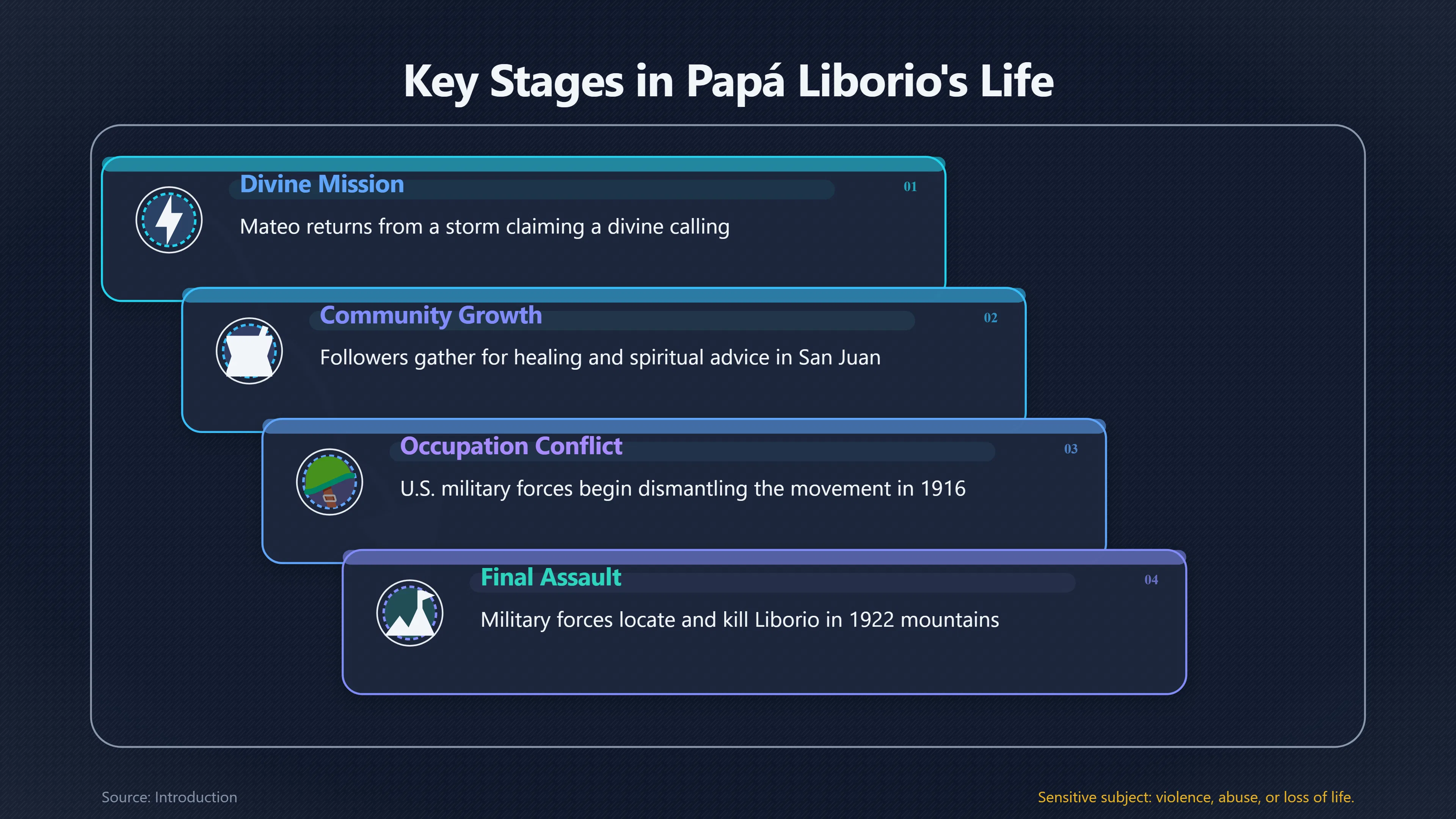
Olivorio Mateo emerged from the farming communities of the San Juan Valley, an area where poverty, limited medical care and weak state institutions meant that local healers often occupied an important social role. Around 1908, stories spread that he had disappeared during a violent storm and returned several days later claiming to have received a divine mission. Whether understood as miracle, legend or symbolic origin story, this narrative helped establish his authority as a man chosen by God.[Wikipedia]WikipediaOlivorio MateoOlivorio Mateo
His appeal rested less on elaborate theology than on practical service. People travelled to him seeking treatment for illness, blessings and spiritual advice. Accounts describe him combining Christian devotion, prayer, herbal remedies and ritual healing while urging peaceful living and reverence for the Holy Trinity. For many rural Dominicans, these practices complemented rather than replaced Catholic belief.[Wikipedia]WikipediaOlivorio MateoOlivorio Mateo
The movement also created a sense of community. Followers gathered around a leader who appeared accessible, offered hope during hardship and claimed that divine justice would eventually prevail over earthly injustice. This combination of healing, prophecy and communal identity explains why his influence spread well beyond his immediate neighbourhood.[Ursinus College Bookstore]ursinus.ecampus.comUrsinus College BookstorePeasants and Religion: A Socioeconomic Study of Dios Olivorio and the Palma Sola Religion in the Dominican Republic…
How healing became political
Papá Liborio did not begin as an armed revolutionary. Historians generally argue that his movement became political because of the changing conditions surrounding it rather than because it was founded as an insurgency. The San Juan region depended heavily on cross-border connections with Haiti, communal patterns of land use and local autonomy. During the early twentieth century, Dominican governments increasingly sought tighter border control, stronger central administration and greater state authority, developments intensified after the United States occupied the country in 1916.[Tiboko]tiboko.comMicrosoft WordMicrosoft Word - DavisMarthaEllen_xCD.doc…
For peasants, these changes disrupted familiar ways of life. Restrictions on movement and trade, new forms of policing and changing land relations affected communities that already felt neglected by the state. Within this environment, Liborio’s religious authority naturally acquired political significance because his followers organised themselves independently of government institutions. His settlements, healing centres and gatherings became spaces where rural people expressed solidarity and preserved older social networks.[Tiboko]tiboko.comMicrosoft WordMicrosoft Word - DavisMarthaEllen_xCD.doc…
Scholars therefore often interpret Liborismo as both a religious movement and a form of peasant resistance. The movement’s political importance emerged from its social role rather than from an explicit revolutionary programme.[OUP Academic]academic.oup.comOUP AcademicThe Invaded: How Latin Americans and Their Allies Fought and Ended U.S. Occupations | Oxford Academic…
Why did the state begin to see him as a threat?
Government concern grew for several overlapping reasons rather than because of one single event.
- Independent authority: Liborio commanded loyalty from thousands of followers outside official political and religious structures.
- Remote geography: His movement operated in mountainous border regions where government control was already weak.
- Association with armed followers: Although many followers sought healing, some men wanted by the authorities reportedly found refuge within the movement, making it increasingly difficult to distinguish peaceful devotees from armed resisters.
- Occupation anxieties: American military authorities viewed any organised rural movement capable of mobilising people beyond state supervision as a potential insurgency.[wikipedia.org]WikipediaOlivorio MateoOlivorio Mateo
Official descriptions increasingly portrayed Liborio less as a healer than as a dangerous guerrilla leader. Contemporary reports and later propaganda often blurred together religious devotion, criminality and rebellion. Modern historians caution that these labels reflected political interests as well as genuine security concerns. While armed clashes certainly occurred, portraying the entire movement as irrational fanaticism simplified a far more complicated rural conflict.[wisc.edu]asset.library.wisc.eduOpen source on wisc.edu.

Pursuit, death and the making of a martyr
Between 1916 and 1922, Papá Liborio repeatedly evaded military campaigns mounted against him and his followers. Fighting broke out on numerous occasions as occupation forces attempted to dismantle the movement. Sources describe negotiations over surrendering weapons in 1920, but disagreements among followers and continued military suspicion meant that the conflict persisted.[Wikipedia]WikipediaOlivorio MateoOlivorio Mateo
On 27 June 1922, military forces located Liborio’s camp in the central mountains and killed him during an assault. His death removed the movement’s charismatic leader but failed to destroy his reputation. Instead, many followers interpreted his killing through a religious lens, seeing him as a martyr whose mission continued beyond death. Stories circulated that he would return, while pilgrimage traditions developed around places associated with his life.[Wikipedia]WikipediaOlivorio MateoOlivorio Mateo
This transformation from living healer to sacred figure strengthened rather than erased his influence. In many communities, Papá Liborio became remembered simultaneously as a holy man, a defender of the poor and a victim of political persecution.[Wikipedia]WikipediaOlivorio MateoOlivorio Mateo
Separating legend from history
Like many charismatic religious leaders, Papá Liborio is surrounded by stories that mix documented events with popular belief.
The best-supported historical evidence confirms that Olivorio Mateo was a widely respected healer, gathered a substantial rural following, clashed with authorities during the American occupation and was killed in 1922. These events are well documented in historical studies and government records.[Wikipedia]WikipediaOlivorio MateoOlivorio Mateo
Other elements belong primarily to oral tradition. His disappearance during the storm, miraculous cures, prophetic visions and expected return are central to Liborista belief but cannot be independently verified as historical events. Rather than dismissing these traditions, historians study them as evidence of how followers understood his significance and why devotion survived long after his death.[Ursinus College Bookstore]ursinus.ecampus.comUrsinus College BookstorePeasants and Religion: A Socioeconomic Study of Dios Olivorio and the Palma Sola Religion in the Dominican Republic…
Similarly, sensational accusations made by opponents—including claims of widespread immorality, witchcraft or organised criminality—are now treated cautiously. Researchers note that hostile elites and sections of the press often used such allegations to discredit movements they regarded as socially or politically dangerous.[Revista GLOBAL]revistaglobal.orgRevista GLOBALUn profeta dominicanoRevista GLOBAL…
Why Papá Liborio still matters
Papá Liborio remains one of the Dominican Republic’s most important examples of the blurred boundary between religious devotion and perceived political danger. His story demonstrates how a movement centred on healing and prophecy could become entangled with struggles over land, national identity, border control and foreign occupation.
His legacy also shaped later history. Devotion to Liborio survived his death and inspired the Liborista movement that eventually centred on Palma Sola decades later, where fears of another independent religious community again led the Dominican state to respond with overwhelming force. His life therefore stands at the beginning of a longer history in which popular religion was repeatedly interpreted by authorities not simply as belief, but as a challenge to political order.[Wikipedia]WikipediaPalma Sola massacrePalma Sola massacre
Amazon book picks
Further Reading
Books and field guides related to Why Did Papa Liborio Frighten the State?. Use these as the next step if you want deeper reading beyond the article.
The Serpent and the Rainbow
First published 1985. Subjects: Social life and customs, Description and travel, Zombiism, Bizango (Cult), Religious life and customs.
Silencing the past
First published 1995. Subjects: Historiography, Historicism, Power (Social sciences), Historiographie, Historicisme.
Why the cocks fight
First published 1999. Subjects: Haiti, Haitians, Relations, International relations, Außenpolitik.
Endnotes
1.
Source: Wikipedia
Title: Olivorio Mateo
Link:https://en.wikipedia.org/wiki/Olivorio_Mateo
2.
Source: academic.oup.com
Link:https://academic.oup.com/book/12392
Source snippet
OUP AcademicThe Invaded: How Latin Americans and Their Allies Fought and Ended U.S. Occupations | Oxford Academic...
3.
Source: tiboko.com
Title: Microsoft Word
Link:https://tiboko.com/wp-content/uploads/2023/07/Revolutionary-Kiskeya-from-Caonabo-to-Liborio.pdf
Source snippet
Microsoft Word - DavisMarthaEllen_xCD.doc...
4.
Source: revistaglobal.org
Title: Revista GLOBALUn profeta dominicano
Link:https://revistaglobal.org/un-profeta-dominicano/
Source snippet
Revista GLOBAL...
5.
Source: Wikipedia
Title: Palma Sola massacre
Link:https://en.wikipedia.org/wiki/Palma_Sola_massacre
6.
Source: youtube.com
Link:https://www.youtube.com/watch?v=RDUPM9arD-E
Source snippet
4 Papa Liborio, the living saint of Maguana (Full Documentary - 2003)[https://www.youtube.com/watch?v=5dFTB9ij7ag](https://www.youtube.com/watch?v=5dFTB9ij7ag) 5 Peasants and Popular R...
7.
Source: ursinus.ecampus.com
Link:https://ursinus.ecampus.com/peasants-religion-socioeconomic-study/bk/9780415174114
Source snippet
Ursinus College BookstorePeasants and Religion: A Socioeconomic Study of Dios Olivorio and the Palma Sola Religion in the Dominican Republic...
8.
Source: asset.library.wisc.edu
Link:https://asset.library.wisc.edu/1711.dl/TXXCYOUZPE2RN8D/R/file-11beb.pdf
Additional References
9.
Source: tandfonline.com
Link:https://www.tandfonline.com/doi/full/10.1080/03066150.2026.2632764
Source snippet
March 5, 2026 — Forum on Palestine: Agrarian Questions Unsettled POST-AGRARIAN LAND DEFENSE: RETHINKING RESISTANCE FROM THE RURAL MARGINS...
Published: March 5, 2026
10.
Source: geocities.ws
Link:https://www.geocities.ws/serie012/olivorio.htm
Source snippet
El Gobierno de los Victoria, nada hizo para evitar la continuación del Olivorismo. Según investigaciones, se considera que las autorid...
11.
Source: routledge.com
Link:https://www.routledge.com/Peasants-and-Religion-A-Socioeconomic-Study-of-Dios-Olivorio-and-the-Palma-Sola-Religion-in-the-Dominican-Republic/Lundahl-Lundius/p/book/9780415174114
Source snippet
ORIO AND THE PALMA SOLA RELIGION IN THE DOMINICAN REPUBLIC By Mats Lundahl, Jan Lundius Copyright 2000 800 Pages by Routledge...
12.
Source: everything.explained.today
Title: Everything Explained Today Olivorio Mateo Explained
Link:https://everything.explained.today/Olivorio_Mateo/
Source snippet
Mateo ExplainedOLIVORIO MATEO EXPLAINED Olivorio Mateo Ledesma (1876 – June 27, 1922) was a Dominican revolutionary and spiritual healer...
Published: June 27, 1922
13.
Source: elfogondesanjuan.com
Title: historia un dia como hoy en 1962 ocurre
Link:https://www.elfogondesanjuan.com/2020/12/historia-un-dia-como-hoy-en-1962-ocurre.html
Source snippet
28, 2020 — HISTORIA: UN DIA COMO HOY EN 1962 OCURRE LA MASACRE DE PALMA SOLA; 58 AÑOS. Reply Locales 15:40...
Published: December 28, 2020
14.
Source: sersantanadominicana.blogspot.com
Title: mesianismo en san juan de la maguana
Link:https://sersantanadominicana.blogspot.com/2011/09/mesianismo-en-san-juan-de-la-maguana.html
Source snippet
SERGIO SANTANA EN REPUBLICA DOMINICANA: Mesianismo en San Juan de la MaguanaSeptember 27, 2011 — SERGIO SANTANA EN REPUBLICA DOMINICANA R...
Published: September 27, 2011
15.
Source: diarionoticias.do
Title: Olivorio Mateo. Papá Liborio
Link:https://diarionoticias.do/olivorio-mateo-papa-liborio/
Source snippet
Papá LiborioOLIVORIO MATEO. PAPÁ LIBORIO Publicado en Todo Incluido, hace 1 año Papá Liborio, fue un curandero, ocultista, líder mesiánic...
16.
Source: youtube.com
Title: The most mysterious and dark man in the history of San Juan
Link:https://www.youtube.com/watch?v=OKy7jcVFdEA
Source snippet
2 TRUJILLO AND LIBORIO: TWO DOMINICAN LEGENDS / Their History...
17.
Source: youtube.com
Title: TRUJILLO AND LIBORIO: TWO DOMINICAN LEGENDS / Their History
Link:https://www.youtube.com/watch?v=WuLznkGeTow
Source snippet
3 Liborio - Official Trailer...
18.
Source: youtube.com
Title: Peasants and Popular Religion: A Socio-Economic Study (Related Context)
Link:https://www.youtube.com/watch?v=H8bsVqo_7E4
Topic Tree