Within Libya
How Witchcraft Accusations Became a Police Weapon
Accusations of sorcery have increasingly become tools for arrest, humiliation and religious policing in divided Libya.
On this page
- From private belief to public accusation
- Women, migrants and vulnerable suspects
- Law No. 6 and the power to punish
Page outline Jump by section
Introduction
Accusations of witchcraft and sorcery have become a distinctive feature of Libya’s post-2011 landscape of social control. Rather than reflecting a revival of historical witch trials, they illustrate how supernatural beliefs can be drawn into modern policing, religious politics and fragmented governance. In different parts of the country, security agencies, religious authorities and armed groups have increasingly treated alleged sorcery as a matter for criminal investigation rather than private belief. The result has been arrests, televised confessions, public denunciations and, more recently, legislation imposing severe criminal penalties.
The pattern is best understood as a governance issue rather than evidence of a nationwide “witch panic”. Belief in harmful magic has long existed in Libyan society, as it does across much of North Africa. What has changed is the growing willingness of competing authorities to present alleged sorcery as a public security threat and to use accusations to demonstrate religious legitimacy, moral authority or state power.[lawsociety.ly]lawsociety.lyالمجمع القانونيCriminalization of WitchcraftLaw No. 6 of 2024May 15, 2024…
From private belief to public accusation
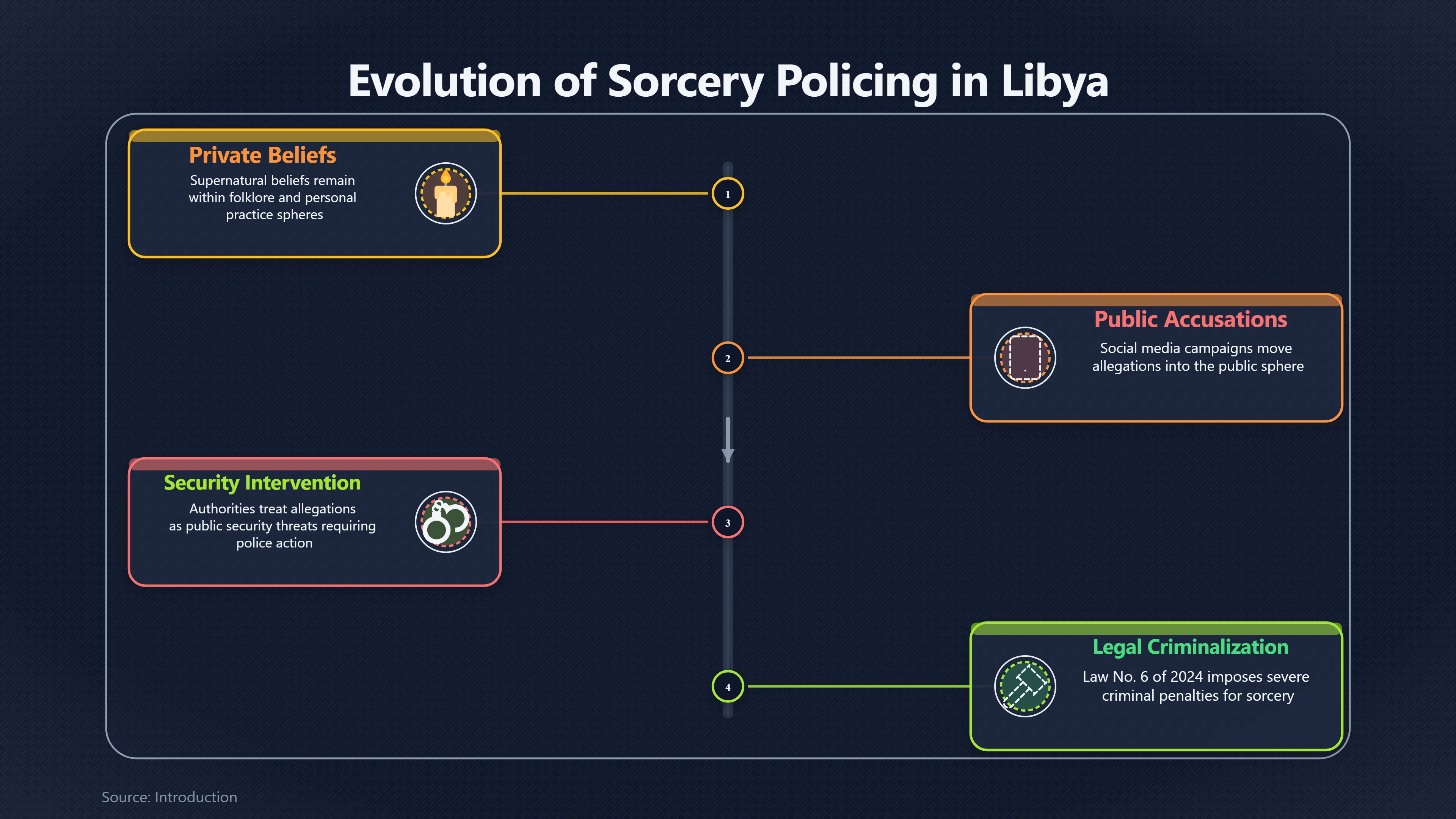
For most Libyans, beliefs about the evil eye, curses or supernatural harm have traditionally belonged to the sphere of religion, folklore and personal practice. Some people sought help from religious healers, while others viewed fortune-tellers or magical practitioners as frauds or as acting against Islamic teaching. These private beliefs did not automatically produce organised campaigns against suspected practitioners.
Since the collapse of central authority after the 2011 uprising, however, accusations of sorcery have increasingly entered the public sphere. Multiple rival governments and security bodies have competed to portray themselves as defenders of religion and public morality. In that environment, allegations of witchcraft have become easier to frame as threats requiring police action rather than civil disputes or alleged fraud.
Several reported arrests illustrate this shift. In 2019, police in Benghazi arrested three Chadian nationals after a customer alleged that rituals intended to restore her marriage had failed. Authorities presented the case primarily as one of “witchcraft”, displaying confiscated objects as evidence, rather than focusing on conventional fraud or consumer deception. The case also reflected the vulnerability of migrant communities, whose unfamiliar religious or cultural practices can attract suspicion.[المجمع القانوني]lawsociety.lyالمجمع القانونيCriminalization of WitchcraftLaw No. 6 of 2024May 15, 2024…
Public campaigns have also spread through social media. Viral accusations, often unsupported by verifiable evidence, have encouraged authorities to intervene, reinforcing the impression that supernatural wrongdoing represents a matter of public order.
Women, migrants and vulnerable suspects
Although anyone can become the target of supernatural accusations, available evidence suggests that certain groups face disproportionate risks.
Women are especially vulnerable because allegations frequently intersect with wider ideas about morality, family honour and acceptable behaviour. One widely reported case involved two Libyan sisters known for their work rescuing stray animals. After an online campaign accused them of witchcraft, they were detained for several days before their release. Supporters argued that the accusations were based on rumours rather than credible evidence, while the case demonstrated how internet harassment can spill into official action.
Migrants from sub-Saharan Africa also face particular danger. Their languages, religious traditions and social isolation may make them easier to portray as practitioners of forbidden supernatural practices. Cases involving Chadian nationals illustrate how accusations of sorcery can merge with wider suspicions surrounding migrants during periods of insecurity.
Other vulnerable groups—including religious minorities, independent activists and people perceived as challenging prevailing social norms—have experienced similar patterns of moral policing. Human rights organisations have documented cases in which security agencies have relied on coerced video “confessions”, prolonged detention and vague religious or moral accusations extending beyond witchcraft alone. These practices create an atmosphere in which allegations can become tools of intimidation regardless of whether any recognisable criminal conduct occurred.[amnesty.org]amnesty.orgAmnesty InternationalLibya's Internal Security Agency must end abuses in name of ‘guarding virtue’…
Law No. 6 and the power to punish
A major turning point came in May 2024, when Libya’s eastern-based House of Representatives enacted Law No. 6 of 2024 on the criminalisation of witchcraft, sorcery, divination and related practices.
The law goes far beyond prohibiting fraudulent spiritual services. It criminalises a wide range of activities, including:
- practising or claiming supernatural powers;
- teaching or learning witchcraft;
- requesting magical services;
- supporting or sheltering alleged practitioners;
- promoting such practices through books, media or online platforms;
- possessing or importing objects considered tools of witchcraft.
The legislation also establishes severe penalties. Depending on the offence and judicial interpretation, punishments range from several years’ imprisonment to life imprisonment, with some provisions allowing the death penalty for certain convictions. It further incorporates evidential rules linked to the Maliki school of Islamic jurisprudence, making it unusual among modern criminal statutes.[المجمع القانوني]lawsociety.lyالمجمع القانونيCriminalization of WitchcraftLaw No. 6 of 2024May 15, 2024…
Supporters describe the law as protecting society from deception, exploitation and practices regarded as incompatible with Islamic values. Critics argue that its definitions are exceptionally broad, making it difficult to distinguish between deliberate fraud, traditional healing, religious expression and alleged supernatural conduct.
Why accusations have become politically useful
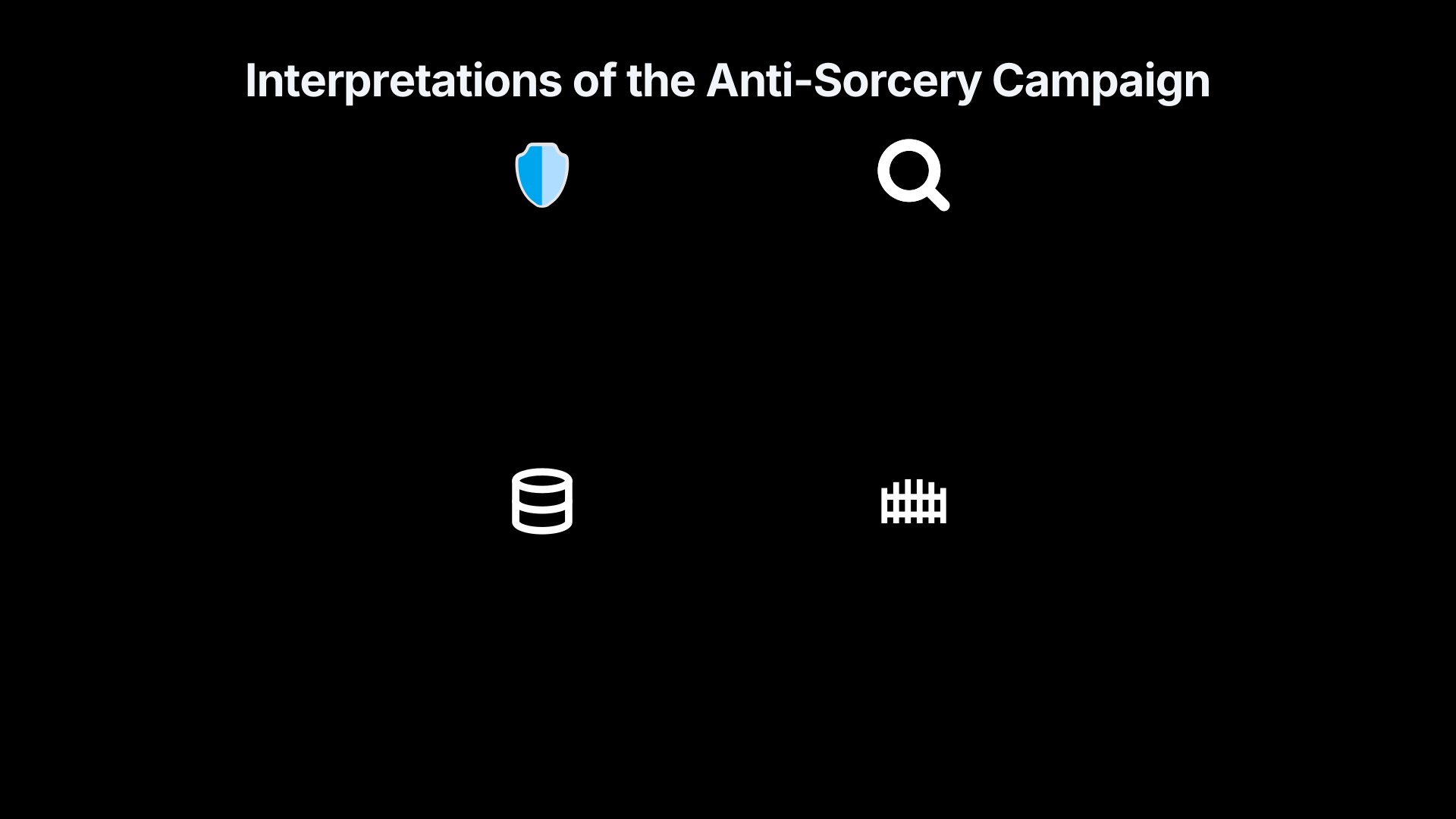
The anti-sorcery campaign cannot be understood simply as a debate over belief in magic. It also reflects Libya’s fragmented political landscape.
Since 2011, rival governments and security institutions have often competed for religious legitimacy as well as military authority. Campaigns against perceived immorality—including alleged witchcraft, religious heterodoxy or challenges to conservative social norms—allow authorities to present themselves as protectors of society.
Human rights organisations have argued that these campaigns frequently overlap with broader restrictions on freedom of expression, civil society and religious diversity. Amnesty International has documented operations by the Internal Security Agency conducted under the banner of “guarding virtue”, including committees established to combat witchcraft and sorcery that have also been associated with attacks on cultural and religious sites. Human Rights Watch likewise reports that security agencies have used moral and religious accusations alongside restrictions on civic organisations and dissent.[amnesty.org]amnesty.orgAmnesty InternationalLibya's Internal Security Agency must end abuses in name of ‘guarding virtue’…
In practice, accusations of sorcery therefore perform several political functions simultaneously:
- demonstrating religious credentials;
- expanding the authority of security institutions;
- discouraging behaviour portrayed as socially deviant;
- reinforcing conservative visions of public morality; and
- legitimising intrusive policing powers.
How much evidence exists for organised witchcraft?
A recurring difficulty is distinguishing documented criminal behaviour from claims about supernatural harm.
There is evidence that some individuals advertise fortune-telling, spiritual healing or magical services in exchange for money. Such practices can involve deception or financial exploitation. However, there is little objective evidence demonstrating the supernatural claims themselves.
This distinction matters because criminal investigations increasingly rely on objects such as handwritten charms, books, powders or ritual items as evidence of sorcery. Such objects may demonstrate participation in traditional or occult practices, but they do not independently establish supernatural effects. Critics therefore argue that prosecutions risk punishing belief, symbolism or religious interpretation rather than demonstrable harm.
The expansion of criminal law into this area also creates opportunities for personal disputes, neighbourhood rumours or online campaigns to acquire legal consequences before factual allegations have been properly tested.

Why the crackdown matters
Libya’s anti-sorcery campaign represents a modern form of moral policing rather than a revival of early modern European witch hunts. The central issue is not widespread collective belief that witches are causing disasters across society. Instead, accusations have become institutional tools that enable authorities to investigate, detain and punish individuals under broadly defined offences connected to supernatural claims.
The campaign illustrates how periods of political fragmentation can blur the boundary between religious belief, criminal law and public security. In Libya, the consequences extend beyond those accused of witchcraft. They affect freedom of belief, due process, minority rights and the relationship between state authority and private religious life. As new legislation strengthens official powers over alleged sorcery, debates increasingly concern not whether supernatural beliefs exist, but how far governments should go in policing them.[lawsociety.ly]lawsociety.lyالمجمع القانونيCriminalization of WitchcraftLaw No. 6 of 2024May 15, 2024…
Amazon book picks
Further Reading
Books and field guides related to How Witchcraft Accusations Became a Police Weapon. Use these as the next step if you want deeper reading beyond the article.
African Religions A Very Short Introduction
Explains indigenous belief systems often misunderstood by colonial authorities.

The Return: Fathers, Sons and the Land in Between
Shows the social effects of authoritarian rule and fear.


Libya: From Colony to Revolution
Explains the political setting behind modern policing and belief.
Endnotes
1.
Source: amnesty.org
Link:https://www.amnesty.org/en/latest/news/2024/02/libya-internal-security-agency-must-end-abuses-in-name-of-guarding-virtue/
Source snippet
Amnesty InternationalLibya's Internal Security Agency must end abuses in name of ‘guarding virtue’...
2.
Source: amnesty.de
Title: libyen 2023
Link:https://www.amnesty.de/informieren/amnesty-report/libyen-2023
3.
Source: amnesty.org
Link:https://www.amnesty.org/fr/latest/news/2024/02/libya-internal-security-agency-must-end-abuses-in-name-of-guarding-virtue/
4.
Source: amnesty.be
Title: Libye, L’Agence de sûreté intérieure doit cesser de piétiner les droits humains
Link:https://www.amnesty.be/infos/actualites/article/libye-agence-surete-interieure-cesser-pietiner-droits-humains
5.
Source: amnesty.org
Link:https://www.amnesty.org/en/latest/news/2023/09/libya-lift-restrictions-on-media-and-facilitate-relief-efforts-in-wake-of-catastrophic-floods/
6.
Source: amnesty.org
Title: HR C 52
Link:https://www.amnesty.org/en/documents/ior40/6635/2023/en/
7.
Source: amnesty.org
Link:https://www.amnesty.org/es/documents/ior40/6635/2023/en/
8.
Source: amnesty.org
Link:https://www.amnesty.org/fr/documents/ior40/6635/2023/en/
9.
Source: lawsociety.ly
Title: المجمع القانونيCriminalization of Witchcraft
Link:https://lawsociety.ly/en/legislation/law-no-6-of-2024-on-the-criminalization-of-witchcraft-sorcery-divination-and-related-practices/
Source snippet
Law No. 6 of 2024May 15, 2024...
Published: May 15, 2024
10.
Source: hrw.org
Link:https://www.hrw.org/world-report/2024/country-chapters/libya
Source snippet
Human Rights WatchWorld Report 2024: Libya | Human Rights Watch...
11.
Source: hrw.org
Link:https://www.hrw.org/news/2023/04/18/libya-crackdown-nongovernmental-groups
12.
Source: ecoi.net
Title: The law jeopardized the rights to freedom of conscience and religion of re
Link:https://www.ecoi.net/en/document/2124742.html
Source snippet
Amnesty International (Author): “The State of the World's Human Rights; Libya 2024”, Document #2124742 - ecoi.netApril 29, 2025 — ETHNIC...
Published: April 29, 2025
13.
Source: lawsociety.ly
Title: Sovereign Archives
Link:https://lawsociety.ly/en/legislation/?sector=sovereign&sort=date_desc
14.
Source: lawsociety.ly
Title: قانون رقم 6 لسنة 2024 م في شأن تجريم السحر وا
Link:https://lawsociety.ly/legislation/%D9%82%D8%A7%D9%86%D9%88%D9%86-%D8%B1%D9%82%D9%85-6-%D9%84%D8%B3%D9%86%D8%A9-2024-%D9%85-%D9%81%D9%8A-%D8%B4%D8%A3%D9%86-%D8%AA%D8%AC%D8%B1%D9%8A%D9%85-%D8%A7%D9%84%D8%B3%D8%AD%D8%B1-%D9%88%D8%A7/
15.
Source: lawsociety.ly
Title: law no 6 of 2022 concerning electronic transactions
Link:https://lawsociety.ly/en/legislation/law-no-6-of-2022-concerning-electronic-transactions/
16.
Source: hrw.org
Link:https://www.hrw.org/world-report/2023/country-chapters/libya
17.
Source: hrw.org
Link:https://www.hrw.org/world-report/2026/country-chapters/libya
18.
Source: hrw.org
Link:https://www.hrw.org/middle-east/n-africa/libya
19.
Source: lawsociety.ly
Link:https://lawsociety.ly/en/legislation/?legal_subject=criminal
20.
Source: lawsociety.ly
Link:https://lawsociety.ly/en/legislation/?legislation_type=laws
Additional References
21.
Source: mdp.omu.edu.ly
Title: omu.edu.ly Evaluation of The Objective Criminal Policy of Law No
Link:https://mdp.omu.edu.ly/journals/index.php/mjls/article/view/1441
Source snippet
(6) Of 2024 Regarding The Criminalization of Witchcraft, Sorcery, Divination and its equivalents | Al-Mukhtar Journal of Legal ScienceJun...
22.
Source: lcw.ngo
Title: report human rights violations in libya during april 2026
Link:https://lcw.ngo/en/blog/report-human-rights-violations-in-libya-during-april-2026/
Source snippet
REPORT: HUMAN RIGHTS VIOLATIONS IN LIBYA DURING APRIL 2026 - Libya Crimes WatchMay 5, 2026 — Al-Sharif had been arbitrarily detained in S...
Published: april 2026
23.
Source: parliament.ly
Title: قوانين مجلس النواب لسنة 2022 م
Link:https://parliament.ly/%D9%82%D9%88%D8%A7%D9%86%D9%8A%D9%86-%D9%85%D8%AC%D9%84%D8%B3-%D8%A7%D9%84%D9%86%D9%88%D8%A7%D8%A8-%D9%84%D8%B3%D9%86%D8%A9-2022-%D9%85/
Source snippet
مجلس النواب الليبيJune 23, 2026 — قوانين مجلس النواب لسنة 2022 م Image | قانون رقم (3) لسنة 2022 ميلادية في شأن اعتماد الميزانية العامة ل...
Published: June 23, 2026
24.
Source: lcss.gov.ly
Title: post 781
Link:https://lcss.gov.ly/articles/blog/post-781/
Source snippet
قانون رقم 6 لسنة 2024 بشأن تجريم السحر والشعوذة والكهانة – LCSSFebruary 5, 2025 — قانون رقم 6 لسنة 2024 بشأن تجريم السحر والشعوذة والكهان...
Published: February 5, 2025
25.
Source: security-legislation.ly
Link:https://security-legislation.ly/latest-laws/decree-no-47-of-2012-organising-and-determining-the-competencies-of-the-administrative-unit-of-the-ministry-of-endowments-and-religious-affairs-and-adopting-certain-provisions/
26.
Source: hrw.org
Title: Libya: Rights Violations Unchecked as Divisions Persist | Human Rights Watch
Link:https://www.hrw.org/news/2024/01/11/libya-rights-violations-unchecked-divisions-persist
27.
Source: newarab.com
Title: Libyan sisters freed after ‘witchcraft’ hate campaign
Link:https://www.newarab.com/news/libyan-sisters-freed-after-witchcraft-hate-campaign
28.
Source: security-legislation.ly
Title: law no 6 of 1992 on establishing a law department
Link:https://security-legislation.ly/latest-laws/law-no-6-of-1992-on-establishing-a-law-department/
29.
Source: youtube.com
Link:https://www.youtube.com/watch?v=aIyiM3PEWCU
30.
Source: youtube.com
Link:https://www.youtube.com/watch?v=o9LoFpO6nI8
Topic Tree