Within Congo
Why Did Kimbangu Frighten Belgian Rule?
Kimbangu's peaceful healing movement became a colonial security scare and later a powerful symbol of African religious independence.
On this page
- The healing ministry that drew mass followings
- Arrest, trial and decades of repression
- From forbidden movement to national memory
Page outline Jump by section
Introduction
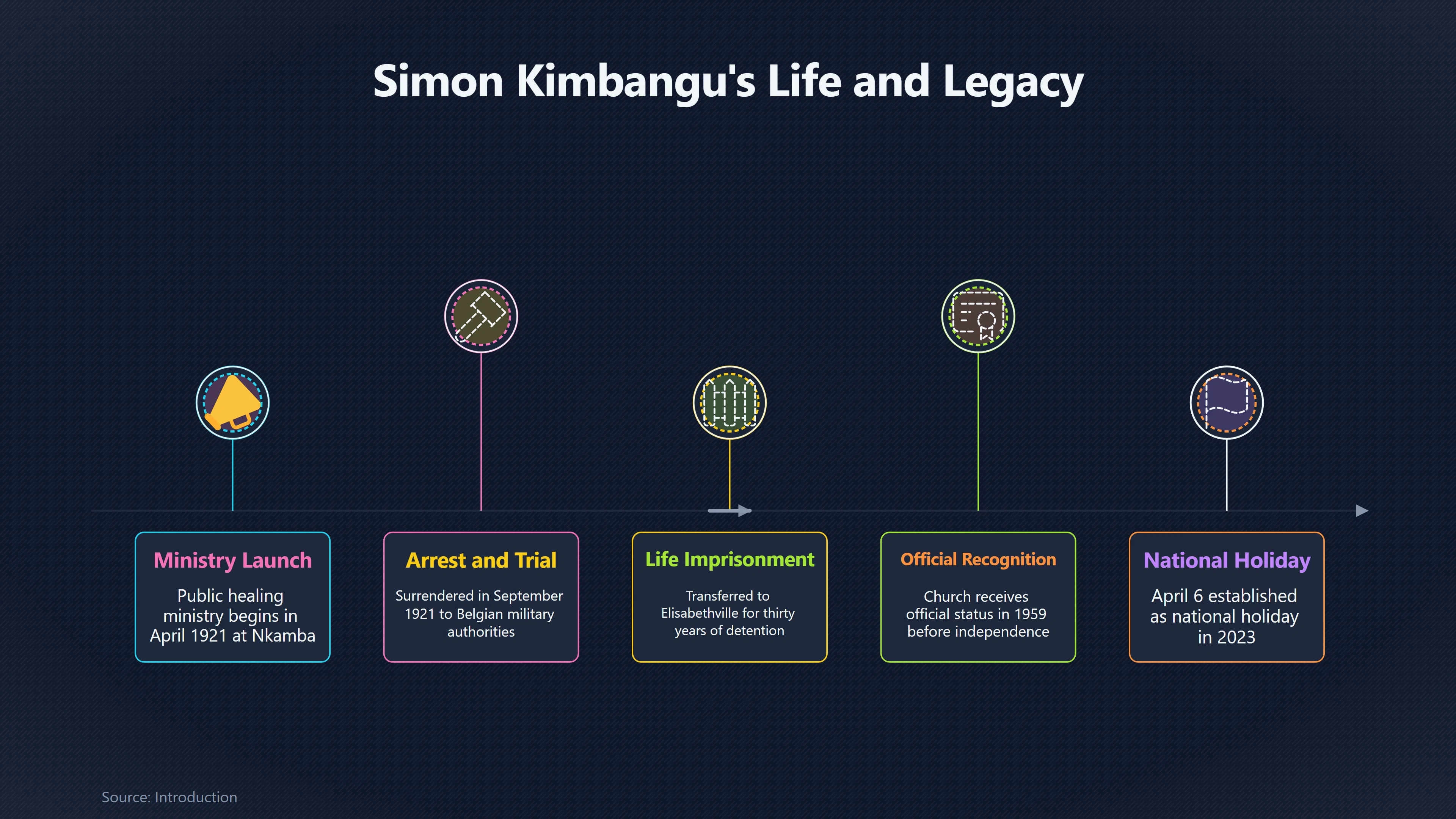
Simon Kimbangu’s rise from village prophet to one of the Democratic Republic of the Congo’s most important national symbols was shaped as much by colonial repression as by his religious message. In 1921, his public healing ministry lasted only a few months, yet it attracted thousands of followers and alarmed the Belgian colonial authorities. They viewed his independent African Christian movement not simply as a religious revival but as a potential threat to colonial order. His imprisonment for the remaining thirty years of his life transformed him from a local preacher into a martyr whose story came to symbolise spiritual independence, African dignity and peaceful resistance to colonial rule. Today, his legacy extends far beyond the church he inspired, making him both a central figure in African Christianity and a powerful symbol in Congolese national memory.[wikipedia.org]WikipediaOpen source on wikipedia.org.
Why Did Kimbangu Frighten Belgian Rule?
Simon Kimbangu was a Baptist-trained catechist from Nkamba in the Belgian Congo. On 6 April 1921, he reportedly performed a miraculous healing that launched a remarkable preaching ministry. News spread rapidly through villages, mission stations and labour camps. Crowds travelled long distances seeking healing, prayer and spiritual guidance.
The movement’s appeal rested on several features that made it unusually powerful:
- It offered an African-led expression of Christianity rather than one controlled by European missionaries.
- Reports of miraculous cures convinced many that divine power was acting through Kimbangu.
- His preaching stressed repentance, moral reform and faith rather than armed resistance.
- His ministry gave many Congolese a new sense of dignity under an intensely unequal colonial system.[iris.unilink.it]iris.unilink.itOpen source on unilink.it.
To many followers, Kimbangu was a prophet sent by God. Belgian administrators, however, interpreted the rapidly growing gatherings through an entirely different lens. They worried that any mass movement operating outside missionary and colonial supervision could undermine labour discipline, weaken state authority and eventually encourage political rebellion. Historians generally argue that colonial fears reflected broader anxieties about African-led religious movements rather than evidence that Kimbangu himself was organising an insurrection.[wikipedia.org]WikipediaOpen source on wikipedia.org.
This distinction is important. Whether followers accepted claims of miraculous healing is a matter of religious belief. The documented historical fact is that colonial officials treated those beliefs as a security problem.
The Healing Ministry That Drew Mass Followings
Kimbangu’s public ministry lasted for only about five months, yet its influence was extraordinary. Witnesses described long processions of people travelling to Nkamba seeking cures for illness, spiritual comfort and biblical teaching. The movement spread largely through word of mouth rather than formal organisation.
His preaching differed from many missionary churches in several ways. It presented Christianity as fully compatible with African identity instead of requiring complete dependence on European religious authority. This challenged assumptions embedded within the colonial system, where European missionaries often occupied positions of considerable social and political influence.
Researchers studying early Kimbanguist sources also note that the movement quickly developed its own sacred geography and historical narrative. Nkamba came to be understood by believers as a spiritually significant place, while Kimbangu’s mission was interpreted as part of God’s continuing work in history rather than merely a local revival. These ideas helped create a durable religious identity that survived even after its founder disappeared into prison.[iris.unilink.it]iris.unilink.itOpen source on unilink.it.
Arrest, Trial and Decades of Repression
Belgian authorities moved quickly. Kimbangu surrendered to officials in September 1921 after weeks in hiding, hoping to spare his followers further persecution. He was tried before a military court without normal legal protections, convicted of threatening public order and initially sentenced to death. King Albert I commuted the sentence to life imprisonment, and Kimbangu was transferred to Elisabethville (now Lubumbashi), more than 1,500 kilometres from his home, where he remained until his death in 1951.[Wikipedia]WikipediaSimon KimbanguSimon Kimbangu
Repression extended far beyond Kimbangu himself.
Thousands of followers experienced surveillance, arrest, forced relocation and imprisonment. The movement was outlawed, while many believers were deported across the colony in an effort to break its organisational strength. Ironically, these forced dispersals helped spread Kimbangu’s teachings into new regions. Rather than eliminating the movement, repression unintentionally widened its geographical reach.[Wikipedia]WikipediaSimon KimbanguSimon Kimbangu
Later Kimbanguist memory places particular emphasis on non-violence during this period. Although colonial officials frequently portrayed the movement as politically dangerous, Kimbangu consistently became remembered by followers as someone who neither organised armed rebellion nor encouraged violent resistance. This image of peaceful endurance became central to his later reputation.[Library of Congress Tiles]tile.loc.govLibrary of Congress Tiles KimbanguismLibrary of Congress Tiles Kimbanguism
From Forbidden Movement to National Memory
The decades after Kimbangu’s death transformed his public reputation.
In 1959, as Belgian colonial rule weakened, the Church of Jesus Christ on Earth by the Prophet Simon Kimbangu finally received official recognition. Under the leadership of Kimbangu’s wife, Marie Muilu, and later his son Joseph Diangienda, the church expanded rapidly through education, worship and community institutions. Following Congolese independence in 1960, Kimbanguism became one of Central Africa’s largest independent Christian churches.[encyclopaediaafricana.com]encyclopaediaafricana.comEncyclopaedia Africana KIMBANGU, SIMONEncyclopaedia AfricanaKIMBANGU, SIMON - Encyclopaedia AfricanaFebruary 28, 2025…
The image of Simon Kimbangu also changed. Colonial records had largely presented him as a dangerous agitator. Independent Congo increasingly celebrated him as:
- a martyr of colonial injustice;
- a pioneer of African religious independence;
- an example of peaceful resistance;
- a symbol of African spiritual dignity.
This shift illustrates how national memory can reinterpret historical figures. The same actions that colonial authorities considered subversive later became evidence of courage and moral leadership.
Why Kimbangu Became a National Symbol
Kimbangu’s symbolic importance rests on more than his religious influence. His story connects several powerful themes in Congolese history.
First, he demonstrated that Christianity in Africa did not have to remain dependent on European leadership. His movement became one of the continent’s most influential African-initiated churches, challenging assumptions that legitimate Christian authority necessarily flowed from colonial missions.[iris.unilink.it]iris.unilink.itOpen source on unilink.it.
Second, his long imprisonment created a narrative of sacrifice that resonated well beyond church membership. Spending three decades in prison without abandoning his beliefs allowed later generations to compare him with other international figures associated with peaceful resistance and endurance under political oppression. While such comparisons are symbolic rather than exact historical parallels, they reflect his place in Congolese public memory.[AP News]apnews.comKimbangu, a lay Baptist who preached a theology of Black liberation, was imprisoned by Belgian colonial authorities in 1921 and died in c…
Third, his legacy became intertwined with ideas of African consciousness. Rather than representing only a religious founder, Kimbangu came to embody wider aspirations for cultural dignity, self-government and freedom from colonial domination.

Continuing Importance in Modern Congo
Recognition of Kimbangu has continued to grow in public life. His remains were reburied with military honours after independence, and commemorations surrounding his life have expanded during the twenty-first century. In 2023, the Democratic Republic of the Congo formally established 6 April—the anniversary of the beginning of his public ministry—as a national public holiday dedicated to “Simon Kimbangu and African Consciousness.”[Wikipedia]WikipediaSimon KimbanguSimon Kimbangu
For many Congolese, Kimbangu therefore represents more than a church founder. He embodies the survival of an African religious movement that colonial authorities attempted to destroy but instead helped strengthen through repression. His story illustrates how a peaceful prophetic movement could become a colonial security scare, and how the memory of that repression later became part of a nation’s understanding of its struggle for dignity, faith and independence.
Amazon book picks
Further Reading
Books and field guides related to Why Did Kimbangu Frighten Belgian Rule?. Use these as the next step if you want deeper reading beyond the article.
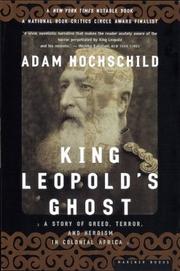
King Leopold's ghost
Best single-volume background for understanding colonial repression.
African religions and philosophy
Places African Christian movements within wider religious traditions.
The scramble for Africa,
First published 1990. Subjects: History, Colonies, Colonization, Colonización, Kolonisatie.
Endnotes
1.
Source: Wikipedia
Link:https://en.wikipedia.org/wiki/Kimbanguism
2.
Source: iris.unilink.it
Link:https://iris.unilink.it/handle/20.500.14085/2266
3.
Source: ojs.unito.it
Link:https://ojs.unito.it/index.php/rsajournal/article/download/8388/6972/27611
Source snippet
RSAJouRnAl 34/2023...
4.
Source: Wikipedia
Title: Simon Kimbangu
Link:https://en.wikipedia.org/wiki/Simon_Kimbangu
5.
Source: apnews.com
Link:https://apnews.com/article/c7ba1dfff9e99e74d91840d9ba75f6f7
Source snippet
Kimbangu, a lay Baptist who preached a theology of Black liberation, was imprisoned by Belgian colonial authorities in 1921 and died in c...
6.
Source: tile.loc.gov
Title: Library of Congress Tiles Kimbanguism
Link:https://tile.loc.gov/storage-services/master/gdc/gdcebookspublic/20/20/42/60/24/2020426024/2020426024.pdf
7.
Source: encyclopaediaafricana.com
Title: Encyclopaedia Africana KIMBANGU, SIMON
Link:https://encyclopaediaafricana.com/kimbangu-simon/
Source snippet
Encyclopaedia AfricanaKIMBANGU, SIMON - Encyclopaedia AfricanaFebruary 28, 2025...
Published: February 28, 2025
8.
Source: cdamm.org
Link:https://www.cdamm.org/articles/kimbanguism
Additional References
9.
Source: presidence.cd
Link:https://www.presidence.cd/actualite-detail/actualite/le_president_de_la_republique_a_nkamba_pour_celebrer_la_journee_du_combat_de_simon_kimbangu_et_de_la_conscience_africaine
Source snippet
2026 LE PRÉSIDENT DE LA RÉPUBLIQUE À NKAMBA POUR CÉLÉBRER LA JOURNÉE DU COMBAT DE SIMON KIMBANGU ET DE LA CONSCIENCE AFRICAINE Image: act...
10.
Source: tianmu.org
Title: The Kimbanguist Church · Tianmu Anglican Church
Link:https://tianmu.org/good-work-library/living-traditions/africa/the-kimbanguist-church
Source snippet
THE CHURCH UNDERGROUND — NGUNZISM The Belgian attempt to destroy Kimbanguism by removing its founder produced, instead, a dispersed, resi...
11.
Source: youtube.com
Title: The Forbidden Story of Simon Kimbangu: Between Faith, Prison and Prophecy
Link:https://www.youtube.com/watch?v=_A9l1k3G6U0
Source snippet
Congolese Church founded during colonial rule marks centenary...
12.
Source: youtube.com
Title: Congolese Church founded during colonial rule marks centenary
Link:https://www.youtube.com/watch?v=GfILrYOXdyA
Source snippet
DR Congo: Kimbanguists celebrate holiday in memory of church movement...
13.
Source: journals.uchicago.edu
Link:https://www.journals.uchicago.edu/doi/abs/10.1086/728884
Source snippet
Chicago JournalsThe way of the prophets: History, structure, imagination The Lévi-Strauss Lecture 20211: The Lévi-Strauss Lecture 20211...
14.
Source: degruyterbrill.com
Link:https://www.degruyterbrill.com/document/doi/10.1515/9780271079707-008/html?lang=en
15.
Source: youtube.com
Title: Worshippers of Papa Simon Kimbangu
Link:https://www.youtube.com/watch?v=S7aY37JBvZE
Source snippet
The Forbidden Story of Simon Kimbangu: Between Faith, Prison and Prophecy...
16.
Source: youtube.com
Title: 5 Months of Fire. 30 Years in Chains. One Forgotten Prophet
Link:https://www.youtube.com/watch?v=rO6RlB9aFgQ
Source snippet
Worshippers of Papa Simon Kimbangu...
17.
Source: youtube.com
Title: DR Congo: Kimbanguists celebrate holiday in memory of church movement
Link:https://www.youtube.com/watch?v=MME5fpJs7GY
18.
Source: cambridge.org
Title: The Revelation Spiritual Home
Link:https://www.cambridge.org/core/elements/revelation-spiritual-home/C5C72690C531F9FDF9CABBB62D2683D0
Topic Tree