Within Guinea
How Conspiracy Claims Became Tools of Rule
Repeated claims of hidden plots helped Guinea's government justify arrests, forced confessions and long imprisonment.
On this page
- The alleged plots and their targets
- Arrests, confessions and Camp Boiro
- Why fear outlived the accusations
Page outline Jump by section
Introduction
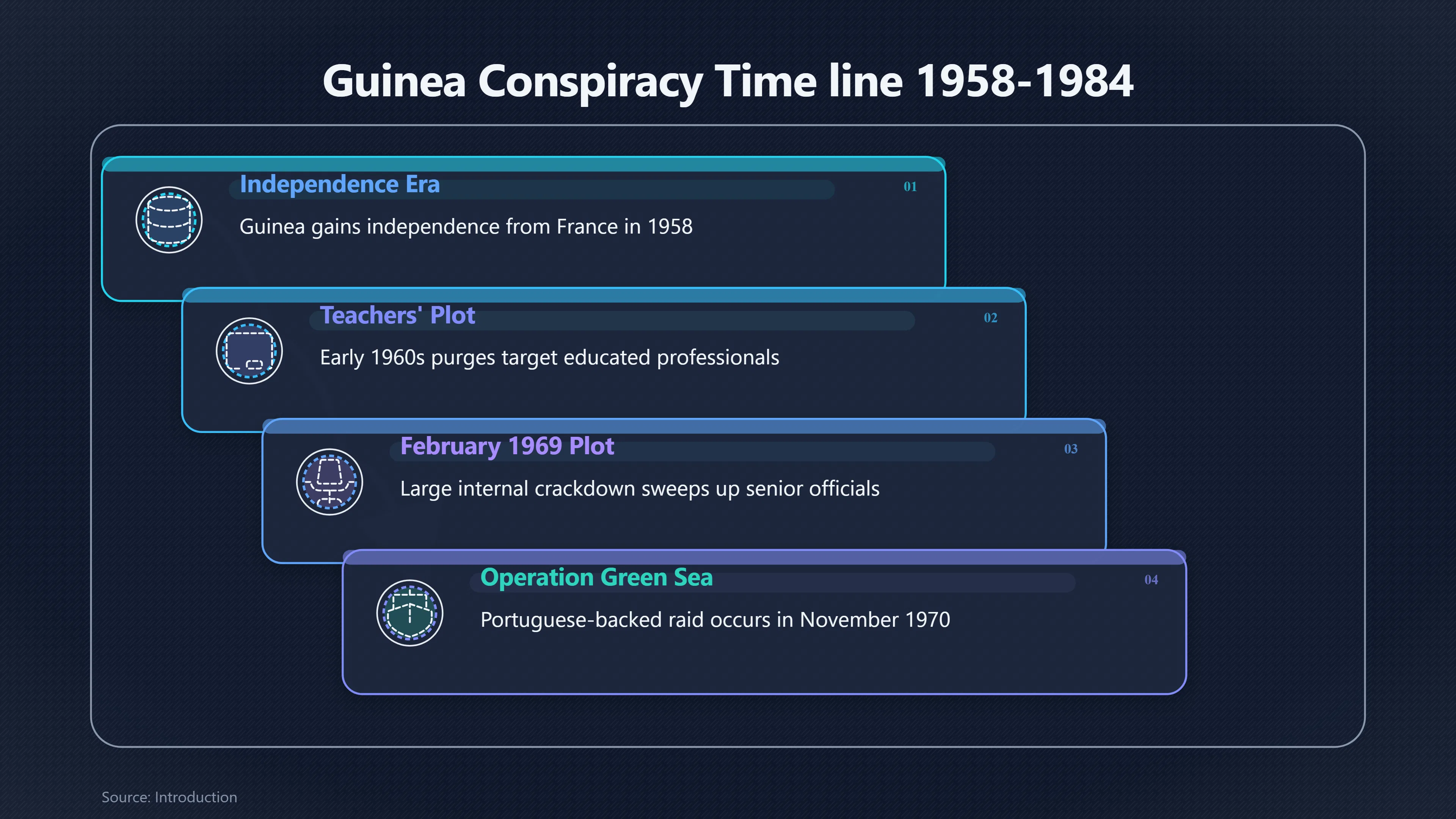
From independence in 1958 until President Ahmed Sékou Touré’s death in 1984, Guinea experienced repeated waves of alleged political conspiracies that reached far beyond ordinary security investigations. The government regularly announced the discovery of hidden networks of traitors said to be working with foreign intelligence services, exiled opponents or neighbouring states. Some real threats did exist—notably the 1970 Portuguese-backed raid on Conakry—but the state increasingly treated dissent, personal rivalry and suspected disloyalty as evidence of vast secret plots. Historians generally regard many of these conspiracy cases as a central mechanism of authoritarian rule rather than the exposure of genuine nationwide conspiracies. The resulting atmosphere of fear led to mass arrests, forced confessions, imprisonment and deaths, especially in the notorious Camp Boiro detention centre.[hrw.org]hrw.orgForces: II. Background…
Rather than a classic example of mass hysteria, this episode illustrates how an authoritarian government used conspiracy narratives to reshape public life. Fear spread not because ordinary citizens independently developed elaborate rumours, but because the state repeatedly declared that hidden enemies were everywhere and demanded public participation in identifying them.
How conspiracy claims became tools of rule
Guinea emerged from French colonial rule in unusually difficult circumstances. Touré’s decision to reject continued association with France brought international prestige but also economic isolation and tense relations with former colonial authorities. Genuine external hostility, assassination fears and attempted destabilisation created an environment in which security concerns were real.
Over time, however, the government’s definition of conspiracy widened dramatically. Official speeches and state media described almost every serious political disagreement as evidence of coordinated sabotage. Alleged conspirators were said to include ministers, army officers, teachers, trade unionists, diplomats, intellectuals and even long-time revolutionaries. They were frequently accused of acting on behalf of France, Portugal, the United States or other foreign powers seeking to overthrow Guinea’s revolution.[africabib.org]africabib.orgOpen source on africabib.org.
This narrative served several political purposes:
- It explained economic failures as deliberate sabotage rather than policy mistakes.
- It justified repeated purges within the ruling party.
- It discouraged criticism by suggesting that disagreement aided foreign enemies.
- It reinforced Touré’s image as the indispensable defender of national independence.
Historians disagree over the reality of particular cases, but many conclude that the distinction between genuine security threats and politically useful accusations became increasingly blurred.[africabib.org]africabib.orgOpen source on africabib.org.
The alleged plots and their targets
The Guinean government announced numerous conspiracies during Touré’s presidency. Official names varied, but they generally followed a similar pattern: authorities claimed to have uncovered a secret network planning assassination, military takeover or foreign intervention.
Among the most significant episodes were:
- The “teachers’ plot” and early purges of the 1960s, which targeted educated professionals accused of ideological deviation.
- The alleged February 1969 conspiracy, which became one of the regime’s largest internal crackdowns and swept up senior officials and intellectuals.
- The aftermath of the November 1970 Portuguese-backed invasion (Operation Green Sea). Unlike many earlier allegations, this raid genuinely occurred, involving Portuguese forces and Guinean exiles attempting to weaken Touré’s government and rescue prisoners. The failed attack nevertheless became the basis for an even broader campaign against supposed collaborators inside Guinea. Thousands were arrested on suspicion of assisting foreign enemies, often with little publicly available evidence.[usherbrooke.ca]perspective.usherbrooke.caPerspective Répression en Guinée | Evenements | Perspective MondeRépression en Guinée | Evenements | Perspective MondeJuly 9, 2026…
Because one genuine external attack had taken place, later official claims became harder for many citizens to challenge openly. The existence of a real invasion strengthened the government’s ability to present subsequent accusations as equally credible, even when independent evidence was lacking.
Arrests, confessions and Camp Boiro
The centre of this system was Camp Boiro in Conakry, which became synonymous with political imprisonment.
Individuals accused of involvement in alleged conspiracies were often detained without ordinary legal safeguards. Many disappeared for months or years. Former prisoners, survivors and later human rights investigations describe widespread torture, starvation, prolonged isolation and forced confessions. Trials, where they occurred, were frequently secret or heavily controlled by the regime.[Human Rights Watch]hrw.orgForces: II. Background…
One of the best-known victims was the diplomat Diallo Telli, formerly the first Secretary-General of the Organisation of African Unity. Arrested during one of the conspiracy purges, he died in detention in 1977 after reportedly being denied food and medical care. His case became an enduring symbol of how even internationally respected figures could be reclassified overnight as enemies of the state.[Human Rights Watch]hrw.orgForces: II. Background…
Researchers emphasise that forced confessions played an important political role. Public admissions of guilt appeared to validate the government’s narrative, creating an impression that each newly announced conspiracy had been conclusively exposed. Under conditions of torture and extreme coercion, however, historians and human rights organisations treat many of these confessions as unreliable evidence.[Theses]theses.frTotalitarisme et re-education: le camp boiro en guinee sous le regime de sekou toure | Theses.fr…
Why fear outlived the accusations
The conspiracy campaigns reshaped everyday life beyond those directly arrested.
Many Guineans became reluctant to discuss politics even with relatives or close friends because they feared denunciation. Loyalty demonstrations, public self-criticism and constant vigilance against supposed hidden enemies became expected features of political culture. Exile also accelerated as professionals, students and officials fled abroad to avoid possible arrest. Human Rights Watch notes that thousands of intellectuals left the country during this period, contributing to a lasting loss of expertise.[Human Rights Watch]hrw.orgForces: II. Background…
The uncertainty itself became a form of control. Since accusations were often unpredictable, citizens could not know precisely which opinions or associations might later be interpreted as evidence of conspiracy.
Were the conspiracies entirely invented?
A balanced historical account requires recognising two realities at once.
First, Guinea did face genuine external threats. Relations with Portugal, France and some neighbouring actors were hostile at different moments, and the Portuguese-backed 1970 attack demonstrated that efforts to destabilise Touré’s government were not imaginary.[Perspective]perspective.usherbrooke.caPerspective Répression en Guinée | Evenements | Perspective MondeRépression en Guinée | Evenements | Perspective MondeJuly 9, 2026…
Second, most historians argue that the regime systematically expanded these real dangers into an all-encompassing narrative of permanent internal conspiracy. Academic studies describe recurring “plots” as part of a ritual of denunciation and political purging, in which accusations—whether partly true, exaggerated or entirely fabricated—served to eliminate rivals and reinforce centralised authority.[africabib.org]africabib.orgOpen source on africabib.org.
For this reason, scholars generally avoid treating every officially announced conspiracy as an established historical fact. Each case must be assessed individually, and the evidence available for many accusations remains weak or inaccessible.
Why this matters in Guinea’s history of collective fear
Within Guinea’s wider history of rumour and social fear, the conspiracy campaigns under Sékou Touré occupy a distinctive place. They were not primarily spontaneous panics spreading through communities. Instead, they were state-driven narratives that encouraged citizens to believe that invisible enemies had infiltrated every level of society.
The resulting climate resembled a political scare more than a conventional conspiracy theory. Public fear became self-reinforcing: every arrest appeared to confirm the existence of another hidden network, while every confession seemed to prove the government’s warnings. Because challenging the official story carried enormous personal risk, alternative explanations rarely entered public discussion.
The legacy remains significant. Camp Boiro has become a symbol of political repression in Guinea, and debates about truth, remembrance and accountability continue decades after Touré’s death. The period is frequently cited by historians and human rights organisations as an example of how conspiracy claims, when backed by unchecked state power, can become instruments of prolonged persecution rather than simply expressions of public anxiety.
Amazon book picks
Further Reading
Books and field guides related to How Conspiracy Claims Became Tools of Rule. Use these as the next step if you want deeper reading beyond the article.


Endnotes
1.
Source: africabib.org
Link:https://www.africabib.org/rec.php?RID=185323480
2.
Source: theses.fr
Link:https://theses.fr/1988PA080203
Source snippet
Totalitarisme et re-education: le camp boiro en guinee sous le regime de sekou toure | Theses.fr...
3.
Source: history.state.gov
Link:https://history.state.gov/historicaldocuments/frus1977-80v17p2/d41
4.
Source: camp-boiro.org
Link:https://www.camp-boiro.org/bourreaux-page
5.
Source: camp-boiro.org
Title: Camp Boiro
Link:https://www.camp-boiro.org/
6.
Source: camp-boiro.org
Link:https://www.camp-boiro.org/victime/CB02569
7.
Source: camp-boiro.org
Title: Camp Boiro
Link:https://www.camp-boiro.org/association
8.
Source: camp-boiro.org
Link:https://www.camp-boiro.org/all-bibliographies
9.
Source: camp-boiro.org
Link:https://www.camp-boiro.org/victime/CB01198
10.
Source: africabib.org
Link:https://www.africabib.org/rec.php?RID=321977386
11.
Source: youtube.com
Title: Guinea: graffiti of ex-president Sékou Touré sparks controversy
Link:https://www.youtube.com/watch?v=YAW4JYiRmkQ
Source snippet
Sékou Touré | The Leader Who Defied France...
12.
Source: youtube.com
Title: Sékou Touré | The Leader Who Defied France
Link:https://www.youtube.com/watch?v=2QjgTxDV59Q
Source snippet
The Untold Story of Guinea's Independence...
13.
Source: hrw.org
Link:https://www.hrw.org/reports/2006/guinea0806/2.htm
Source snippet
Forces: II. Background...
14.
Source: cnrseditions.fr
Title: CNRS Editions Conakry. Une utopie panafricaine
Link:https://www.cnrseditions.fr/catalogue/histoire/conakry-une-utopie-panafricaine/
Source snippet
Une utopie panafricaine - Récits et contre-récits 1958-1984 - CNRS EditionsSeptember 11, 2025 — Elara Bertho CONAKRY. UNE UTOPIE PANAFRIC...
Published: September 11, 2025
15.
Source: perspective.usherbrooke.ca
Title: Perspective Répression en Guinée | Evenements | Perspective Monde
Link:https://perspective.usherbrooke.ca/bilan/servlet/BMEve/1034
Source snippet
Répression en Guinée | Evenements | Perspective MondeJuly 9, 2026...
Published: July 9, 2026
16.
Source: hrw.org
Link:https://www.hrw.org/reports/2007/guinea0407/4.htm
17.
Source: hrw.org
Link:https://www.hrw.org/legacy/french/reports/2006/guinea0806/2.htm
Additional References
18.
Source: amnesty.org
Link:https://www.amnesty.org/en/latest/news/2024/01/burkina-faso-free-human-rights-defender-daouda-diallo-and-end-discriminatory-conscription-of-independent-voices/
Source snippet
Amnesty InternationalJanuary 22, 2024 — Image © OLYMPIA DE MAISMONT/AFP via Getty Images News 22 January 2024 Also available in Español,F...
Published: January 22, 2024
19.
Source: amnesty.org
Title: Silence and Repression: The new face of the Sahel
Link:https://www.amnesty.org/en/latest/campaigns/2025/10/silence-and-repression-the-new-face-of-the-sahel/
Source snippet
Human rights defenders and journalists are being silenced under the pretext of national security. READ OU...
20.
Source: youtube.com
Link:https://www.youtube.com/watch?v=haWCqhx16ho
Source snippet
Guinea: graffiti of ex-president Sékou Touré sparks controversy...
21.
Source: cambridge.org
Link:https://www.cambridge.org/core/journals/journal-of-global-history/article/entangled-political-histories-of-twentiethcentury-west-africa-the-case-of-guinean-exile-networks/DB200192A43D16F6275C932C5717E6B3
22.
Source: cambridge.org
Link:https://www.cambridge.org/core/journals/comparative-studies-in-society-and-history/article/guineas-political-prisoners-colonial-models-postcolonial-innovation/5CAEA02986DEF4DD6693608454E00BA1
23.
Source: youtube.com
Title: Guinea and the reign of Sekou Toure (2/2)
Link:https://www.youtube.com/watch?v=jL9kFT-leq8
Source snippet
When Sékou Touré Held All Americans in Guinea Hostage in 1966...
24.
Source: amnestyusa.org
Link:https://www.amnestyusa.org/press-releases/cameroon-rampant-atrocities-amid-anglophone-regions-must-be-stopped-and-investigated/
25.
Source: amnesty.org.uk
Link:https://www.amnesty.org.uk/knowledge-hub/all-resources/guinea-new-report-reveals-foreign-weapons-and-training-behind-bloody-monday-massacre/
26.
Source: shs.cairn.info
Link:https://shs.cairn.info/revue-vingtieme-siecle-revue-d-histoire-2013-2-page-31?lang=fr
27.
Source: cambridge.org
Title: Conspiracy theorizing as political practice in Guinea | Africa | Cambridge Core
Link:https://www.cambridge.org/core/journals/africa/article/conspiracy-theorizing-as-political-practice-in-guinea/00A4FE35D392E05A14F2BD32F93021A6
Topic Tree