Within Hungary's Collective Fears
Why the Weeping Icon Inspired Pilgrimage, Not Panic
Reports of a weeping Marian icon created pilgrimage and sacred authority rather than persecution or crowd panic.
On this page
- What witnesses reported at Máriapócs
- How church and imperial authorities responded
- Why the shrine became a lasting pilgrimage centre
Page outline Jump by section
Introduction
Máriapócs is one of Hungary’s best-known religious sites, but it is not an example of a moral panic, witch-hunt, or mass persecution. Instead, it shows how reports of a miracle can create a long-lasting culture of organised pilgrimage and shared devotion. In 1696, worshippers in the small village church reported that an icon of the Virgin Mary shed tears during the liturgy. News spread rapidly across the Kingdom of Hungary and beyond, attracting pilgrims, clergy and imperial officials. Rather than producing an accused enemy or a wave of violence, the event strengthened the authority of a sacred place and helped establish one of Central Europe’s most important pilgrimage centres. The history of Máriapócs therefore offers an important contrast within Hungary’s wider history of collective belief: a contagious religious conviction that generated enduring ritual and identity instead of panic.

What witnesses reported at Máriapócs
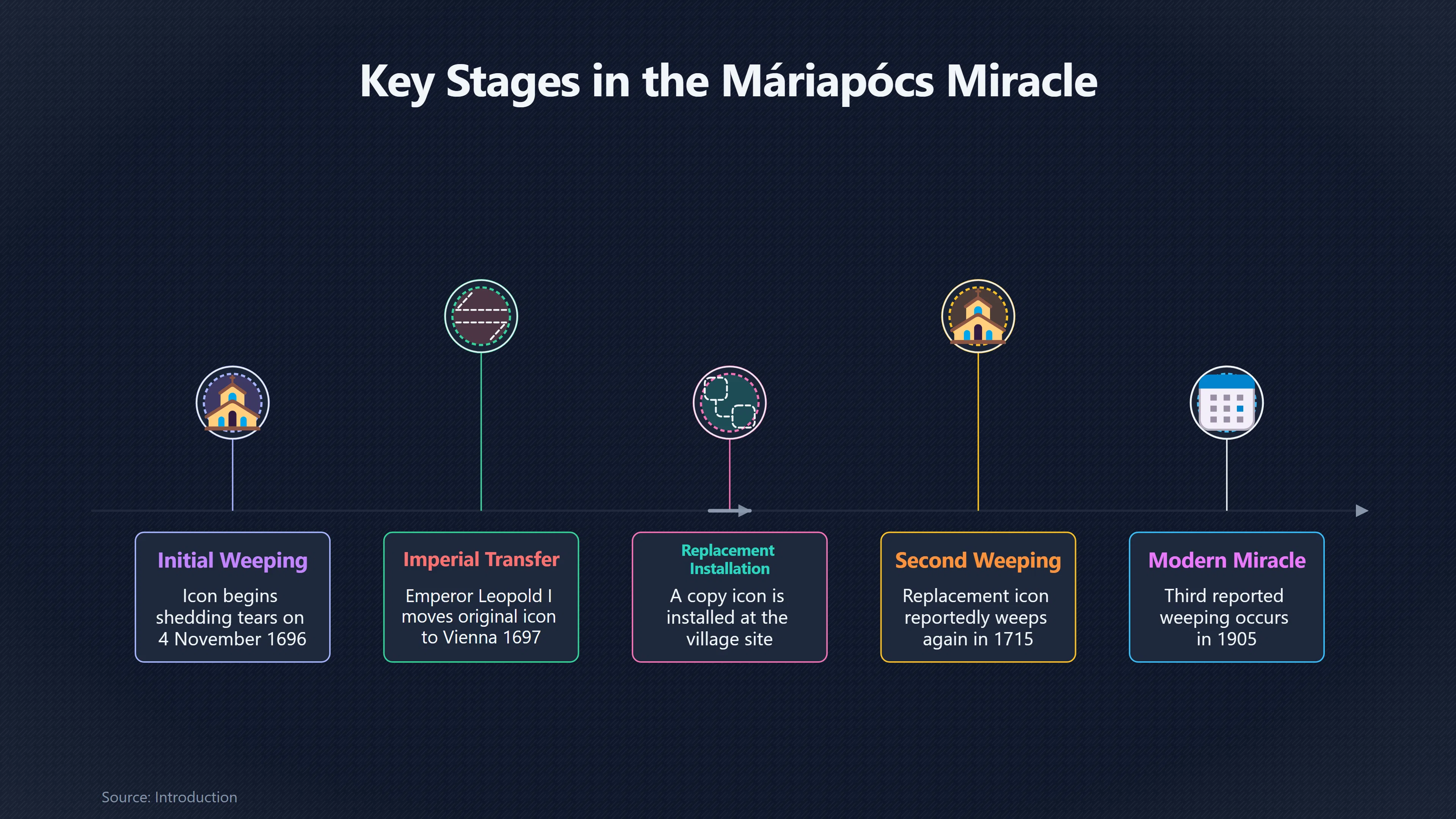
According to contemporary accounts, the icon began to weep on 4 November 1696 in the Greek Catholic wooden church at Máriapócs in eastern Hungary. Worshippers claimed that tears flowed from the Virgin Mary’s eyes during the Divine Liturgy, and reports state that the phenomenon continued over several weeks, with interruptions, until early December. News travelled quickly through nearby towns and eventually reached the Habsburg court in Vienna.[Nyíregyházi Egyházmegye]nyirgorkat.huNyíregyházi EgyházmegyeThe first weeping of the holy image of Máriapócs | Eparchy of NyíregyházaNovember 4, 2025…
The icon itself had only recently been painted by the local artist István Papp after being commissioned by a villager who wished to commemorate his release from Ottoman captivity. What began as an ordinary parish icon suddenly became the focus of extraordinary attention. Pilgrims travelled to witness the reported miracle, while stories of answered prayers and healings circulated alongside eyewitness testimony. Among the best-known traditions is the account of a gravely ill child who was reportedly restored to health after being brought before the icon, although such miracle stories belong to the devotional tradition rather than modern historical verification.[Mandadb]en.mandadb.huMarian shrines • Hungarian National Digital ArchiveMarian shrines • Hungarian National Digital Archive…
Unlike episodes driven by rumours of hidden conspiracies or supernatural enemies, the central claim at Máriapócs was positive rather than accusatory. Believers interpreted the tears as a sign of divine compassion, warning or comfort rather than evidence that a particular individual or group had committed wrongdoing.
How church and imperial authorities responded
The authorities did not simply accept the reports without question. Church and secular officials interviewed witnesses, inspected the icon and examined whether the reported tears might have had a natural explanation. Contemporary records describe formal testimony being gathered from clergy, local residents and visiting officials. Although modern historians recognise that seventeenth-century standards of evidence differed greatly from those used today, the investigation illustrates that the event was treated as a matter requiring official scrutiny rather than spontaneous popular enthusiasm alone.[Nyíregyházi Egyházmegye]nyirgorkat.huNyíregyházi EgyházmegyeThe first weeping of the holy image of Máriapócs | Eparchy of NyíregyházaNovember 4, 2025…
The response of the Habsburg monarchy was equally significant. Emperor Leopold I ordered the original icon to be transferred to Vienna in 1697. The journey itself became a public religious event, with communities along the route gathering to venerate the image before it was installed in St Stephen’s Cathedral, where it remains today. The removal disappointed many local believers, but it also transformed the miracle into an imperial religious symbol rather than merely a village tradition.[CNEWA]cnewa.orgHungary’s Weeping Icon of Máriapócs | ONE MagazineHungary’s Weeping Icon of Máriapócs | ONE Magazine…
To replace the original, a copy was installed in Máriapócs. According to church tradition, this replacement icon was itself reported to weep in 1715 and again in 1905. These later events reinforced the shrine’s reputation and encouraged continuing pilgrimage rather than diminishing interest after the original icon left Hungary.[Hungarikum]hungarikum.huNational Shrine and Pilgrimage of Máriapócs | Collection of Hungarikums – Collection of Hungarian Values…

Why the shrine became a lasting pilgrimage centre
The reported miracle permanently changed the status of Máriapócs. What had been a modest rural parish became the spiritual centre of Hungarian Greek Catholicism and one of the country’s most visited pilgrimage destinations. As visitor numbers increased, the original wooden church proved too small, leading to the construction of a larger Baroque church during the eighteenth century. The site later developed into the National Shrine of Hungary’s Greek Catholic Church.[Hungarikum]hungarikum.huNational Shrine and Pilgrimage of Máriapócs | Collection of Hungarikums – Collection of Hungarian Values…
Pilgrimage to Máriapócs differs from episodes of collective fear because participation is voluntary and ritualised. Visitors typically arrive seeking prayer, thanksgiving, healing or spiritual renewal rather than protection from an imagined social threat. Offerings, processions and repeated annual pilgrimages have sustained the shrine for more than three centuries.
The shrine also occupies an unusual place within Hungary’s religious landscape. It reflects the country’s historical meeting point between Eastern and Western Christianity. Byzantine liturgy, Eastern-style iconography and communion with Rome combine in a tradition that has shaped Hungarian Greek Catholic identity while attracting Roman Catholic pilgrims as well. The importance of the site was highlighted internationally when Pope John Paul II celebrated the Byzantine liturgy there during his 1991 visit to Hungary.[Hungarikum]hungarikum.huNational Shrine and Pilgrimage of Máriapócs | Collection of Hungarikums – Collection of Hungarian Values…
Why belief spread without becoming a panic
From the perspective of historians and scholars of religion, Máriapócs demonstrates that collective belief does not inevitably produce mass hysteria or persecution. Several factors distinguish the episode from witch panics or moral scares.
First, the reported miracle centred on a revered object rather than an alleged enemy. Nobody needed to be blamed or punished for the tears. The event generated attraction instead of suspicion.
Second, ecclesiastical and imperial authorities largely channelled popular enthusiasm into established religious structures. Investigations, official recognition, church patronage and organised pilgrimage all helped institutionalise belief rather than allowing uncontrolled rumours to develop.
Third, pilgrimage itself became the mechanism through which the tradition spread. Visitors carried stories home, encouraging further journeys, donations and devotion. The shrine’s authority rested not on fear of hidden conspiracies but on repeated acts of worship reinforced over generations.
Social historians often describe such developments as examples of the social construction of sacred places. Whether individual observers accept or reject miraculous explanations, the historical importance of Máriapócs lies in the measurable consequences: expanding pilgrimage networks, new religious buildings, enduring local identity and continuing devotion across Central Europe.[CNEWA]cnewa.orgHungary’s Weeping Icon of Máriapócs | ONE MagazineHungary’s Weeping Icon of Máriapócs | ONE Magazine…

Why Máriapócs still matters
Within Hungary’s history of collective belief, Máriapócs provides a valuable counter-example to narratives focused solely on fear or irrationality. The same mechanisms that can spread rumours—shared testimony, emotionally powerful stories, trusted authorities and repeated public rituals—can also create stable traditions that endure for centuries without producing violence or persecution.
For historians of religion, the shrine illustrates how miracle reports become embedded in institutions, architecture and annual pilgrimage. For students of social psychology, it demonstrates that contagious belief is not always destructive. Shared conviction may reinforce community, identity and ritual instead of generating accusations or panic.
Seen alongside Hungary’s witch trials, later blood-libel scares and modern moral panics, Máriapócs reminds us that collective belief can follow very different paths. Here, reports of a weeping icon inspired devotion, pilgrimage and lasting religious culture rather than a search for scapegoats.
Amazon book picks
Further Reading
Books and field guides related to Why the Weeping Icon Inspired Pilgrimage, Not Panic. Use these as the next step if you want deeper reading beyond the article.


The Habsburg empire
Provides political and religious context for seventeenth-century Hungary.

The triumph of Christianity
Explores the growth of Christian belief and devotional practice.
Endnotes
1.
Source: hungarikum.hu
Link:https://www.hungarikum.hu/en/node/7751
Source snippet
National Shrine and Pilgrimage of Máriapócs | Collection of Hungarikums – Collection of Hungarian Values...
2.
Source: en.mandadb.hu
Title: Marian shrines • Hungarian National Digital Archive
Link:https://en.mandadb.hu/cikk/1291219/Marian_shrines
Source snippet
Marian shrines • Hungarian National Digital Archive...
3.
Source: cnewa.org
Title: Hungary’s Weeping Icon of Máriapócs | ONE Magazine
Link:https://cnewa.org/magazine/hungarys-weeping-icon-of-mariapocs-30770/
Source snippet
Hungary’s Weeping Icon of Máriapócs | ONE Magazine...
4.
Source: nyirgorkat.hu
Link:https://www.nyirgorkat.hu/?id=8603&l=en&q=hir
Source snippet
Nyíregyházi EgyházmegyeThe first weeping of the holy image of Máriapócs | Eparchy of NyíregyházaNovember 4, 2025...
Published: November 4, 2025
5.
Source: mariapocs.hu
Link:https://mariapocs.hu/a-kegykep
Additional References
6.
Source: osbm.info
Title: Changes at the Máriapócs Monastery in Hungary | Basilian Order of Saint Josaphat
Link:https://osbm.info/en/changes-at-the-mariapocs-monastery-in-hungary/
Source snippet
April 24, 2026 — CHANGES AT THE MÁRIAPÓCS MONASTERY IN HUNGARY 24.04.2026 907 Recently, the monks of the Order of Saint Basil the Great o...
Published: April 24, 2026
7.
Source: researchgate.net
Title: (PDF) Representations of the Mary-icon of máriapócs in engravings
Link:https://www.researchgate.net/publication/306134265_Representations_of_the_Mary-icon_of_mariapocs_in_engravings
Source snippet
Sources are manifold and varied with regards to their genre, form and use, and range from leaflets and the...
8.
Source: researchgate.net
Title: Csodatörténetek Máriapócsról
Link:https://www.researchgate.net/publication/357880117_Csodatortenetek_Mariapocsrol
Source snippet
January 1, 2021 — Article CSODATÖRTÉNETEK MÁRIAPÓCSRÓL * January 2021 * Kaleidoscope History 11(23):132-142 DOI:10.17107/KH.2021.23.132-1...
Published: January 1, 2021
9.
Source: hellohungary.hu
Title: Hello Hungary A miracle in Máriapócs
Link:https://hellohungary.hu/en/did-you-know/tokaj-and-nyiregyhaza/attraction/exhibition/culture/a-miracle-in-mariapocs
Source snippet
A miracle in Máriapócs - Did you know? - Hello Hungary...
10.
Source: youtube.com
Title: AE50: Marian Pilgrimage: Disk 4: Mariapocs Private
Link:https://www.youtube.com/watch?v=fa0vTLbK4WY
Source snippet
AE50: Marian Pilgrimage: Disk 5: Mariapocs Anniversary...
11.
Source: parma.org
Link:https://parma.org/shrine-of-mariapoch
12.
Source: archpitt.org
Link:https://archpitt.org/carpathian-miraculous-icons-the-weeping-icon-of-mariapovch/
13.
Source: basilicasantamariamaggiore.va
Link:https://www.basilicasantamariamaggiore.va/en/basilica/storia-e-arte.html
14.
Source: osbm.info
Link:https://osbm.info/en/miraculous-icons/
15.
Source: encyclopedia.com
Link:https://www.encyclopedia.com/science/encyclopedias-almanacs-transcripts-and-maps/mariapovch
Topic Tree