When Fear Tested Costa Rica's Peaceful Image
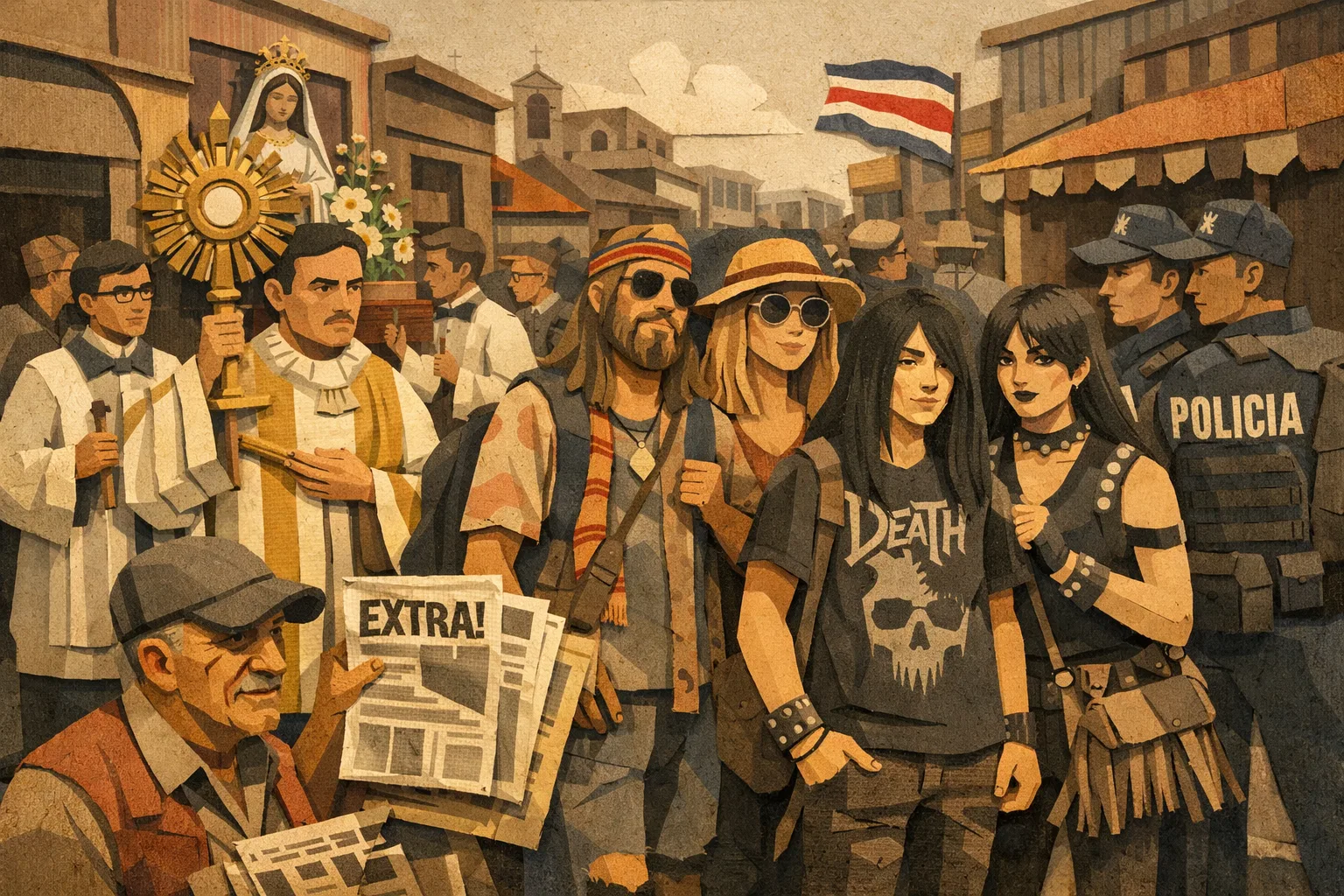
Costa Rica has no well-documented equivalent of the Salem witch trials, a fatal millenarian commune or a nationwide outbreak of mass psychogenic illness. Its most revealing episodes are subtler: religious controversies, press-driven scares and moments when unfamiliar people were treated as threats to the country’s moral order.
Page outline Jump by section
Introduction
These events matter because they show how collective fear works in a country often portrayed as unusually peaceful and moderate. Costa Rican panics generally did not become mass bloodshed. They did, however, produce police action, public humiliation, discrimination and pressure on religious or cultural minorities. The historical record also warns against treating every miracle tradition, unconventional faith or unexplained illness as “mass hysteria”. Belief, prejudice, folklore, disease and psychological contagion are related subjects, but they are not interchangeable.
What counts as a Costa Rican panic?
“Mass hysteria” is an imprecise and increasingly unpopular label. In medicine, mass psychogenic illness describes genuine physical symptoms that spread through a group without an identified toxic, infectious or other organic cause. A moral panic, by contrast, occurs when politicians, religious leaders or the media present a person, group or practice as a greatly exaggerated threat to social values.
Costa Rica’s historical cases fall mostly into the second category. They repeatedly feature what sociologists call a folk devil: an outsider who becomes a convenient symbol of wider unease. Depending on the period, the supposed danger was represented by occult intellectuals, foreign hippies, gay men or black-clad metal fans.
That does not mean every underlying concern was imaginary. HIV was a real and deadly epidemic. Vandalism and drug use sometimes occurred within youth cultures, just as they did elsewhere in society. The panic arose when evidence of particular harms was expanded into claims about an entire population, hidden conspiracy or national moral collapse.
The evidence is also uneven. Costa Rica’s university historians have produced detailed studies of the 1968 hippie scare, the early HIV years and the 1992 metal panic. Earlier stories about witches and miracles are more dependent on court fragments, church histories and traditions written down long after the alleged events. That difference in source quality is essential.
Witches, miracles and the limits of the evidence
Costa Rica did not experience a large colonial witch hunt comparable with those in Europe or British North America. One frequently repeated account says that the country’s surviving Inquisition record includes two young women accused of witchcraft who were ultimately absolved, rather than an expanding chain of accusations and executions. The scarcity of cases makes it misleading to speak of a Costa Rican witch panic.[Wikipedia]WikipediaAntisemitism in Costa RicaAntisemitism in Costa Rica
Witchcraft nevertheless became deeply embedded in folklore. Escazú acquired a reputation as the “city of witches”, while stories throughout the Central Valley and Guanacaste described women who could heal, cast spells, transform into animals or mislead night-time travellers. These tales combine European ideas about witches with Indigenous understandings of healing and spiritual power. They are evidence of a durable cultural imagination, not proof that organised groups of witches existed or that the authorities conducted a sustained persecution.[Wikipedia]WikipediaLeyendas de Costa RicaLeyendas de Costa Rica
Costa Rica’s most important apparition tradition also requires careful handling. According to the familiar story, a small dark stone image of the Virgin Mary repeatedly returned to the place near Cartago where a woman found it. The image became the Virgin of the Angels, popularly known as La Negrita, and eventually Costa Rica’s national patroness.
The oldest detailed version commonly cited was written in 1826, nearly two centuries after the supposed discovery in 1635. Historians therefore distinguish between the devotion’s colonial existence and the later, polished apparition narrative. Research on the tradition also places it within the racially segregated settlement known as the Puebla de los Pardos, whose population included free people of African descent. The shrine may have helped incorporate that community into Catholic administration even as later national storytelling presented the Virgin as a symbol of racial harmony.[CUNY Graduate Center]gc.cuny.eduCUNY Graduate CenterAfrican Origins of La Negrita in 17th Century Costa RicaSeptember 9, 2013 — Miguel Bonila, a Cartago priest, document…
La Negrita is better understood as a developing religious and national tradition than as a miracle panic. Pilgrimage and belief persisted because they were supported by institutions, family practice and personal experiences of healing or protection. Whether the original episode was supernatural is a matter of faith; historians can more confidently analyse how the story was recorded, promoted and given social meaning.
When Theosophy became a religious threat
One of Costa Rica’s clearest early “cult scares” involved the Theosophical Society, founded locally in 1904. Theosophy drew on Asian religions, Western esotericism, spiritual evolution and comparative religion. In Costa Rica it attracted teachers, writers, artists and political figures rather than forming an isolated commune under an all-powerful leader. Calling it a cult without qualification would therefore obscure more than it explains.
Its growth challenged a Catholic establishment accustomed to considerable influence over education and public morality. The dispute centred on fundamental questions: Was the soul uniquely Christian? Could miracles be explained through hidden natural laws? Should schools expose pupils to religious ideas outside Catholic doctrine? Newspapers became an arena for accusation and reply, turning philosophical disagreement into a struggle over the country’s spiritual future.[Academia]academia.eduSociability, Religiosity and New Cosmovisions in CostaSociability, Religiosity and New Cosmovisions in Costa…October 1, 2013 — This paper intends to analyze Freemasonry's role in t…
The conflict had tangible consequences. The Theosophical centre in San José was burned in 1913, reportedly by a Catholic extremist. Church authorities denounced the movement, and Archbishop Juan Gaspar Stork later excommunicated its members. Controversy also reached government, education and even the design of a banknote whose imagery was alleged to contain Theosophical symbolism.[Wikipedia]WikipediaTheosophical Society in Costa RicaTheosophical Society in Costa Rica
The episode is revealing because the feared movement was neither underground nor socially marginal. Its members included prominent intellectuals and future political leaders. The scare was driven partly by competition between institutions: Catholic authorities feared losing influence over educated urban Costa Ricans, while Theosophists presented themselves as agents of modern thought and spiritual freedom.
Over time, the alleged emergency faded. Theosophy remained a minority current and did not overthrow Catholic culture. The controversy now looks less like society defending itself from a dangerous sect and more like a struggle over modernity, education and the boundaries of acceptable religion.
The ten hippies who alarmed a nation
In May 1968, roughly ten foreign travellers identifying as hippies arrived in Costa Rica. Their numbers were tiny, but their appearance—long hair, unconventional clothing and association with the international counterculture—generated an outsized reaction in the press. Historian Randall Chaves Zamora describes the episode as a moral panic shaped by Cold War ideas about youth, drugs, sexuality and foreign subversion.[kerwa.ucr.ac.cr]kerwa.ucr.ac.cr¡No más hippies! Identidad juvenil, memoria y pánico en¡No más hippies! Identidad juvenil, memoria y pánico en
Reports and commentary treated the visitors not merely as scruffy tourists but as advance representatives of a corrupting movement. Their presence became entangled with anxieties about marijuana, sexual freedom, anti-war protest and youthful disrespect for authority. The foreign hippie provided a simple face for changes that were already unsettling older Costa Ricans.
The scare was also connected to national self-image. Costa Rica was commonly represented as orderly, educated, white or European-looking, Catholic and politically exceptional within Central America. The hippies’ visible rejection of grooming, work and conventional family life allowed commentators to define the respectable Costa Rican citizen by contrast.
Authorities restricted the visitors and moved towards expelling them. Yet the episode produced no evidence of an organised plot or serious danger. Its importance lies in the disproportion between the small group and the breadth of the alarm. It established a pattern later visible in the metal panic: an unfamiliar youth style was read as evidence of drugs, moral disorder and a threatening foreign ideology.
HIV fear became persecution
The arrival of HIV in Costa Rica during the 1980s was not an imaginary scare. It was a genuine public-health crisis, initially accompanied by major scientific uncertainty and an absence of effective treatment. By November 1987, researchers had recorded 43 AIDS cases, including cases among gay or bisexual men, haemophiliacs, blood recipients and a spouse of a haemophiliac. The variety of transmission routes already contradicted the notion that HIV belonged exclusively to one community.[kerwa.ucr.ac.cr]kerwa.ucr.ac.crOpen source on ucr.ac.cr.
The moral panic emerged when the disease was represented as proof of homosexual corruption. Historical analysis of Costa Rican newspapers shows that coverage often joined medical danger to older condemnations of sexual diversity. Gay men became both patients and alleged sources of contamination.
Police raids on bars and other meeting places intensified between 1985 and 1989. These measures did not simply follow neutral epidemiology: they treated gay identity and social gathering as suspicious. The resulting climate helped stimulate organised gay activism, as those targeted began challenging police harassment and public stigma.[kerwa.ucr.ac.cr]kerwa.ucr.ac.cr61 La criminalización de la diversidad sexual y el inicio61 La criminalización de la diversidad sexual y el inicio
Costa Rica’s response was not uniformly punitive. Blood donations were screened from 1985, a national education campaign was introduced, and condoms were distributed in gay venues from 1987. Health professionals, activists and public institutions gradually helped shift the response towards prevention and rights.[kerwa.ucr.ac.cr]kerwa.ucr.ac.crFacind AIDS in Costa RicaFacind AIDS in Costa Rica
Later legal developments further complicated the story. Costa Rican patients used constitutional litigation to demand access to antiretroviral medicines, contributing to a more rights-based model. The country thus moved from an early period in which fear could legitimise persecution towards policies that increasingly recognised people with HIV as rights-holders.[Michigan Journal of History]michiganjournalhistory.wordpress.comOpen source on wordpress.com.
This case demonstrates why “panic” must not be used to deny the epidemic’s reality. People were becoming seriously ill and dying. The distortion lay in attaching infection to moral guilt, exaggerating casual risks and using a medical emergency to police an already stigmatised minority.
The 1992 Satanic metal scare
Costa Rica’s best-documented Satanic panic began around the fourth Cráneo Metal festival, held at a former match factory in San José on 31 May 1992. Heavy-metal fans in black shirts gathered for a concert that became known as the Fosforera event. Rumours that a Satanic ritual was taking place helped bring police attention and intense media coverage.[repositorio.sibdi.ucr.ac.cr]repositorio.sibdi.ucr.ac.crOpen source on ucr.ac.cr.
The central claim was not simply that some songs used occult imagery. Young metal fans were portrayed collectively as Satanists, drug users, grave desecrators or potential criminals. Clothing, long hair, inverted crosses, band logos and horror-inspired artwork were treated as clues to a hidden religious allegiance.
Historian Sergio Isaac Hernández Parra argues that the panic was produced by a chain of amplification. Sensational reporting joined together unrelated phenomena—cemetery vandalism, rumours of ritual crime, alternative religions, Gothic fashion and heavy metal—until they appeared to be manifestations of one Satanic network.[Scribd]es.scribd.comJovenes Rock SatanicoJovenes Rock Satanico
Police intervention was followed by raids or inspections involving music shops and people associated with the scene. The practical effect was to mark a recognisable youth population as suspect. Fans could be stopped, insulted or treated as dangerous because of their appearance rather than evidence of an offence. Contemporary recollections describe a climate in which “Satanist” became a broad accusation rather than a precise religious category.[diarioextra.com]diarioextra.comel concierto de camisetas negras que persiguio rockeros satanicosel concierto de camisetas negras que persiguio rockeros satanicos
Several pressures made the story persuasive:
- Imported panic narratives: Claims circulating internationally during the 1980s and early 1990s linked rock music, role-playing games and youth suicide to organised Satanism.
- Religious competition: Evangelical preaching and Catholic concern about new spiritual movements made occult language especially charged.
- Generational distance: Adults unfamiliar with metal often interpreted its theatrical symbols literally.
- Crime anxiety: Real acts of vandalism or violence could be absorbed into a larger conspiracy narrative without proof of coordination.
- Media incentives: Images of black-clad youths and alleged rituals offered a dramatic story that ordinary concerts did not.
No evidence emerged of the vast murderous Satanic organisation implied by the scare. The metal community survived and became more visible within Costa Rican culture. In retrospect, the episode is remembered less as the discovery of a dangerous sect than as an example of youth criminalisation and journalistic excess.
A school illness and the danger of instant diagnosis
In February 2025, emergency services were called to the Liceo Jerusalén in Pérez Zeledón after students began vomiting. Nineteen pupils—eleven girls and eight boys—were assessed and remained stable; none required hospital transfer. Initial concern focused on possible food poisoning because many students and staff used the school dining service.[El Observador CR]observador.crEl Observador CRHisteria colectiva en estudiantes generó emergenciaEl Observador CRHisteria colectiva en estudiantes generó emergencia
The school administration and Ministry of Public Education publicly described the incident as “collective hysteria” after poisoning was reportedly ruled out. According to the account, one pupil felt ill and displayed a photograph related to food, after which similar symptoms appeared among classmates. Food was nevertheless reviewed and a report prepared under the relevant school protocol.[El Observador CR]observador.crEl Observador CRHisteria colectiva en estudiantes generó emergenciaEl Observador CRHisteria colectiva en estudiantes generó emergencia
The event resembles the pattern of mass psychogenic illness: symptoms appear in a close group, attention focuses on a possible hazard, anxiety rises and others develop similar symptoms. Vomiting, nausea, dizziness and fainting are among the symptoms recorded in such outbreaks. The symptoms are involuntary and real; describing them as fabricated is both inaccurate and harmful.[PMC]pmc.ncbi.nlm.nih.govOpen source on nih.gov.
Yet the available public evidence is too limited for a confident retrospective diagnosis. A news report and an administrator’s statement are not equivalent to a detailed epidemiological investigation. Food contamination, infection and environmental exposure should be assessed before clinicians settle on a psychogenic explanation.
The language used by authorities also matters. “Hysteria” carries a history of dismissing distress, particularly among women and young people. Terms such as “collective stress response” or “mass psychogenic illness” are more precise when the clinical evidence supports them. Calm communication can reduce further symptoms; dramatic announcements, speculation and circulating images can magnify attention and anxiety.
What these episodes have in common
Costa Rica’s panics differ in subject and severity, but the recurring mechanism is recognisable. A real event—a religious challenge, a handful of visitors, an epidemic, a concert or a pupil becoming ill—creates uncertainty. Public discussion then attaches that uncertainty to an already available fear: spiritual corruption, foreign influence, sexual disorder, Satanism or poisoning.
The supposed threat is made visible through a group whose appearance or identity is easy to recognise. Authorities are pressured to act before the evidence is clear. Actions such as raids, exclusion or public denunciation then seem to confirm that a serious danger must have existed.
The cases also show that media attention is not merely descriptive. Newspapers helped transform ten hippies into a national concern and a metal concert into evidence of Satanism. During the HIV crisis, repeated association between disease and homosexuality strengthened stigma. In a school illness, photographs and messages can now circulate through phones faster than officials can investigate.
Costa Rica’s relatively strong institutions sometimes limited the damage. Accused witches were reportedly absolved rather than executed; Theosophy was eventually normalised; HIV policy moved towards education, treatment and rights; and metal became part of ordinary cultural life. Moderation, however, did not prevent individuals from suffering harassment, exclusion or fear while each scare was active.

Why the history still matters
These episodes challenge the comforting idea that collective irrationality happens only in fanatical societies or distant periods. It can develop within democratic, educated communities when uncertainty meets prejudice and urgent demands for protection.
Costa Rica’s record suggests several useful tests for modern scares. Is the alleged danger supported by independent evidence? Are isolated events being treated as proof of an organised conspiracy? Has a whole population been defined by the behaviour of a few people? Are authorities investigating harm, or policing identity and appearance? Is a vivid label—witch, sect member, deviant, carrier or Satanist—doing more work than the facts?
The most important distinction is between taking harm seriously and accepting the first dramatic explanation. HIV required decisive medical action, not persecution of gay men. Unexplained sickness at a school deserves investigation, not ridicule. Crimes associated with an individual fan do not establish a Satanic network. Unconventional spiritual beliefs are not, by themselves, evidence of coercion or abuse.
Seen together, Costa Rica’s miracle traditions, religious conflicts and moral panics form a history of contested belonging. Each episode raised the same underlying question: who counted as a respectable member of the nation, and who could be portrayed as an alien influence? The answers changed over time, but the social machinery of suspicion remained remarkably familiar.
Amazon book picks
Further Reading
Books and field guides related to When Fear Tested Costa Rica's Peaceful Image. Use these as the next step if you want deeper reading beyond the article.
The Better Angels of Our Nature
Frames violence and social conflict in long-term perspective.
Folk devils and moral panics
Directly explains the moral panic framework used throughout the page.
Endnotes
1.
Source: Wikipedia
Title: Antisemitism in Costa Rica
Link:https://en.wikipedia.org/wiki/Antisemitism_in_Costa_Rica
2.
Source: Wikipedia
Title: Leyendas de Costa Rica
Link:https://es.wikipedia.org/wiki/Leyendas_de_Costa_Rica
3.
Source: Wikipedia
Title: Witchcraft in Latin America
Link:https://en.wikipedia.org/wiki/Witchcraft_in_Latin_America
4.
Source: gc.cuny.edu
Link:https://www.gc.cuny.edu/sites/default/files/2021-05/NGChipembere-Facing-Contradictions-African-Origins-04-04-14.pdf
Source snippet
CUNY Graduate CenterAfrican Origins of La Negrita in 17th Century Costa RicaSeptember 9, 2013 — Miguel Bonila, a Cartago priest, document...
Published: September 9, 2013
5.
Source: academia.edu
Link:https://www.academia.edu/14968119/La_Negrita_Queen_of_the_Ticos_The_Black_Roots_of_Costa_Rica_s_Patron_Saint
Source snippet
Academia(PDF) “La Negrita, Queen of the Ticos: The Black Roots of...The Virgen's apparition in 1635 among the pardos symbolizes the comp...
6.
Source: academia.edu
Title: Sociability, Religiosity and New Cosmovisions in Costa
Link:https://www.academia.edu/11171150/Sociability_Religiosity_and_New_Cosmovisions_in_Costa_Rica_at_the_turn_of_the_Nineteenth_to_Twentieth_Centuries
Source snippet
Sociability, Religiosity and New Cosmovisions in Costa...October 1, 2013 — This paper intends to analyze Freemasonry's role in t...
Published: October 1, 2013
7.
Source: Wikipedia
Title: Theosophical Society in Costa Rica
Link:https://en.wikipedia.org/wiki/Theosophical_Society_in_Costa_Rica
8.
Source: kerwa.ucr.ac.cr
Title: ¡No más hippies! Identidad juvenil, memoria y pánico en
Link:https://www.kerwa.ucr.ac.cr/server/api/core/bitstreams/f517c1c5-70b2-4d61-9808-ff13518dc7c8/content
9.
Source: kerwa.ucr.ac.cr
Link:https://www.kerwa.ucr.ac.cr/server/api/core/bitstreams/9dad05e8-602e-4e5b-94bd-ff7e3303ead5/content
10.
Source: kerwa.ucr.ac.cr
Title: 61 La criminalización de la diversidad sexual y el inicio
Link:https://www.kerwa.ucr.ac.cr/bitstreams/eb14d1dc-f68f-4329-a841-8c506b858416/download
11.
Source: kerwa.ucr.ac.cr
Title: Facind AIDS in Costa Rica
Link:https://www.kerwa.ucr.ac.cr/items/23000d0a-2bc6-45ca-86aa-77683fa46501
12.
Source: repositorio.sibdi.ucr.ac.cr
Link:https://repositorio.sibdi.ucr.ac.cr/handle/123456789/6006
13.
Source: diarioextra.com
Title: el concierto de camisetas negras que persiguio rockeros satanicos
Link:https://www.diarioextra.com/noticia/el-concierto-de-camisetas-negras-que-persiguio-rockeros-satanicos/
14.
Source: es.scribd.com
Title: Jovenes Rock Satanico
Link:https://es.scribd.com/document/722744761/Jovenes-Rock-Satanico
15.
Source: kerwa.ucr.ac.cr
Link:https://kerwa.ucr.ac.cr/items/b46e890b-b454-4a62-87a7-f05832fa4ab5
16.
Source: observador.cr
Title: El Observador CRHisteria colectiva en estudiantes generó emergencia
Link:https://observador.cr/histeria-colectiva-en-estudiantes-genero-emergencia-en-colegio-de-perez-zeledon/
17.
Source: pmc.ncbi.nlm.nih.gov
Link:https://pmc.ncbi.nlm.nih.gov/articles/PMC7396040/
18.
Source: Wikipedia
Title: List of mass panic cases
Link:https://en.wikipedia.org/wiki/List_of_mass_panic_cases
19.
Source: Wikipedia
Title: Satanic panic
Link:https://en.wikipedia.org/wiki/Satanic_panic
20.
Source: Wikipedia
Title: Moral panic
Link:https://en.wikipedia.org/wiki/Moral_panic
21.
Source: Wikipedia
Link:https://en.wikipedia.org/wiki/QAnon
22.
Source: Wikipedia
Title: Abuso ritual satánico
Link:https://es.wikipedia.org/wiki/Abuso_ritual_sat%C3%A1nico
23.
Source: Wikipedia
Link:https://es.wikipedia.org/wiki/Milenarismo
24.
Source: Wikipedia
Title: Timeline of LGBTQ history in Costa Rica
Link:https://en.wikipedia.org/wiki/Timeline_of_LGBTQ_history_in_Costa_Rica
25.
Source: Wikipedia
Title: Virgen de los Ángeles
Link:https://en.wikipedia.org/wiki/Virgen_de_los_%C3%81ngeles
26.
Source: kerwa.ucr.ac.cr
Link:https://kerwa.ucr.ac.cr/bitstreams/d502dedb-ae86-4d62-a3e4-b6db778165e5/download
27.
Source: kerwa.ucr.ac.cr
Link:https://kerwa.ucr.ac.cr/bitstreams/f7124268-092b-47b6-beb3-a0fe9f2209ef/download
28.
Source: repositorio.sibdi.ucr.ac.cr
Title: ucr.ac.cr D Space
Link:https://repositorio.sibdi.ucr.ac.cr/collections/ed218382-0e05-494c-866a-1a9d07179eac/browse/author?value=Arias+Mora%2C+Dennis
29.
Source: kerwa.ucr.ac.cr
Link:https://www.kerwa.ucr.ac.cr/server/api/core/bitstreams/917cf5aa-c795-46e6-8cfe-088a611d4be0/content
30.
Source: repositorio.sibdi.ucr.ac.cr
Title: ucr.ac.cr D Space
Link:https://repositorio.sibdi.ucr.ac.cr/collections/ed218382-0e05-494c-866a-1a9d07179eac/search?f.dateIssued.max=2016&f.dateIssued.min=2014&spc.page=1
31.
Source: kerwa.ucr.ac.cr
Link:https://www.kerwa.ucr.ac.cr/server/api/core/bitstreams/c0cce12c-9036-4f6a-87bf-7c450243370a/content
32.
Source: repositorio.sibdi.ucr.ac.cr
Title: ucr.ac.cr D Space
Link:https://repositorio.sibdi.ucr.ac.cr/collections/ed218382-0e05-494c-866a-1a9d07179eac/search?f.dateIssued.max=2016&f.dateIssued.min=2016&spc.page=1
33.
Source: kerwa.ucr.ac.cr
Link:https://www.kerwa.ucr.ac.cr/server/api/core/bitstreams/16f91451-ae5c-4fb5-98f5-8d02b0fa460a/content
34.
Source: kerwa.ucr.ac.cr
Link:https://kerwa.ucr.ac.cr/bitstreams/aa4deec8-41e3-4715-922c-8fc2866d7b04/download
35.
Source: kerwa.ucr.ac.cr
Link:https://kerwa.ucr.ac.cr/bitstreams/a75a4300-87fc-4441-9200-cf4462f3ee99/download
36.
Source: kerwa.ucr.ac.cr
Link:https://kerwa.ucr.ac.cr/bitstreams/54720e76-e5e6-4acf-a36c-34e08908e932/download
37.
Source: kerwa.ucr.ac.cr
Link:https://kerwa.ucr.ac.cr/bitstreams/80ffbb2e-6ce8-46c3-ba01-00c0ca498dc8/download
38.
Source: academia.edu
Link:https://www.academia.edu/79086238/Satanismo_y_cr%C3%ADmenes_de_culto_sat%C3%A1nico
39.
Source: scribd.com
Link:https://www.scribd.com/document/82224264/1000-Bc-1869-UFO-Reports
40.
Source: es.scribd.com
Link:https://es.scribd.com/document/388811967/Tesis-FUENTES-DE-LA-MUSICA-TRADICIONAL-AREQUIPENA-PARA-LA-ELABORACION-DE-RECURSOS-EDUCATIVOS-MUSICALES
41.
Source: es.scribd.com
Link:https://es.scribd.com/doc/48603781/fosforera
42.
Source: theosophy.world
Link:https://www.theosophy.world/taxonomy/term/549
43.
Source: who.int
Link:https://www.who.int/news-room/spotlight/why-the-hiv-epidemic-is-not-over
44.
Source: history.com
Title: what was satanic panic 1980s
Link:https://www.history.com/articles/what-was-satanic-panic-1980s
45.
Source: resources.theosophical.org
Title: Year Book 1937
Link:https://resources.theosophical.org/pdf/Series/International%20Year%20Books/Year_Book_1937.pdf
46.
Source: pubmed.ncbi.nlm.nih.gov
Link:https://pubmed.ncbi.nlm.nih.gov/8339112/
47.
Source: michiganjournalhistory.wordpress.com
Link:https://michiganjournalhistory.wordpress.com/wp-content/uploads/2014/02/rosenblum_a_ray_of_hope.pdf
48.
Source: pmc.ncbi.nlm.nih.gov
Link:https://pmc.ncbi.nlm.nih.gov/articles/PMC8493181/
49.
Source: pmc.ncbi.nlm.nih.gov
Link:https://pmc.ncbi.nlm.nih.gov/articles/PMC12643078/
50.
Source: pubmed.ncbi.nlm.nih.gov
Link:https://pubmed.ncbi.nlm.nih.gov/8574148/
51.
Source: ebsco.com
Link:https://www.ebsco.com/research-starters/communication-and-mass-media/satanic-panic
52.
Source: princeton.edu
Link:https://www.princeton.edu/~jweisenf/northstar/volume8/white.pdf
53.
Source: healthline.com
Title: mass hysteria
Link:https://www.healthline.com/health/mental-health/mass-hysteria
54.
Source: fieldepidemiology.org
Link:https://fieldepidemiology.org/index.php/ajfe/article/download/7807/6433
55.
Source: science.howstuffworks.com
Title: collective hysteria
Link:https://science.howstuffworks.com/life/inside-the-mind/human-brain/collective-hysteria.htm
Additional References
56.
Source: mdpi.com
Link:https://www.mdpi.com/2077-1444/16/1/42
Source snippet
Roots of 20th-Century Western Countercultureby J Andrés-Gallego · 2025 — The intellectual Brenes Mesén worked to introduce theosophy...
57.
Source: facebook.com
Link:https://www.facebook.com/noticiasrepretelcostarica/posts/nr-este-mensaje-encendi%C3%B3-las-alarmas-entre-la-comunidad-estudiantil-y-provoc%C3%B3-un/1403952658442614/
58.
Source: researchgate.net
Link:https://www.researchgate.net/publication/348923045Los_movimientos_pentecostales_y_la_sociologia_de_la_religion_en_Mexico_Cuatro_decadas_de_encuentros_y_diversificacion_en_Mansilla_y_Mosqueira_dirs-2020-_Sociologia_del_pentecostalismo_en_AL
59.
Source: historysnob.com
Link:https://www.historysnob.com/war-and-historical-events/20-chilling-cases-mass-hysteria-throughout-history
60.
Source: facebook.com
Link:https://www.facebook.com/groups/3138610063127632/posts/4191440534511241/
61.
Source: facebook.com
Link:https://www.facebook.com/TheCostaRicaNews/videos/a-few-years-ago-a-supposed-ufo-sighting-was-reported-in-the-skies-of-costa-rica-/837118652122525/
62.
Source: sweetstudy.com
Link:https://www.sweetstudy.com/sites/default/files/qx/15/12/09/12/the_witchcraft_trials_of_paula_de_eguiluz_a_black_woman_in_cartagena_de_indias_1620-1636_afro-latino_voices.pdf
63.
Source: visitationproject.org
Link:https://visitationproject.org/pages/august-2-our-lady-queen-of-the-angels-in-costa-rica?srsltid=AfmBOopxtX8wNf0aHEsdE4ltfk0bu3J0QEKrgcBFj7trnoU3qMQPFq0j
64.
Source: instagram.com
Link:https://www.instagram.com/reel/DYSnRTXAQgs/
65.
Source: reddit.com
Link:https://www.reddit.com/r/history/comments/4o8dkd/examples_of_mass_hysteria_through_the_ages/?tl=es-es
Topic Tree
Follow this branch
Related pages 192
- Antigua and Barbuda
- Argentina Belief Scares
- Azerbaijan Belief
- Bahrain Beliefs
- North Korea
- +187 more in sidebar