Within Ukraine
Was There Really a Ukrainian Witch Craze?
Ukraine's witchcraft cases grew from illness, quarrels and damaged reputations rather than one sustained national witch craze.
On this page
- How everyday misfortune became an accusation
- What courts, witnesses and clergy actually did
- Why the trials differed from western European witch hunts
Page outline Jump by section
Introduction
Was there really a Ukrainian witch craze? The surviving evidence suggests not. Early modern Ukrainian lands experienced repeated witchcraft prosecutions during the seventeenth and eighteenth centuries, but they did not produce the sustained, large-scale persecutions seen in parts of Germany, Scotland or Switzerland. Instead, court records from Volhynia, Podolia and Ruthenia reveal a pattern of local accusations that grew out of everyday tensions: unexplained illness, failed harvests, dead livestock, quarrels between neighbours and damaged reputations. Witchcraft was understood as a real danger, yet accusations usually remained rooted in individual communities rather than expanding into a nationwide panic. Modern historians therefore see these trials less as a single “witch craze” than as recurring episodes of neighbourhood fear shaped by local relationships, legal practice and shared religious beliefs.[Harvard Ukrainian Studies]husj.harvard.eduUkrainian Studies Harvard Ukrainian StudiesHarvard Ukrainian StudiesHarvard Ukrainian Studies…
How everyday misfortune became an accusation
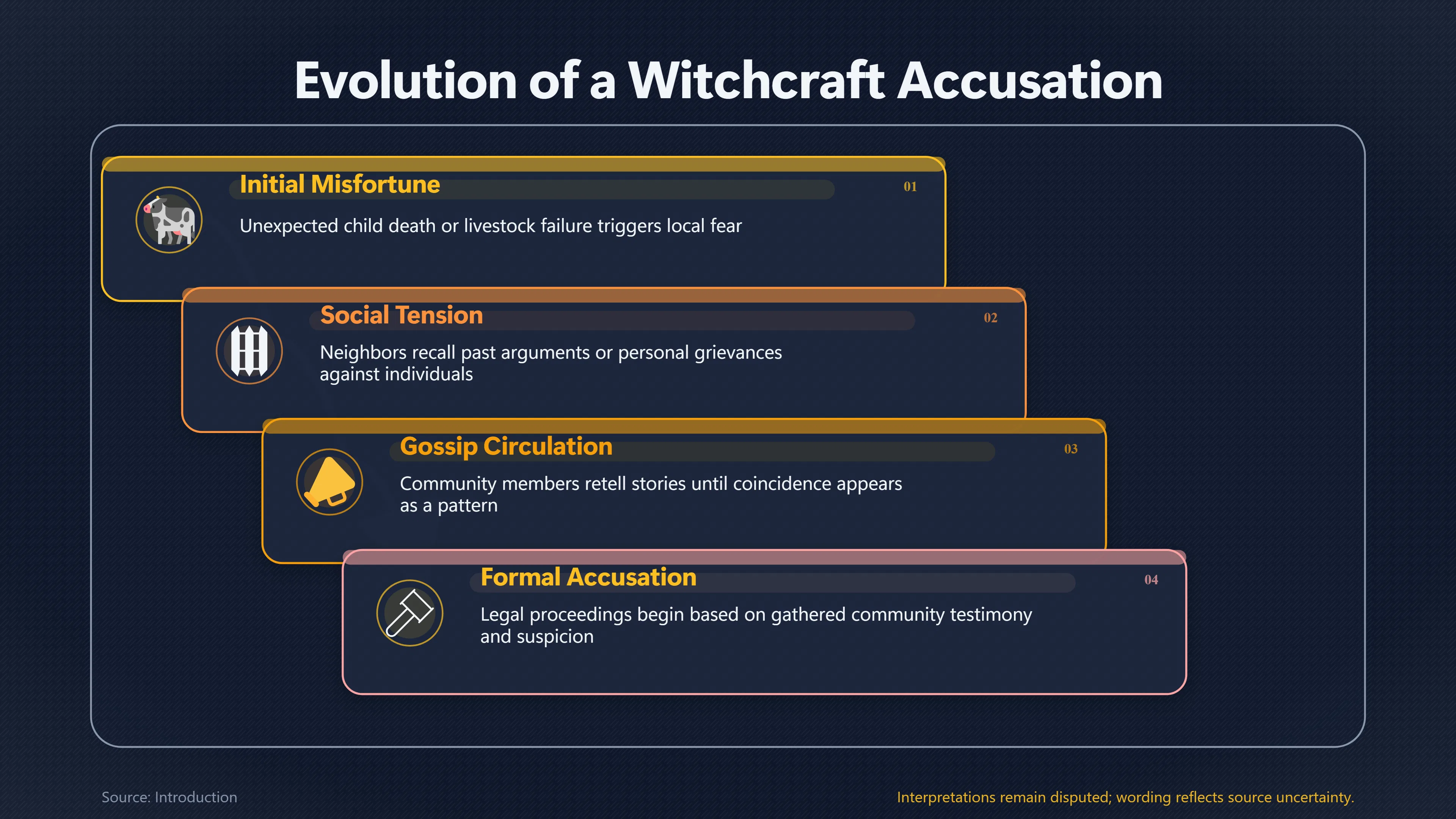
The records show that accusations rarely appeared out of nowhere. Most began with ordinary misfortunes that people struggled to explain.
When a child died unexpectedly, cattle stopped producing milk, bread repeatedly failed to bake properly or illness spread through a household, neighbours often searched for a human cause rather than accepting chance. If someone had recently argued with the affected family, refused help, made an angry remark or already carried a reputation for unusual knowledge, suspicion could quickly focus on that individual.[Amsterdam University Press]aup.nlOpen source on aup.nl.
This process depended heavily on memory and gossip. A single disagreement became more convincing after later misfortunes appeared to confirm it. Witnesses frequently recalled earlier quarrels or strange behaviour only after illness or loss occurred. The accusation therefore developed gradually, as neighbours retold stories until coincidence seemed to form a pattern.
The importance of reputation also meant that accusations often reflected existing social tensions. Those who lived on the margins of village life, had difficult personalities, quarrelled frequently or possessed local reputations as healers or practitioners of folk magic could become particularly vulnerable. Yet the records also show that defendants often belonged to the same social world as their accusers rather than standing outside it. They were neighbours, relatives and fellow villagers whose relationships had broken down.[Harvard Ukrainian Studies]husj.harvard.eduUkrainian Studies Harvard Ukrainian StudiesHarvard Ukrainian StudiesHarvard Ukrainian Studies…
What courts, witnesses and clergy actually did
Although belief in witchcraft was genuine, the legal process was often more cautious than popular stereotypes suggest.
Judges heard testimony from neighbours, examined witness statements and considered whether accusations were supported by recognised legal procedures rather than relying solely on rumour. Clergy provided the religious language through which witchcraft was understood, reinforcing belief in the Devil’s ability to work through human agents, but ecclesiastical ideas did not automatically produce convictions. Local courts frequently balanced religious assumptions with practical legal concerns.[Amsterdam University Press]aup.nlOpen source on aup.nl.
One striking finding from Kateryna Dysa’s analysis of surviving records is the comparatively restrained use of torture. Among the nearly 200 cases she examined, torture appeared only rarely. Acquittals, negotiated settlements and lesser punishments all occurred alongside convictions. Even where death sentences were imposed, execution methods varied, with beheading appearing alongside burning rather than the latter serving as an automatic punishment.[Harvard Ukrainian Studies]husj.harvard.eduUkrainian Studies Harvard Ukrainian StudiesHarvard Ukrainian StudiesHarvard Ukrainian Studies…
This does not mean the trials were harmless. Defendants faced imprisonment, public disgrace, financial costs and lasting damage to their reputations. Even an unsuccessful accusation could permanently alter someone’s standing within a community.
Why the trials differed from western European witch hunts
The Ukrainian cases share important features with witch trials elsewhere in Europe but differ in several significant respects.
First, there is little evidence for a sustained, centrally driven campaign of persecution. Instead of one expanding panic, the archival record contains many separate local disputes unfolding over decades in different jurisdictions. This fragmented pattern prevented accusations from escalating into the enormous chain reactions that characterised some western European witch hunts.[Harvard Ukrainian Studies]husj.harvard.eduUkrainian Studies Harvard Ukrainian StudiesHarvard Ukrainian StudiesHarvard Ukrainian Studies…
Second, the legal culture of the Polish–Lithuanian Commonwealth, under which much of present-day Ukraine fell during this period, produced considerable regional variation. Different courts interpreted evidence differently, and local magistrates exercised significant discretion. This reduced the uniformity that sometimes intensified prosecutions elsewhere.
Third, Ukrainian accusations focused strongly on practical harm rather than elaborate claims about organised satanic conspiracies. Allegations commonly involved spoiled food, damaged crops, sick animals, illness or personal revenge. While ideas about the Devil certainly appeared in legal and theological writings, spectacular narratives about secret gatherings of witches or vast conspiracies were generally less prominent than in some western European demonological literature.[De Gruyter Brill]degruyterbrill.comDe Gruyter Brill Ukrainian Witchcraft TrialsDe Gruyter Brill Ukrainian Witchcraft Trials

Neighbourhood conflict mattered more than gender alone
Most defendants were women, reflecting broader European patterns, but gender by itself does not explain the prosecutions.
Men also appeared among the accused, while both women and men acted as accusers and witnesses. Court records reveal conflicts between households rather than a simple divide between male authorities and female victims. Married couples often presented complaints together, and suspicions voiced within families could eventually become formal legal accusations.
Historians therefore caution against reducing Ukrainian witch trials to either misogyny alone or religious fanaticism alone. They instead reflect a combination of factors:
- personal quarrels and longstanding grievances;
- competition over property, resources and reputation;
- fear created by unexplained illness or misfortune;
- widespread belief that harmful magic could produce real physical effects;
- legal institutions willing to hear such accusations but not invariably determined to convict.[Harvard Ukrainian Studies]husj.harvard.eduUkrainian Studies Harvard Ukrainian StudiesHarvard Ukrainian StudiesHarvard Ukrainian Studies…
This combination helps explain why accusations repeatedly emerged without ever becoming a continuous national panic.
What these records reveal about collective fear
The surviving trials offer an unusually detailed picture of how collective fear developed in everyday communities.
Rather than spreading through newspapers or state propaganda, fear circulated through face-to-face conversation. Gossip preserved memories of old disputes, neighbours interpreted new events through existing suspicions and witnesses reinforced one another’s stories during legal proceedings. The process shows how ordinary communities could construct convincing narratives from fragments of experience, even when objective proof remained elusive.
At the same time, the records demonstrate that belief alone did not dictate outcomes. Courts sometimes rejected accusations, demanded stronger evidence or imposed relatively limited penalties. This distinction is important. Shared belief in witchcraft created the possibility of prosecution, but it did not inevitably produce mass executions or uncontrolled persecution.[Harvard Ukrainian Studies]husj.harvard.eduUkrainian Studies Harvard Ukrainian StudiesHarvard Ukrainian StudiesHarvard Ukrainian Studies…
Why the Ukrainian trials still matter
The Ukrainian witch trials remain historically important because they challenge the popular image of a single European “witch craze”. They reveal instead how fear operated at the scale of villages and neighbourhoods, where personal relationships mattered as much as theology.
For historians, these archives illuminate the psychology of suspicion: how grief, bad luck and unresolved conflict could become persuasive evidence of supernatural harm. They also demonstrate that early modern eastern Europe followed its own legal and cultural trajectory, producing repeated but relatively localised witchcraft prosecutions rather than one overwhelming campaign of persecution.
Seen in this light, the Ukrainian experience is best understood not as an exception to European witch hunting, nor as a simple copy of western patterns, but as a distinctive example of how everyday social conflict, sincere belief and cautious legal institutions interacted to transform neighbourhood fear into courtroom accusations.[harvard.edu]husj.harvard.eduUkrainian Studies Harvard Ukrainian StudiesHarvard Ukrainian StudiesHarvard Ukrainian Studies…
Amazon book picks
Further Reading
Books and field guides related to Was There Really a Ukrainian Witch Craze?. Use these as the next step if you want deeper reading beyond the article.

The Gates of Europe
Provides the wider historical setting for Ukrainian legal culture.
The witch-hunt in early modern Europe
Explains why some regions saw larger persecutions than others.


Endnotes
1.
Source: husj.harvard.edu
Title: Ukrainian Studies Harvard Ukrainian Studies
Link:https://husj.harvard.edu/books/ukrainian-witchcraft-trials-volhynia-podolia-and-ruthenia-17th18th-centuries
Source snippet
Harvard Ukrainian StudiesHarvard Ukrainian Studies...
2.
Source: husj.harvard.edu
Title: in the labyrinth of the kgb ukraines intelligentsia in the 1960s 1970s
Link:https://www.husj.harvard.edu/books/in-the-labyrinth-of-the-kgb-ukraines-intelligentsia-in-the-1960s-1970s
Source snippet
Ukrainian StudiesJanuary 1, 2022 — Olga Bertelsen IN THE LABYRINTH OF THE KGB: UKRAINE'S INTELLIGENTSIA IN THE 1960S-1970S Share your tho...
Published: January 1, 2022
3.
Source: husj.harvard.edu
Title: in the maelstrom the waffen ss galicia division and its legacy
Link:https://www.husj.harvard.edu/books/in-the-maelstrom-the-waffen-ss-galicia-division-and-its-legacy
4.
Source: husj.harvard.edu
Link:https://husj.harvard.edu/books/eighteenth-century-ukraine-new-perspectives-on-social-cultural-and-intellectual-history
5.
Source: husj.harvard.edu
Link:https://husj.harvard.edu/books/ukrainian-historical-writing-in-north-america-during-the-cold-war-the-struggle-for-recognition
6.
Source: husj.harvard.edu
Link:https://www.husj.harvard.edu/
8.
Source: huri.harvard.edu
Title: huris publications program
Link:https://www.huri.harvard.edu/huris-publications-program
9.
Source: huri.harvard.edu
Title: huri publications
Link:https://www.huri.harvard.edu/huri-publications
10.
Source: aup.nl
Link:https://www.aup.nl/en/book/9789633867068/ukrainian-witchcraft-trials
11.
Source: degruyterbrill.com
Title: De Gruyter Brill Ukrainian Witchcraft Trials
Link:https://www.degruyterbrill.com/document/doi/10.1515/9786155053122/html?lang=en
12.
Source: books.google.com
Title: Ukrainian Witchcraft Trials
Link:https://books.google.com/books/about/Ukrainian_Witchcraft_Trials.html?id=EwsN0AEACAAJ
Source snippet
Kateryna Dysa - Google BooksSeptember 15, 2023 — UKRAINIAN WITCHCRAFT TRIALS: VOLHYNIA, PODOLIA, AND RUTHENIA, 17TH–18TH CENTURIES Image...
Published: September 15, 2023
13.
Source: aup.nl
Title: Ukrainian Witchcraft Trials | Amsterdam University Press
Link:https://www.aup.nl/en/book/9786155053115/ukrainian-witchcraft-trials
Source snippet
September 1, 2020 — KATERYNA DYSA UKRAINIAN WITCHCRAFT TRIALS VOLHYNIA, PODOLIA, AND RUTHENIA, 17TH–18TH CENTURIES Drawing on quantitativ...
Published: September 1, 2020
14.
Source: aup.nl
Title: Ukrainian Witchcraft Trials | Amsterdam University Press
Link:https://www.aup.nl/nl/book/9786155053122/ukrainian-witchcraft-trials
Source snippet
September 1, 2020 — KATERYNA DYSA UKRAINIAN WITCHCRAFT TRIALS VOLHYNIA, PODOLIA, AND RUTHENIA, 17TH–18TH CENTURIES Drawing on quantitativ...
Published: September 1, 2020
15.
Source: degruyterbrill.com
Title: Ukrainian Witchcraft Trials
Link:https://www.degruyterbrill.com/document/doi/10.1515/9786155053122/html
16.
Source: degruyterbrill.com
Title: Ukrainian Witchcraft Trials
Link:https://www.degruyterbrill.com/de/document/doi/10.1515/9786155053122/html
Additional References
17.
Source: revdem.ceu.edu
Title: ukrainian witchcraft
Link:https://revdem.ceu.edu/2026/03/05/ukrainian-witchcraft/
Source snippet
European societies once confronted witches, revenants and vampires as threats to moral and political order. These fi...
18.
Source: youtube.com
Title: The Salem Witch Trials: How Fear Turned Neighbors Into Enemies
Link:https://www.youtube.com/watch?v=LJSQ0hpi1D8
Source snippet
3 Bridget Bishop: The First Person Executed in the Salem Witch Trials...
19.
Source: youtube.com
Title: Bridget Bishop: The First Person Executed in the Salem Witch Trials
Link:https://www.youtube.com/watch?v=Pz33kJfelxI
Source snippet
4 Salem Witch Trials: A Political Hysteria...
20.
Source: youtube.com
Title: Ukrainian Witchcraft Trials in the 17-18th Centuries
Link:https://www.youtube.com/watch?v=Lo-C26Qmck8
Source snippet
2 The Salem Witch Trials: How Fear Turned Neighbors Into Enemies...
21.
Source: journals.openedition.org
Link:https://journals.openedition.org/monderusse/12737?lang=de
Source snippet
Ukrainian Witchcraft Trials. Volhynia, Podolia, and Ruthenia, 17th-18th CenturiesDecember 1, 2021 — KATHERYN DYSA. UKRAINIAN WITCHCRAFT T...
Published: December 1, 2021
22.
Source: routledge.com
Link:https://www.routledge.com/Ukrainian-Witchcraft-Trials-Volhynia-Podolia-and-Ruthenia-17th-18th-Centuries/Dysa/p/book/9789633867068
23.
Source: nli.org.il
Link:https://www.nli.org.il/en/books/NNL_ALEPH997010709501605171/NLI
24.
Source: perlego.com
Title: ukrainian witchcraft trials volhynia podolia and ruthenia 17th18th centuries pdf
Link:https://www.perlego.com/book/2061819/ukrainian-witchcraft-trials-volhynia-podolia-and-ruthenia-17th18th-centuries-pdf
25.
Source: goodreads.com
Title: Ukrainian Witchcraft Trials by Kateryna Dysa | Goodreads
Link:https://www.goodreads.com/book/show/14696388-witchcraft-trials-and-beyond
26.
Source: youtube.com
Title: Salem Witch Trials: A Political Hysteria
Link:https://www.youtube.com/watch?v=XNDzSkdxO2c
Source snippet
5 Andrew Moore on witchcraft...
Topic Tree