Within Mongolia
How Sacred War Rumours Fuelled Rebellion
Religious prophecy did not cause the 1932 rebellion, but it helped rebels interpret hardship, recruit supporters and imagine victory.
On this page
- Collectivisation, confiscation and the roots of revolt
- Panchen Lama rumours and the promise of Shambhala
- Violence, suppression and the policy retreat that followed
Page outline Jump by section
Introduction
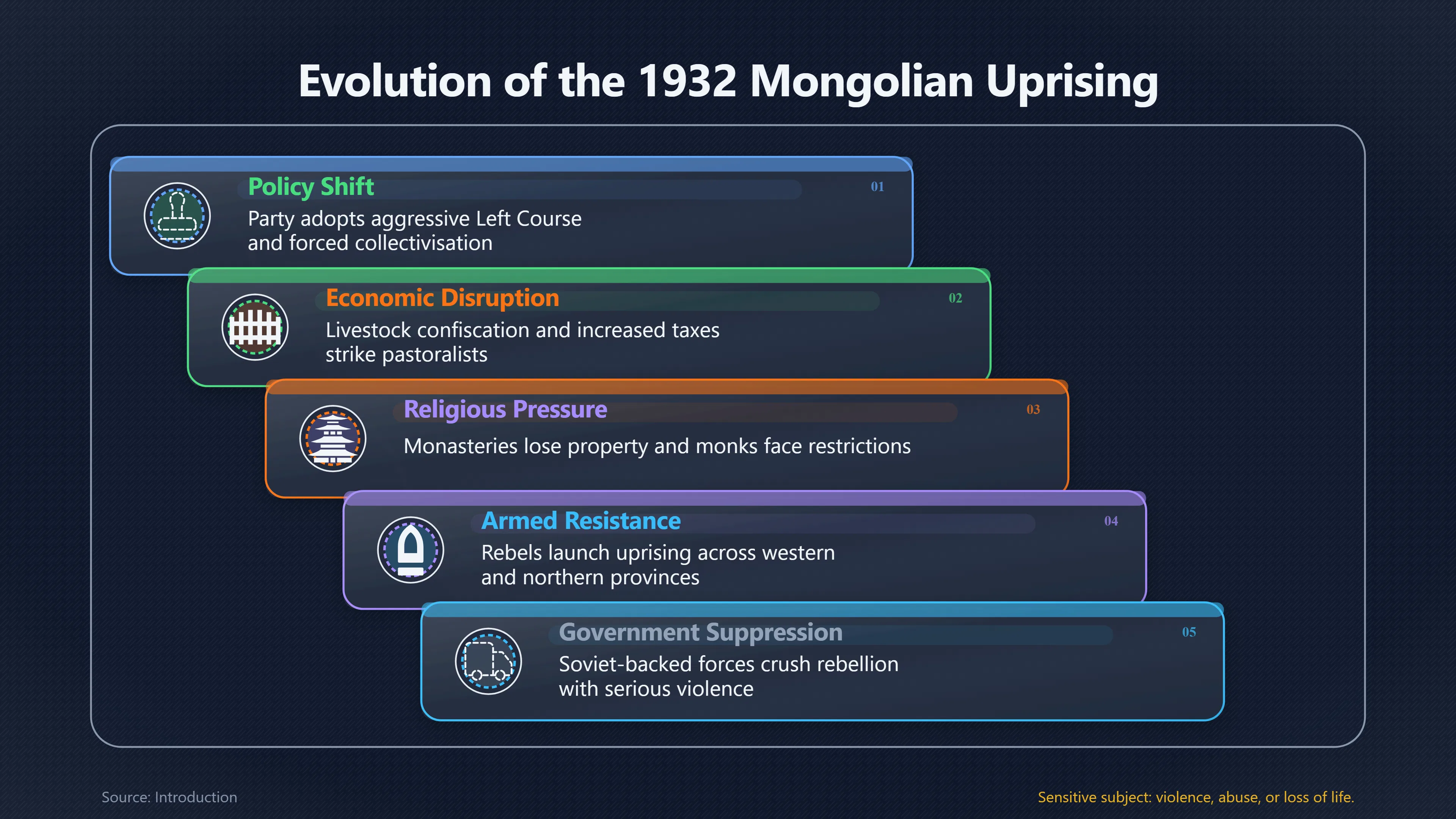
The 1932 armed uprising in Mongolia was not simply a religious revolt, nor was it driven solely by prophecy. It emerged from severe economic disruption, forced collectivisation, attacks on Buddhist institutions and growing resentment towards the Mongolian People’s Revolutionary Party’s radical socialist policies. Within that crisis, rumours of a coming sacred war gave many rebels a framework for understanding events. Stories spread that powerful Buddhist allies, especially the Ninth Panchen Lama, would soon arrive, that the mythical forces of Shambhala would destroy the enemies of religion, and that victory over the government was divinely assured. These beliefs did not create the rebellion on their own, but they helped recruit supporters, sustain morale and explain hardship in religious terms. Later Soviet and Mongolian officials exaggerated these rumours into claims of a foreign-directed conspiracy, an interpretation that modern historians have largely rejected.[oup.com]academic.oup.comOUP AcademicRebellions, War, and Aftermaths | The Lama Question: Violence, Sovereignty, and Exception in Early Socialist Mongolia | Hawai…

Collectivisation, confiscation and the roots of revolt
By the early 1930s Mongolia was undergoing one of the most disruptive periods in its modern history. Following Soviet advice, the ruling party adopted an aggressive “Left Course” that attempted to transform the largely pastoral economy through forced collectivisation, expanded state control and campaigns against private wealth. Livestock was confiscated, taxes increased, monasteries lost property, and many monks faced restrictions or pressure to abandon religious life. These measures struck directly at both economic survival and the social influence of Buddhism.[OUP Academic]academic.oup.comOUP AcademicRebellions, War, and Aftermaths | The Lama Question: Violence, Sovereignty, and Exception in Early Socialist Mongolia | Hawai…
Resistance spread across several western and northern provinces during 1932. Although many leaders were monks, the uprising also attracted ordinary herders, local officials and even some party members who had become disillusioned with government policy. The movement therefore reflected a broad coalition of grievances rather than a narrowly religious rebellion. Modern scholarship increasingly describes the conflict as a popular resistance movement or even a limited civil war because communities on both sides included Mongolians rather than a simple confrontation between state and clergy.[researchgate.net]researchgate.netRebellion or People’s Resistance Movement Against the Party and the Government | Request PDFJune 1, 2025…
Religion nevertheless remained central to how many participants interpreted events. Government attacks on monasteries were widely understood as attacks on the Buddhist faith itself. Defending religion became inseparable from defending local society, making sacred language a powerful tool for mobilisation.
Panchen Lama rumours and the promise of Shambhala
The most remarkable feature of the rebellion was not formal Buddhist doctrine but the rapid spread of rumours linking the uprising to supernatural and prophetic expectations.
The Ninth Panchen Lama, one of Tibetan Buddhism’s highest-ranking figures, had become a symbol of hope for many Mongolian Buddhists after leaving Tibet in the 1920s. During the uprising, reports circulated that he was preparing to enter Mongolia with armed supporters or that his followers had already captured the capital. Some rebel groups even described themselves as soldiers of the Panchen Lama despite having no verified contact with him.[biblio.uz]biblio.uzTHE KHUBSUGUL UPRISING OF 1932 IN MONGOLIATHE KHUBSUGUL UPRISING OF 1932 IN MONGOLIA
These rumours blended with older expectations surrounding Shambhala, the legendary hidden Buddhist kingdom that, in some popular interpretations, would eventually defeat the enemies of the faith in a final righteous struggle. Rebel proclamations reportedly warned that those opposing religion would perish at the hands of the army of Shambhala and urged believers to join the “Yellow Warriors” defending Buddhism. Such language transformed political resistance into a sacred mission, giving suffering a place within a larger cosmic story.[biblio.uz]biblio.uzTHE KHUBSUGUL UPRISING OF 1932 IN MONGOLIATHE KHUBSUGUL UPRISING OF 1932 IN MONGOLIA
Importantly, historians distinguish these popular rumours from established Buddhist teaching. Shambhala occupies a symbolic place within Buddhist tradition, but rebels interpreted it in a highly political and immediate way. Their expectations reflected local crisis, fear and hope rather than official religious doctrine.
How sacred war rumours encouraged mobilisation
Rumours of divine intervention worked because they addressed practical uncertainties.
For communities facing confiscation, economic collapse and political repression, stories of imminent rescue provided reassurance that resistance was neither hopeless nor merely local. If the Panchen Lama or the forces of Shambhala were believed to be approaching, joining the uprising could appear both spiritually justified and militarily sensible.
The rumours also solved several psychological problems at once:
- They explained suffering, presenting hardship as part of a struggle between religion and its enemies.
- They encouraged recruitment, assuring hesitant supporters that powerful allies would soon arrive.
- They reinforced commitment, making retreat seem equivalent to abandoning both faith and community.
- They linked scattered local revolts, allowing isolated groups to imagine themselves participating in one larger sacred campaign.
In this sense, belief functioned as a mechanism for collective mobilisation rather than as the rebellion’s underlying cause. Economic distress and political repression created the conditions; prophetic rumours helped transform those grievances into coordinated action.[OUP Academic]academic.oup.comOUP AcademicRebellions, War, and Aftermaths | The Lama Question: Violence, Sovereignty, and Exception in Early Socialist Mongolia | Hawai…
Violence, suppression and the policy retreat that followed
Government forces, supported by Soviet advisers and military assistance, eventually crushed the rebellion after months of fighting. Both rebels and government troops committed serious violence, and more than 1,500 people are estimated to have died during the conflict.[Wikipedia]Wikipedia1932 armed uprising in Mongolia1932 armed uprising in Mongolia
The uprising forced the socialist leadership to confront the failure of its most radical policies. Rather than intensifying collectivisation immediately, the government temporarily retreated from aspects of the Left Course. Some confiscatory measures were relaxed, and officials adopted a more cautious approach towards poorer monks while continuing to target higher-ranking clergy and influential religious institutions. Christopher Kaplonski argues that the rebellion marked a significant shift in how the socialist state managed the “lama question”, moving from broad confrontation towards a more selective class-based strategy.[OUP Academic]academic.oup.comOUP AcademicRebellions, War, and Aftermaths | The Lama Question: Violence, Sovereignty, and Exception in Early Socialist Mongolia | Hawai…
The moderation proved temporary. Later in the decade, Mongolia experienced far more extensive political purges in which thousands of monks were arrested or executed and monasteries were destroyed.

Separating rumour from later political myth
During and after the uprising, Soviet and Mongolian authorities frequently claimed that the rebellion had been organised by the Panchen Lama, often linking him to alleged Japanese plots against Mongolia. These accusations served political purposes by portraying domestic unrest as foreign subversion rather than as a reaction to unpopular policies.[ResearchGate]researchgate.netResearchGate(PDF) THE ISSUE OF THE NINTH PANCHEN LAMA IN THE HISTORY OF THE 1932 UPRISING IN MONGOLIA…
More recent archival research has challenged this interpretation. Historians have found abundant evidence that rebels invoked the Panchen Lama’s name and genuinely believed rumours of his support. However, documentary evidence demonstrating that the Panchen Lama himself planned, directed or materially supported the uprising has not been found. Modern scholarship therefore separates the undeniable importance of the rumours from the unsupported claim that they reflected an actual conspiracy.[ResearchGate]researchgate.netResearchGate(PDF) THE ISSUE OF THE NINTH PANCHEN LAMA IN THE HISTORY OF THE 1932 UPRISING IN MONGOLIA…
This distinction matters because it illustrates how collective belief can influence historical events without requiring the underlying rumour to be true.
Why the rebellion remains important
The 1932 rebellion demonstrates that collective beliefs often become politically powerful during periods of severe social disruption. Religious prophecy did not cause Mongolia’s crisis, but it offered language through which communities interpreted rapid economic change, attacks on long-established institutions and fears about the future.
For historians of collective belief, the episode is valuable because it sits between several categories. It was not simply a millenarian movement, nor merely a political rebellion, nor just a rumour panic. Instead, it shows how practical grievances and sacred expectations can reinforce one another. Rumours of the Panchen Lama’s arrival and the coming army of Shambhala did not replace material causes; they transformed those causes into a compelling story of sacred resistance that helped sustain one of the most significant uprisings in socialist Mongolia before the devastating purges of the late 1930s.
Amazon book picks
Further Reading
Books and field guides related to How Sacred War Rumours Fuelled Rebellion. Use these as the next step if you want deeper reading beyond the article.

The True Believer:Thoughts on the Nature of Mass Movements
Explores dynamics behind ideological and religious mobilization.
Imagined communities
Helps explain how shared narratives and beliefs mobilize populations.

The history of Mongolia
Places the 1932 rebellion within wider political and religious change.

Mongolia
First published 2019. Subjects: Mongolia, history, Asia, politics and government, History, Politics and government.
Endnotes
1.
Source: academic.oup.com
Link:https://academic.oup.com/hawaii-scholarship-online/book/29976/chapter-abstract/254957123
Source snippet
OUP AcademicRebellions, War, and Aftermaths | The Lama Question: Violence, Sovereignty, and Exception in Early Socialist Mongolia | Hawai...
2.
Source: biblio.uz
Title: THE KHUBSUGUL UPRISING OF 1932 IN MONGOLIA
Link:https://biblio.uz/m/articles/view/THE-KHUBSUGUL-UPRISING-OF-1932-IN-MONGOLIA
3.
Source: researchgate.net
Link:https://www.researchgate.net/publication/401541827_THE_ISSUE_OF_THE_NINTH_PANCHEN_LAMA_IN_THE_HISTORY_OF_THE_1932_UPRISING_IN_MONGOLIA
Source snippet
ResearchGate(PDF) THE ISSUE OF THE NINTH PANCHEN LAMA IN THE HISTORY OF THE 1932 UPRISING IN MONGOLIA...
4.
Source: Wikipedia
Title: 1932 armed uprising in Mongolia
Link:https://en.wikipedia.org/wiki/1932_armed_uprising_in_Mongolia
5.
Source: researchgate.net
Link:https://www.researchgate.net/publication/392675515_Rebellion_or_People%27s_Resistance_Movement_Against_the_Party_and_the_Government
Source snippet
Rebellion or People’s Resistance Movement Against the Party and the Government | Request PDFJune 1, 2025...
Published: June 1, 2025
6.
Source: academic.oup.com
Link:https://academic.oup.com/book/32685/chapter-abstract/270767932?itm_content=Oxford_Academic_Books_0
Source snippet
"Wallace (ed.) [https://doi.org/10.1093/acprof:oso/9780199958641.001.0001..."](https://doi.org/10.1093/acprof:oso/9780199958641.001.0001...")...
7.
Source: academic.oup.com
Link:https://academic.oup.com/hawaii-scholarship-online/book/29976
8.
Source: researchgate.net
Link:https://www.researchgate.net/publication/401540837_THE_GREAT_REPRESSION_OF_LAMAS_IN_MONGOLIA_AND_THE_NINTH_PANCHEN_LAMA_ISSUE
9.
Source: library.kg
Title: THE KHUBSUGUL UPRISING OF 1932 IN MONGOLIA
Link:https://library.kg/blogs/entry/THE-KHUBSUGUL-UPRISING-OF-1932-IN-MONGOLIA?lang=en
Source snippet
November 29, 2024 — THE KHUBSUGUL UPRISING OF 1932 IN MONGOLIA [Button: Join ] [Button: Login ] * * * THE KHUBSUGUL UPRISING OF 1932 IN M...
Published: November 29, 2024
10.
Source: nit.tuva.asia
Link:https://nit.tuva.asia/nit/en/article/view/951
Source snippet
"Samdan Tuvan Institute of Humanities and Applied Social and Economic Research under the Government of the Republic of Tuva [https://orcid..."](https://orcid...")...
11.
Source: military-history.fandom.com
Title: 1932 armed uprising in Mongolia
Link:https://military-history.fandom.com/wiki/1932_armed_uprising_in_Mongolia
Additional References
12.
Source: journal.num.edu.mn
Title: Wallace University of Cali
Link:https://journal.num.edu.mn/actamongolica/article/view/6083
Source snippet
People’s Prophecies: Subversive Adaptations and Transformations of Śambhala Eschatology | Acta MongolicaOctober 1, 2019 — OTHER PEOPLE’S...
Published: October 1, 2019
13.
Source: studybuddhism.com
Link:https://studybuddhism.com/en/advanced-studies/history-culture/shambhala/use-of-the-shambhala-legend-for-control-of-mongolia
14.
Source: escholarship.org
Link:https://escholarship.org/uc/item/61d3r4cd
15.
Source: youtube.com
Link:https://www.youtube.com/watch?v=9_1oi7mUJPI
Source snippet
History of Mongolia | History Documentary...
16.
Source: kci.go.kr
Link:https://www.kci.go.kr/kciportal/ci/sereArticleSearch/ciSereArtiView.kci?sereArticleSearchBean.artiId=ART002503085
17.
Source: cambridge.org
Link:https://www.cambridge.org/core/journals/modern-asian-studies/article/mongolian-revolution-of-1921/2FD9F6600841118EEC430BB238D09AF7
18.
Source: youtube.com
Title: Mongolia’s Cold War History
Link:https://www.youtube.com/watch?v=B3CNKYy7V2w
Source snippet
COMMUNIST MONGOLIA 1924-1990...
19.
Source: portal.num.edu.mn
Title: num.edu.mnБүтээл, нийтлэл
Link:https://portal.num.edu.mn/Staff/ff366ae3-9128-4f2f-a17d-a6d4f840252d/Publications
20.
Source: youtube.com
Title: History of Mongolia | History Documentary
Link:https://www.youtube.com/watch?v=3OlcwTc8YwA
21.
Source: researchportal.murdoch.edu.au
Title: In Search of Shambhala Nicholas Roerichs
Link:https://researchportal.murdoch.edu.au/esploro/outputs/journalArticle/In-Search-of-Shambhala-Nicholas-Roerichs/991005543995907891
Topic Tree