Within Barbados Panics
How Did Colonial Law Invent Obeah?
Colonial officials grouped healing, divination and spirit work under one criminal label that made diverse practices easier to police.
On this page
- What practices officials called Obeah
- How law created a single threatening category
- Why practitioners were cast as both dangerous and fraudulent
Page outline Jump by section
Introduction
In Barbados, colonial law did more than ban a spiritual practice: it created a legal category called “Obeah” that gathered together many different forms of African-Caribbean healing, divination, ritual protection and spirit work under a single criminal label. That label did not describe one organised religion with shared beliefs or institutions. Instead, it reflected how colonial officials understood—and chose to police—practices they associated with enslaved Africans. By treating these diverse traditions as a single dangerous activity, the law made them easier to prosecute and easier to present as threats to public order, rebellion and Christian society. Historians now argue that this legal invention shaped public attitudes for generations, helping to turn a flexible range of spiritual practices into a feared and stigmatised category in colonial records and later popular culture.[ed.ac.uk]research.ed.ac.ukUniversity of Edinburgh ResearchObeah acts: Producing and policing the boundaries of religion in the Caribbean - University of Edinburgh…
What practices officials called Obeah
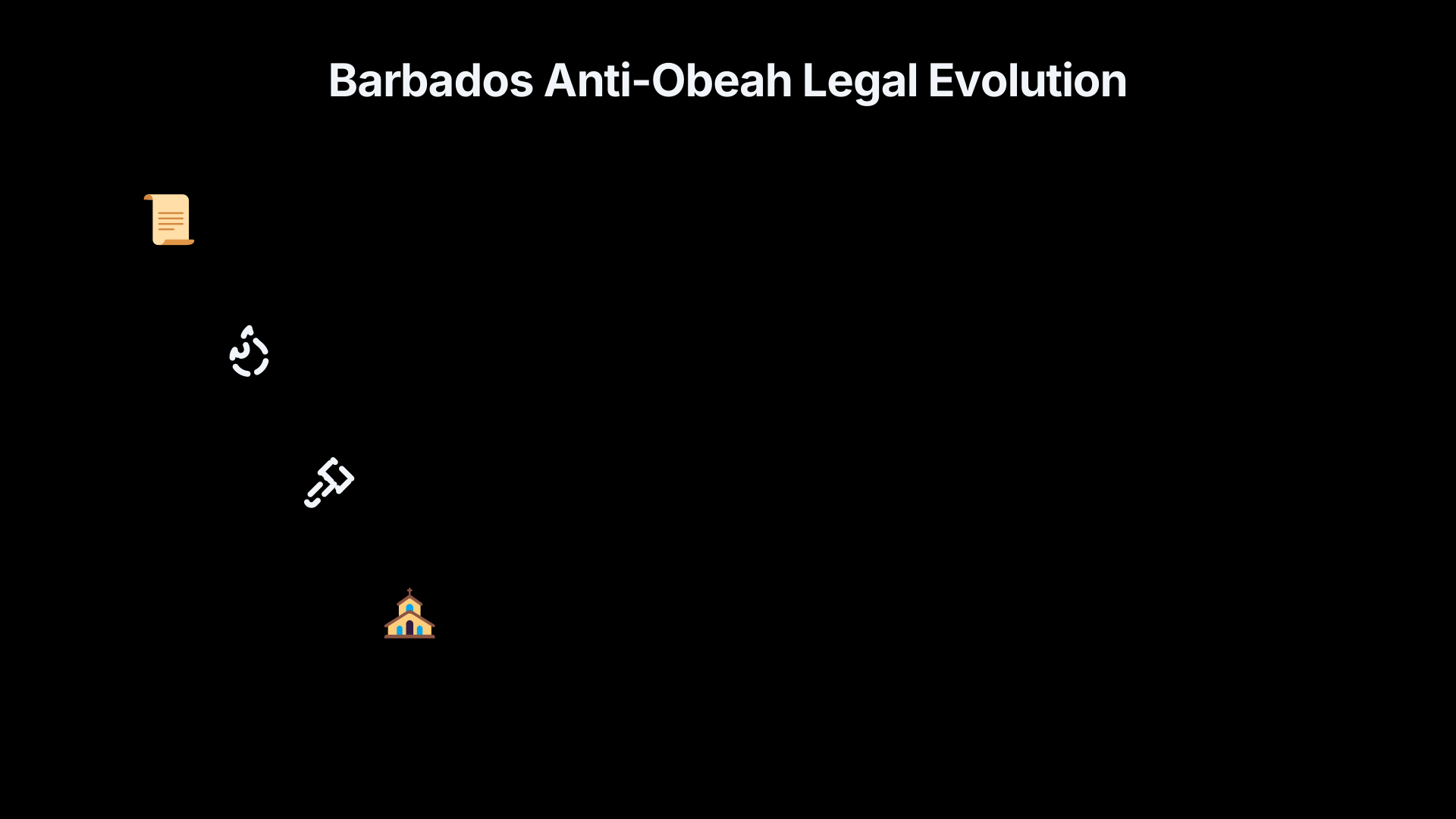
Colonial legislation rarely defined Obeah in precise religious terms. Instead, laws and court records grouped together a wide variety of activities that could include herbal medicine, protective charms, divination, communication with spirits, ritual objects, healing ceremonies and, in some accusations, attempts to cause harm through supernatural means. The people involved did not necessarily see themselves as belonging to a single faith or movement. Practices varied according to African cultural origins, local traditions and individual specialists.
This distinction is important because “Obeah” functioned primarily as a colonial label rather than a self-description. Officials often used the same word to describe activities that served very different purposes. A healer treating illness, someone preparing protective amulets and a person accused of cursing an enemy could all be prosecuted under the same heading. Modern scholarship therefore treats Obeah less as one unified religion than as an umbrella term imposed by colonial authorities on diverse African-Caribbean spiritual traditions.[ed.ac.uk]research.ed.ac.ukUniversity of Edinburgh ResearchObeah acts: Producing and policing the boundaries of religion in the Caribbean - University of Edinburgh…
How law created a single threatening category
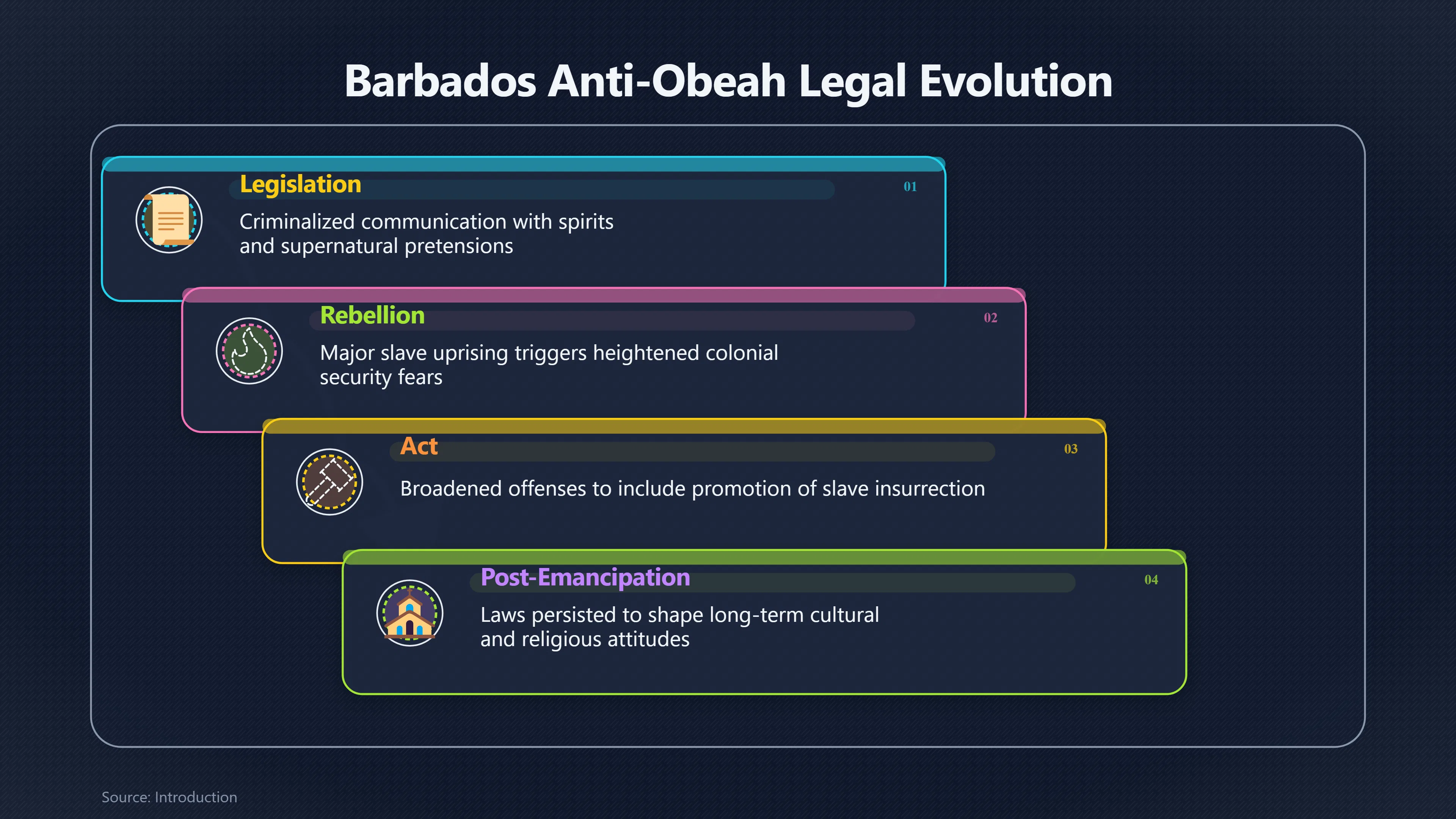
Barbados’s legislation shows how the legal system transformed an imprecise cultural label into a criminal offence. An 1806 Act referred to “Obeah men and women” who supposedly claimed communication with evil spirits and deceived enslaved people through supernatural pretensions. Rather than regulating particular harmful acts alone, the law criminalised the practice itself, linking spiritual authority with fraud, poison and social danger. Penalties could include death or transportation.[slaveryandfreedomlaws.lib.unb.ca]slaveryandfreedomlaws.lib.unb.caNovember 3, 1806…
The colony expanded this approach in 1819 with an “Act for the better Prevention of the Practice of Obeah.” The new legislation declared earlier measures ineffective and broadened the offence. It connected alleged magical claims not only with injury but also with the promotion of slave insurrection or rebellion. In effect, spiritual authority became legally associated with political subversion, even when the evidence concerned claims of supernatural power rather than participation in an organised revolt.[slaveryandfreedomlaws.lib.unb.ca]slaveryandfreedomlaws.lib.unb.caMay 25, 1819…
This legal framing mattered because it collapsed important distinctions. Colonial courts no longer needed to separate healing from harmful magic or religious ritual from political organising. Once officials classified an activity as Obeah, it entered a legal category already associated with deception, danger and rebellion. Historians argue that this was one of the law’s most enduring effects: it produced Obeah as a criminal identity rather than merely regulating isolated offences.[University of Edinburgh Research]research.ed.ac.ukUniversity of Edinburgh ResearchObeah acts: Producing and policing the boundaries of religion in the Caribbean - University of Edinburgh…

Why practitioners were cast as both dangerous and fraudulent
Colonial authorities often described Obeah practitioners in two apparently contradictory ways. On one hand, legislation portrayed them as dangerous figures capable of encouraging rebellion, poisoning victims or exercising frightening supernatural influence. On the other, the same laws accused them of merely pretending to possess magical powers and deceiving the gullible.
This combination was politically useful. If supernatural claims were dismissed as fraud, officials could deny the legitimacy of African-derived religious knowledge. Yet by simultaneously insisting that practitioners threatened public safety and slave discipline, governments could justify severe punishment. The issue was therefore not simply whether colonial officials believed in supernatural powers themselves. Rather, they argued that belief in such powers could influence enslaved communities in ways that challenged plantation authority.[slaveryandfreedomlaws.lib.unb.ca]slaveryandfreedomlaws.lib.unb.caNovember 3, 1806…
The wording of Barbados’s statutes illustrates this approach. They repeatedly referred to people “pretending” to supernatural powers while still prescribing capital punishment or transportation for those judged to be practising Obeah. The offence lay as much in the social authority that practitioners exercised as in any alleged magical act.[slaveryandfreedomlaws.lib.unb.ca]slaveryandfreedomlaws.lib.unb.caNovember 3, 1806…
Why Obeah became linked with rebellion
Barbados’s anti-Obeah laws cannot be separated from the wider fears of resistance within a plantation colony where enslaved Africans vastly outnumbered the white population. Colonial governments worried about any networks capable of creating trust, secrecy or collective organisation among enslaved people.
After major slave uprisings elsewhere in the British Caribbean and Barbados’s own 1816 rebellion, legislators increasingly connected Obeah with insurrection. The 1819 Act explicitly mentioned attempts to promote rebellion, demonstrating how spiritual practices became entangled with colonial fears of organised resistance. This did not mean that every healer or ritual specialist was politically active. Rather, officials treated independent spiritual authority itself as suspicious because it operated outside colonial institutions and could strengthen community solidarity.[slaveryandfreedomlaws.lib.unb.ca]slaveryandfreedomlaws.lib.unb.caMay 25, 1819…
Why historians see colonial law as the lasting legacy
Modern historians argue that the greatest impact of anti-Obeah legislation was not only the punishment of individuals but the creation of a lasting public category. Diana Paton has shown that colonial governments isolated practices labelled “magic”, “witchcraft” and “superstition” from activities they were prepared to recognise as legitimate religion. This legal separation helped ensure that Obeah was remembered primarily as criminality rather than as part of a broader landscape of African-Caribbean spirituality.[University of Edinburgh Research]research.ed.ac.ukUniversity of Edinburgh ResearchObeah acts: Producing and policing the boundaries of religion in the Caribbean - University of Edinburgh…
Research on Caribbean legislation also demonstrates that anti-Obeah laws spread across the British Caribbean and, in some territories, survived long after emancipation. Although their wording changed over time, they continued to influence how courts, churches and the wider public understood African-derived spiritual practices. The colonial legal definition therefore shaped cultural attitudes as much as legal outcomes, reinforcing the idea that Obeah was inherently threatening instead of recognising the diversity of practices that colonial officials had grouped together under a single name.[Obeah Histories]obeahhistories.orgObeah Histories Legislation | Obeah HistoriesObeah Histories Legislation | Obeah Histories
Amazon book picks
Further Reading
Books and field guides related to How Did Colonial Law Invent Obeah?. Use these as the next step if you want deeper reading beyond the article.
Interesting Narrative of the Life of Olaudah Equiano
Background on African traditions in the Atlantic world.
Obeah, Orisa, and Religious Identity in Trinidad
Explains Obeah traditions and colonial interpretations.
Endnotes
1.
Source: cambridge.org
Link:https://www.cambridge.org/core/journals/journal-of-law-and-religion/article/abs/obeah-vagrancy-and-the-boundaries-of-religious-freedom-analyzing-the-proscription-of-pretending-to-possess-supernatural-powers-in-the-anglophone-caribbean/11EEE1AD5948F72F423FE174FFE61F87
Source snippet
OBEAH, VAGRANCY, AND THE BOUNDARIES OF RELIGIOUS FREEDOM: ANALYZING THE PROSCRIPTION OF “PRETENDING TO POSSESS SUPERNATURAL POWERS” IN TH...
2.
Source: slaveryandfreedomlaws.lib.unb.ca
Link:https://slaveryandfreedomlaws.lib.unb.ca/laws/barbados-1806
Source snippet
November 3, 1806...
Published: November 3, 1806
3.
Source: slaveryandfreedomlaws.lib.unb.ca
Link:https://slaveryandfreedomlaws.lib.unb.ca/laws/barbados-1819
Source snippet
May 25, 1819...
Published: May 25, 1819
4.
Source: slaveryandfreedomlaws.lib.unb.ca
Link:https://slaveryandfreedomlaws.lib.unb.ca/laws/barbados-1818
5.
Source: research.ed.ac.uk
Link:https://www.research.ed.ac.uk/en/publications/obeah-acts-producing-and-policing-the-boundaries-of-religion-in-t/
Source snippet
University of Edinburgh ResearchObeah acts: Producing and policing the boundaries of religion in the Caribbean - University of Edinburgh...
6.
Source: obeahhistories.org
Title: Obeah Histories Legislation | Obeah Histories
Link:https://obeahhistories.org/law/
7.
Source: obeahhistories.org
Link:https://obeahhistories.org/
8.
Source: research.ed.ac.uk
Title: ed.ac.uk Witchcraft, poison, law and Atlantic slavery
Link:https://www.research.ed.ac.uk/en/publications/witchcraft-poison-law-and-atlantic-slavery/
Additional References
9.
Source: researchgate.net
Link:https://www.researchgate.net/publication/339663096_Divorcing_Diabolism_English_Legal_Framing_of_Afro-Creole_Spiritual_Practices_in_the_Caribbean
Source snippet
Request PDFOctober 1, 2018 — DIVORCING DIABOLISM: ENGLISH LEGAL FRAMING OF AFRO-CREOLE SPIRITUAL PRACTICES IN THE CARIBBEAN, 1625-1807...
Published: October 1, 2018
10.
Source: scholarship.miami.edu
Title: Powers of Imagination and Legal Regimes
Link:https://scholarship.miami.edu/esploro/outputs/journalArticle/Powers-of-Imagination-and-Legal-Regimes/991031660538402976
Source snippet
of Imagination and Legal Regimes against “Obeah” in the Late Eighteenth- and Early Nineteenth-Century British Caribbean - University of M...
11.
Source: youtube.com
Title: Obeah and the Caribbean Connection: A Review of Obeah Using Archive Newspapers
Link:https://www.youtube.com/watch?v=UbOPQj0f99A
Source snippet
How Barbados became the first slave society | History - Britain's Forgotten Slave Owners...
12.
Source: youtube.com
Title: Author Dianne M. Stewart | Obeah, Orisa, and Religious Identity in Trinidad
Link:https://www.youtube.com/watch?v=3P_Wy4DTmkY
Source snippet
Obeah and the Caribbean Connection: A Review of Obeah Using Archive Newspapers...
13.
Source: academic.oup.com
Link:https://academic.oup.com/chicago-scholarship-online/book/34072/chapter/288999409
Source snippet
Our Bare Word: Oath Taking, Evidence Giving, and the Law | The Freedom of Speech: Talk and Slavery in the Anglo-Caribbean World | Chicago...
14.
Source: jstor.org
Link:https://www.jstor.org/stable/j.ctv1134dbz
15.
Source: jstor.org
Link:https://www.jstor.org/stable/jj.2775911
16.
Source: youtube.com
Title: FAMOUS OBEAH CASES IN JAMAICA
Link:https://www.youtube.com/watch?v=70DFUDwOkvQ
Source snippet
Author Dianne M. Stewart | Obeah, Orisa, and Religious Identity in Trinidad...
17.
Source: youtube.com
Title: How Barbados became the first slave society | History
Link:https://www.youtube.com/watch?v=IpgD2ehtMmM
18.
Source: youtube.com
Title: Archival Irruptions: Moravians, Obeah, and Hidden Caribbean Histories
Link:https://www.youtube.com/watch?v=crP-n_zfkZc
Source snippet
FAMOUS OBEAH CASES IN JAMAICA...
Topic Tree