When Belief Became a National Scare
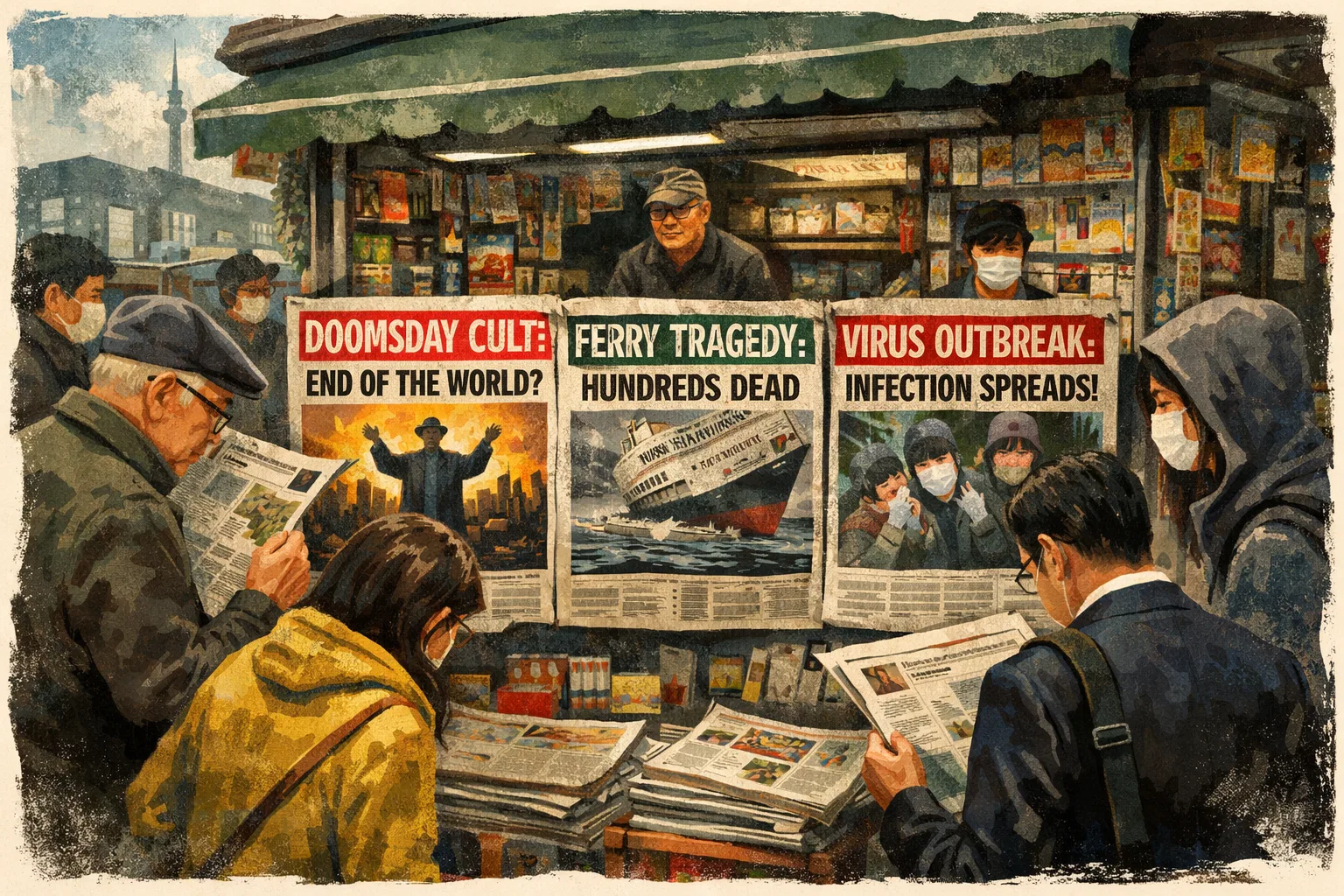
South Korea’s history of cult scares and collective belief is not chiefly a story of unexplained fainting epidemics or medieval-style witch hunts. Its most revealing episodes grew from rapid social change: war, dictatorship, urbanisation, intense religious competition and recurring mistrust of institutions.
Page outline Jump by section
Introduction
Four episodes are especially important: the failed 1992 apocalypse predicted by the Dami Mission; the unresolved and heavily mythologised Odaeyang mass deaths of 1987; the “cult” narratives attached to the 2014 Sewol ferry disaster; and the public fury directed at the Shincheonji Church during the first major South Korean outbreak of COVID-19. Together, they show why genuine misconduct and justified investigation must be separated from scapegoating, rumour and indiscriminate hostility towards religious minorities.[accesson.kr]accesson.krNew Religions and Social Change in Modern Korea Historyby 노길명 · 2002 · Cited by 23 — Over the last century and a half, many new r…
Why new religions found an audience
Modern Korean new religions emerged from unusually severe disruption. During the late nineteenth and twentieth centuries, Korea experienced foreign intervention, Japanese colonial rule, national division, war, authoritarian government and exceptionally fast industrialisation. Religious innovators offered explanations for suffering and visions of a transformed future, sometimes combining Christian ideas with older Korean traditions, healing practices, nationalism or prophecies of a coming new age.
Researchers therefore warn against treating every unconventional Korean religion as a deceptive “cult”. Many movements arose because established political and religious institutions seemed unable to answer the pressures of colonialism, poverty and cultural dislocation. Some criticised materialism or authoritarian modernisation; others offered close communities to people uprooted from villages and extended families. The growth of urban churches, campus movements and lay-led religious organisations was part of a broader transformation of South Korean society, not simply an outbreak of irrationality.[accesson.kr]accesson.krNew Religions and Social Change in Modern Korea Historyby 노길명 · 2002 · Cited by 23 — Over the last century and a half, many new r…
The word cult nevertheless became powerful in public debate. Mainstream Protestant churches often used it for theological rivals, particularly groups claiming that a living leader possessed unique authority or that established Christianity had misunderstood scripture. Journalists and anti-cult campaigners also used it for organisations accused of secret recruitment, financial exploitation or control over members. These concerns could be well founded, but the label often bundled several separate questions together:
- Does the movement teach beliefs considered heretical by another church?
- Does its leadership deceive, exploit or abuse people?
- Has it committed a crime that can be proved in court?
- Is it merely secretive, unpopular or socially unfamiliar?
- Has the group become a convenient symbol for a wider institutional failure?
South Korean controversies repeatedly became confused when theological hostility was treated as proof of criminality, or when documented wrongdoing by leaders was used to portray every member as dangerous.
The 1992 apocalypse that did not arrive
The clearest South Korean example of millenarian excitement was the Dami Mission’s prediction that believers would be taken bodily into heaven on 28 October 1992. Its leader, Lee Jang-rim, promoted a detailed end-times message that circulated through affiliated churches, preaching networks, publications and word of mouth. Contemporary reports estimated that the prophecy attracted thousands of committed followers and influenced a much larger audience of anxious observers.[latimes.com]latimes.comla xpm 1992 10 29 mn 925 storyLos Angeles TimesNo Doomsday Rapture for S. Korea SectOct 29, 1992 — It was Dami Mission's pastor, Lee Jang Rim, who spread the Rapture t…
For adherents, the prediction was not merely an interesting theory. Reports described people abandoning employment, selling property, separating from relatives or devoting savings to preparations for the expected rapture. The exact number and severity of such cases are difficult to verify because contemporary coverage tended to emphasise the most dramatic examples. Even so, sufficient evidence emerged of financial and family harm for the movement to become a major national story.
The authorities did not wait for the predicted date. Lee was arrested before 28 October and accused of obtaining money from followers while holding financial instruments that matured after the supposed end of the world. That detail powerfully undermined his credibility: it suggested that the prophet’s own financial planning did not match the certainty demanded from his followers. Lee was subsequently convicted of fraud.[Wikipedia]WikipediaDami MissionDami Mission
On the appointed night, police, reporters, anxious relatives and curious spectators gathered near churches where believers waited, sang and prayed. Midnight passed without the promised event. There was no mass violence. Some adherents immediately accepted that the prophecy had failed; others searched for explanations, blamed errors of interpretation or quietly left.
The episode illustrates a familiar finding in the study of failed prophecy: disconfirmation does not produce one uniform reaction. Belief may collapse, but people may also reinterpret the date, spiritualise the expected event or preserve their faith while rejecting a particular leader. Embarrassment and the loss of a supportive community can make public admission of error especially difficult.
Dami became culturally important because the drama unfolded almost like a national countdown. Television and newspapers transformed a minority prophecy into a shared public event. This attention helped warn families and expose suspected fraud, but it also created a spectacle in which believers appeared as objects of fascination. Later accounts have sometimes compressed a diverse apocalyptic environment into the story of a single gullible crowd, overlooking the emotional bonds, biblical interpretations and personal crises that made the prediction persuasive.[koreajoongangdaily]koreajoongangdaily.comthe rapture scare of the dami missionthe rapture scare of the dami mission
Odaeyang and the danger of a ready-made explanation
On 29 August 1987, dozens of bodies were discovered in the cramped attic of a factory connected to Odaeyang, a business and religious community led by Park Soon-ja. Most accounts give a total of 32 dead, although some early international reports said 33. The victims included Park and members of her family and community. Bodies had been bound or gagged, and investigators believed that several victims had been strangled after being drugged or incapacitated.[upi.com]upi.comKoreans believed drugged before mass slayingKoreans believed drugged before mass slaying
Odaeyang had reportedly accumulated serious debts and was under investigation over allegations that Park had obtained money from followers or investors. The deaths were therefore interpreted as a murder-suicide connected with financial collapse, authoritarian leadership and apocalyptic belief. Korean and international reporting quickly invited comparison with Jonestown, where more than 900 people died in Guyana in 1978.
That comparison gave the public an instantly recognisable narrative: a charismatic leader, isolated followers and collective death. Yet the precise sequence of the Odaeyang killings has never been entirely clear. The physical evidence showed that this was not a straightforward case in which every participant voluntarily took their own life. Some people were killed by others, and questions remained over who performed the killings, how decisions were enforced and whether all victims understood what was happening.
The case also accumulated disputed allegations linking Odaeyang to the Evangelical Baptist Church of Korea, commonly called the Salvation Sect, and to businessman Yoo Byung-eun. Subsequent investigations did not establish that the church had directed the deaths, but the alleged connection remained embedded in popular memory. It resurfaced with enormous force after the Sewol ferry sank in 2014.[Financial Times]ft.comFinancial Times South Korean sect ends stand-off over Sewol ferry disasterFinancial Times South Korean sect ends stand-off over Sewol ferry disaster
Odaeyang is therefore both a documented atrocity and a lesson in later mythmaking. The deaths, financial pressures and controlling environment were real. What became unstable was the widening web of association around them. Once an event is remembered as “Korea’s Jonestown”, every connected person or organisation can appear guilty before its actual role has been demonstrated.
How Sewol revived the cult narrative
The sinking of the passenger ferry Sewol on 16 April 2014 killed 304 people, most of them secondary-school pupils. Public anger centred on the crew’s conduct, the ship operator, weak safety regulation and the disastrous official response. Early reports had incorrectly suggested that everyone aboard had been rescued, deepening distrust as the scale of the tragedy became clear. Research on the disaster describes it as a profound national trauma and a crisis of confidence in government.[nih.gov]pmc.ncbi.nlm.nih.govPMCPublic Trauma after the Sewol Ferry DisasterPMCPublic Trauma after the Sewol Ferry Disaster
The ferry operator was connected through a network of companies to Yoo Byung-eun, who had ties to the Salvation Sect. Investigators pursued Yoo over suspected financial and corporate offences, while prosecutors raided church-related sites in their search for him. Members protested that the religious community was being treated collectively as criminal and denied accusations that it had protected or enriched Yoo through systematic exploitation.[Financial Times]ft.comFinancial Times South Korean sect ends stand-off over Sewol ferry disasterFinancial Times South Korean sect ends stand-off over Sewol ferry disaster
The “cult” frame offered an emotionally satisfying answer to an intolerable event. It made the disaster seem like the product of a secretive religious empire rather than the result of overlapping failures in ship modification, cargo management, corporate governance, regulation and emergency response. The old Odaeyang allegations reinforced this narrative even though previous inquiries had not proved that Yoo’s church was responsible for the 1987 deaths.
None of this means that Yoo’s business relationships or possible wrongdoing were irrelevant. Powerful figures should be investigated, particularly when ownership structures are obscure. The problem arose when the search for individual and corporate responsibility expanded into suspicion of an entire faith community. A disaster caused by identifiable operational and regulatory failures risked being retold as an almost mystical tale of cult influence.
Sewol also generated another questionable explanation: that Korean pupils died because a supposedly Confucian culture had taught them to obey authority without question. Commentators noted that this interpretation ignored the crew members and institutions that failed in their duty, as well as passengers who challenged instructions or tried to rescue others. “Culture” and “cult” could both serve as shortcuts, directing attention away from specific decisions and systems that could be reformed.[Time]time.comCulture Blaming and Stereotyping in the South Korean Ferry TragedyCulture Blaming and Stereotyping in the South Korean Ferry Tragedy
Shincheonji: outbreak, secrecy and scapegoating
In February 2020, South Korea’s first major COVID-19 wave was traced largely to gatherings of the Shincheonji Church of Jesus in Daegu. Close indoor worship, frequent contact between members and the virus’s ability to spread before obvious symptoms created highly favourable conditions for transmission. The cluster was a genuine public-health emergency, not an invented panic. Studies of the early epidemic identify it as central to the rapid rise in cases in Daegu and the surrounding region.[Taylor & Francis Online]tandfonline.comTaylor & Francis OnlineCOVID-19 AND RELIGION: PANDEMIC LESSONS AND…by K Marshall · 2022 · Cited by 18 — A religious community in South…
Shincheonji was already deeply controversial. It teaches that its founder, Lee Man-hee, has a singular role in interpreting biblical prophecy. Critics, especially mainstream Christian organisations and former members, have accused it of deceptive recruitment and concealing members’ affiliation during evangelism. That existing reputation shaped the response to the outbreak. Reports that some adherents feared revealing their membership intensified suspicion that the church was withholding information.
Health authorities needed accurate membership and attendance records for contact tracing. Disputes over the completeness and speed of the lists therefore involved legitimate questions. Shincheonji closed facilities, supplied records and publicly apologised, but officials accused its leadership of obstructing disease-control work. Lee was arrested and prosecuted.[USCIRF]uscirf.govThe Global Response to the CoronavirusThe Global Response to the Coronavirus
Public anger soon went beyond epidemiology. More than a million people signed a petition seeking the group’s dissolution. Members reported hostility and feared consequences at work or within their families if their affiliation became known. Religious-freedom advocates warned that local officials and commentators were turning a disease cluster into collective blame.[USCIRF]uscirf.govcondemns stigmatization religious minorities during covid 19condemns stigmatization religious minorities during covid 19
The later court outcome complicated the initial story. South Korea’s Supreme Court upheld Lee’s acquittal on the principal charge that he had obstructed the government’s COVID-19 response. The ruling did not declare Shincheonji harmless or erase the epidemiological importance of its gatherings. It established that the prosecution had not proved the alleged public-health offence under the applicable law. Lee received punishment for separate financial offences, demonstrating why distinct accusations must be assessed separately.[The Korea Times]koreatimes.co.krThe Korea Times Supreme Court upholds acquittal of Shincheonji leaderThe Korea Times Supreme Court upholds acquittal of Shincheonji leader
Shincheonji shows how a real threat can coexist with a moral panic. The infections were real, urgent tracing was justified and secrecy made cooperation harder. At the same time, theological dislike and pre-existing cult imagery encouraged people to treat every member as personally responsible for a national epidemic. Effective public health depends on trust: when individuals believe disclosure will lead to humiliation, dismissal or family conflict, they may become less willing to cooperate.
What spreads in a South Korean moral panic
These episodes differ greatly, but several recurring mechanisms help explain why they became national dramas.
Pre-existing religious rivalry matters. South Korea has a competitive religious marketplace, particularly within Protestant Christianity. Established churches frequently identify groups they consider heretical, while minority movements claim that mainstream institutions are corrupt or spiritually blind. When a scandal occurs, theological conflict can shape supposedly neutral descriptions.
Secrecy creates both protection and danger. Members of stigmatised movements may conceal their affiliation to avoid hostility. Leaders may also encourage secrecy to control information or recruit deceptively. Outsiders then interpret every hidden connection as evidence of a larger conspiracy. Shincheonji demonstrated how this cycle can become dangerous during an epidemic.
National trauma produces pressure for a single villain. Complex disasters involve chains of failure, but chains are emotionally unsatisfying. A prophetic leader, secret church or fugitive businessman offers a human face for anger. Odaeyang and Sewol show how quickly one scandal can be used to explain another.
Media exposure enlarges minority events. The Dami prophecy became a national countdown because cameras waited for midnight. Shincheonji became almost synonymous with COVID-19 during the early Daegu wave. Coverage can reveal abuse and mobilise public protection, but repetition may also make a group appear larger, more unified and more powerful than evidence supports.
Rapid change makes certainty attractive. South Korea’s extraordinary economic development brought mobility and opportunity alongside insecure employment, family disruption and intense competition. Movements promising hidden truth, healing, community or an approaching transformation can turn uncertainty into a meaningful story. Contemporary interest in spiritual counselling and fortune-telling likewise persists alongside advanced technology and low formal religious affiliation, suggesting that modernisation does not simply eliminate supernatural or prophetic belief.[AccessOn]accesson.krNew Religions and Social Change in Modern Korea Historyby 노길명 · 2002 · Cited by 23 — Over the last century and a half, many new r…

Cult scare, crime or collective illness?
The broad phrase “mass hysteria” is a poor fit for most South Korean cases. In medicine, the preferred term mass psychogenic illness describes real physical symptoms that spread through a group without an identified toxic or infectious cause. It should be considered only after appropriate medical and environmental investigation. The major Korean episodes discussed here concern contagious belief, social fear and scapegoating rather than well-established outbreaks of psychogenic symptoms.
A useful assessment begins by separating four layers:
- The documented event: a failed prophecy, deaths in a factory, a ferry sinking or an infectious-disease cluster.
- The alleged misconduct: fraud, coercion, obstruction, unsafe business practices or abuse.
- The wider social story: claims that a movement controls politics, caused an unrelated tragedy or threatens the nation.
- The evidence produced later: forensic findings, financial records, independent research and court decisions.
Confusion flourishes when the first layer is assumed to prove all the others. Odaeyang’s deaths did not automatically validate every later allegation about connected religious organisations. Shincheonji’s COVID-19 cluster did not prove that its founder committed the specific offence charged. Conversely, overreaction by the public does not mean that leaders accused of fraud or coercion deserve immunity from investigation.
Why these episodes still matter
South Korea’s cult and panic history is ultimately about trust. Apocalyptic followers trusted a confident interpreter more than ordinary warnings. Odaeyang members appear to have been caught in a closed system of authority, debt and fear. After Sewol, many citizens no longer trusted official rescue information or regulatory institutions. During COVID-19, health authorities did not trust Shincheonji’s records, while members feared what employers, relatives and the public might do with their identities.
The strongest lesson is not that unusual religion inevitably leads to disaster. Nor is it that criticism of minority movements is merely prejudice. Religious freedom and scrutiny can coexist. Authorities can investigate financial crime, protect vulnerable members and enforce neutral health and safety laws without treating theology itself as evidence of guilt.
The most reliable accounts resist the simplicity that makes panics spread. They distinguish leaders from followers, allegations from verdicts and dramatic associations from demonstrated causes. That approach does not make South Korea’s strangest religious episodes less compelling. It reveals the more important story: how fear, certainty and the demand for a single explanation can reshape public understanding long after the immediate crisis has passed.
Amazon book picks
Further Reading
Books and field guides related to When Belief Became a National Scare. Use these as the next step if you want deeper reading beyond the article.
Cults in Our Midst
Introduces controversial religious movements relevant across the page.

The pursuit of the millennium
Useful comparative background for Korean apocalyptic movements.
Endnotes
1.
Source: accesson.kr
Link:https://accesson.kr/rks/assets/pdf/7450/journal-5-1-31.pdf
Source snippet
New Religions and Social Change in Modern Korea Historyby 노길명 · 2002 · Cited by 23 — Over the last century and a half, many new r...
2.
Source: iikii.sg
Link:https://www.iikii.sg/sites/default/files/ecei2019/127-130_0.pdf
Source snippet
Revitalisation of Korean New Religions in the 1970sby JY Kim — The 1970s saw a dramatic shift in Korean religious circles, when new relig...
3.
Source: Wikipedia
Title: Dami Mission
Link:https://en.wikipedia.org/wiki/Dami_Mission
4.
Source: koreajoongangdaily.com
Title: the rapture scare of the dami mission
Link:https://www.koreajoongangdaily.com/opinion/the-rapture-scare-of-the-dami-mission/12211278
5.
Source: upi.com
Title: Koreans believed drugged before mass slaying
Link:https://www.upi.com/Archives/1987/08/30/Koreans-believed-drugged-before-mass-slaying/3810557294400/
6.
Source: Wikipedia
Title: Evangelical Baptist Church of Korea
Link:https://en.wikipedia.org/wiki/Evangelical_Baptist_Church_of_Korea
7.
Source: pmc.ncbi.nlm.nih.gov
Title: PMCPublic Trauma after the Sewol Ferry Disaster
Link:https://pmc.ncbi.nlm.nih.gov/articles/PMC4586655/
8.
Source: e-jps.org
Title: download pdf
Link:https://www.e-jps.org/download/download_pdf?pid=jps
9.
Source: time.com
Link:https://time.com/76931/obama-south-korea-visit-ferry-sewol/
10.
Source: time.com
Title: Culture Blaming and Stereotyping in the South Korean Ferry Tragedy
Link:https://time.com/75742/south-korea-ferry-asian-stereotypes-culture-blaming/
11.
Source: uscirf.gov
Title: The Global Response to the Coronavirus
Link:https://www.uscirf.gov/sites/default/files/2020%20Factsheet%20-%20Covid-19%20and%20FoRB.pdf
12.
Source: uscirf.gov
Title: condemns stigmatization religious minorities during covid 19
Link:https://www.uscirf.gov/news-room/releases-statements/uscirf-condemns-stigmatization-religious-minorities-during-covid-19
13.
Source: uscirf.gov
Title: opinio juris dont let religious freedom become casualty coronavirus
Link:https://www.uscirf.gov/news-room/op-eds/opinio-juris-dont-let-religious-freedom-become-casualty-coronavirus
14.
Source: Wikipedia
Title: List of mass panic cases
Link:https://en.wikipedia.org/wiki/List_of_mass_panic_cases
15.
Source: Wikipedia
Title: Mass psychogenic illness
Link:https://en.wikipedia.org/wiki/Mass_psychogenic_illness
16.
Source: Wikipedia
Title: Shincheonji Church of Jesus
Link:https://en.wikipedia.org/wiki/Shincheonji_Church_of_Jesus
17.
Source: Wikipedia
Title: Sinking of MV Sewol
Link:https://en.wikipedia.org/wiki/Sinking_of_MV_Sewol
18.
Source: uscirf.gov
Link:https://www.uscirf.gov/node?page=1223&scale=800
19.
Source: uscirf.gov
Link:https://www.uscirf.gov/node?Itemid=48&catid=7&option=com_zoom&page=1207
20.
Source: uscirf.gov
Link:https://www.uscirf.gov/news-room/op-eds/arkansas-gazette-dont-let-religious-freedom-become-casualty-coronavirus
21.
Source: accesson.kr
Link:https://accesson.kr/kaa/assets/pdf/42744/journal-6-0-63.pdf
22.
Source: accesson.kr
Link:https://accesson.kr/jceasia/assets/pdf/48020/journal-18-1-189.pdf
23.
Source: history.com
Title: what was satanic panic 1980s
Link:https://www.history.com/articles/what-was-satanic-panic-1980s
24.
Source: latimes.com
Title: la xpm 1992 10 29 mn 925 story
Link:https://www.latimes.com/archives/la-xpm-1992-10-29-mn-925-story.html
Source snippet
Los Angeles TimesNo Doomsday Rapture for S. Korea SectOct 29, 1992 — It was Dami Mission's pastor, Lee Jang Rim, who spread the Rapture t...
25.
Source: koreaherald.com
Link:https://www.koreaherald.com/article/3137227
Source snippet
Mass murder-suicide of 32 in connection to Odaeyang cult shocks nation in 1987. From the infamous Jonestown Massacre in Guyana...Read more...
26.
Source: tandfonline.com
Link:https://www.tandfonline.com/doi/pdf/10.1080/15570274.2022.2139523
Source snippet
Taylor & Francis OnlineCOVID-19 AND RELIGION: PANDEMIC LESSONS AND...by K Marshall · 2022 · Cited by 18 — A religious community in South...
27.
Source: tampabay.com
Title: doomsday fails to arrive in s korea
Link:https://www.tampabay.com/archive/1992/10/29/doomsday-fails-to-arrive-in-s-korea/
Source snippet
Tampa Bay TimesDoomsday fails to arrive in S. KoreaOct 29, 1992 — It was Dami Mission's pastor, Lee Jang Rim, who first spread the Raptur...
28.
Source: latimes.com
Title: la xpm 1987 08 30 mn 4994 story
Link:https://www.latimes.com/archives/la-xpm-1987-08-30-mn-4994-story.html
29.
Source: ft.com
Title: Financial Times South Korean sect ends stand-off over Sewol ferry disaster
Link:https://www.ft.com/content/6e1e194c-e0c0-11e3-a934-00144feabdc0?syn-25a6b1a6=1
30.
Source: tandfonline.com
Link:https://www.tandfonline.com/doi/full/10.2147/RMHP.S334326
31.
Source: koreatimes.co.kr
Title: The Korea Times Supreme Court upholds acquittal of Shincheonji leader
Link:https://www.koreatimes.co.kr/southkorea/society/20220812/supreme-court-upholds-acquittal-of-shincheonji-leader
32.
Source: pmc.ncbi.nlm.nih.gov
Link:https://pmc.ncbi.nlm.nih.gov/articles/PMC9210177/
33.
Source: pmc.ncbi.nlm.nih.gov
Link:https://pmc.ncbi.nlm.nih.gov/articles/PMC7201200/
34.
Source: tandfonline.com
Link:https://www.tandfonline.com/doi/full/10.1080/09637494.2023.2212579
35.
Source: tandfonline.com
Link:https://www.tandfonline.com/doi/full/10.1080/15570274.2022.2139523
36.
Source: tandfonline.com
Link:https://www.tandfonline.com/doi/full/10.1080/14754835.2022.2080497
37.
Source: tandfonline.com
Link:https://www.tandfonline.com/doi/pdf/10.1080/09637494.2023.2212579
38.
Source: tandfonline.com
Link:https://www.tandfonline.com/doi/pdf/10.1080/14754835.2022.2080497
39.
Source: tandfonline.com
Link:https://www.tandfonline.com/doi/full/10.1080/23311886.2021.2006393
40.
Source: tandfonline.com
Link:https://www.tandfonline.com/doi/full/10.1080/20502877.2022.2109697
41.
Source: sewolfacts.com
Link:https://sewolfacts.com/sewol-scapegoating/
42.
Source: taipeitimes.com
Link:https://www.taipeitimes.com/News/world/archives/2026/06/26/2003859783
Additional References
43.
Source: unesdoc.unesco.org
Link:https://unesdoc.unesco.org/ark%3A/48223/pf0000071872
Source snippet
UNESCO DocumentsNew religious movements and rapid social changeTowards the end of the nineteenth century, Koreans were in danger of losin...
44.
Source: youtube.com
Link:https://www.youtube.com/watch?v=Bb1yxMFIQbU
Source snippet
In the Name of God: A Holy Betrayal | Official Trailer | Netflix...
45.
Source: arxiv.org
Link:https://arxiv.org/abs/2012.13296
46.
Source: youtube.com
Title: In the Name of God: A Holy Betrayal | Official Trailer | Netflix
Link:https://www.youtube.com/watch?v=-UXGtpWfWlE
Source snippet
The Sewol Tragedy: Searching for answers...
47.
Source: youtube.com
Title: The Sewol Tragedy: Searching for answers
Link:https://www.youtube.com/watch?v=T8Y75zs0akA
Source snippet
How a secretive church in South Korea became a coronavirus 'super spreader'...
48.
Source: researchgate.net
Link:https://www.researchgate.net/publication/271759288_Mass_hysteria_among_South_African_primary_school_learners_in_Kwa-Dukuza_KwaZulu-Natal
49.
Source: asianstudies.org
Link:https://www.asianstudies.org/wp-content/uploads/Chapter-3-Noh.pdf
50.
Source: facebook.com
Link:https://www.facebook.com/100064214280369/posts/european-religious-scholars-urge-south-korea-to-release-95-year-old-shincheonji-/1466296802187449/
51.
Source: reddit.com
Link:https://www.reddit.com/r/history/comments/4o8dkd/examples_of_mass_hysteria_through_the_ages/
52.
Source: study.com
Link:https://study.com/learn/lesson/mass-hysteria-moral-panic.html
Topic Tree
Follow this branch
Related pages 192
- Antigua and Barbuda
- Argentina Belief Scares
- Azerbaijan Belief
- Bahrain Beliefs
- North Korea
- +187 more in sidebar