Within Turkmenistan
Did Turkmenistan Believe Its Leader's Myth?
Niyazov's cult made praise of the president a practical test of patriotism, employment and personal safety.
On this page
- Building the Leader of All Turkmen
- How Public Loyalty Was Performed
- Coercion Behind the Spectacle
Page outline Jump by section
Introduction
After Turkmenistan became independent in 1991, President Saparmurat Niyazov transformed loyalty to himself into a practical test of loyalty to the state. His personality cult was not simply a campaign of flattering propaganda. It became an administrative system in which public praise, ritual participation and visible conformity affected education, careers, access to public life and, for many people, personal security. Historians and political scientists therefore distinguish between genuine belief and enforced public performance. The striking monuments, renamed calendar and endless portraits attracted international attention, but the more important mechanism was that citizens learned the costs of appearing insufficiently loyal.[tandfonline.com]tandfonline.comTaylor & Francis OnlineA tale of two presidents: personality cult and symbolic nation-building in Turkmenistan: Nationalities Papers: Vol…
This makes Niyazov’s rule an important case in the study of collective belief under authoritarian government. Rather than a spontaneous mass movement or a classic religious cult, it demonstrates how a state can use ceremonies, education, media and fear to manufacture the appearance of unanimous devotion while making private disagreement difficult or dangerous to express.[Taylor & Francis Online]tandfonline.comTaylor & Francis OnlineA tale of two presidents: personality cult and symbolic nation-building in Turkmenistan: Nationalities Papers: Vol…
Building the Leader of All Turkmen
Niyazov adopted the title “Leader of All Turkmen” (often rendered internationally as Turkmenbashi) and gradually presented himself as the living embodiment of the nation. Political authority, national identity and personal loyalty became increasingly difficult to separate. Academic studies argue that this was part of a broader nation-building project in a newly independent state that lacked strong post-Soviet national institutions. Instead of building civic identity around constitutional principles, the official narrative concentrated symbolic authority in the president himself.[Taylor & Francis Online]tandfonline.comTaylor & Francis OnlineA tale of two presidents: personality cult and symbolic nation-building in Turkmenistan: Nationalities Papers: Vol…
State-controlled television, newspapers, schools and public ceremonies repeated the same themes:
- Niyazov was portrayed as the nation’s founder and protector.
- His biography became part of official national history.
- His portrait appeared throughout public buildings, schools, workplaces and public spaces.
- Large monuments—including the famous rotating golden statue in Ashgabat—made his presence physically unavoidable.
- National symbols increasingly incorporated references to him and his family.[wikipedia.org]WikipediaSaparmurat NiyazovSaparmurat Niyazov
The goal was not merely admiration. By making the leader appear inseparable from the nation, criticism of the president could be treated as disloyalty to Turkmenistan itself. Political scientists describe this as symbolic nation-building through personal rule rather than through independent institutions.[Taylor & Francis Online]tandfonline.comTaylor & Francis OnlineA tale of two presidents: personality cult and symbolic nation-building in Turkmenistan: Nationalities Papers: Vol…
How Public Loyalty Was Performed
The most distinctive feature of Niyazov’s personality cult was that it demanded repeated public demonstrations of loyalty in everyday life.
Government employees, teachers, students and civil servants were expected to participate in ceremonies praising the president. Public celebrations, official speeches and workplace meetings reinforced the message that enthusiasm was expected rather than optional. Television broadcasts regularly featured praise of the president, while schools devoted substantial attention to his ideas and writings.[Human Rights Watch]hrw.orgHuman Rights WatchHuman Rights Watch World Report 2003: Europe & Central Asia: Turkmenistan…
The Ruhnama (“Book of the Soul”) became one of the principal instruments of compulsory loyalty. Although presented as a work of history, morality and national philosophy, it also functioned as an ideological text centred on Niyazov’s authority.
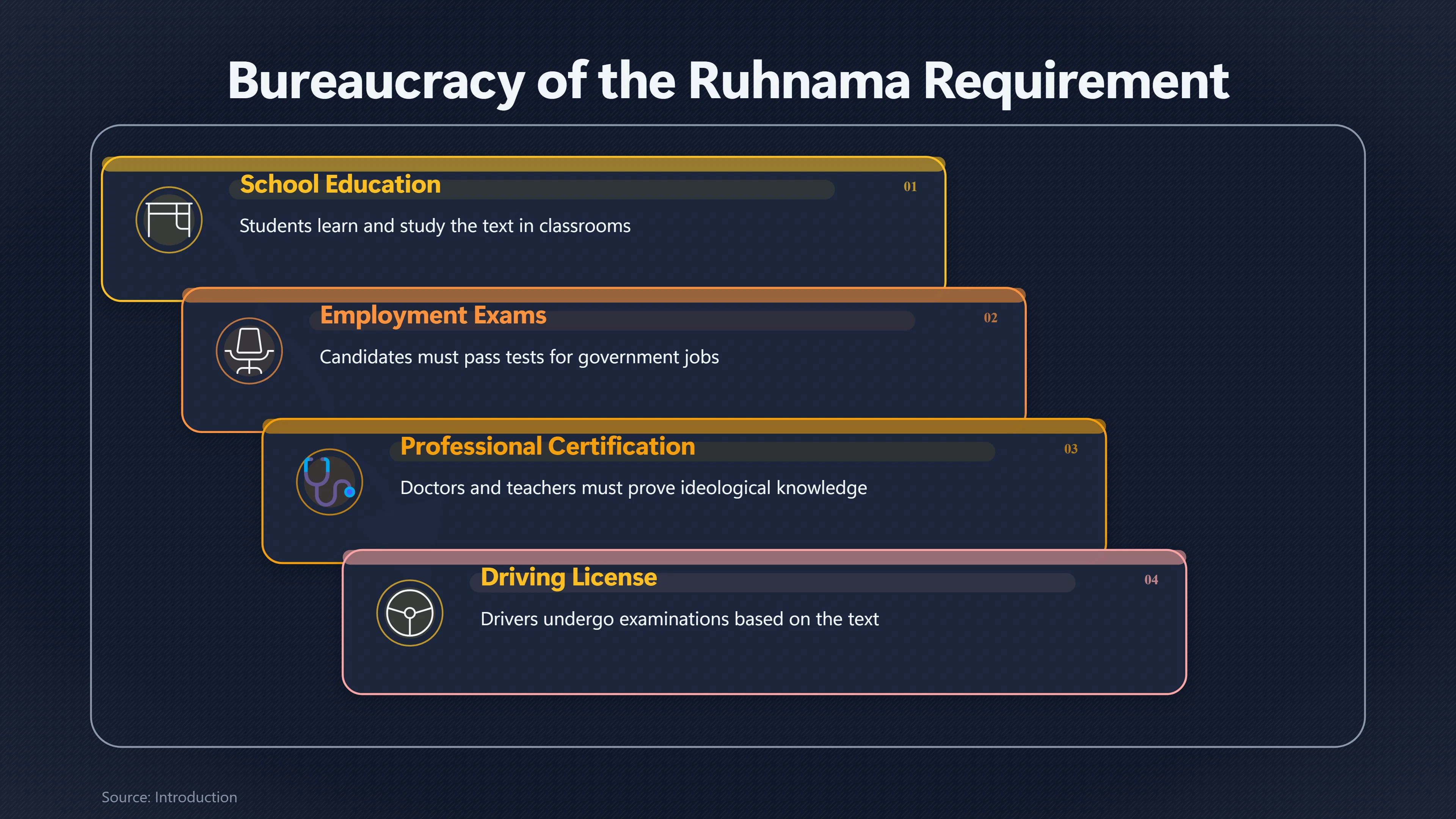
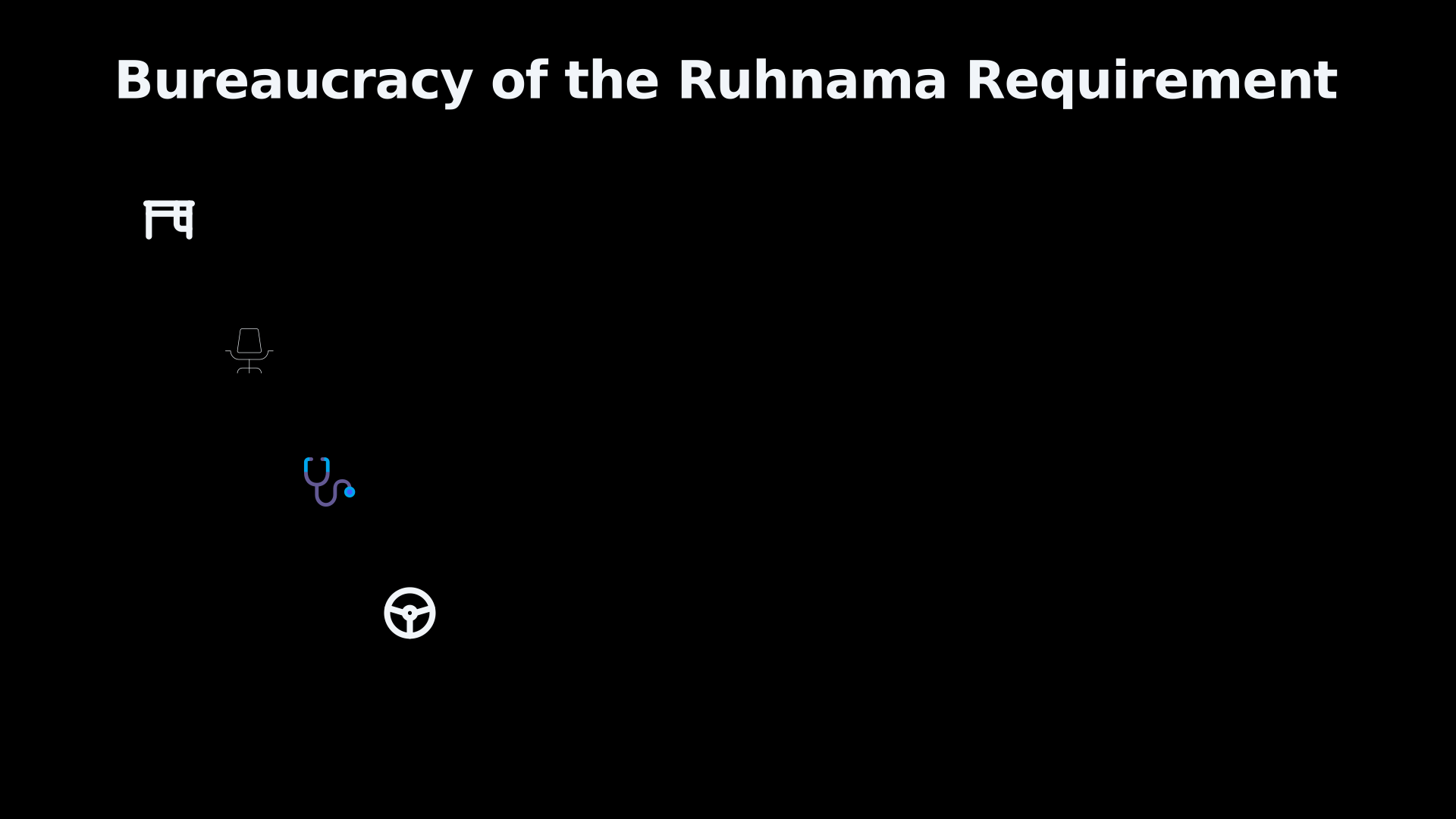
Knowledge of the book became a practical requirement in many areas of life, including:
- school and university education;
- examinations for government employment;
- professional certification for teachers, doctors and other public-sector workers;
- driving licence examinations.[hrw.org]hrw.orgHuman Rights WatchHuman Rights Watch World Report 2003: Europe & Central Asia: Turkmenistan…
This transformed praise into bureaucracy. Citizens were often required not merely to avoid criticism but to demonstrate familiarity with the leader’s worldview in formal assessments.
Public rituals reinforced the same message. The national oath was amended so that it included a personal pledge to Niyazov rather than simply to the state, further blurring the distinction between patriotic duty and personal allegiance.[Refworld]refworld.orgU.S. Department of State Country Report on Human Rights Practices 2002 - Turkmenistan | RefworldMarch 31, 2003…
Coercion Behind the Spectacle
The extraordinary symbolism of the regime has sometimes encouraged outsiders to view it mainly as political eccentricity. Human rights organisations, however, argue that the spectacle cannot be understood separately from coercion.
Independent political opposition was effectively eliminated. Critical journalists, activists and perceived opponents faced surveillance, imprisonment, internal exile, confiscation of property or pressure to leave the country. Frequent purges within the political elite reinforced the lesson that apparent loyalty offered no permanent protection if one fell out of favour.[hrw.org]hrw.orgOpen source on hrw.org.
Because nearly all major media were controlled by the state, citizens had few opportunities to encounter competing interpretations of public events. This did not necessarily produce sincere belief, but it greatly increased the risks of expressing scepticism.
As a result, many observers distinguish between:
Public appearanceLikely private realityEnthusiastic participation in ceremoniesOften impossible to verify genuine opinionUniversal praise in state mediaStrict censorship prevented open disagreementApparent unanimous supportSocial and professional pressure discouraged dissentConstant celebration of the leaderParticipation often reflected necessity rather than conviction
This distinction is central to understanding authoritarian personality cults. Visible conformity should not automatically be interpreted as widespread private belief.[tandfonline.com]tandfonline.comTaylor & Francis OnlineA tale of two presidents: personality cult and symbolic nation-building in Turkmenistan: Nationalities Papers: Vol…
Did People Really Believe the Myth?
The available evidence does not allow historians to measure how many ordinary Turkmen sincerely accepted the official image of Niyazov.
Reliable public opinion polling did not exist under the regime, independent media were absent and citizens had strong incentives to conceal their true views. Researchers therefore avoid claiming either universal belief or universal disbelief. Instead, they focus on the conditions under which opinions were formed and expressed.[Taylor & Francis Online]tandfonline.comTaylor & Francis OnlineA tale of two presidents: personality cult and symbolic nation-building in Turkmenistan: Nationalities Papers: Vol…
Several factors probably existed simultaneously:
- some citizens genuinely admired Niyazov, particularly during the early years of independence;
- others accepted official narratives because alternative information was difficult to obtain;
- many performed loyalty primarily to avoid social, educational or professional consequences;
- private humour and scepticism may have existed, but open criticism carried substantial risks and is therefore poorly documented.[tandfonline.com]tandfonline.comTaylor & Francis OnlineA tale of two presidents: personality cult and symbolic nation-building in Turkmenistan: Nationalities Papers: Vol…
For scholars of authoritarianism, this uncertainty is itself significant. Systems based on compulsory displays of enthusiasm make it extremely difficult to distinguish authentic public opinion from behaviour driven by fear.
Why the Personality Cult Matters
Niyazov’s personality cult remains one of the clearest modern examples of enforced public loyalty becoming part of ordinary administration rather than existing only as propaganda.
Its importance lies less in the unusual monuments or renamed months than in the way symbolic politics became embedded in everyday decisions about education, employment, professional advancement and civic participation. The cult demonstrated how an authoritarian government could use repeated rituals, examinations, official ceremonies and state-controlled media to create the appearance of unanimous national devotion while making dissent personally costly.[tandfonline.com]tandfonline.comTaylor & Francis OnlineA tale of two presidents: personality cult and symbolic nation-building in Turkmenistan: Nationalities Papers: Vol…
Within the broader history of Turkmenistan, the episode illustrates a form of collective behaviour that differs from classic episodes of mass hysteria or moral panic. The central dynamic was not uncontrolled public fear spreading through society but the systematic production of compulsory public belief through state power. That distinction helps explain why historians interpret Niyazov’s rule primarily as a case of authoritarian conformity, symbolic nation-building and ritualised loyalty rather than spontaneous popular worship.[Taylor & Francis Online]tandfonline.comTaylor & Francis OnlineA tale of two presidents: personality cult and symbolic nation-building in Turkmenistan: Nationalities Papers: Vol…
Amazon book picks
Further Reading
Books and field guides related to Did Turkmenistan Believe Its Leader's Myth?. Use these as the next step if you want deeper reading beyond the article.

The Future Is History: How Totalitarianism Reclaimed Russia
Explores mechanisms of authoritarian social control.
Dictators Without Borders
First published 2019. Subjects: Dictators, Political corruption, Globalization, Wealth, Power (social sciences).
Endnotes
1.
Source: Wikipedia
Title: Saparmurat Niyazov
Link:https://en.wikipedia.org/wiki/Saparmurat_Niyazov
2.
Source: ecoi.net
Link:https://www.ecoi.net/en/document/1304472.html
Source snippet
Freedom House (Author): “Nations in Transit 2007”, Document #1304472 - ecoi.net...
3.
Source: refworld.org
Link:https://www.refworld.org/reference/annualreport/usdos/2003/en/29092
Source snippet
U.S. Department of State Country Report on Human Rights Practices 2002 - Turkmenistan | RefworldMarch 31, 2003...
Published: March 31, 2003
4.
Source: 2009-2017.state.gov
Title: U.S. Department of State Turkmenistan
Link:https://2009-2017.state.gov/j/drl/rls/hrrpt/1999/366.htm
5.
Source: refworld.org
Title: The imposition
Link:https://www.refworld.org/reference/annualreport/uscirf/2008/en/58860
Source snippet
USCIRF Annual Report 2008 - Turkmenistan | RefworldMay 1, 2008 — According to some reports, the new leadership intends to decrease emphas...
Published: May 1, 2008
6.
Source: refworld.org
Title: Nations in Transit
Link:https://www.refworld.org/reference/annualreport/freehou/2006/50866
7.
Source: ecoi.net
Link:https://www.ecoi.net/en/document/1163305.html
8.
Source: tandfonline.com
Link:https://www.tandfonline.com/doi/abs/10.1080/00905992.2015.1028913
Source snippet
Taylor & Francis OnlineA tale of two presidents: personality cult and symbolic nation-building in Turkmenistan: Nationalities Papers: Vol...
9.
Source: hrw.org
Link:https://www.hrw.org/legacy/wr2k3/europe14.html
Source snippet
Human Rights WatchHuman Rights Watch World Report 2003: Europe & Central Asia: Turkmenistan...
10.
Source: hrw.org
Link:https://www.hrw.org/news/2006/12/20/turkmenistan-new-leader-should-end-rights-abuses
11.
Source: tandfonline.com
Link:https://www.tandfonline.com/doi/full/10.1080/00905992.2015.1028913
Source snippet
Get AccessMay 13, 2015 — The Journal of Nationalism and Ethnicity Volume 43, 2015 - Issue 3: "Imagined" vs "real" nation-building: langua...
Published: May 13, 2015
12.
Source: globalsecurity.org
Link:https://www.globalsecurity.org/military/world/centralasia/niyazov.htm
13.
Source: taylorfrancis.com
Title: Personality Cults and Nation-Building in Turkmenistan | 9 | Nation-Bui
Link:https://www.taylorfrancis.com/chapters/edit/10.4324/9781315597386-9/personality-cults-nation-building-turkmenistan-1-2-slavomir-hor%C3%A1k-abel-polese
Additional References
14.
Source: forum18.org
Link:https://www.forum18.org/archive.php?article_id=522
Source snippet
1 March 2005...
Published: March 2005
15.
Source: youtube.com
Title: Inside the Bizarre World of Türkmenbaşy’s Turkmenistan
Link:https://www.youtube.com/watch?v=nvXsywnwRqM
Source snippet
Undercover in Turkmenistan | Full Documentary | TRACKS...
16.
Source: kci.go.kr
Link:https://www.kci.go.kr/kciportal/landing/article.kci?arti_id=ART002859144
17.
Source: youtube.com
Title: Turkmenistan: the North Korea of Central Asia
Link:https://www.youtube.com/watch?v=4sEEEKTVk2E
Source snippet
Inside the Bizarre World of Türkmenbaşy's Turkmenistan...
18.
Source: youtube.com
Title: Turkmenbashi’s Reign of Terror
Link:https://www.youtube.com/watch?v=KNJS2-Zv-Tc
Source snippet
Inside Turkmenistan - Exploring the World's Strangest Dictatorship...
19.
Source: ihrc.org.uk
Title: Niyazov’s Turkmenistan: The Land of the Personality Cult
Link:https://www.ihrc.org.uk/briefing-niyazov-s-turkmenistan-the-land-of-the-personality-cult/
20.
Source: rferl.org
Title: CA S: Turkmen President Fires Scores Of Officials
Link:https://www.rferl.org/a/1095268.html
21.
Source: wvia.org
Title: Niyazov’s Cult of Personality Grips Turkmenistan
Link:https://www.wvia.org/2007-08-09/niyazovs-cult-of-personality-grips-turkmenistan
22.
Source: rferl.org
Title: Turkmenistan’s Niyazov Marks 20 Years In Power
Link:https://www.rferl.org/a/1064057.html
23.
Source: rferl.org
Title: Turkmenistan: Looking Back On Niyazov’s Legacy
Link:https://www.rferl.org/a/1073601.html
Topic Tree